The Allium giganteum is a perennial bulbous flower from the Allium genus of the Amaryllidaceae family. Its root bulb is fleshy with an onion-like taste, and it features clumps of glaucous, lanceolate leaves.
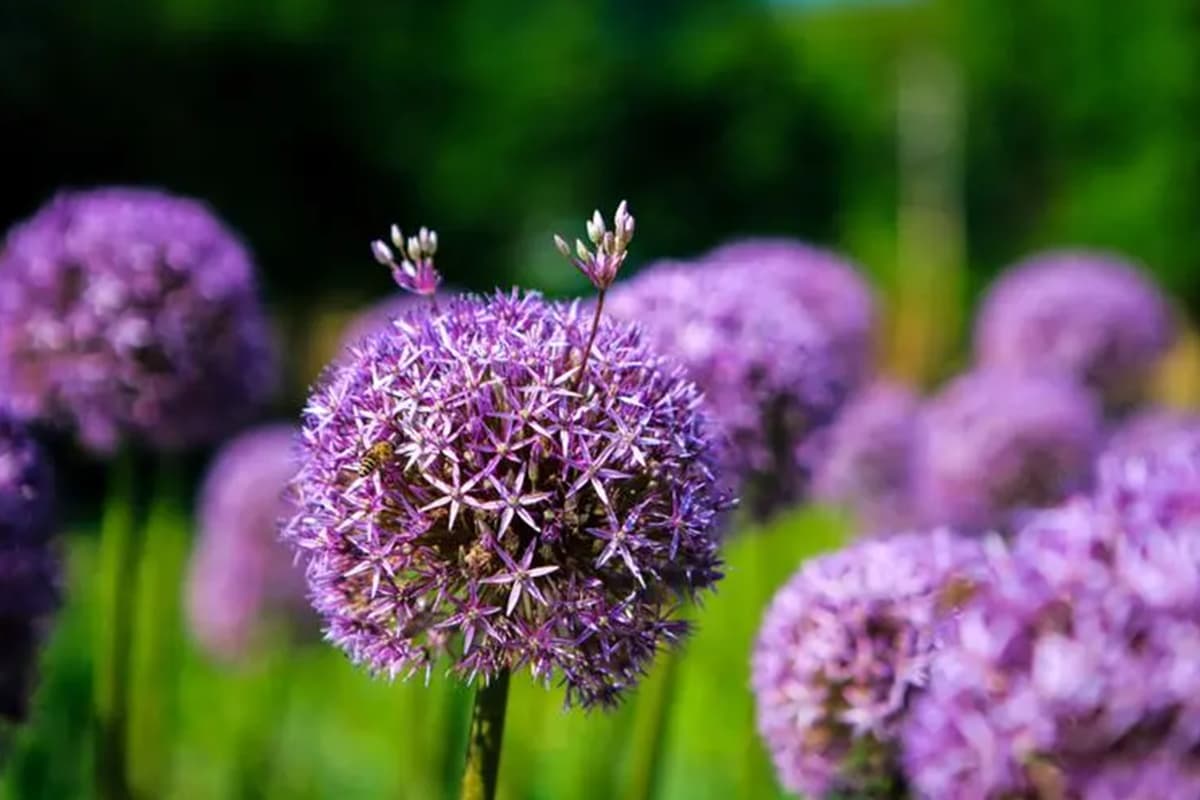
The inflorescence is umbel-shaped and capitate, with dense clusters of flowers, fruits, and seeds at the top of the scape. The small flowers are purple-red with long stems, and the seeds are round and black.
Native to Central Asia, the Giant Allium is widely cultivated in gardens around the world, with the Netherlands being a major exporter of bulbs.
This species is highly valued for decorating and beautifying flower beds, rock gardens, or lawn edges, named for its large, head-like clusters of blooms. Its vibrant purple-red color makes it one of the most ornamental plants in its genus.
I. Morphological Characteristics
This perennial herb features a flower scape rising from the base of the bulb, with the part above ground either sheathed in leaves or bare.
The leaves are clumped, glaucous, and lanceolate with smooth edges, measuring 60 centimeters in length and 12 centimeters in width, arranged in 7-12 pieces in 3-4 whorls.
The flowering bulb weighs around 30 grams with a diameter of about 3 centimeters, and it develops 80-90 adventitious roots. The umbel-shaped, capitate inflorescence is densely packed with flowers, fruits, and seeds at the top of the scape.
The flowers emerge from amongst the leaves, reaching up to 12.5 centimeters high; the inflorescence is composed of 2,000-3,000 small, star-shaped flowers, with a diameter of up to 18 centimeters, hence its name. The petals are purple-red, arranged in two whorls of six.
The plant produces capsule fruits with round, black seeds, with a thousand-seed weight of 4.18 grams. A single inflorescence can produce over 80 mature seeds under natural pollination conditions. The blooming period is in the spring and summer.
II. Growing Environment
It prefers a cool and sunny environment, avoids hot, humid, and rainy conditions, and does not tolerate continuous cropping or partial shade. The ideal temperature range is 15-25°C. It requires loose, fertile sandy loam soil and must not be waterlogged.
III. Distribution
Originally from Central Asia and the Mediterranean region, the Giant Allium is commonly cultivated in gardens worldwide, with the Netherlands being the primary bulb exporter.
IV. Growth and Propagation
Seed Propagation: Seeds mature in early July, are harvested and dried in the shade, stored at low temperatures of 5-7°C, and sown in the autumn from September to October.
Seedlings germinate in March of the following year. In summer, the upper part withers, forming small bulbs, and seedlings take about five years to flower.
Bulb division takes place in summer and autumn. The offsets around the main bulb are peeled off, selecting a cultivation site with low groundwater levels, good drainage, and loose, fertile sandy loam soil.
Each mother bulb can be divided into 1-3 smaller bulbs, with the larger bulbs able to flower in the second year after planting.
V. Pest and Disease Control
During storage, the bulbs of the Giant Allium must be protected from high temperatures and humidity to prevent rot. They should be kept ventilated and dry.
Before planting, seeds can be disinfected by soaking them in a 600-fold solution of 60% thiophanate-methyl wettable powder. Additionally, continuous cropping should be avoided.
VI. Main Value
The flower cluster of the Giant Allium enlarges as the small flowers bloom, with the inflorescence reaching up to 20 centimeters in diameter.
Its large and distinctive floral display is brightly colored and vibrant, and its flowering period can last nearly 20 days, making it highly ornamental.
The Giant Allium can be planted in clusters within flower beds, beside rocks, or in lawns as an accent, and it can also be used as cut flowers with a unique shape for floral artistry.




 English
  العربية
  Bahasa Indonesia
  Deutsch
  Français
  Italiano
  Nederlands
  Português
  Русский
  日本語
日本語