600+ Types of Flowers A To Z (With Names and Pictures)
Types Of Flowers By Names (A-Z) Types Of Flowers By Color Types Of Flowers By Season Types Of Flowers By Blooming Time 600+ Types of Flowers No. Flower Name No.…

The Prunus blireana ‘Meiren’, also known as the ‘Beauty Plum’, is a famous variety of plum blossom. It’s a horticultural hybrid that was cultivated by cross-breeding the double-petal pink plum blossom with the red-leafed cherry plum, and was imported from France.
As a hybrid variety, it blooms easily and profusely, with long flower stalks. The calyx is typically a deep red, while the petals are pink. Thanks to the infusion of cherry plum genes, it is very cold-resistant and has a late blooming period.
Its vibrant and dense blossoms, upon closer inspection, resemble butterflies fluttering in flight. The blooming period generally ranges from late March to early April, making it one of the latest blooming varieties among plum blossoms.
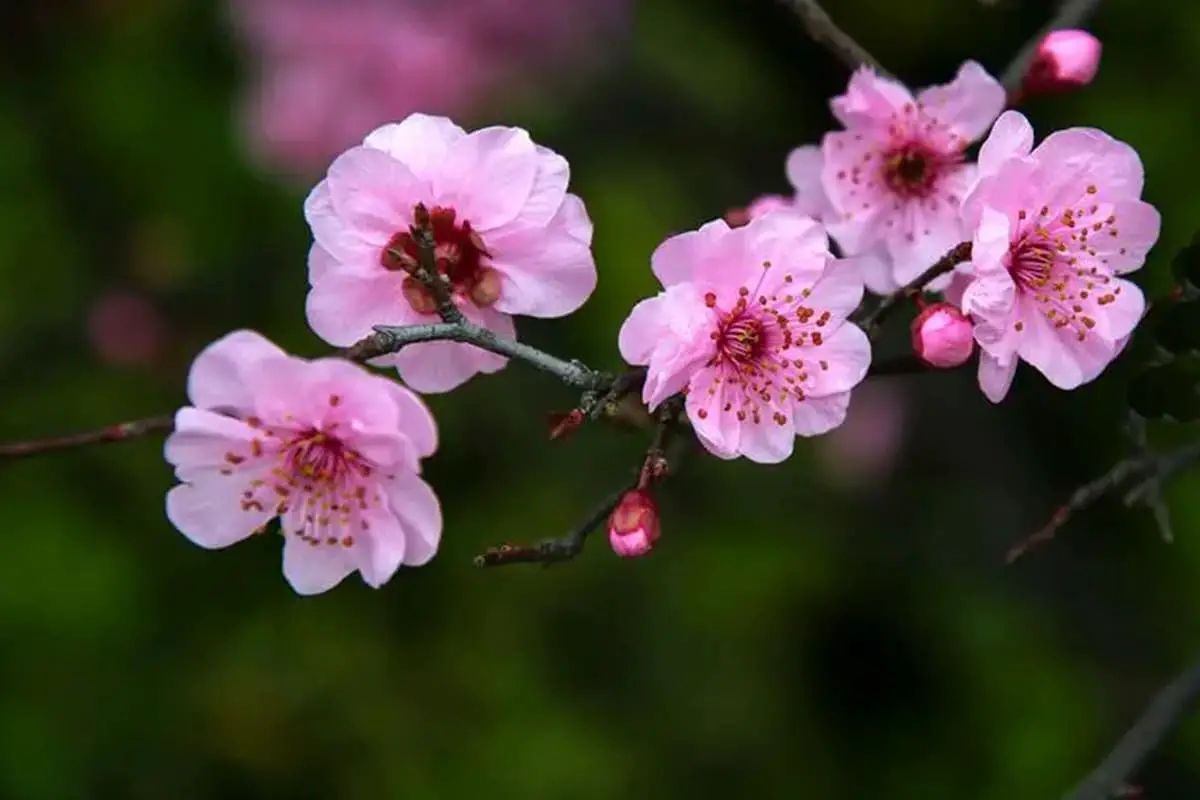
In terms of growth and distribution, the ‘Beauty Plum‘ is a type of plum blossom. It is a colorful ornamental tree species, imported by plum blossom expert Professor Chen Junyu from the United States.
As a rare variety among plums, the ‘Beauty Plum’ is not only appreciated for its beautiful color, floral shape, and blooming period, but also for its branches and leaves.
Throughout the year, its red branches, bright red leaves, and beautiful branches add a vibrant touch to the less-floral seasons.
The leaves and branches remain a bright purple-red all year round, and they can withstand temperatures as low as -30 degrees Celsius.
The ‘Beauty Plum’ can be propagated using peach and apricot as rootstocks, with a survival rate of over 95%.
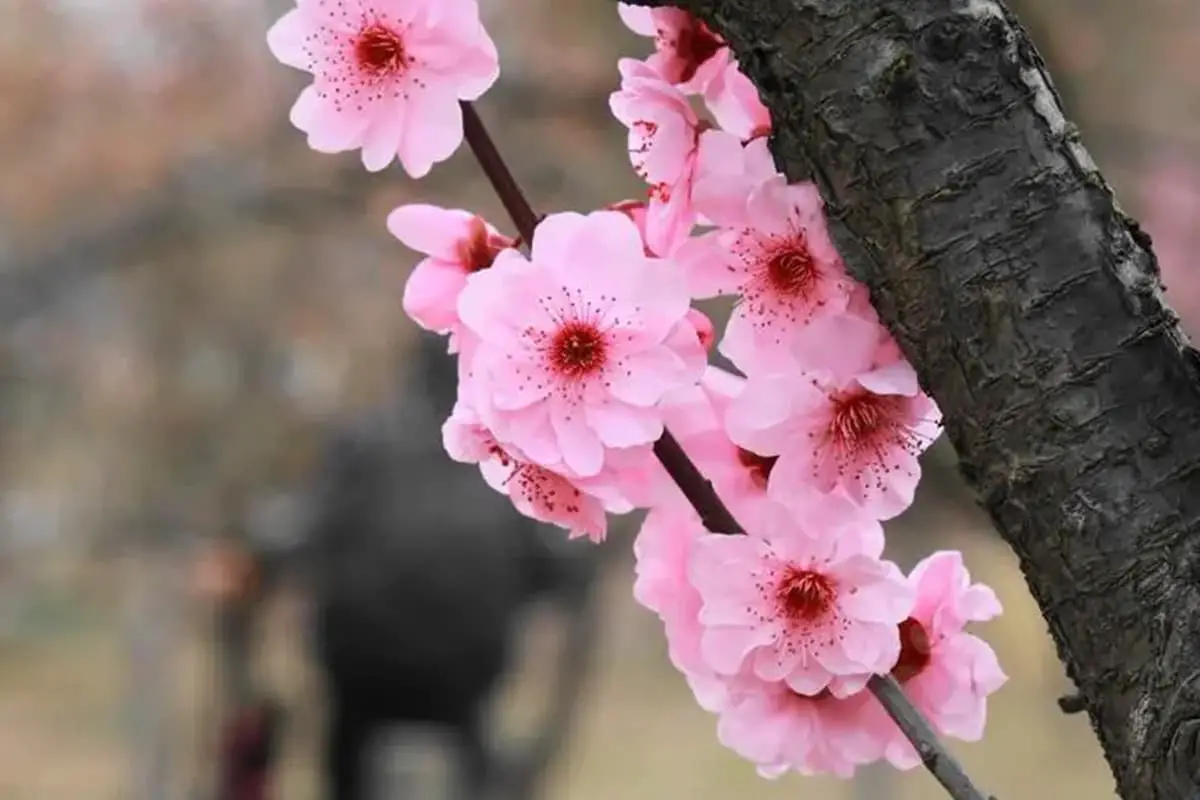
The horticultural hybrid, a deciduous shrub, is a crossbreed of the double-petaled pink plum blossom and the red-leaf plum. The leaf is ovate, 5-9 cm long, purple-red, ovate-elliptical in shape.
The blossoms are pink, densely flowered, one to two growing on long, medium, and short branches. It flowers before leafing, blooming in spring, with flowers and leaves appearing simultaneously.
The flower color is light purple, a double-flowered plum blossom that blooms before leafing. The calyx tube is wide bell-shaped, with 5 calyx lobes, nearly round to flattened round, 15-17 petals, 5-6 small petals, a flower stalk of 1.5 cm, and numerous stamens.
The natural blooming period starts on March 18th, gradually unfolding from top to bottom until mid-April.
The flower shape is nearly butterfly-like, with layers of loose petals. The edges of the petals ripple and flutter, with the flower center often containing fragmented petals, exhibiting a swirling multitude of forms.
The flower color ranges from very light purple to pale purple, with a slightly darker reverse side and a deeper color at the heart of the flower.
There are 19-28 petals, plus 0-1 stamen-turned-petals; 5 calyx lobes, slightly flattened round, light green with a faint purple-red blush, edges with a faint red-purple blush, finely toothed, curved to strongly recurved.
The flower has a purple long stalk, often appearing thread-like; radiating stamens, far shorter than petal length, light purple-red filaments, small anthers, ranging in color from clay-yellow to salmon-red.
There is one pistil, generally blushed with purple, the lower part of the style is hairy, either developed or still developing. The flowers have a fragrance, but not the typical plum scent.
Sometimes it bears fruit. The fruit skin is fresh purple-red, and the plum flesh can be consumed fresh.
The Plum Blossom demonstrates strong resilience to cold weather. As a sun-loving species, it thrives in areas with ample sunlight, producing abundant blooms. Its drought resistance is also quite notable.
The tree prefers high humidity but cannot tolerate waterlogging. It isn’t particularly choosy about the soil, but slightly acidic loam (with a pH value around 6) is preferred.
It is sensitive to air pollution, reacting to fluorides, sulfur dioxide, and car exhaust. It also shows extreme sensitivity to pesticides such as Le Fruit.
Cold Resistance
In Shijiazhuang City, the Plum Blossom can overwinter in the open air without any protection other than watering to prevent freezing. It blooms in mid-March, and the leaf buds open in mid-April.
Adaptability
The Plum Blossom is not strict about soil texture. It can adapt to mountains, open fields, slightly acidic or slightly alkaline soils, and can endure thin soils. However, loose topsoil and regular fertilization enhance its growth. It prefers to grow in well-drained places and hates waterlogging. No significant pests or diseases have been observed in cultivation.
Drought and Heat Tolerance
Excessive drought, waterlogging, and poor soil drainage can cause physiological leaf drop. In high summer temperatures of 37-39 degrees Celsius, the tree grows normally.
Abundant, Beautiful, and Early Blooming
A properly pruned Plum Blossom can produce up to 450 flowers per plant. The flowers are a light purple color, intense but not flashy, cool but not pale. The blooming period is in early spring when few other flowers are in bloom. If potted, the blooming period can be artificially controlled to coincide with the “May Day” holiday.
High Ornamental Value, Wide Uses
The Plum Blossom’s bright red leaves and purplish-red branches are uncommon among other plum blossom varieties, making it a year-round spectacle.
Its versatility lends itself to a variety of uses: it can be planted in courtyards, used to create exclusive gardens, or cultivated in large plum gardens and plum streams.
It can also be potted or shaped into bonsai for display in hotels and restaurants, used for holiday flower arrangements, or even as cut flowers for other decorative purposes.
Peony likes a moist environment, but despises waterlogging. It should be watered during early spring and winter to promote green growth and prevent freezing. Unless the weather is excessively dry, it doesn’t require watering during its growth period.
In hot, dry summer conditions with little rain, appropriate watering is needed. After heavy rain or continuous cloudy weather, excess water should be drained to prevent root rot, which can lead to plant death.
It’s worth noting that newly transplanted seedlings can be watered more: immediately after planting, in 3 to 4 days, and then 4 to 5 days later. After that, watering should be adjusted according to the weather conditions.
During windy spring days in the north, where evaporation is high, aside from watering, it’s beneficial to spray water on the leaves in the morning and evening to effectively reduce leaf evaporation and aid plant survival.
Peony also appreciates fertilizer. When planting, using decomposed fermented manure as a base fertilizer is recommended, as well as chicken, duck, or pigeon manure.
However, these must be thoroughly mixed with the soil. A compound fertilizer containing nitrogen, phosphorus, and potassium can be applied during its bud differentiation period, after which no more fertilizer is needed.
Peony isn’t picky about soil and can grow normally in light clay, loam, and sandy loam, with loam being the best growth medium. It’s a hybrid of purple-leafed plum and palace-pink plum, and as such, it has the advantages of both, including a certain degree of salt and alkali resistance.
I once planted peony in soil with a pH of 8.7 and a salt content of 0.2%, and observed no adverse reactions. Peony dislikes waterlogging and should be planted in a high and dry location, not in low-lying areas or near ponds.
When planting in lawns, the terrain should be slightly elevated. Peony loves light and can’t tolerate shade, and will grow poorly if planted under large trees or shady areas.
Peony has some cold resistance, but it should still be planted in a wind-protected, sun-facing location. Saplings planted in the current spring season should have their trunks and main branches entirely whitened, in addition to watering to prevent freezing.
Saplings planted in the fall should also adopt measures such as wrapping the tree body with straw rope and covering the tree pit with plastic film. Once the sapling has survived for a year, it can be managed normally, and overwintering only requires whitening the trunk.
Peony tolerates pruning well and generally takes a naturally open heart shape. Leave 3 main branches, each with 3 to 4 side branches.
Pruning is divided into winter pruning and post-flowering pruning: the former mainly shapes the plant by cutting off useless large branches, diseased branches, crossed branches, excessively long branches, etc.
Weak seedlings should be heavily pruned in winter, with some branches thinned out and long branches shortened. The latter is for cultivating new flower-bearing branches, by shortening the old branches after flowering, leaving 3 to 4 buds at the base to sprout branches.
When the branches grow to 40 centimeters, trim the tips to promote the fullness of the axillary buds. To increase the survival rate of transplantation, pruning should combine heavy short cutting and thinning of branches.
This can reduce the consumption of nutrients and water evaporation from the tree, but large cuts should be treated with whitewashing.
Common pests include aphids, thorns, red spiders, and longicorn beetles, which can be prevented with broad-spectrum insecticides like DDVP.
However, it’s not recommended to use pesticides like Parathion that can easily cause pesticide injury. For stubborn pests like longicorn beetles, injecting undiluted solution into the trunk can be adopted.
Common diseases include leaf spot, leaf hole disease, and gummosis. Besides strengthening water and fertilizer management, proactive prevention is needed. Spray broad-spectrum fungicides like Carbendazim 2 to 3 times at the beginning of summer and autumn.
If diseases occur, choose broad-spectrum fungicides for prevention and treatment, alternating use for better results. After winter pruning, collect and incinerate cut diseased branches and dead branches, and clean up fallen leaves. Keep the tree pit clean during daily maintenance, and do not let weeds grow.
Propagation can be achieved through cutting and layering.
Around mid to late October, cuttings tend to root more easily. Healthy branches are usually selected from the upper or outer parts of the tree. After planting, precautions against cold and wind are necessary.
Grafting is carried out after the leaves fall in late autumn or before buds sprout in early spring. Peach or apricot trees and plum seedlings can be used as rootstock. Strong, disease-free branches from 1-2 year old plum trees are ideal for grafts, and should be cut short to have 3-5 full buds.
Healthy, one-year-old saplings are chosen as rootstock and cut about 5 cm from the ground. On one side of the cut, a vertical slit is made. Strong, disease-free branches from 1-2 year old plum trees are cut short to have 3-5 full buds, and the bottom end is whittled into a wedge shape to fit into the rootstock’s slit.
The cambium layers of the rootstock and graft are aligned, then tightly bound with film strips.
This is commonly done during the growing season, with 1-2 year old seedlings serving as rootstock. The bark of the rootstock is cut into a “T” shape, and the bark is peeled back along the cuts.
The graft is usually a bud from the middle of a strong, current year’s branch. After cutting 1-2 mm into the woody part above the bud, the bud is cut off the graft to form a shield-shaped bud piece. This bud piece is inserted into the rootstock’s slit, aligned with the cambium layer, and tightly bound with film strips.
During the grafting process, the cuts should be made cleanly and evenly for a smooth surface. The grafting actions should be swift. After grafting, if the grafted part is close to the ground, it can be covered with soil to prevent moisture loss.
Once the graft or bud has survived, the film and covering soil should be promptly removed to facilitate the healing of the cambium layer and the growth of new buds. For the rootstock, pruning and budding should be done in a timely manner to concentrate nutrients for the growth of the graft.
With high ornamental value and wide-ranging usages, the plum tree stands out with its bright red leaves and purple-red branches, which are rare among other varieties of plum trees. It can be admired in all four seasons.
Its versatility allows for it to be used in landscaping courtyards, creating specialty gardens, and large scale planting in plum gardens and streams.
It can also be potted, made into bonsai for display in hotels and restaurants, used as holiday decorations, cut flowers and other decorative purposes.
The plum tree is an important species for garden viewing of flowers and leaves. In early spring, its scarlet flowers bloom before the leaves, covering the entire tree in a dazzling display of beauty. It can be planted alone, in groups, or paired with green foliage plants in courtyards or along garden paths.

Peggie was once a high school mathematics teacher, but she set aside her chalkboard and textbooks to follow her lifelong passion for flowers. After years of dedication and learning, she not only established a thriving flower shop but also founded this blog, “Flowers Library”. If you have any questions or wish to learn more about flowers, feel free to contact Peggie.
 English
  العربية
  Bahasa Indonesia
  Deutsch
  Français
  Italiano
  Nederlands
  Português
  Русский
  日本語
日本語