600+ Types of Flowers A To Z (With Names and Pictures)
Types Of Flowers By Names (A-Z) Types Of Flowers By Color Types Of Flowers By Season Types Of Flowers By Blooming Time 600+ Types of Flowers No. Flower Name No.…

The Spiraea japonica is an upright shrub in the rose family, capable of reaching 1.5 meters in height.
Its slender branches are nearly cylindrical; winter buds are ovate, with several scales; leaves range from ovate to ovate-elliptical, with tips sharply pointed to shortly acuminate, and petioles covered in short soft hairs.
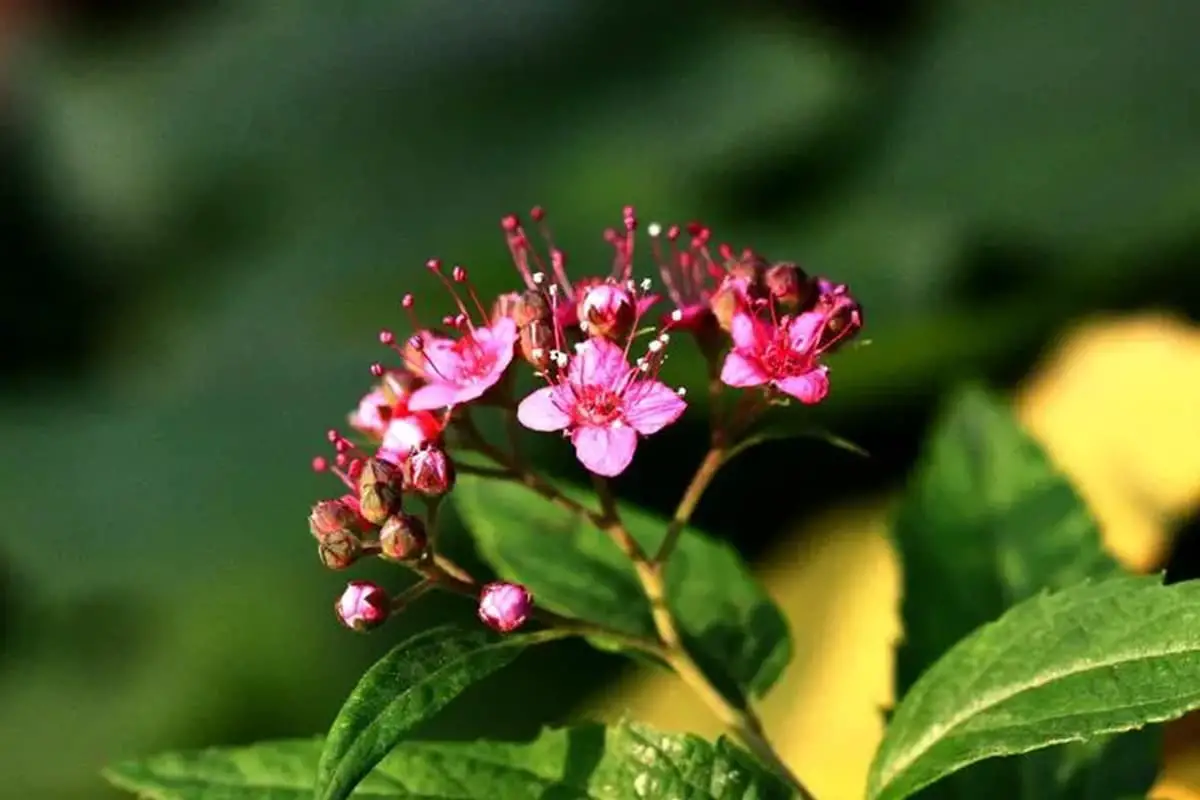
Compound umbel inflorescences appear at the tips of the current year’s erect new shoots, with bracts ranging from lanceolate to linear-lanceolate; the flower calyx has sparse short soft hairs on the outside, and the calyx tube is bell-shaped with triangular sepals.
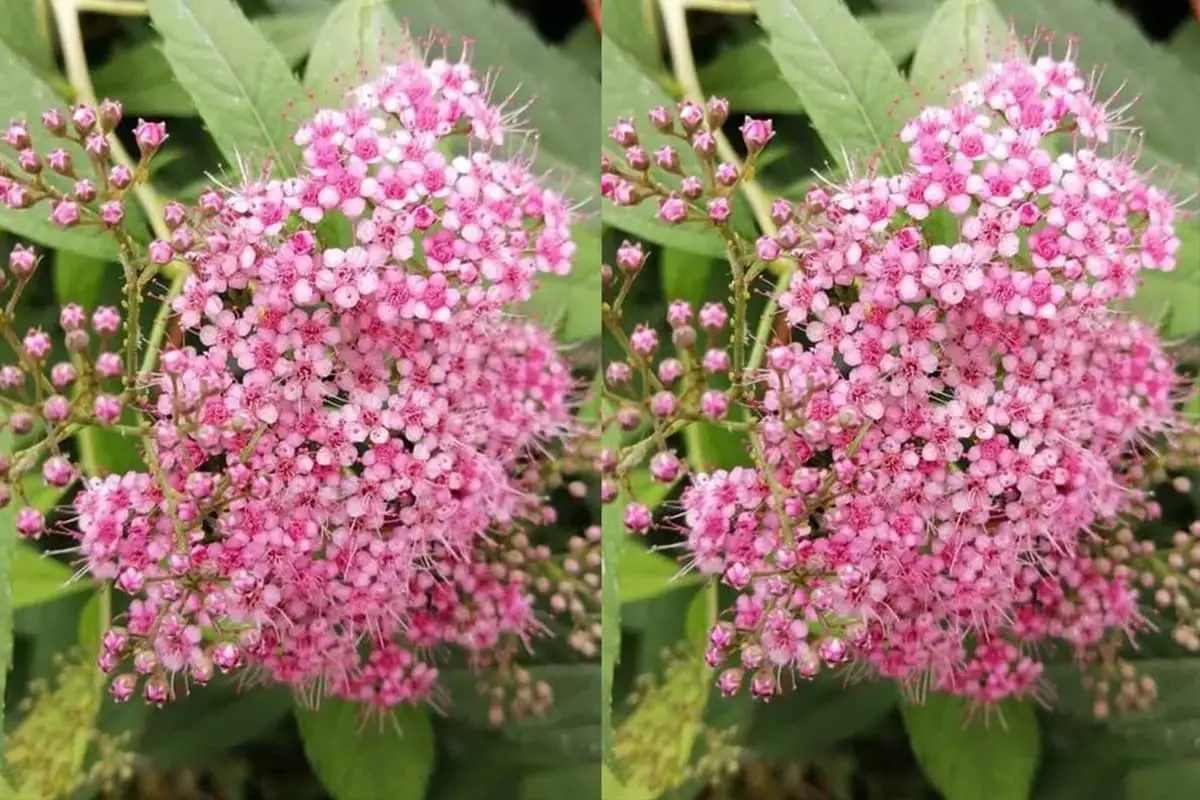
The petals are pink, ranging from ovate to round, and the floral disk is annular. The blooming period is from June to July, with fruit maturing from August to September.
Native to Japan and the Korean Peninsula. It thrives on mountain slopes, in shrub forests, or beside valleys at altitudes of 1100 to 2600 meters.
It is robust, light-loving, tolerates light shade, cold-resistant, drought-resistant, and can grow in poor soils. It prefers moist and fertile soil. Common propagation methods include division, cutting, or seeding.
Japanese Spiraea, with its bitter taste and cool nature, is non-toxic and known for its cough-relieving, vision-improving, and pain-relieving properties, used in treating coughs, red eyes, ocular opacity, and headaches.
Its vibrant flowers make it suitable for flower beds, borders, hedges, or mass planting on lawns and garden paths. It can also be used as a foundational plant. Its leaves are elegant and uniquely shaped, making them ideal for cut flowers and potted plant production.
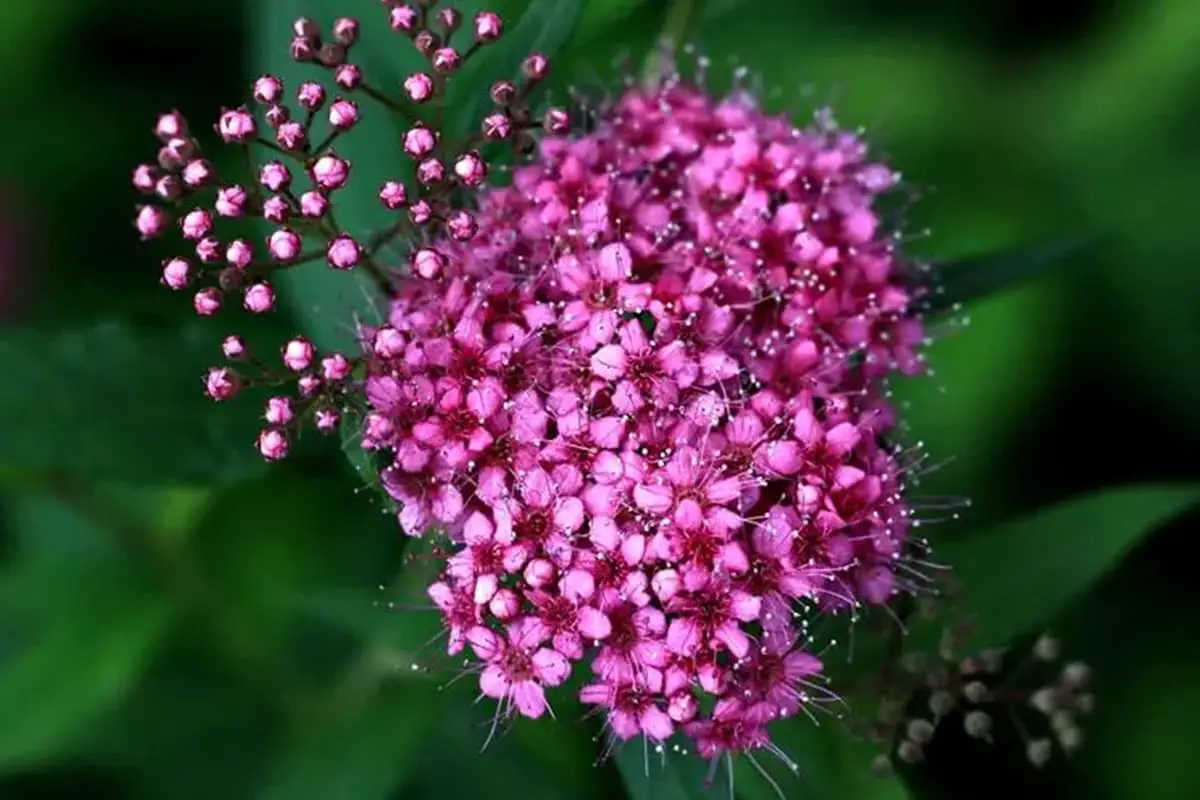
This upright shrub can grow up to 1.5 meters tall; its branches are slender and spreading, with young twigs nearly cylindrical, hairless or covered with short soft hairs when young. The winter buds are ovate with sharply pointed tips and several scales.
The leaves are ovate to ovate-elliptical, 2 to 8 centimeters long, 1 to 3 centimeters wide, with tips sharply pointed to shortly acuminate, bases cuneate, and margins serrated or singly toothed.
The upper surface is dark green, hairless or with short soft hairs along the veins, while the underside is lighter in color or has a white frost, usually with short soft hairs along the veins. The petioles are 1 to 3 millimeters long, with short soft hairs.
Compound umbel inflorescences are dense with short soft hairs and appear at the ends of erect new branches of the current year; pedicels are 4 to 6 millimeters long; bracts are lanceolate to linear-lanceolate, slightly hairy on the underside.
The flowers have a diameter of 4 to 7 millimeters, with the outer calyx sparsely covered in short soft hairs, the calyx tube bell-shaped, and the inner surface short-haired.
The sepals are triangular with sharply pointed tips and short soft hairs near the ends on the inside; petals are ovate to round, usually blunt at the tips, 2.5 to 3.5 millimeters long, and 2 to 3 millimeters wide, pink in color.
The plant has 25 to 30 stamens, much longer than the petals, and an annular floral disk with about 10 irregular lobes.
The follicle fruits are semi-open, hairless, or with sparse soft hairs along the ventral suture, with styles borne at the top, slightly spreading. The plant flowers in June to July and bears fruit from August to September.
The Japanese Spiraea grows on mountain slopes, in shrub forests, or alongside valleys at altitudes of 1100 to 2600 meters.
It is a robust plant that loves sunlight, tolerates slight shade, withstands cold, survives drought, thrives in poor soil, and prefers moist and fertile ground.
The Japanese Spiraea is indigenous to Japan and the Korean Peninsula.
Japanese Spiraea is typically propagated through division, cuttings, or seeding.
After the seeds mature in the fall, they are harvested, dried, threshed, and stored. The following spring, the seeds are taken out for sowing. Due to their minute size, seeding propagation requires meticulous care.
Before sowing, thoroughly moisten the soil in the pot, then scatter the seeds evenly across the surface. Cover them with a layer of finely sifted soil and keep the soil consistently moist.
Seedlings usually emerge within a month. Seedlings should be spaced 50 to 60 centimeters apart, in rows running north to south, and covered with 2 to 3 centimeters of soil.
Additionally, as seedlings are prone to damping-off disease, preventive treatment with Bordeaux mixture is advised before the onset of the disease.
Typically, in February or March, in conjunction with transplanting, shoot cuttings are separated from the parent plant. After appropriate pruning, they are transplanted.
Alternatively, the soil can be enriched before dividing to encourage the parent plant to produce more shoots, with division taking place the following year.
Both softwood and hardwood cuttings can be used, with softwood cuttings being significantly superior.
Cuttings Experiment Material: Select healthy, pest-free, current-year softwood shoots from three-year-old Japanese Spiraea parent plants at the Xianglong Nursery in Boni River Town, Jiutai City.
Method: Experiments on the effects of different substrates on cutting survival rates
Cut the collected shoots into 6-centimeter lengths, leaving 2 to 3 leaves at the top, making sure the top cut is straight and the bottom cut is slanted.
Insert the cuttings into four different substrates: river sand, furnace ash, farmland soil, and a mix of river sand and sawdust (3:1 ratio), with 30 cuttings per group and three repetitions.
After 30 days, investigate the rooting rate (number of rooted cuttings/total number of cuttings) and the number of roots (the total number of roots for each control group’s rooted cuttings).
Experiments on the effects of different concentrations of rooting powder on cutting survival rates
The rooting powder used in this experiment is Green Leaf Rooting Powder produced by Anhui Wuwei Humus Factory.
It is first dissolved in a small amount of alcohol (19 grams of rooting powder + 5 grams of alcohol), then diluted with water to concentrations of 0, 500, 1500, 2000, 2500, and 3000 milligrams per kilogram.
Prepare 30 cuttings per group, with three repetitions. Use a mixture of river sand and sawdust as the rooting substrate. Soak the cuttings’ bases in the various concentrations of rooting solution for two hours before inserting.
After 30 days, examine the rooting rate (number of rooted cuttings/total number of cuttings) and the number of roots (the total number of roots for each control group’s rooted cuttings).
Post-Cutting Care: After insertion, cover the cuttings with a plastic film tent. Water thoroughly once a day with a fine-mist watering can, and ensure proper ventilation during high temperatures in the afternoon and on rainy days. Apply fungicide spray once a week to prevent disease and promptly remove any weeds.
Propagating with softwood cuttings allows for rapid acquisition of seedlings. The substrate and concentration of rooting powder significantly affect the rooting of Japanese Spiraea cuttings.
Among the different substrates tested, a mixture of river sand and sawdust (3:1 ratio) provided the best rooting conditions, with a rooting rate of 94.1% and an average of 12.6 roots per cutting.
At different concentrations of rooting powder, a concentration of 2000 milligrams per kilogram yielded the best results, with a rooting rate and number of roots per cutting of 96.5% and 14.1, respectively.
Till the soil deeply, turning the nursery bed to a depth of 15-20 centimeters, finely leveling and firming the soil, and removing debris. Disinfect the soil when preparing the bed.
Beds should be aligned in a north-south direction, usually flat with a length of 40 meters (or about 20 meters), height of 10-20 centimeters, with a width of 1-2 meters, and walkways 50 centimeters wide to facilitate weeding and watering.
Firm the surface and pack down the soil. Set up reed screens for shade over the cutting beds. If possible, add a layer of base fertilizer (farmyard manure) to the bed, mix in a 1:5000 solution of carbendazim for disinfection, and finally, spread a layer of fine sand evenly over the bed surface.
Mix fertile loam with river sand in a 1:1 ratio for the top layer of the seedbed, then thoroughly water the cuttings.
Collect tender shoots from the current year’s growth from mid to late June until early to mid-July.
Cuttings should be 10-12 centimeters long, without terminal buds, with 4-5 buds, a thickness of at least 0.2 centimeters, retaining 2-3 leaves at the top, trimmed to 8 centimeters, leaving the top 2 leaves and removing the lower 2-3 leaves and terminal flower spikes.
The bottom end should have plump buds. Soak the base of the cuttings in a rooting powder solution for 3-5 minutes before insertion. The best time to insert cuttings is mid-June, before the peak of summer heat, at a depth of 3 centimeters.
Soak cuttings’ bases in a 50-150 ppm IBA solution for 24 hours, then insert them 4-5 centimeters deep into the bed surface. Space cuttings 5-6 centimeters apart, with a density of 280-400 per square meter.
Water thoroughly after planting to ensure close contact between the cuttings and the substrate.
For open-air cuttings, construct shade shelters that block out 75% of sunlight. If inserting cuttings under forest cover, utilize the shade provided by the trees. For seedlings inserted in a seedbed, cover with plastic film shaped into an arch, 60 centimeters high.
Transplant in the following spring, typically from February to March. Separate the shoots from the parent plant, prune appropriately, and then transplant. Prior to splitting, fertilize the soil to encourage the parent plant to produce more shoots.
When transplanting, first dig holes, water them, and then transplant, ensuring to firm the soil around the roots. If cuttings are inserted in a greenhouse, they can be done at any time until autumn, and can be removed from the nursery as they are ready.
This method is easy to manage, profitable, convenient, and suitable for widespread adoption.
To improve the survival rate, retain a short section of the root system when lifting seedlings. If planting large seedlings with a diameter of 1.5 meters or more during summer, transplant with a soil ball 20-30 centimeters in diameter.
After transplanting, prune some branches. Thinning and heading back reduce water loss and promote survival. After inserting cuttings, cover securely with plastic film, watering once daily with a fine sprinkler.
On cloudy days, water deeply every two days. After 15 days, the cuttings typically begin to root. At this time, apply a fungicide every 7 days, twice in total.
If rainy days persist, ensure ventilation by opening the film at both ends of the seedbed and covering it again in the evening. Moreover, prevent waterlogging; excessive moisture hampers rooting.
During management, remove weeds promptly. Once rooted, the seedlings can overwinter on the insertion bed, covered with a straw mat. Maintain humidity within the bed at 80-90% and temperature below 28 degrees Celsius.
Ventilate by opening the plastic film to cool down if the temperature exceeds 28 degrees Celsius. After 30 days, the cuttings begin to root, and after 45-50 days, remove the shading net, water appropriately, and maintain soil moisture.
To promote growth, apply diammonium phosphate once, 8-10 liters per square meter, and water timely. Spray a 0.3-0.5% solution of potassium dihydrogen phosphate every 10 days, 2-3 times to encourage early lignification.
For cuttings inserted before or after flowering, the survival rate of hardwood cuttings can reach 70%, while tender cuttings generally exceed 90%. To enhance their value, it is recommended to propagate by cuttings after flowering.
Gradually remove the plastic film and shade net after rooting, harden off the seedlings, and transplant in the second spring.
The Coreopsis has a bitter taste, cool nature, non-toxic, and offers benefits such as cough relief, vision improvement, and pain relief. It is used to treat coughs, red eyes, clouded vision, headaches, and other symptoms.
With its vibrant flowers, Coreopsis is ideal for flower beds, borders, hedges, clumped on lawns, or tucked into corners of garden paths.
It can also be used as a foundational plant. Its elegant foliage and unique leaf shape make it excellent for cut flowers and potted plant production.

Peggie was once a high school mathematics teacher, but she set aside her chalkboard and textbooks to follow her lifelong passion for flowers. After years of dedication and learning, she not only established a thriving flower shop but also founded this blog, “Flowers Library”. If you have any questions or wish to learn more about flowers, feel free to contact Peggie.
 English
  العربية
  Bahasa Indonesia
  Deutsch
  Français
  Italiano
  Nederlands
  Português
  Русский
  日本語
日本語