600+ Types of Flowers A To Z (With Names and Pictures)
Types Of Flowers By Names (A-Z) Types Of Flowers By Color Types Of Flowers By Season Types Of Flowers By Blooming Time 600+ Types of Flowers No. Flower Name No.…

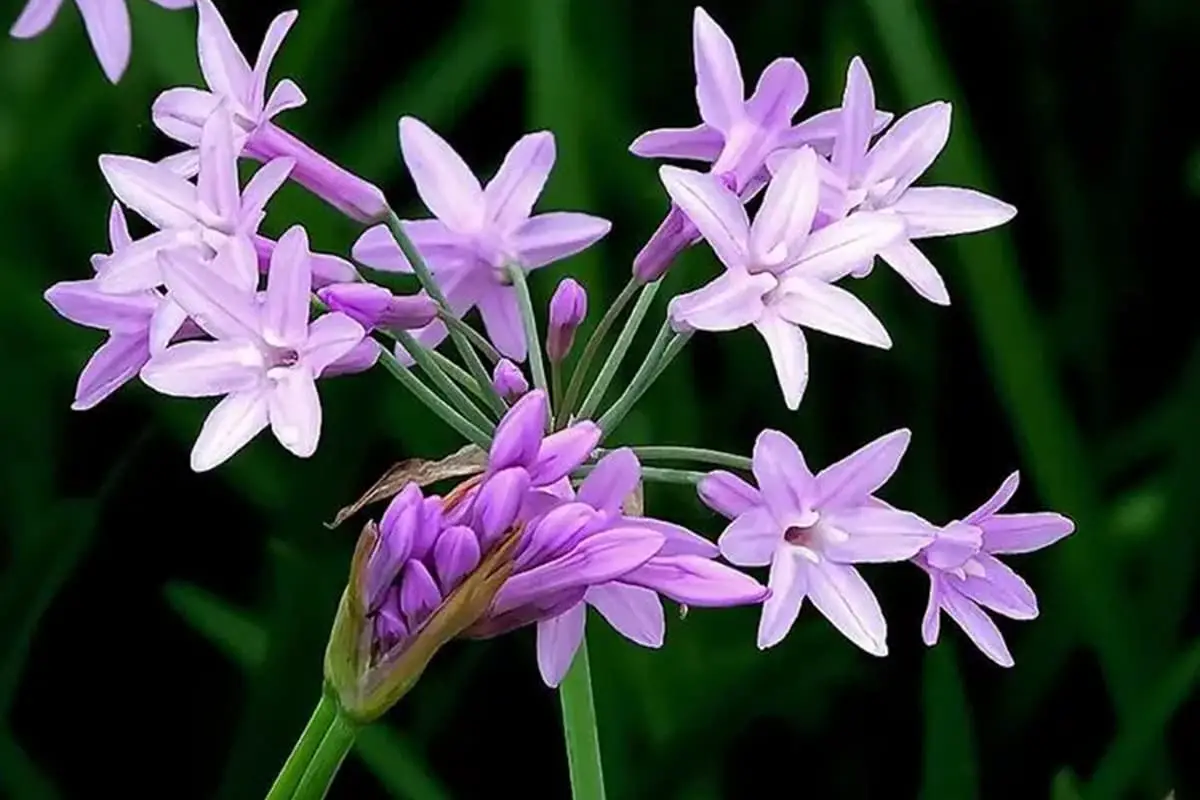
The Tulbaghia violacea, a perennial herbaceous plant from the Amaryllidaceae family, is known for its bulbous flowers. These plants typically reach a height of 12 to 20 inches and boast cylindrical, small-scale bulbs that cluster together.
Although the bloom’s color differs from that of Chinese chives, its other characteristics are remarkably similar. The entire plant emits a strong chive-like aroma and is edible, akin to Chinese chives.
It can be stir-fried, used in cold dishes, or added to soups, which is why it is also known as “foreign chives” or “wild chives.” The inflorescences at the top produce small, pinkish-purple flowers.
The bulbs are plump and spherical, with a diameter of up to 0.8 inches, surrounded by a white membranous leaf sheath.
The leaves are semi-cylindrical, slightly hollow in the center, about 12 inches long and 0.2 inches wide, with leaf sheaths ranging from 2 to 8 inches in length.
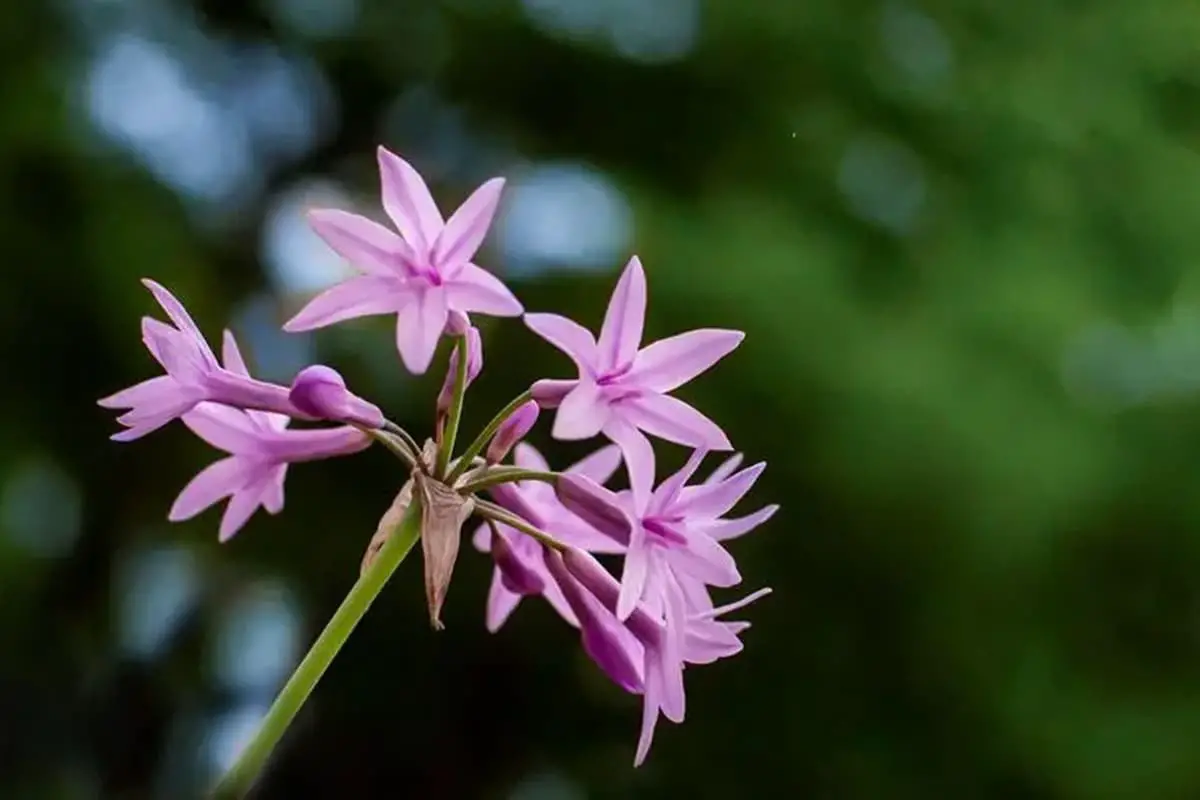
The flower stem stands erect, 12 to 24 inches tall, with a spherical umbel inflorescence containing numerous flowers, measuring 0.8 to 2 inches in diameter.
The flowers are pinkish with petal-like tepals that are ovate to elongated, 0.16 to 0.2 inches long, slightly fused at the base with blunt or acute tips, and a purple-red dorsal ridge.
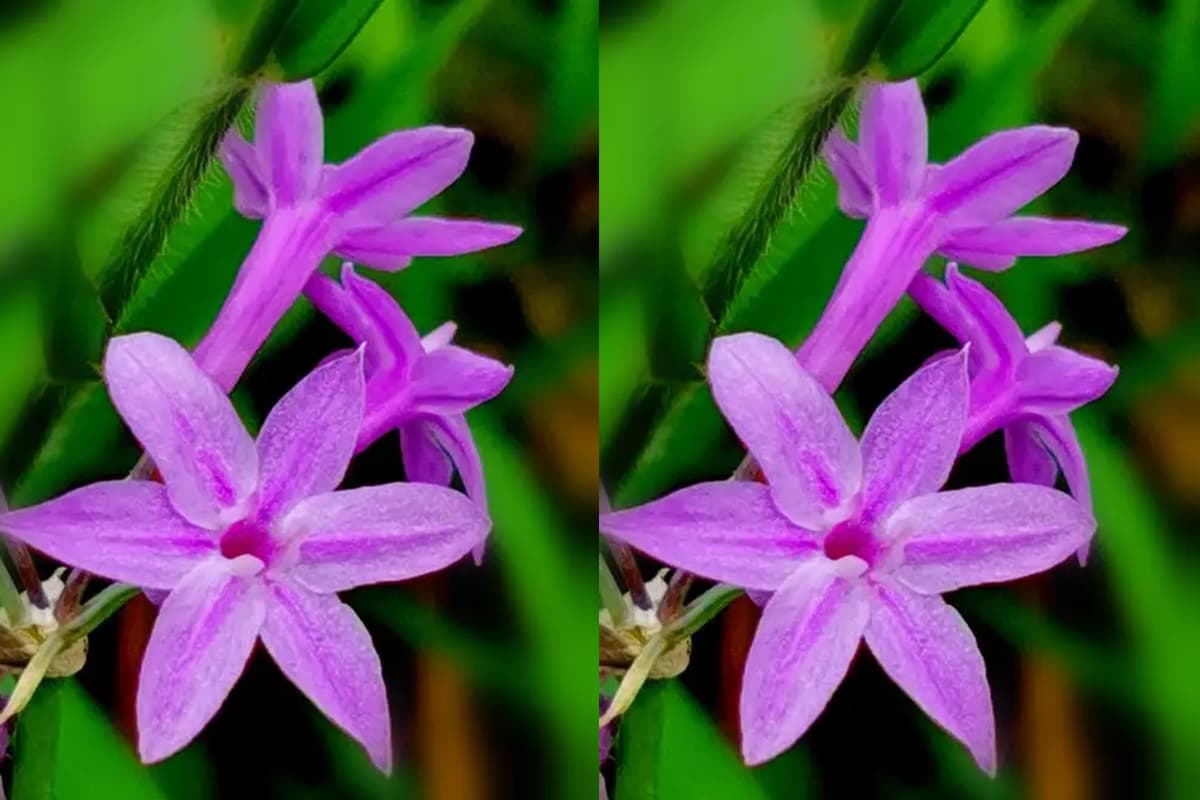
The stamens are longer than the tepals and are attached at the base of the tepals, with the lower part of the filaments being flat and broad, slightly fused at the base.
The style protrudes outward; the stigma is small and undivided. The flowering period is from May to July.
The stems and leaves both have a chive flavor. The terminal umbel inflorescence produces small pinkish-purple flowers. The fruit is a triangular capsule containing flat, hard, black seeds.
These plants thrive in light. They do well in both full sun and partial sun environments but should not be shaded. They prefer high temperatures, are heat-resistant, and grow best at temperatures between 75 and 86 degrees Fahrenheit.
They are not particular about soil quality and can tolerate poor soils. However, they flourish in fertile, well-drained sandy loam or loamy soil.
Native to South Africa, the Tulbaghia violacea has been extensively introduced in the Jiangsu region of China.
With its lush green foliage and charming flowers, possessing fleshy petals and a long blooming season, it is a rare summer-flowering plant. Ideal for mid-ground flower beds or as ground cover along forest edges or in lawns, it also serves as an excellent cut flower.
The white roots are used medicinally, known as “zhan bai.” Its flavor profile is pungent, bitter, warm, and smooth, with no toxicity.
Indications: It is used to treat chest pain and dysentery with bloody stools. Its garlic-like flavor has earned it the name “wild garlic,” and the white roots are also referred to as “xie bai” in traditional Chinese medicine.
The flower language of the Tulbaghia violacea: “Etched in the heart.

Peggie was once a high school mathematics teacher, but she set aside her chalkboard and textbooks to follow her lifelong passion for flowers. After years of dedication and learning, she not only established a thriving flower shop but also founded this blog, “Flowers Library”. If you have any questions or wish to learn more about flowers, feel free to contact Peggie.
 English
  العربية
  Bahasa Indonesia
  Deutsch
  Français
  Italiano
  Nederlands
  Português
  Русский
  日本語
日本語