600+ Types of Flowers A To Z (With Names and Pictures)
Types Of Flowers By Names (A-Z) Types Of Flowers By Color Types Of Flowers By Season Types Of Flowers By Blooming Time 600+ Types of Flowers No. Flower Name No.…

Lonicera maackii, commonly known as Amur honeysuckle, is a deciduous shrub that often grows in clusters. Its fragrant flowers provide an excellent nectar source for pollinators, while its fruit serves as a valuable food source for birds. The plant also possesses various medicinal properties, adding to its versatility in the garden.
Despite sharing a name with the more familiar honeysuckle vines, Lonicera maackii is distinctly different. It is a woody shrub, unlike its herbaceous counterparts. The fruit of the Amur honeysuckle is dark red and spherical, measuring 5-6 millimeters in diameter. Its seeds feature minute, honeycomb-like depressions, a characteristic unique to this species.
The Amur honeysuckle blooms from May to June, with fruit development occurring from August to October. The aesthetic harmony of its flowers and fruit make it a highly ornamental plant throughout multiple seasons. In spring, one can appreciate its fragrant white flowers that gradually turn yellow, while autumn brings an abundance of vibrant red fruit.
In landscaping, Amur honeysuckle is often planted in clusters on lawns, slopes, forest edges, roadsides, or around buildings. This versatile shrub provides visual interest and ecological benefits, attracting both human admirers and wildlife.
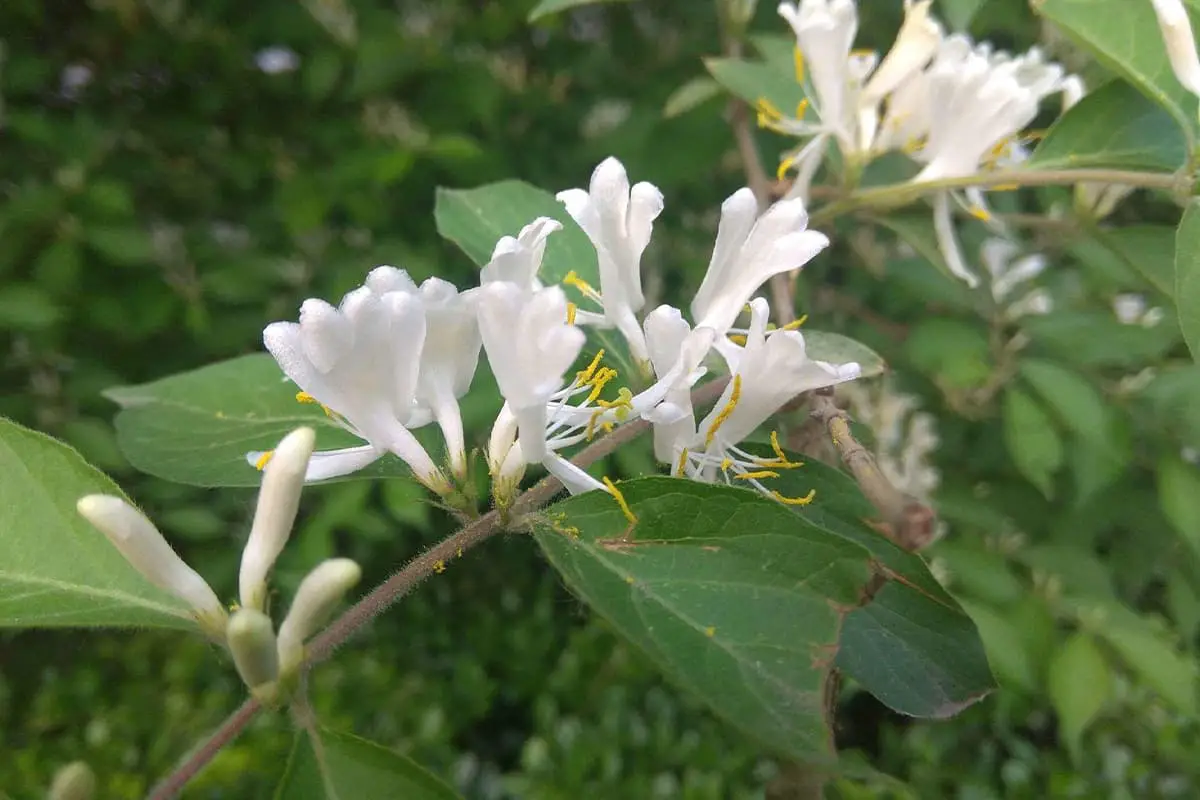
Lonicera maackii is a robust deciduous shrub that can reach heights of up to 6 meters, with stem diameters of up to 10 centimeters. The young branches, leaves (both sides), leaf stalks, bracts, bracteoles, and the exterior of the calyx are covered in short, soft trichomes and minute glandular hairs, giving the plant a slightly fuzzy texture.
The winter buds are small and oval-shaped, protected by 5-6 or more pairs of scales. The leaves are papery in texture and exhibit considerable variation in shape. They are typically ovate-elliptical to ovate-lanceolate, though less common forms include rectangular-lanceolate, obovate-rectangular, rhomboid-rectangular, or round-ovate.
Leaves measure 5-8 centimeters in length, with tips that gradually taper or form a long point. The leaf bases range from broadly cuneate to rounded, and petioles measure 2-8 millimeters long.
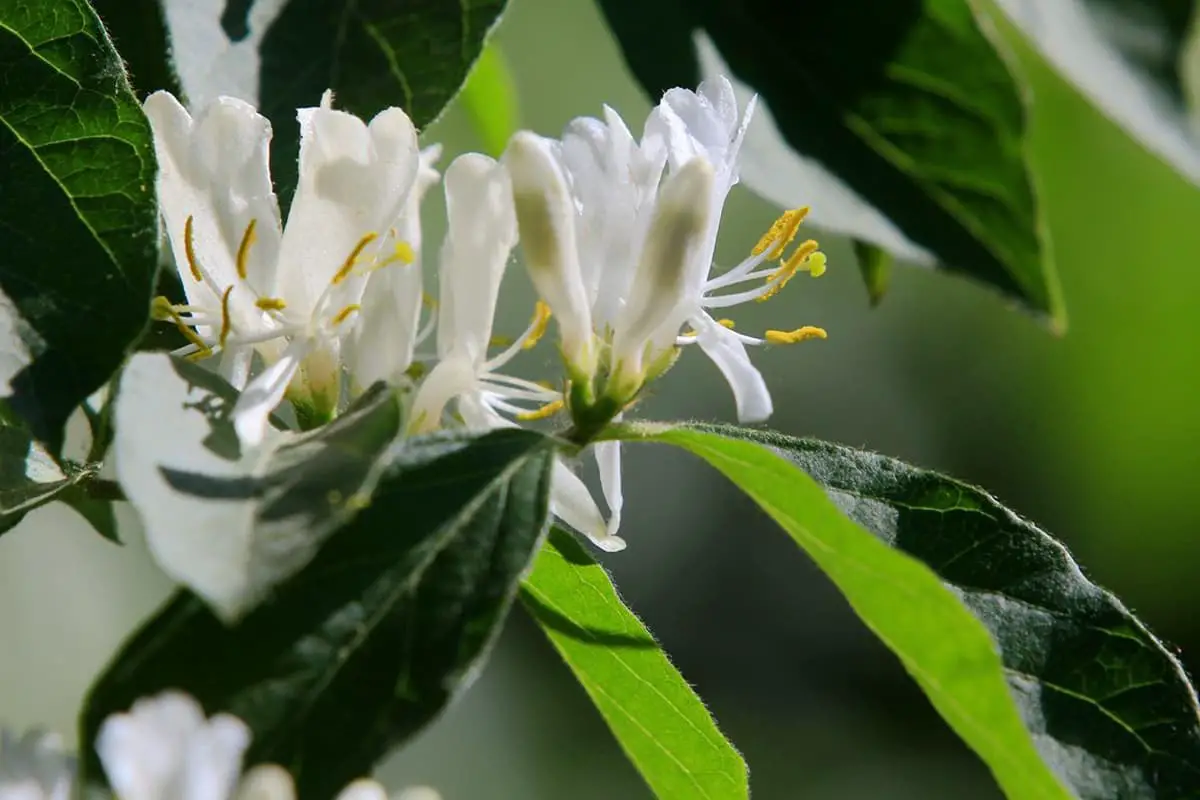
The fragrant flowers are borne in the leaf axils of young branches. The peduncle is short, measuring 1-2 millimeters, which is shorter than the petiole. Linear bracts, sometimes leaf-like and linear-lanceolate, measure 3-6 millimeters in length. The bracteoles are more or less paired and range from half to almost equal the length of the calyx tube, with truncate tips.
The calyx tubes of adjacent flowers are separate, measuring about 2 millimeters long, and may be glabrous or sparsely covered with tiny glandular hairs. The calyx limb is campanulate, equal to or slightly longer than the calyx tube, with a membranous texture. The calyx teeth are broadly triangular or lanceolate, unequal, and pointed, with divisions reaching about halfway down the calyx limb.
The corolla is initially white, later turning yellow, and measures 1-2 centimeters in length. It may be covered with short hairs or glabrous and is bilabiate in form. The corolla tube is about half the length of the limb and lined with soft hairs on the inside. The stamens and pistil are approximately two-thirds the length of the corolla, with the filaments and lower half of the style covered in upward-pointing hairs.
The fruit is a dark red, globose berry measuring 5-6 millimeters in diameter. The seeds feature a distinctive honeycomb-like texture with shallow depressions. Flowering occurs from May to June, with fruiting from August to October.
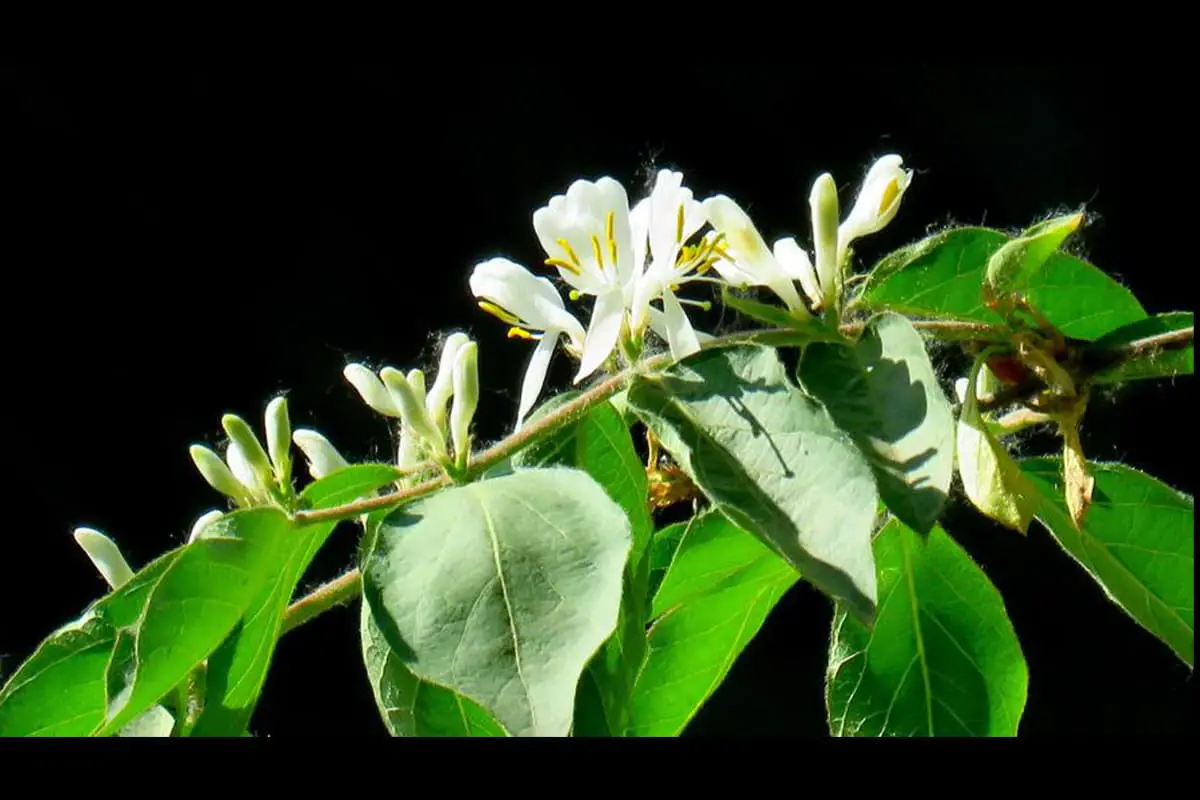
Lonicera maackii thrives in shrublands near streams within forests or at forest edges. It can be found at elevations up to 1800 meters, demonstrating its adaptability to various climatic conditions.
The natural range of Amur honeysuckle includes North Korea, Japan, and the Far East regions of Russia. However, it has been introduced to many other parts of the world as an ornamental plant.
Propagation of Lonicera maackii is primarily achieved through seed. The seeds are collected in October and November when fully mature. To prepare the seeds, the fruit is crushed, washed, and the pulp is removed. The clean seeds are then separated by flotation, sun-dried, and stored until mid to late January of the following year.
To promote germination, seeds are soaked in warm water for 3 hours, then mixed with 2-3 times their volume of moist sand. This mixture is placed in a sunny, wind-protected location to increase temperature. The area is covered with plastic film to maintain humidity, and the seeds are regularly turned and watered to ensure even warmth distribution.
By mid to late March, the seeds begin to sprout and are ready for sowing. Seedbeds are prepared with furrows 20-25 centimeters apart and 2-3 centimeters deep. The seeding rate is approximately 50g per 10 m², with seeds covered by about 1 centimeter of soil. Agricultural film is used to retain moisture and increase soil temperature.
Seedlings typically emerge 20-30 days after sowing. At this point, the film is removed, and seedlings are thinned out. When they reach 4-5 centimeters in height, they are spaced 10-15 centimeters apart. Fertilization with urea is carried out twice, in May and June, at a rate of 15-20 kilograms per 667 m² each application.
Regular watering, weeding, and cultivation are essential for optimal growth. With proper care, seedlings can reach over 40 centimeters in height during their first year.
Lonicera maackii is prized for its ornamental qualities throughout the growing season. Its lush branches and deep green foliage provide a beautiful backdrop for the bright white spring flowers and vivid red autumn fruits. The layered blooming pattern in late spring and early summer creates a striking visual effect, resembling a large floral sphere when viewed from a distance.
The fragrant flowers not only please human senses but also attract a variety of pollinators, including bees and butterflies, enhancing the ecological value of the garden. In autumn, the abundant red fruits add another dimension of visual interest while providing a food source for birds.
In landscape design, Amur honeysuckle is versatile and can be used in various settings. It is particularly effective when planted in groups on lawns, slopes, forest edges, or along roadsides. It also serves as an attractive accent around buildings, offering both floral displays and fruiting interest throughout the growing season.
While Lonicera maackii offers many aesthetic and ecological benefits, it’s important to note that in some regions outside its native range, it can be invasive.
Therefore, gardeners should consult local authorities or extension offices before planting to ensure it is appropriate for their area. When used responsibly, Amur honeysuckle can be a valuable addition to many garden landscapes, providing beauty, fragrance, and wildlife support throughout the year.

Peggie was once a high school mathematics teacher, but she set aside her chalkboard and textbooks to follow her lifelong passion for flowers. After years of dedication and learning, she not only established a thriving flower shop but also founded this blog, “Flowers Library”. If you have any questions or wish to learn more about flowers, feel free to contact Peggie.
 English
  العربية
  Bahasa Indonesia
  Deutsch
  Français
  Italiano
  Nederlands
  Português
  Русский
  日本語
日本語