600+ Types of Flowers A To Z (With Names and Pictures)
Types Of Flowers By Names (A-Z) Types Of Flowers By Color Types Of Flowers By Season Types Of Flowers By Blooming Time 600+ Types of Flowers No. Flower Name No.…

The Hydnora africana, commonly known as the African White Egret flower, ranks among the sixteen globally recognized notorious yet beautiful plants. Belonging to the Euphorbiaceae family, it is native to southern Africa, typically thriving in the arid, barren desert regions.
In Namibia, it is often referred to as a savannah-type Euphorbiaceae plant. This silver-grey succulent shrub can reach heights of up to two meters, boasting a root diameter as hard as wood, and an external structure reminiscent of a honeycomb.
Southwestern Namibia and the northern cape of South Africa.
The African White Egret flower, a member of the Euphorbiaceae family, is part of a large family with over 2000 species identified worldwide. This silver-grey succulent shrub, growing up to two meters, is found in the arid, barren desert regions of South Africa. It has wood-like, tough rhizomes and a honeycomb-like exterior.
Furthermore, it features a peculiar, flesh-colored parasitic flower that attaches itself to the rhizomes of nearby shrubs. Clusters of foul-smelling flowers attract swarms of carrion beetles.
The Hydnora flower can protrude about 8 to 10 cm above the ground, with the flower itself being 4 to 7 cm high. It has a vibrant red color, is hollow on the inside, fleshy, and three to four tulip-shaped petals are attached at the top.
To attract pollen dispersers like carrion beetles, it releases an unpleasant smell of rotting meat. Due to the Hydnora flower’s propensity to hide within the shrubs serving as its hosts, its presence is hard to detect and can only be traced through its odious odor.
Scientifically known as “Hydnora africana,” the African White Egret flower is indigenous to southern Africa, typically flourishing in the arid, barren desert regions. This flower grows underground, with its meat-like petals exposed on the surface, giving an impression of a blind sea snake opening its mouth to the outside world.
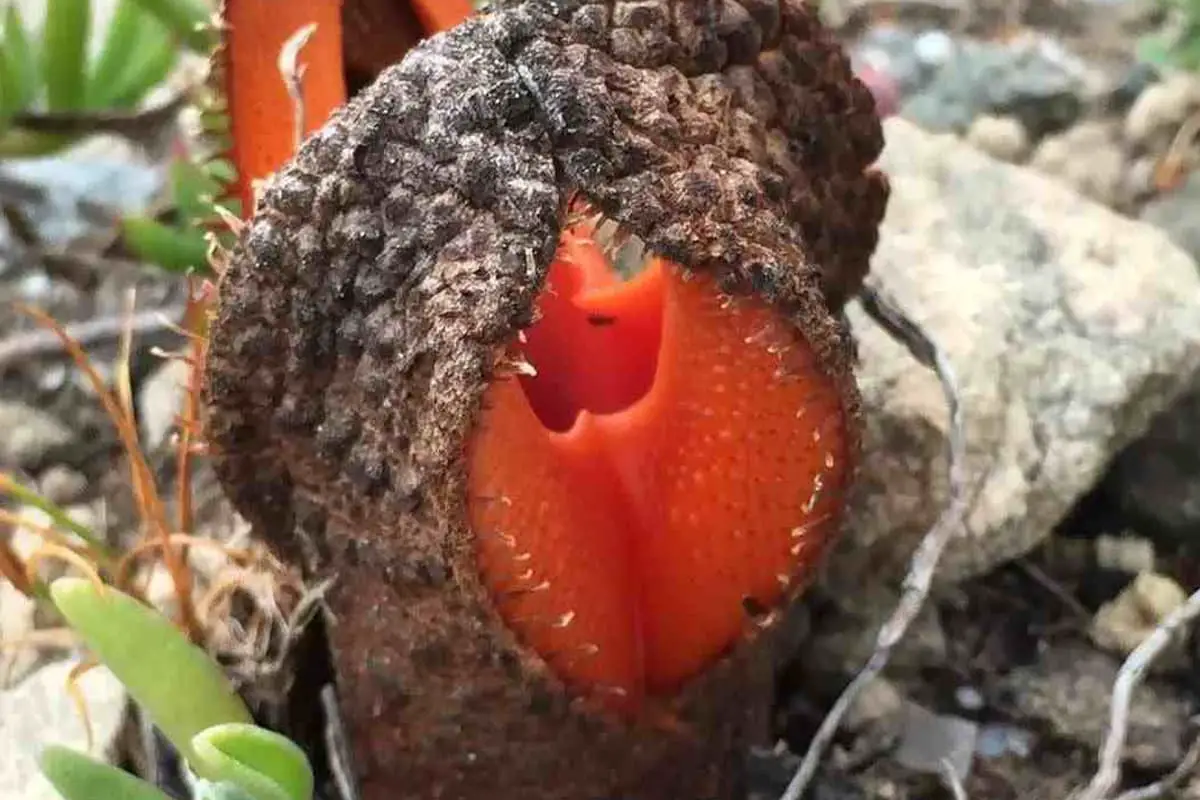
The most peculiar aspect of the African White Egret flower lies not just in its form, but also its odor. It emits a scent reminiscent of a rotting corpse to attract insects like scarabs and carrion beetles. The true purpose of its beautiful red petals is to act as a trap.
The foul smell draws beetles into the flower for pollination. It then traps these beetles until they die, absorbing nutrients from their decaying bodies.

Peggie was once a high school mathematics teacher, but she set aside her chalkboard and textbooks to follow her lifelong passion for flowers. After years of dedication and learning, she not only established a thriving flower shop but also founded this blog, “Flowers Library”. If you have any questions or wish to learn more about flowers, feel free to contact Peggie.
 English
  العربية
  Bahasa Indonesia
  Deutsch
  Français
  Italiano
  Nederlands
  Português
  Русский
  日本語
日本語