The Bellflower Cherry, also known as the Fujian Mountain Cherry Blossom, is indigenous to regions like Zhejiang, Fujian, Taiwan, Guangdong, and Guangxi, among others. It is one of the most successful domestically cultivated varieties of cherry blossoms.
It typically blooms in early spring, displaying vibrant and brilliant colors, with lush and vigorous foliage. It is a significant ornamental tree for early spring and is frequently used for garden display.
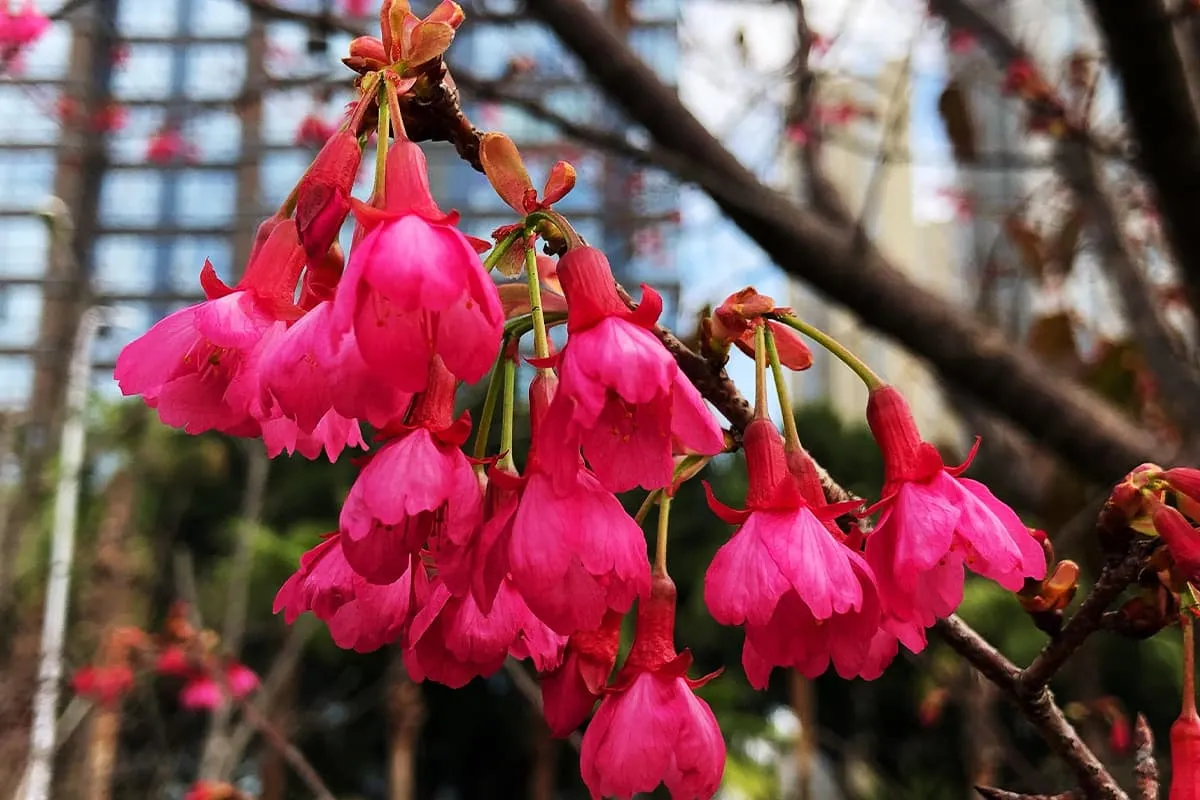
When in full bloom, the tree is abundantly adorned with dazzling flowers, creating a spectacular sight resembling clouds and rosy dawn.
It can be planted in large amounts to create a ‘sea of flowers’ landscape, grouped in clusters to form a colorful spot in a green field, or planted singularly to create an artistic scene of ‘a touch of red among the greenery’.
Basic Introduction
The Bellflower Cherry (Scientific name: Cerasus campanulata (Maxim.) Yu et Li) is a tree or shrub that grows between 3 to 8 meters tall, with dark brown bark. The twigs are gray-brown or purple-brown, while the young branches are green and hairless.
The leaves are ovate, ovate-elliptic or inverted ovate-elliptic, thin and leathery, green on top and pale green underneath.
It produces an umbrella-shaped inflorescence with 2-4 flowers that bloom before the leaves, with a diameter of 1.5-2 cm. The fruit is a ovate-globose drupe. It flowers from February to March and bears fruit from April to May.
It thrives in forest valleys and edges, at altitudes of 100-600 meters. It is found in Zhejiang, Fujian, Taiwan, Guangdong, and Guangxi in China, as well as in Japan and Vietnam.
Growth and Distribution
It thrives in forest valleys and edges, at altitudes of 100-600 meters. It is found in Zhejiang, Fujian, Taiwan, Guangdong, and Guangxi in China, as well as in Japan and Vietnam. The model specimen was collected from Fujian.
Morphology and Features
The Bellflower Cherry is a tree or shrub that grows between 3 to 8 meters tall, with dark brown bark. The twigs are gray-brown or purple-brown, while the young branches are green and hairless.
The leaves are ovate, ovate-elliptic or inverted ovate-elliptic, thin and leathery, 4-7 cm long and 2-3.5 cm wide, tapering towards the tip, with a round base. The edges have abrupt pointed serrations, often slightly irregular.
The leaves are green on top and pale green underneath, hairless or with tufts of hair in the vein axils. The leaf stalks are 8-13 mm long, hairless, and usually have two glands at the top; the stipules fall off early.
The umbrella-shaped inflorescence consists of 2-4 flowers that bloom before the leaves, with a diameter of 1.5-2 cm.
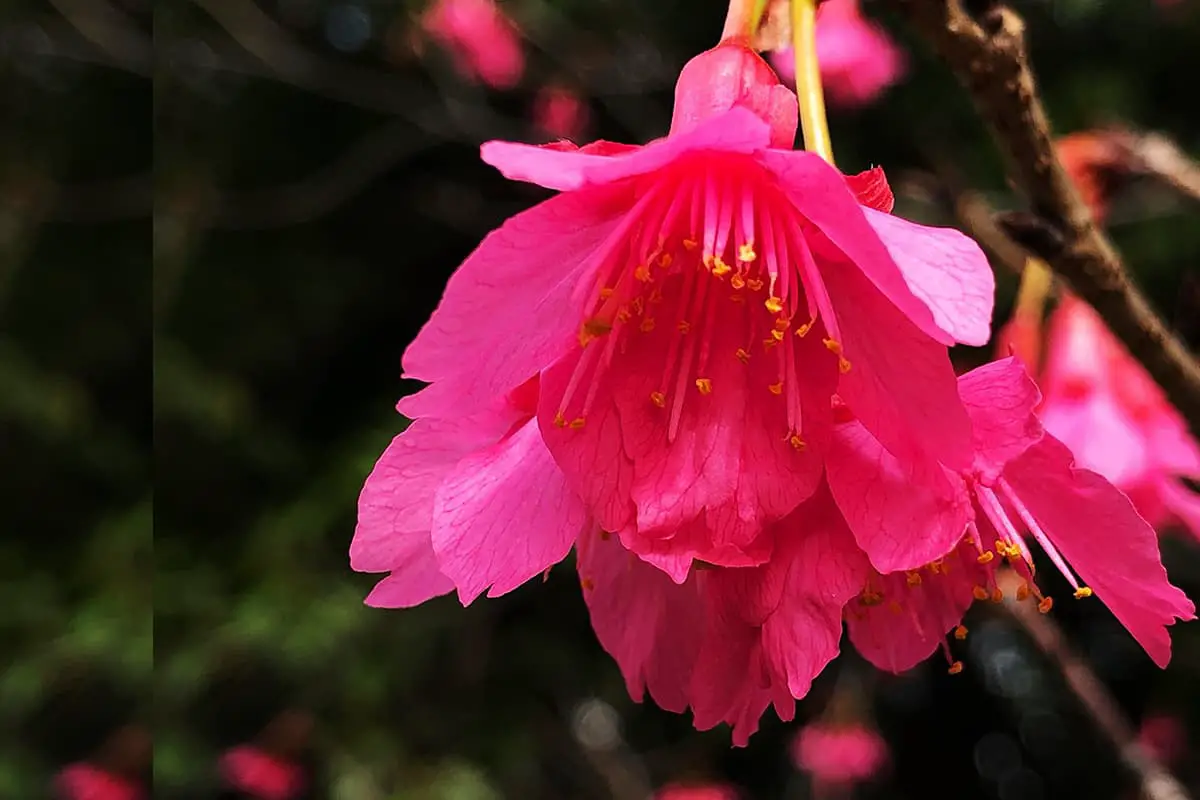
The sepals are bell-shaped and the petals are inverted ovate-elliptical, pink in color, with the tips a deeper shade, indented, and rarely entire. The fruit is a ovate-globose drupe. It flowers from February to March and bears fruit from April to May.
Cultivation Methods
Planting
Before planting, the ground should be leveled, and a hole with a diameter of 0.8 meters and a depth of 0.6 meters should be dug.
First, fill the hole with 10 cm of organic fertilizer, then place the seedling in the hole, spreading its roots outwards. After filling the hole with soil, gently pull the seedling upwards to allow the roots to spread out, then tamp down the soil.
The planting depth should be about 5 cm from the top layer of the seedling’s roots. After planting, water thoroughly and prop up with a stick to prevent it from being blown down by the wind.
When planting, apply 15-25 kg of mature compost per pit. In July, apply 1-2 kg of ammonium sulfate per plant. After flowering and before the buds sprout in early spring, prune dead branches, weak branches, and overly long branches, avoiding pruning thick branches as much as possible to maintain a well-rounded crown.
Watering
After planting, the seedlings are easily affected by drought. In addition to fully watering at the time of planting, water again every 8-10 days afterwards to keep the soil moist but not waterlogged.
After watering, loosen the soil in time. It is best to cover the ground with a thin layer of grass to reduce evaporation. In the 2-3 years after planting, to prevent the trunk from drying out, it can be wrapped with straw.
However, 2 to 3 years later, when the seedlings have grown new roots and their adaptability to the environment has gradually increased, it is no longer necessary to wrap them with straw.
Fertilizing
Cherry blossoms are fertilized twice a year, preferably with acidic fertilizer. One application is a winter fertilizer, applied in winter or early spring, using organic fertilizers such as bean cake, chicken manure, and mature compost.
The other application is after the flowers fall, using quick-acting fertilizers such as ammonium sulfate, ferrous sulfate, and superphosphate. For large cherry blossom trees, hole application can be used.
This means digging a circular trench about 10 cm deep along the edge of the crown projection line and applying the fertilizer there. This method is simple and facilitates root absorption.
As the tree grows, the diameter and depth of the fertilizer application trench should also increase. The root system of the cherry blossom is shallow and requires good drainage and ventilation.
Therefore, especially in the area where the roots are distributed, it is strictly forbidden for people and animals to trample on the soil. Pedestrian trampling can weaken the tree, shorten its life, and even cause root rot and death.
Pruning
Pruning mainly involves cutting off wilted branches, overly long branches, overlapping branches, and disease and insect branches.
In addition, when many branches grow on the trunk of a large cherry blossom tree, several strong branches should be retained and the rest should be cut off from the base to facilitate ventilation and light penetration. The pruned branches should be disinfected with medicine in time to prevent bacteria from invading and causing rot after rain.
Cherry blossoms are easily damaged and rot due to prolonged exposure to the sun, so the rotten parts should be removed in time and disinfected. Afterwards, the rotten parts should be wrapped with leaf mold and charcoal powder to promote the recovery of normal physiological functions.
Propagation Methods
Primarily propagated by sowing, cutting, and grafting. When propagating cherry blossoms by sowing, do not allow the seed embryos to dry out. It is better to sow as soon as they are harvested or after being stratified in damp sand, ready for spring sowing the next year. Grafting can use cherry or wild cherry seedlings as rootstock. Cut grafting is usually done in late March or bud grafting in late August. After grafting, 3 to 4 years of cultivation will be necessary before the plants can be moved to the nursery for planting.
Sowing
For cherry trees that bear fruit, it is best to sow the seeds as soon as they are harvested and they should not be allowed to dry out. Since the seeds may be dormant or sand-stored, they can be sown the following spring to cultivate seedlings for grafting.
Cutting: Use year-old hardwood in the spring and the current year’s softwood in the summer for cutting. Treatment with NAA can be used for cuttings, and a shaded, moist bed with good ventilation is necessary for high survival rates.
Grafting
Since most cherry tree varieties do not bear fruit, grafting can use single-petalled cherry (P.pseudocerrasus) or wild cherry as rootstock. Grafting can be done either by cut grafting in late March or bud grafting in late August. After 3-4 years of cultivation post-grafting, they are ready for nursery planting. Cherry trees can also be grafted with a high branch replacement method, where the shaved graft is inserted into the rootstock using a cleft grafting method, tightly wrapped with a plastic bag for insulation and protection. This method has a high survival rate and can be used to introduce new varieties.
Pest and Disease Control
Cherry trees should primarily be protected against gummosis and root-knot disease, as well as pests such as aphids, red spider mites, and scale insects. Gummosis is caused by moths laying eggs in the tree trunk, which can be treated by using a sharp knife to remove the eggs, amending the soil, and strengthening water and fertilizer management. Root knot disease can cause abnormal growth in the roots of infected trees, and the trees will not thrive, no matter how much fertilizer is applied. It’s necessary to remove the tumors in a timely manner, disinfect the soil, and improve the soil using leaf mold, charcoal powder, and beneficial microorganisms.
For pests like aphids, red spider mites, and scale insects, prevention is key. Spray the trees 3 to 4 times per year, with the first spraying before flowering, the second after flowering, and the third in July or August.
There are many types of pests and diseases that can affect cherry trees. Here are some common ones and how to deal with them:
Brown Spot Disease
This disease occurs in May or June. Leaves develop purple-brown spots that gradually expand into circles. The diseased area dries up and shrinks, forming small holes. The fungus overwinters on diseased branches and leaves. It grows best at temperatures between 25℃ and 28℃ and is spread by the wind. The disease is more likely to occur and spread during rainy seasons and when the tree is weak, drainage is poor, or ventilation and light are insufficient.
Prevention Methods:
(1) Strengthen cultivation management, pruning correctly, and remove and burn diseased shoots and leaves in a timely manner to create a clean growing environment for the plant.
(2) Before the new shoots sprout, spray with a 3 to 5 Baume degree lime sulfur mixture. During the disease period, spray with a 160 times Bordeaux mixture or 1000 to 2000 times dilution of 50% Benomyl wettable powder, or 600 to 800 times dilution of 15% Thiram Zinc.
Leaf Blight
In summer, leaves develop yellow-green circular spots that later turn brown and scattered black granules appear. Diseased leaves wither but do not fall off.
Value and Other Uses
Main Uses
Gardening
Cherry trees bloom in early spring with bright, colorful flowers and lush foliage, making them an important ornamental tree in spring. They are often used for garden viewing. They can be planted in groups, on hillsides, courtyards, roadside, or in front of buildings.
When in full bloom, the trees are spectacular, resembling clouds or a rosy glow, and can create a remarkable “sea of flowers” landscape when planted in large numbers.
They can also be planted in small groups to form brocade clusters in green spaces or planted singly for a “red dot among a sea of green” artistic effect. Cherry trees can also line small roads, form hedges, or be used for bonsai.
Medicinal Use
Cherry bark and wood contain gentiopicrin, a 5-glucoside, and sakurarin, cherry glycoside, and D-catechin; stems and leaves contain quercetin-3-galactoside; tender leaves contain coumarin, trans-para-hydroxycinnamic acid glucose glycoside, cyanogenic glycoside; seeds contain 32% fatty oil, mainly containing alpha-linolenic acid, stigmasterol, used for cough, fever, and other symptoms.
Skincare
Cherry blossoms have excellent pore-tightening and oil-balancing effects, and are rich in natural vitamins A, B, and E.
The flavonoids in cherry leaves also have beauty and skin-nourishing effects, strengthen the mucous membrane, and promote sugar metabolism, making them a flower that can help maintain youthful skin.
Cherry blossoms have skin-softening and brightening effects and are one of the important ingredients in skincare products. Cherry blossoms usually need to be extracted and refined.
Experts have used high-tech methods to extract the cherry blossoms into oil, and the cherry blossom extract contains a component commonly used to treat acne called cherry blossom enzyme.


 English
  العربية
  Bahasa Indonesia
  Deutsch
  Français
  Italiano
  Nederlands
  Português
  Русский
  日本語
日本語