600+ Types of Flowers A To Z (With Names and Pictures)
Types Of Flowers By Names (A-Z) Types Of Flowers By Color Types Of Flowers By Season Types Of Flowers By Blooming Time 600+ Types of Flowers No. Flower Name No.…

The Cerasus campanulata (Maxim.), typically blooms in early spring, showcasing vibrant and radiant colors. Its branches are vigorous and lush, making it an important flowering tree during the early spring season.
It is frequently used for ornamental purposes in gardens. The tree’s blossoms are abundant and dazzling during peak blooming period, creating a spectacular display that resembles clouds or twilight.
The Bellflower Cherry can be planted in large quantities to create a “sea of flowers” landscape or in clusters to adorn green spaces, forming a brocade group. It can also be planted solo, forming a striking contrast of “a spot of red in the sea of green.”
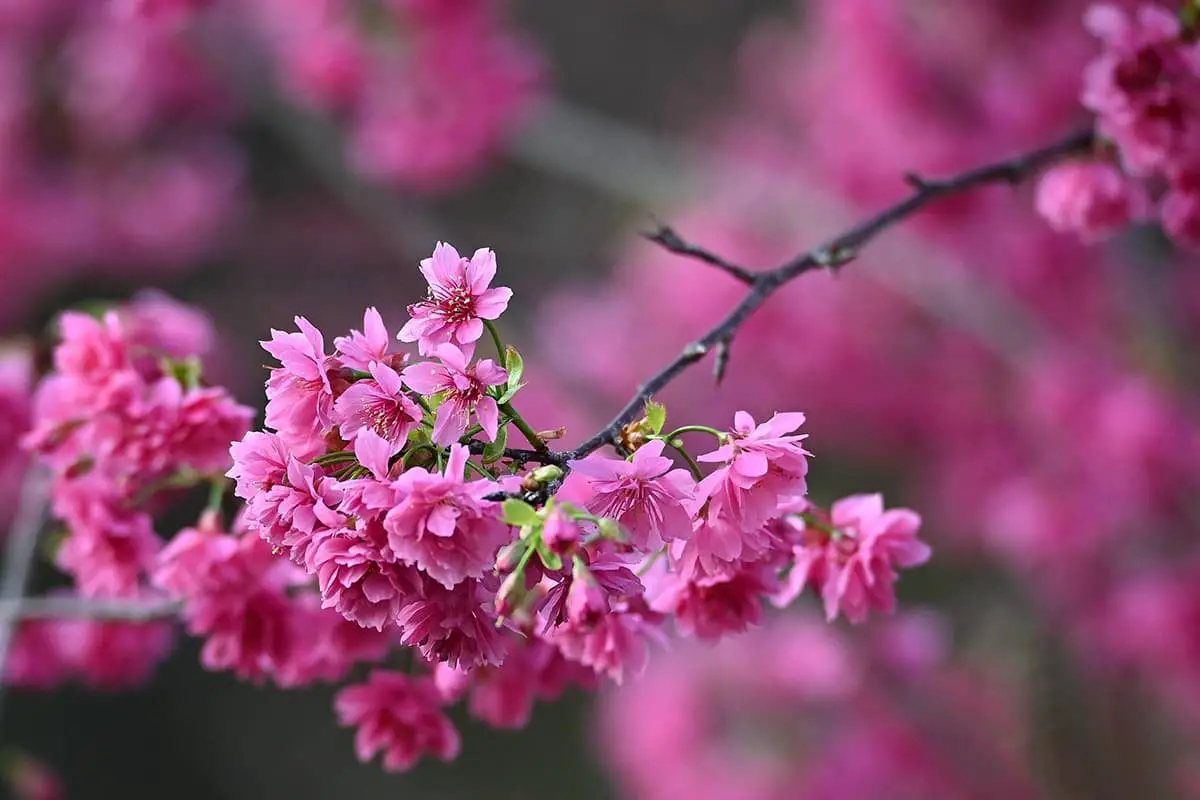
The Bellflower Cherry (scientific name: Cerasus campanulata (Maxim.) Yu et Li) is a tree or shrub that grows between 3 to 8 meters high with a dark brown bark. Its twigs are greyish-brown or purplish-brown, while its young branches are green and hairless.
The winter buds are ovate and hairless. The leaves are ovate, ovate-elliptic, or inverted ovate-elliptic, thin and leathery. The top is green and hairless, the underside is light green, with or without tufted hairs in the vein axils.
The umbel inflorescence has 2-4 flowers, which bloom before the leaves. The flower diameter is 1.5-2 cm. The drupe is ovoid. The flowering period is from February to March, and the fruiting period is from April to May.
It grows in forest valleys and edges, at an altitude of 100-600 meters. It is found in Zhejiang, Fujian, Taiwan, Guangdong, and Guangxi in China. It also grows in Japan and Vietnam.
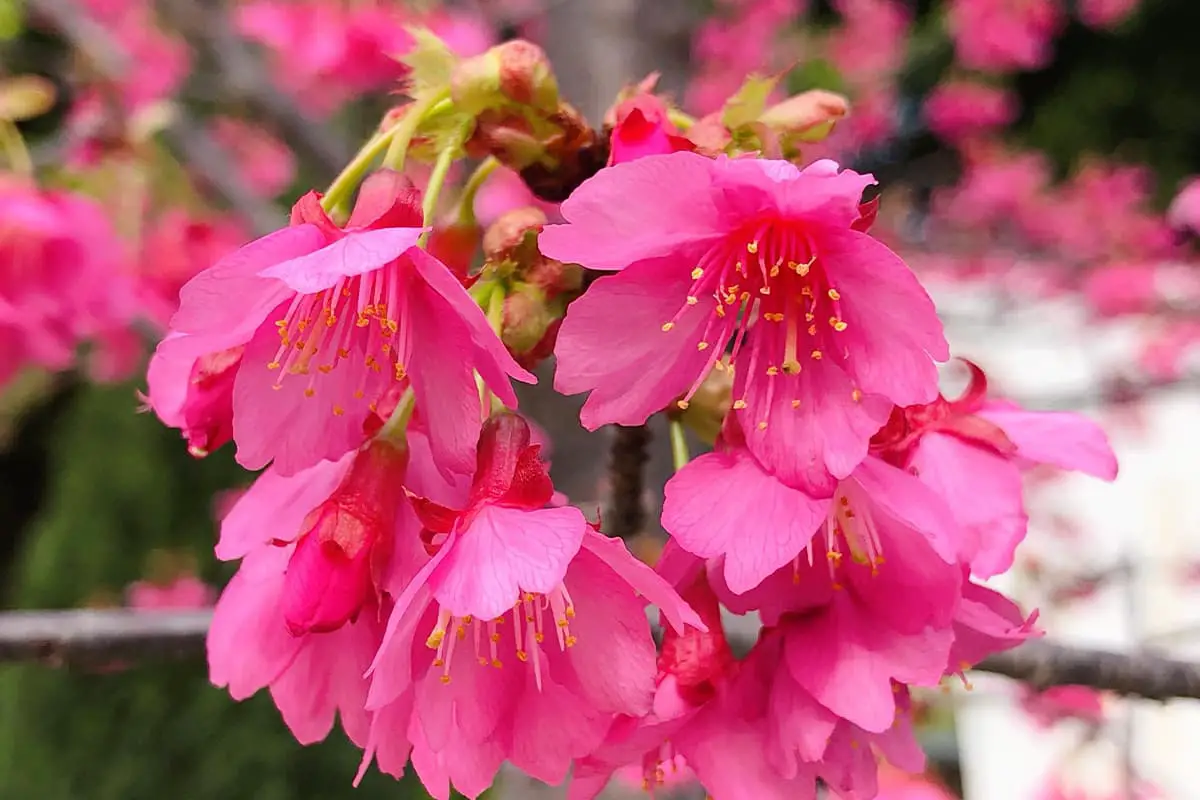
It grows in forest valleys and edges, at an altitude of 100-600 meters.
The Bellflower Cherry is a tree or shrub, growing between 3 to 8 meters high, with a dark brown bark. Its twigs are greyish-brown or purplish-brown, while its young branches are green and hairless.
The winter buds are ovate and hairless. The leaves are ovate, ovate-elliptic, or inverted ovate-elliptic, thin and leathery, 4-7 cm long and 2-3.5 cm wide. The top is green and hairless, the underside is light green, with or without tufted hairs in the vein axils.
The umbel inflorescence has 2-4 flowers, which bloom before the leaves. The flower diameter is 1.5-2 cm. The drupe is ovoid. The flowering period is from February to March, and the fruiting period is from April to May.
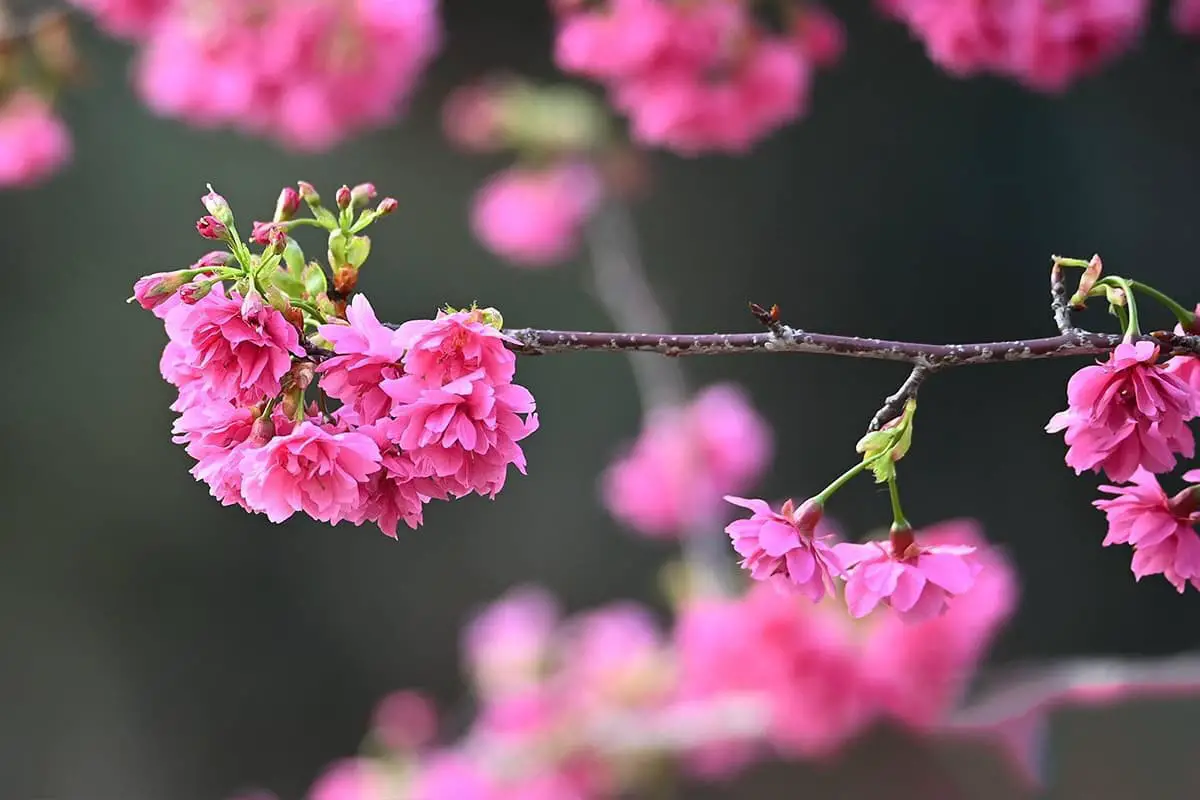
Before planting, level the ground and dig a hole with a diameter of 0.8 meters and a depth of 0.6 meters. Fill the hole with 10 centimeters of organic fertilizer, place the seedling in the hole, and allow the roots to spread.
After filling the hole with soil, lift the seedling slightly to allow the roots to spread more deeply. The planting depth should be about 5 centimeters away from the top layer of the seedling’s roots.
After planting, water thoroughly, provide support with a stick to prevent the wind from blowing it over.
During planting, apply 15-25 kilograms of compost per hole. In July, apply 1-2 kilograms of ammonium sulfate per plant.
After flowering and before budding in early spring, prune away dead, weak, and overgrown branches. Try to avoid pruning thick branches to maintain a full canopy.
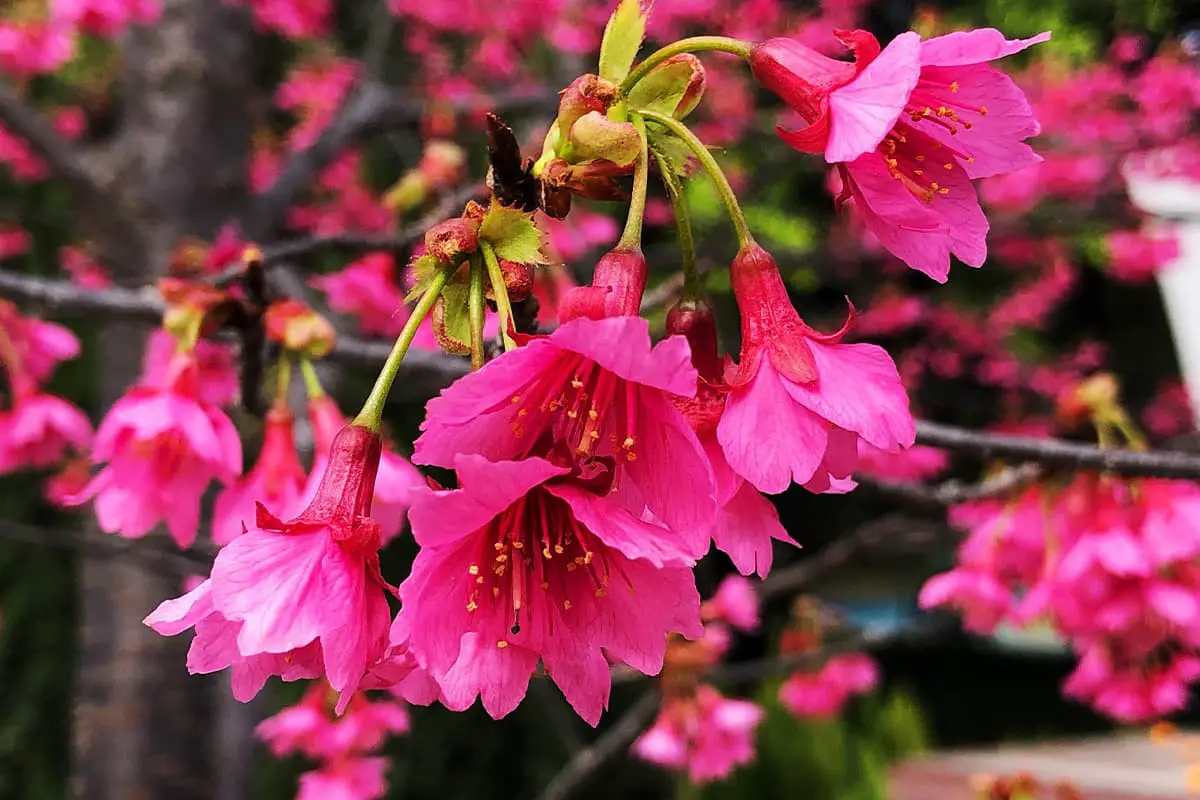
After planting, the saplings are prone to drought. Apart from thoroughly watering during planting, continue to water every 8-10 days, maintaining soil moisture without waterlogging. After watering, loosen the soil promptly.
It is best to cover the ground thinly with grass to reduce evaporation. In the 2-3 years after planting, wrap the tree trunk with straw to prevent it from drying out.
However, after 2-3 years, as the sapling grows new roots and its adaptability to the environment gradually increases, it is no longer necessary to wrap it with straw.
Cherry blossoms require two fertilizations per year, preferably with acidic fertilizer. The first is winter fertilizer, applied in winter or early spring using organic fertilizers such as bean cake, chicken manure, and compost.
The second is after the flowers drop, using quick-acting fertilizers such as ammonium sulfate, ferrous sulfate, and superphosphate.
Generally, for large cherry trees, fertilization can be done by trenching, i.e., digging a circular trench about 10 centimeters deep at the edge of the tree’s canopy projection, and applying the fertilizer there.
This method is simple and conducive to root absorption. As the tree grows, the diameter and depth of the fertilizer trench should also increase. Cherry tree roots are shallow and require good drainage and ventilation.
Therefore, especially within the root distribution range, avoid compaction of the soil by humans, livestock, and vehicles. Pedestrian trampling can weaken the tree, shorten its lifespan, and even cause root rot and death.
Pruning mainly involves removing wilted, overgrown, overlapping branches, and those infested by pests or diseases.
In addition, when many branches grow on the trunk of a large cherry tree, retain several strong branches and prune the rest from the base to allow for air and light.
After pruning, disinfect the wounds promptly with medicine to prevent bacterial invasion and rot after rain. Exposure to long periods of sun can cause the cherry tree’s bark to age and damage, leading to rot. Promptly remove and disinfect it.
Then, wrap the rotted area with leaf mold and charcoal powder to promote the recovery of its normal physiological functions.
Primarily, propagation is achieved through seeding, cutting, and grafting. When propagating cherry blossoms by seeding, it is important to avoid letting the seed embryos dry out.
These should be sowed immediately after being harvested or after being stratified in damp sand, and then broadcast the following spring.
For grafting, cherry or wild cherry seedlings can be used as rootstock. Grafting should take place in late March or late August, and after 3 to 4 years of cultivation, the plant can be transplanted.
Seeds from fruiting cherry blossoms should be sown immediately after harvesting, and should not be allowed to dry out. As the seeds may be dormant or stratified in sand until the following spring, they are cultivated to be used as seedlings for grafting.
Cutting: In spring, use one-year-old hard branches, and in summer, use the current year’s tender branches. For successful rooting, treatment with NAA is beneficial, and the seedbed should be shaded, well-ventilated, and kept moist for a high survival rate.
As most varieties of cherry blossom do not bear fruit, single petal cherry blossoms (P. pseudocerrasus) or wild cherry can be used as rootstock for grafting. This can be done in late March or late August. After 3 to 4 years of cultivation, the plant can be transplanted.
High branch grafting can also be performed on cherry blossoms, by inserting the whittled scion into the rootstock, securing it with a plastic bag, and then covering it with another plastic bag for thermal protection. This method has a high survival rate and can be used to introduce new varieties.
Cherry blossoms primarily require prevention against gummosis and root-knot disease, as well as pests such as aphids, red spiders, and scale insects.
Gummosis is caused by moths laying eggs inside the trunk, which can be removed with a sharp knife while simultaneously improving the soil and strengthening the water and fertilizer management.
Root-knot disease impedes the normal growth of the tree roots, and no matter how much fertilizer is applied, the tree will remain unhealthy. It’s necessary to promptly remove the tumors, disinfect the soil, and improve it using leaf mold, charcoal powder, and microorganisms.
For pests such as aphids, red spiders, and scale insects, prevention should be the main strategy, involving pesticide spraying 3 to 4 times a year. The first spray should be before flowering, the second after flowering, and the third in July or August.
Cherry blossoms are susceptible to a variety of diseases and pests, some of which are described below:
This occurs in May and June when purple-brown spots appear on the leaves, gradually enlarging into a circular shape. The infected area dries and shrinks, forming small holes. The fungi overwinter on the branches and leaves, spreading in the wind.
The optimal development temperature is between 25℃ to 28℃. In a rainy season, the disease can spread easily, especially when the tree is weak, drainage is poor, and sunlight is inadequate.
Control measures:
In summer, yellow-green circular spots appear on the leaves, which later turn brown, with scattered small black dots. The infected leaves die but do not fall off.
Gardening
This plant blooms in early spring, presenting a vibrant and bright display. With its lush and vigorous foliage, it is a significant ornamental tree for springtime viewing and is often used in landscaping.
It can be planted in groups or on slopes, courtyards, road sides, and in front of buildings. When in full bloom, its profuse and resplendent flowers create a spectacular sight, resembling clouds and rosy dawn.
It can be planted en masse to create a “sea of flowers” landscape, grouped in clusters to form a splash of color amidst the greenery, or planted individually to create a “pop of color” effect amidst the green. The plant can also be used as a pathway tree, hedge, or made into a bonsai.
Medicinal Uses
The bark and wood of this plant contain gentiopicrin, a glucoside, and sakuranin, a rhamnose glucoside. The plant also contains cherry glucoside and its wood contains D-catechin.
The stems and leaves contain quercitrin 3-galactoside, while the young leaves contain coumarin, trans-p-coumaric acid glucoside, and cyanogenic glycosides.
The seeds contain 32% oil, primarily consisting of alpha-tocopherol and sitosterol, which are used for symptoms such as cough and fever.
Skincare
This plant has excellent astringent properties and helps balance sebum. It is rich in natural vitamins A, B, and E. Cherry flavonoids also have beauty-enhancing effects, strengthen mucous membranes, and promote carbohydrate metabolism. It is often referred to as the “flower of youth” for maintaining youthful skin.
The plant has skin-softening and brightening effects and is an important ingredient in skincare products. The plant extracts need to be refined. Experts have used advanced extraction techniques to refine the plant into cherry powder oil. A component called cherry enzyme in the plant extract is commonly used to treat acne.

Peggie was once a high school mathematics teacher, but she set aside her chalkboard and textbooks to follow her lifelong passion for flowers. After years of dedication and learning, she not only established a thriving flower shop but also founded this blog, “Flowers Library”. If you have any questions or wish to learn more about flowers, feel free to contact Peggie.
 English
  العربية
  Bahasa Indonesia
  Deutsch
  Français
  Italiano
  Nederlands
  Português
  Русский
  日本語
日本語