600+ Types of Flowers A To Z (With Names and Pictures)
Types Of Flowers By Names (A-Z) Types Of Flowers By Color Types Of Flowers By Season Types Of Flowers By Blooming Time 600+ Types of Flowers No. Flower Name No.…

Wisteria sinensis, also known as Chinese Wisteria, Flowering Vine, Red Vine, or Bean-inviting Vine, belongs to the legume family and the Wisteria genus. It is a large deciduous climbing and twining plant.
The Chinese Wisteria has a deep primary root with few lateral roots; its seedlings resemble shrubs when young. Several years later, the twining nature is exhibited at the top of the vigorous shoots, with the twining long branches occurring at the base of the main vine.
The vine twines counterclockwise and can self-twist around columnar objects less than 30 centimeters. The wisteria flower is a racemose inflorescence, borne at the ends of the branches or at the tops of the leaf axils, dangling down 20 to 30 centimeters long.
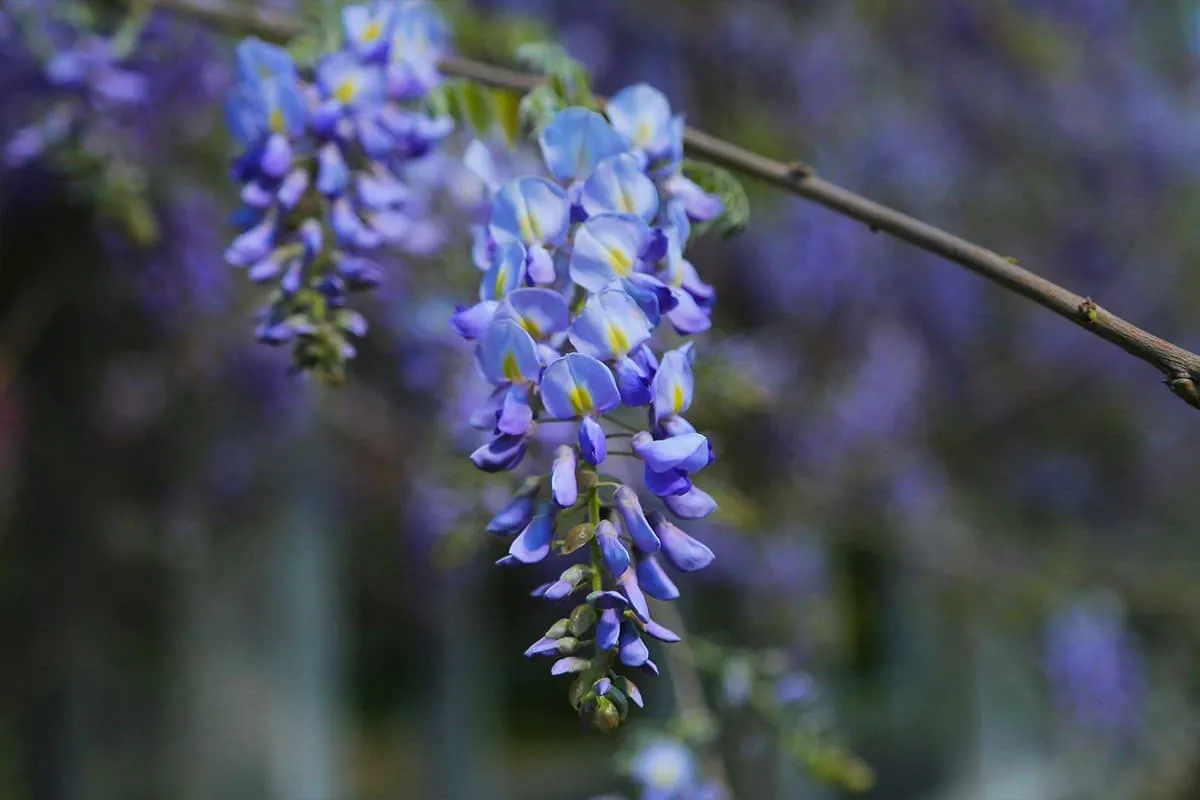
The flowers are dense and striking, with each inflorescence bearing 50 to 100 flowers. They range from blue-purple to light purple and are fragrant. The flowering period is from mid-April to early May.
Wisteria sinensis, a plant in the legume family and the Wisteria genus, is a deciduous vine. The stem twines leftward and the branches are robust, with the young shoots covered in white downy hairs before becoming smooth; the winter buds are ovoid.
Odd-pinnate compound leaves are 15-25 centimeters long; the stipules are linear and early deciduous; the leaflets are in 3-6 pairs, papery, ovate-elliptic to ovate-lanceolate.
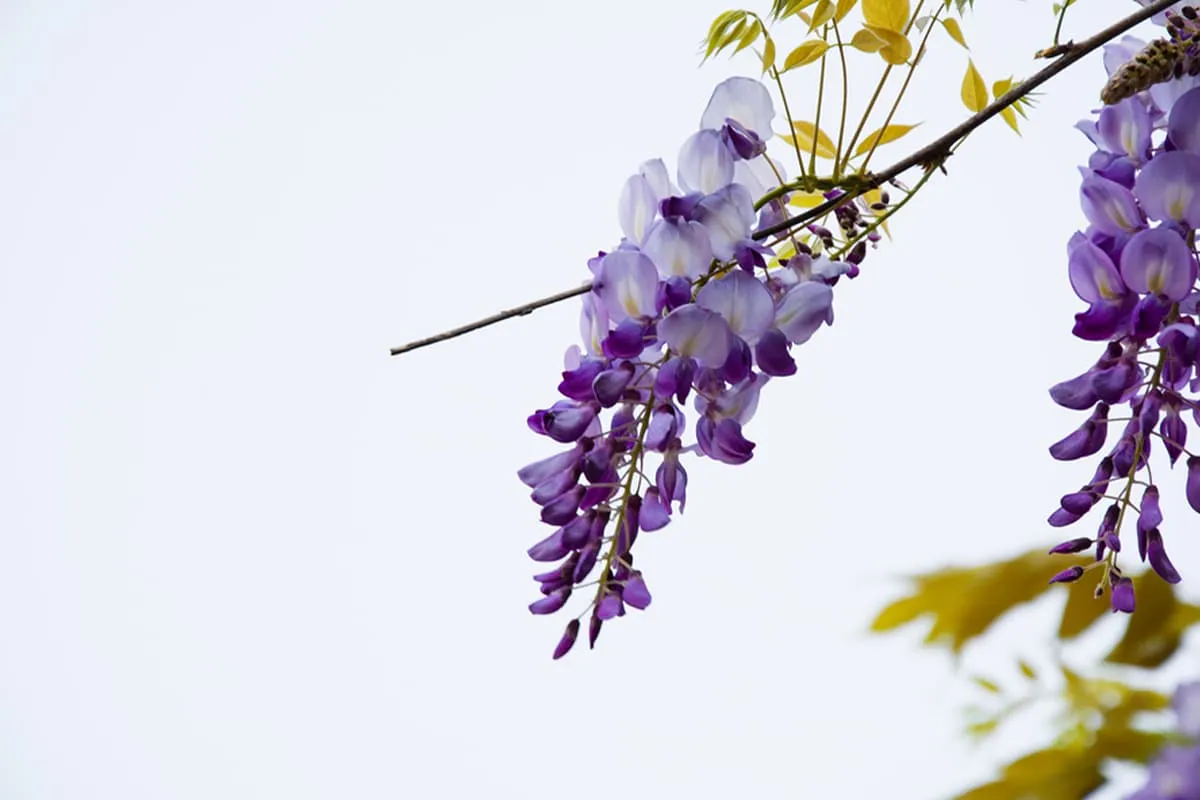
The racemose inflorescence originates from the axillary or terminal buds of one-year-old shoots, 15-30 centimeters long and 8-10 centimeters in diameter, with the inflorescence axis covered with white downy hairs; the bracts are lanceolate and early deciduous; the flowers are 2-2.5 centimeters long.
The legume is inverted lanceolate, 10-15 centimeters long, 1.5-2 centimeters wide, densely velvety, hanging on the branches without falling, with 1-3 seeds; the seeds are brown, shiny, round, 1.5 centimeters wide, and flat. The flowering period is from mid-April to early May, and the fruiting period is from May to August.
It is distributed in many places in China. It grows in mountain valleys, slopes, and thickets between 500 and 1000 meters above sea level.
Wisteria flowers can be distilled to produce aromatic oils, and they have detoxifying, antiemetic, and antidiarrheal effects. Wisteria bark has insecticidal, analgesic, and wind-expelling effects; it can also be edible. At the same time, it can be used as a landscaping ornamental plant.
As its name suggests, Silk Wisteria often has flowers as white as jade or silver. Therefore, it is also often called White Flower Wisteria. This plant has a very strong fragrance, slenderer branches, and it is not frost resistant.
The flowers of Red Jade Wisteria are bright and deep peach red, luxurious and stunning. Compared to other varieties, Red Jade Wisteria has larger flowers and a medium length, making it more suitable for pot cultivation. The vine can also grow very long, reaching over twenty meters.
Many people might confuse White Jade Wisteria with Silk Wisteria because their colors are both pure white. However, they have differences.
The inflorescences of White Jade Wisteria are shorter and it has a smaller stature. It is commonly found on the market and is a very suitable wisteria variety for pot cultivation.
Don’t be deceived by the name of Three Feet Wisteria, its actual length does not reach three feet but only about 60-70 centimeters. It has smaller flowers that are often lotus green in color, and its size is moderate, making it very suitable for either courtyard or pot cultivation.
Multiflora Wisteria possesses an unusual tender pink color compared to the typical purple of common Wisterias. It emits a delicate scent that’s reminiscent of pea blossoms.
The plant grows quite long, even twice the length of standard Wisterias, making it spectacular when planted over large areas. It is ideal for landscaping projects or park decorations.
Double-Petaled Wisteria usually exhibits purple flowers. Its blossoms are shorter but bloom in abundant quantities, creating a rich, layered effect. The heavy clusters of flowers resemble bunches of grapes, making it visually stunning and a favorite for its ornamental value.
Wisteria is a warm and temperate plant with a strong adaptability to climate and soil conditions. It is hardy, capable of tolerating wet soils and thin, barren lands. The plant prefers light but can also endure shade. It thrives best in sunny, wind-sheltered locations with deep, well-drained soil.
The plant has a deep primary root system with shallow lateral roots, making it difficult to transplant. It grows rapidly and has a long lifespan. With its powerful twining ability, Wisteria can strangle other plants.
Wisteria is highly adaptable, heat-tolerant, and cold-resistant, and is cultivated across China, from the south to the north. Thus, the temperature in Guangdong, which varies throughout the year, suits Wisteria well. During winter, the plant should be kept at around 0°C with slightly damp soil to ensure a proper dormant period.
Native to China, Wisteria can also be found in Korea and Japan. It is widely distributed in North China and commonly cultivated in gardens for its aesthetic appeal.
Wisteria is a deciduous vine. The stem twines counterclockwise, and the branches are rather thick. New shoots are covered with white down that later falls off, leaving the branches bare.
Winter buds are egg-shaped. Odd-pinnate compound leaves measure 15-25 cm in length; stipules are linear and drop early. The leaflets, arranged in 3-6 pairs, are papery, varying from ovate-elliptical to ovate-lanceolate shapes.
Inflorescences are racemes that originate from axillary or terminal buds on the one-year-old short branches. These racemes, 15-30 cm long and 8-10 cm in diameter, have a central axis covered with white down. The flowers, 2-2.5 cm long, emit a fragrant aroma.
The fruit is a lanceolate legume, 10-15 cm long and 1.5-2 cm wide, densely covered with downy hairs. Hanging from the branches, it does not fall off and contains 1-3 seeds. The seeds are glossy brown, round, and flat, measuring about 1.5 cm in width. Flowering occurs from mid-April to early May, and the fruiting period extends from May to August.
Soil
Wisteria thrives in poor soil, but fertile ground is more conducive to its growth. It adapts well to various soil pH levels, favoring deep, rich, well-draining soil.
Light
Wisteria loves light. Indoor potted plants should be placed in a well-lit area, as ample sunlight aids in nutrient accumulation and encourages blooming. For outdoor planting, position your Wisteria in a sunny location rather than a shaded corner. Insufficient light can result in slower growth and fewer blossoms.
Temperature
Wisteria is cold-resistant and can endure temperatures as low as -10°C (14°F). Thus, it can be grown outdoors in both southern and some northern regions. In northeastern areas, pot cultivation is advised. During winter, move the plant indoors to overwinter, maintaining a night temperature between 5-10°C (41-50°F) is optimal.
Watering
Wisteria has specific water needs. For potted plants, water thoroughly when the soil surface appears white or dry. For outdoor cultivation, protect the plant from continuous rain to prevent root rot from excessive water in the soil. Ground-planted Wisteria is less susceptible to waterlogging.
Fertilization
Wisteria enjoys fertilizer. During its growth period, it requires frequent fertilization. Apply diluted liquid fertilizer, such as cake fertilizer or compound fertilizer, every half a month to promote growth.
Prior to blooming, switch to a phosphorus and potassium fertilizer, like dipotassium phosphate, to encourage blossoming.
Pruning
Potted Wisteria should be pinched back when new shoots reach 14-17cm in length during its growth period. This encourages branching and prevents the plant from becoming too large, which could negatively affect its aesthetics as a bonsai. A heavy pruning should be performed annually after the flowers have faded to avoid overconsumption of nutrients.
Wisteria does not require excessive sunlight, normal daylight is sufficient. It grows more vigorously with ample summer sunlight. It can tolerate both bright sunlight and chilly shade.
During winter, simply place potted Wisteria by a window where the room temperature stays above freezing and it receives daylight, ensuring its safe passage through the colder months.
Planting Time
Wisteria can be propagated by seeds, which should be planted in the spring, as the temperature is suitable for seed germination and growth during this season.
Seed Treatment
Around November, Wisteria seeds mature and can be collected. After picking, remove the outer skin, then sun-dry and store the seeds. Before planting, prepare some hot water and soak the seeds in it while stirring, then rinse and place them in a warm place for germination.
Soil Preparation
Wisteria is not picky about its soil and can grow normally in various soil types. A mixture of garden soil, leaf mould, and sandy soil can be used. After preparing the soil, sterilize it to remove any bacteria and insect eggs. Lay a layer of crushed stone at the bottom of the pot, then mix in the base fertilizer and fill the pot with soil.
Planting Seeds
Once the basic soil conditions are prepared, you can start sowing. Level the soil, scatter the seeds, and cover with a thin layer of soil.
Care and Maintenance
After sowing, water regularly, ensure sufficient sunlight, and fertilize as needed. Wisteria is a climbing plant, so after the seeds have sprouted, you can set up a support for the vines to climb.
Choosing Cuttings
Wisteria propagation is often done by cuttings. Choose robust branches from one- or two-year-old plants and cut them into approximately 15cm long segments. Cuttings should be done in mid to late March, before the branches start budding.
Prepare the Seedbed
The seedbed for cuttings should be airy and loose. When preparing, add a proper amount of river sand to improve drainage. Note that homemade seedbeds should be sterilized before use to avoid insect eggs or bacteria in the soil.
Planting in the Soil
The method of cutting planting is straightforward. Simply insert the prepared cuttings into the seedbed, ensuring that about two-thirds of the cutting is in the soil.
After planting, mist promptly to maintain moisture, and intensify management in the later stage to improve the survival rate. Once the propagated plants grow to 20-50cm in height, they can be transplanted after two years.
The main diseases affecting wisteria are soft rot and leaf spot. Soft rot can cause the entire plant to die, while leaf spot damages the leaves of wisteria. Both diseases can be controlled by a solution of 50% carbendazim at 1000 times dilution or 50% methyloxime at 800 times dilution.
The most common pests for wisteria are snails, scale insects, and mealybugs. Snails are active in the rainy season of spring and summer. During this time, lime powder should be spread around the plantation or at the base of the support structure.
Scale insects, which often infest the edges or surfaces of leaves and suck the sap, causing plant wilting, are usually caused by poor ventilation in the cultivation environment. In severe cases, the entire plant may turn yellow and die.
These can be eradicated by spraying a solution of 40% parathion-methyl emulsion at 1000 times dilution, or 50% marathon oil emulsion at 2000 times dilution, or using a solution of Sufu kill or speed lice at 800-1000 times dilution. Mealybugs can be controlled with a 3000 times diluted solution of Sufu aphids or aphid eliminator.
Medicinal Use
Wisteria flowers can be used to extract aromatic oil, which has detoxifying, antiemetic, and antidiarrheal effects. Wisteria bark has insecticidal, analgesic, and wind-dispelling effects.
Edible Use
Wisteria flowers, also known as “vine flowers”, are a life-saving vegetable during times of disaster. In regions of Henan, Shandong, and Hebei in China, people often steam and eat wisteria flowers.
Dishes such as Beijing’s “Purple Radish Cake”, and other local dishes like “Wisteria Cake”, “Wisteria Porridge”, “Fried Wisteria Fish”, “Cold Mixed Kudzu Flower”, and “Stir-fried Kudzu Flower” are made with wisteria flowers.
Greening
Wisteria, being long-lived, is suitable for greening pergolas, porches, dead trees, rocks, and walls. It can also be pruned into a shrub form and planted on lawns, by streams, or near rocks, and can be used for pot planting.
Vertical Greening: With its raceme flowers drooping down 20-30 cm, densely packed and noticeable, ranging from blue-purple to light purple, wisteria can be used for vertical greening on overpasses, changing the three-dimensional image of the overpass and adding a beautiful scenic line to the city. Exposed rocks or steep slopes can be covered with wisteria to hide their imperfections.
Structural Greening: Wisteria’s climbing and twining nature can be used to build various shaped arches, corridors, and pergolas. For quicker landscaping, larger seedlings can be planted around the structures, creating a scenic view within 2 years.
Bonsai Material: With its large stem that can be bent at will, wisteria can be twisted into various shapes to create a variety of bonsai, presenting a beautiful view during the flowering season.
Roof Greening: Using the characteristic of wisteria stems being soft and swaying in the wind, wisteria can be planted on the roof, with the stems growing downwards to form a green barrier, creating a more pleasant view during the flowering season.
China has a long history of cultivating wisteria. Many official residences and private gardens in Beijing, China, plant wisteria to beautify their courtyards, and many famous wisteria plants come from these gardens.
Flower Language of Wisteria
The flower language of wisteria is “obsessive love” and “persistent love. Wisteria flowers can be given to a lover or girlfriend to express that your love for her has reached the point of obsession.
Wisteria symbolizes romance because its flowers are purple, a color that gives a sense of romance. Wisteria flowers can be given to a girlfriend to enhance the relationship between the two of you.

Peggie was once a high school mathematics teacher, but she set aside her chalkboard and textbooks to follow her lifelong passion for flowers. After years of dedication and learning, she not only established a thriving flower shop but also founded this blog, “Flowers Library”. If you have any questions or wish to learn more about flowers, feel free to contact Peggie.
 English
  العربية
  Bahasa Indonesia
  Deutsch
  Français
  Italiano
  Nederlands
  Português
  Русский
  日本語
日本語