600+ Types of Flowers A To Z (With Names and Pictures)
Types Of Flowers By Names (A-Z) Types Of Flowers By Color Types Of Flowers By Season Types Of Flowers By Blooming Time 600+ Types of Flowers No. Flower Name No.…

Monotropa uniflora Linn, commonly known as Ghost Plant or Indian Pipe, is a perennial herb of the Ericaceae family that is mycoheterotrophic, or parasitic, in nature. It typically blooms from August to September and bears fruit between September and November. The Ghost Plant generally thrives in cool, moist coniferous or mixed coniferous and broadleaf forests located at altitudes between 800 and 3,200 meters on mountain slopes.
Standing about ten centimeters tall with a translucent, ghost-like appearance, it grows unbranched from its rhizome, clustered over the decayed leaves. It is often referred to as the flower of the underworld or the flower of death. Its distribution spans various provinces in China, with populations also found in Russia, Japan, India, Southeast Asia, and North America.
Growth and Distribution
Growth Environment
Ghost Plants are often found in secluded, cool, and humid coniferous or mixed coniferous and broadleaf forests located at altitudes between 800 and 3,200 meters on mountain slopes.
Distribution Range
The Ghost Plant is found across many provinces and regions in China, as well as in Japan, India, Southeast Asia, and North America, growing in mountainous forested regions at altitudes from 800 to 3,850 meters.
Morphology and Characteristics
This perennial herb is parasitic, featuring a single, unbranched stem that stands 10 to 30 centimeters tall. Lacking chlorophyll, the plant is white and fleshy, turning a dark brown-black when dried. It has a fine, densely branching root system, forming a nest-like structure.
Leaves are reduced to scale-like structures, standing erect, alternately arranged, oblong or narrowly oblong, or broadly lanceolate, 1.4 to 1.5 centimeters long and 4 to 4.5 millimeters wide, with blunt tips and either hairless or slightly hairy on the upper leaves, and nearly entire margins.
Each plant bears a single flower, initially drooping and later standing erect, with a tubular bell-shaped corolla, 1.4 to 2 centimeters long and 1.1 to 1.6 centimeters in diameter. The bracts are scale-like and resemble the leaves in shape; the sepals are also scale-like and early-deciduous.
The petals, numbering between five to six, are separate, wedge-shaped or oblong-ovate, 1.2 to 1.6 centimeters long and widest at the upper part between 5.5 to 7 millimeters, irregularly toothed, often densely covered with coarse hairs on the inside, and early-deciduous.
The plant has 10 to 12 stamens, with hairy filaments and yellow anthers; a 10-toothed disk; a central placentation ovary with five chambers; and a 2 to 3 millimeter long style with a funnelform stigma.
The fruit is an erect, upward-facing, ellipsoid capsule, 1.3 to 1.4 centimeters long. The plant flowers in August and September and bears fruit in September or October to November.
Cultivation Method

Cultivating the Ghost Plant requires strong and healthy seedlings. Initially, it is important to maintain the number of seedlings per clump, which should be no less than three, and cultivate them together.
The cultivation environment should be sufficiently warm, and ample light and water are essential to promote the growth of the plant and ensure the seedlings are robust. Protecting the growth of the plant’s roots is crucial as the Ghost Plant absorbs its nutrients through them. Blackened or decayed root tips hinder timely water and nutrient supply, often leading to scorched Ghost Plants.
Therefore, to protect the roots, good drainage and aeration in the pot are essential, ensuring thorough watering without leaving the interior dry; it is also important to regularly rinse the roots in summer to prevent residual fertilizer from damaging them.
Increasing humidity is an important condition for cultivating Ghost Plants. Uneven humidity, especially during the high temperatures of summer and early spring, can lead to excessive water evaporation from the plants, causing scorched tips.
Thus, it is crucial to maintain the humidity above 70%. One should absolutely avoid touching or damaging the crystal-like structure of the Ghost Plant with hands during its growth.
Try to minimize repotting to avoid damaging the root tips and disrupting the plant’s growth. Choose permeable, well-aerated, fertile soil for planting.
Unless artificially mimicking its original wild environment, the Ghost Plant’s survival period is quite short. It sprouts in the spring and goes through its entire life cycle – from growth, flowering, to fruit-bearing – in just a few months. Therefore, plant lovers are advised against altering its growth state, and it is often more suitable to let it grow naturally in its original wild environment.
Propagation Method
Ghost Plants obtain all their organic nutrients from the soil. Their roots are covered with a dense layer of fungal hyphae, which are 1-2 times thicker than the root epidermis itself.
The tips of the small roots are encased in a fungal sheath, from which individual or bundles of hyphae separate on all sides, distinguishing it from parasitic fungi whose hyphae are only on the root surface and do not invade root tissues.
Clearly, the Ghost Plant’s nutrient supply is assumed by the hyphae, which physiologically replace the role of the Ghost Plant’s root hairs.
Value and Other Information
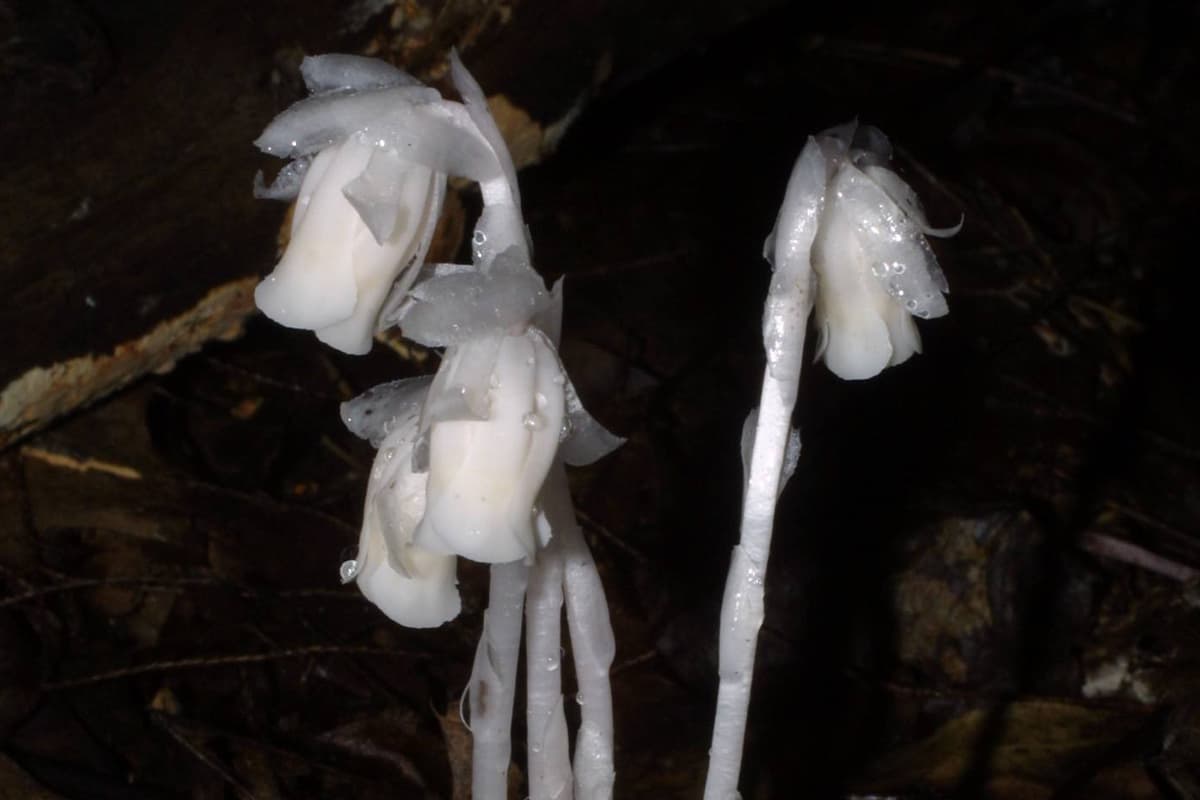
In the natural world, the Ghost Plant, or Water Crystal Orchid, is not a rare “ghost” that is difficult to encounter. With knowledge of its habits and a careful selection of the place and time, one can easily observe this plant. The best time to admire the Ghost Plant is usually around mid-April in the south and slightly later in the north. The Ghost Plant observed during this period is in its best form.
If too early, the Ghost Plant has not sprouted yet, and if too late, aging causes brown spots to appear on the Ghost Plant, making it impossible to appreciate its clear, transparent, and dreamlike beauty. Just like a lotus “rises out of the mud but remains unsoiled”, the Ghost Plant can produce lovely white flowers without a single green leaf in the humus.
Plant Culture
In the forests of Shaanxi and Yunnan in China, a rare plant has been discovered. It stands over ten centimeters tall, with a straight, unbranched root, and a whole body that is crystal clear. It clusters and grows on decomposed leaves, known as the flower of the underworld, also called the flower of death, the dream orchid, the saprophytic flower, etc.
In some novels, it is also considered the flower of ghosts, a deadly poison, or a magical herb that can bring the dead back to life.
This mysterious plant is the Ghost Plant, or Water Crystal Orchid. True to its name, it is crystal clear and is a perennial saprophytic plant belonging to the orchid family. What’s special about this plant is that it does not have chlorophyll, so it cannot photosynthesize like other plants.
But it has its own way of survival – it absorbs nutrients from the decomposed leaves to sustain its life, which is why it is referred to as the “flower of death.” It is worth mentioning that contrary to its depiction in novels, it is not a poisonous plant but is in fact non-toxic.
Since the Ghost Plant is rare, can it be artificially cultivated? The Ghost Plant is a parasitic plant with extremely small seeds that contain almost no nutrients. Its roots are entirely parasitic on the roots of other plants. This biological feature makes the Ghost Plant only suitable for specific climatic environments in forests, such as cool, humid places rich in humus, where it can survive with the help of special fungi.
Unless one can simulate its native environment, the Ghost Plant is unlikely to survive in a normal artificial environment, and current scientific technology cannot take the Ghost Plant out of the deep mountains and old forests. Therefore, the Ghost Plant is not suitable for artificial cultivation. If you want to appreciate the beauty of the Ghost Plant, it’s best to go to natural forests.
The Ghost Plant withers easily and its entire life cycle lasts only a few short months. It is difficult to survive after being transplanted from the mountains to the plains, so if you see this plant in the wild, be sure to protect it and refrain from randomly picking it.

Peggie was once a high school mathematics teacher, but she set aside her chalkboard and textbooks to follow her lifelong passion for flowers. After years of dedication and learning, she not only established a thriving flower shop but also founded this blog, “Flowers Library”. If you have any questions or wish to learn more about flowers, feel free to contact Peggie.
 English
  العربية
  Bahasa Indonesia
  Deutsch
  Français
  Italiano
  Nederlands
  Português
  Русский
  日本語
日本語