600+ Types of Flowers A To Z (With Names and Pictures)
Types Of Flowers By Names (A-Z) Types Of Flowers By Color Types Of Flowers By Season Types Of Flowers By Blooming Time 600+ Types of Flowers No. Flower Name No.…

The Leontopodium leontopodioides, a perennial herbaceous plant in the aster family, features robust rhizomes enveloped by short leaf sheaths, with numerous flowering stems and root shoots similar in shape to the stems, but devoid of a rosette of leaves.
The erect stems, which range from 5 to 45 centimeters in height, are covered with long soft hairs or cobwebby hairs.
The leaves stand upright, are linear or narrowly lanceolate, lack sheaths and petioles, and are densely coated with white woolly hairs on both sides.
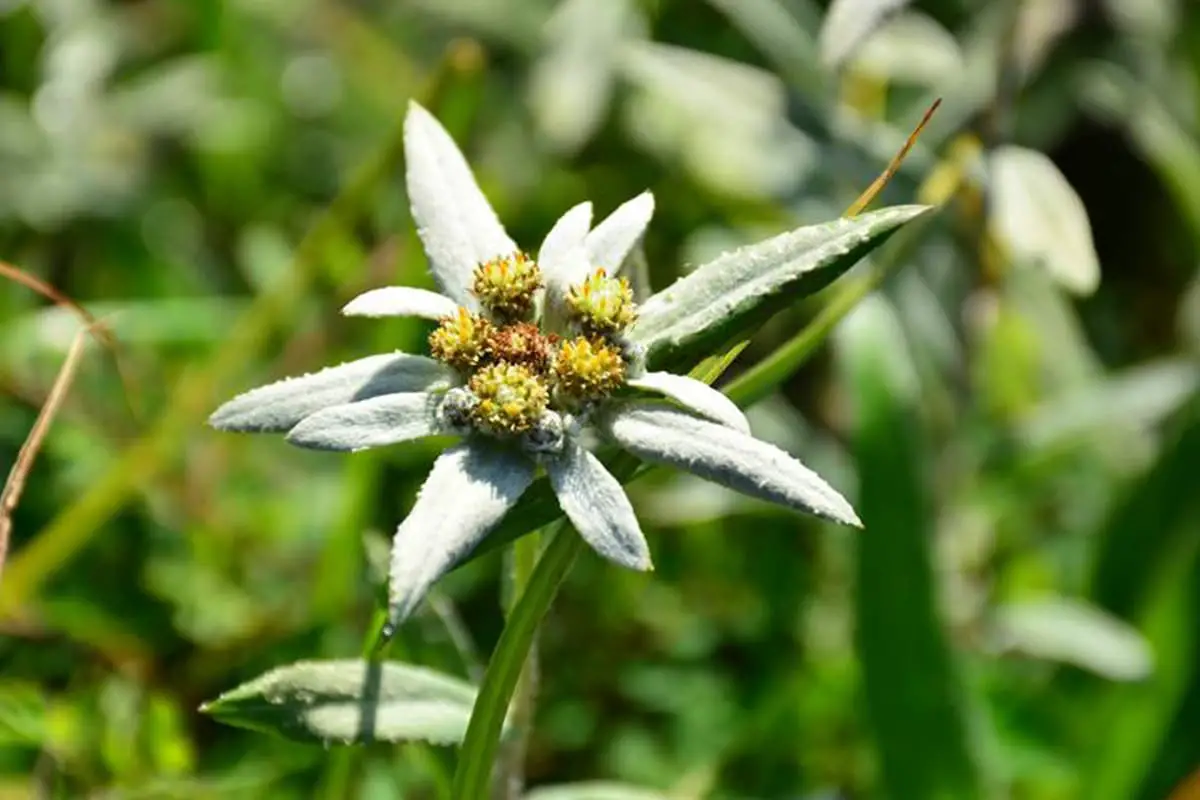
There are a few bracts, which are rectangular or linear and covered with white or gray-white thick hairs, often spreading out as a group or not arranged in a clear pattern.
The capitulum inflorescences are large, with 3-7 closely packed together or arranged on a general peduncle in a corymb-like fashion; the involucre is hemispherical and covered with white tomentose hairs; the corolla base is slightly yellow.
The fruit is an achene with papillate projections or dense coarse hairs. The flowering and fruiting period is from July to October.
Edelweiss is native to high-altitude areas of Europe and South America but also grows in Mongolia, Korea, Japan, Russia, and China.
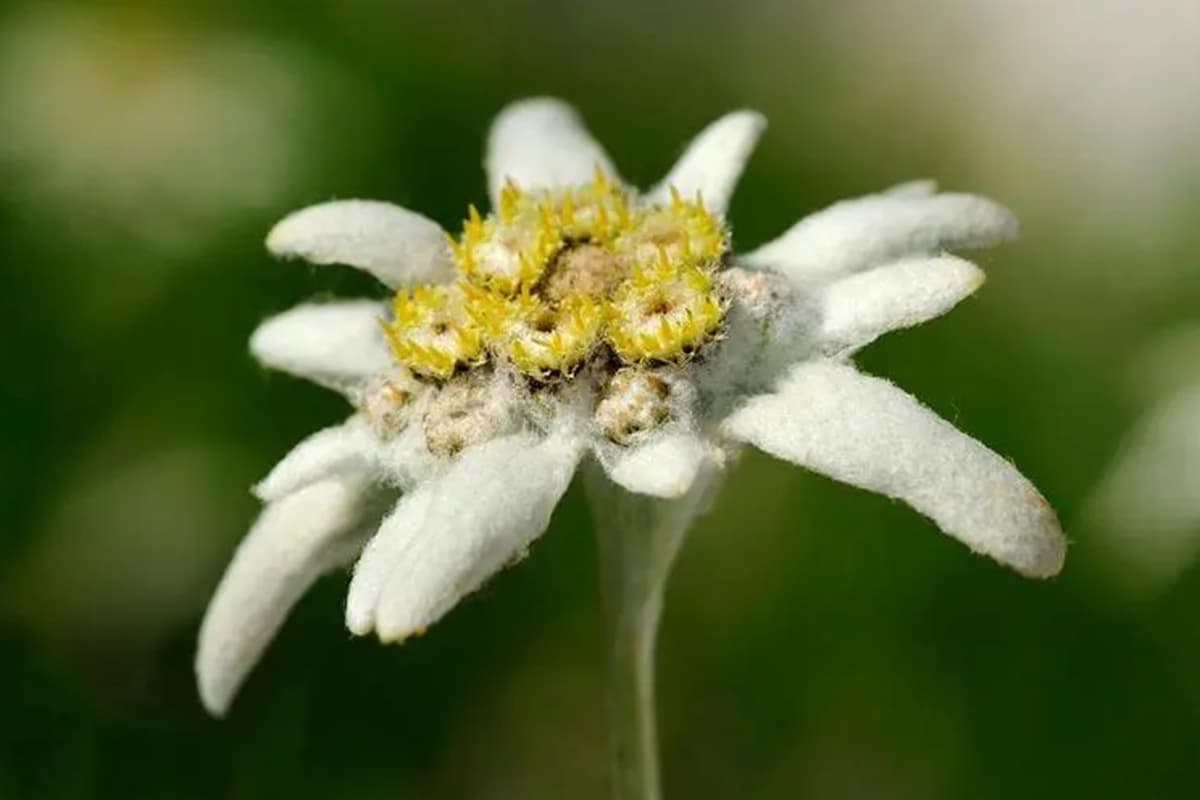
It typically thrives on dry grasslands, loess slopes, gravel fields, and mountain pastures at altitudes of 100 to 3200 meters, and less commonly in moist areas. It prefers sunlight and is resistant to cold, drought, and poor soil conditions, and it has some tolerance to moisture.
Edelweiss is a beautiful alpine flower suitable for rock garden planting or container gardening for ornamental display and as a dried flower.
The above-ground parts are used in traditional medicine to clear heat, cool the blood, promote urination, and are used to treat epidemic influenza, acute and chronic nephritis, urethritis, and urinary tract infections.
The whole plant is medicinal and effective in treating proteinuria and hematuria.
Edelweiss is a perennial herb. Its rhizome is thick and short-branched, covered with withered short leaf sheaths, with many clustered flowering stems and root shoots, without a rosette of leaves.
The flower stem is erect, thin, and straight or sometimes slightly curved, ranging from 5 to 45 centimeters tall, covered with gray-white long soft hairs or white silky hairs, unbranched or sometimes with corymb-like or general inflorescence branches in the upper part, with denser leaves at the lower part and sparser towards the top, with internodes 5-20 millimeters long, sometimes reaching up to 10 centimeters at the upper part.
The lower leaves wither and persist during the flowering period.
The leaves are upright and sometimes spread after flowering, are linear or narrowly lanceolate, 2-4.5 centimeters long, 0.2-0.5 centimeters wide, with a pointed or slightly pointed tip, broadened base, without sheaths or petioles, with flat edges or sometimes rolled back or wavy, gray-green on the upper surface with soft hairs, and densely white or gray-white woolly or sometimes silky hairs on the underside.
There are few bracts, which are slightly shorter and often wider than the upper leaves, oval or linear, slightly pointed at the tip, narrowing at the base, and covered with white or gray-white thick velvety hairs on one or both sides, equal in length to the inflorescence or 1.5-2 times longer, spreading out more in male plants and more erect in female plants, not arranged in a clear bract group.
The capitulum inflorescences are large, about 7-10 millimeters in diameter on female plants, with 3-7 densely packed together, rarely solitary or more numerous, often with longer peduncles arranged in a corymb-like fashion on female plants.
The involucre is hemispherical, 4-6 millimeters long, and covered with white woolly hairs; the phyllaries are about four layers, colorless or brown, usually narrow and pointed, slightly protruding above the down.
The flowers are dioecious, rarely monoecious; male flowers have a corolla 3.5 millimeters long, narrow funnel-shaped with small lobes; female flowers have a filamentous corolla, which grows after the flower, about 4.5-5 millimeters long.
The pappus is white; male flower pappus is not or rarely slightly thicker, with serrated or hair-like teeth; female flower pappus is fine filamentous with minute teeth.
The sterile ovary is hairless or has papillate projections; the achene has papillate projections or dense coarse hairs. The flowering and fruiting period is from July to October.
The Leontopodium leontopodioides may be difficult to differentiate from its close relative, the Leontopodium smithianum Hand.-Mazz.
Typically, the former is dioecious with the male plants being shorter and boasting prominent bract clusters, while the female plants are taller with larger capitulum flower heads and longer pappus, and often have scattered bracts.
In monoecious plants, the capitulum usually comprises numerous female flowers and very few male flowers.
This species thrives in dry grasslands, loess slopes, gravel areas, and mountain grasslands at elevations of 100 to 3,200 meters. It is occasionally found in moist locations.
It prefers full sun exposure and is tolerant to cold, drought, and poor soils, with slight tolerance to wet conditions.
The Edelweiss originates from high-altitude areas in Europe and South America and is also found in Mongolia, Korea, Japan, Russia, and China.
Edelweiss is commonly propagated through division and sowing seeds.
For division propagation: It is typically done in spring by separating the clumped plants, which can then be directly potted.
For seed propagation: Spring sowing is preferred, with an optimum germination temperature of 15-20°C, and germination occurring within 10-12 days.
For potting: After seedling emergence, thinning is necessary. Once 2-3 true leaves have developed, the plants can be potted. A fertile, loose leaf mold is commonly used.
During the growing period, the potting soil should not be too wet. Fertilize once a month, ensuring the fertilizer solution does not soil the leaves. During winter, keep the potting soil slightly dry.
Harvesting: Cut in June or July, wash clean, remove the remaining branches, leaves, and the outer skin of the roots, and dry in the sun.
Ornamental: The Edelweiss is a delicately charming plant with silvery-gray leaves and white capitulum flower heads.
It is a beautiful alpine flower and a renowned bloom of the European Alps, suitable for rock gardens, pot cultivation, or as a dried flower for decoration.
Medicinal: The above-ground parts are used in herbal medicine. They have heat-clearing, blood-cooling, and diuretic properties.
They are primarily used to treat epidemic influenza, acute and chronic nephritis, urethritis, and urinary tract infections. The whole plant is effective in treating proteinuria and hematuria.
Switzerland, known as “the garden of the world,” has designated the Edelweiss as its national flower, symbolizing honor and friendship. Austria has also chosen the Edelweiss as its national flower.
In Austria, the Edelweiss is a symbol of valor, as it grows in the harsh conditions of high mountains and is seldom seen in its full beauty, hence those who have seen it are considered heroes.
In the past, many young Austrians risked their lives climbing steep cliffs just to pluck an Edelweiss for their beloved, as it was the ultimate token of sacrifice for love.
Many Austrian legends revolve around the flower. It is believed that the King of Edelweiss can guide those who seek the elusive bloom, but anyone who uproots the flower will fall into an abyss.

Peggie was once a high school mathematics teacher, but she set aside her chalkboard and textbooks to follow her lifelong passion for flowers. After years of dedication and learning, she not only established a thriving flower shop but also founded this blog, “Flowers Library”. If you have any questions or wish to learn more about flowers, feel free to contact Peggie.
 English
  العربية
  Bahasa Indonesia
  Deutsch
  Français
  Italiano
  Nederlands
  Português
  Русский
  日本語
日本語