600+ Types of Flowers A To Z (With Names and Pictures)
Types Of Flowers By Names (A-Z) Types Of Flowers By Color Types Of Flowers By Season Types Of Flowers By Blooming Time 600+ Types of Flowers No. Flower Name No.…

The Kanzan Cherry, commonly known as “Red Tassel”, is a representative variety of the double-flowered cherries. It is widely cultivated in China, with its blooming period at the end of March or the beginning of April.
The Kanzan Cherry blossoms are deep red, with stems of about 6 cm, approximately 30 petals, and 2 pistils that are leaf-like, thus unable to bear fruit. The flower stalks are thick and long, with young leaves of a tea-brown color. The small branches are numerous and curve upward.
The average height is 2.5m, with many branching, and numerous blossoms. The autumn leaves are orange-yellow, comparable to ginkgo, and exceedingly beautiful.
The Kanzan Cherry, colloquially known as “Red Tassel”, is a characteristic variety of the double-flowered cherries. It’s extensively planted in China, with a blooming period at the end of March or early April, with flowers and leaves blooming simultaneously.
Comparable to the more common species, it has deep red flowers, stems about 6 cm long, approximately 30 petals, and two leaf-like pistils making it incapable of bearing fruit. The flower stalks are thick and long, and the young leaves are tea-brown.
It has a multitude of small branches that curve upwards. This small tree has an average height of 2.5m, many branches, and numerous blossoms. Its orange-yellow autumn leaves are as beautiful as those of a ginkgo tree. It can be planted alone or in groups and can also serve as a street tree.
The flowers and leaves bloom together, with the spring leaves being purple-brown. The flower buds are red; the flowers are pink, with 33-35 petals, and a diameter of 5.5 to 155 pixels.
There are 1 to 2 pistils, which are leaf-like; the stamens are few and short; the flower calyx is tubular and hairless, with 5 to 6 segments, usually 5, and purple-brown; the flowers are in bunches of 1 to 3, forming an umbel.
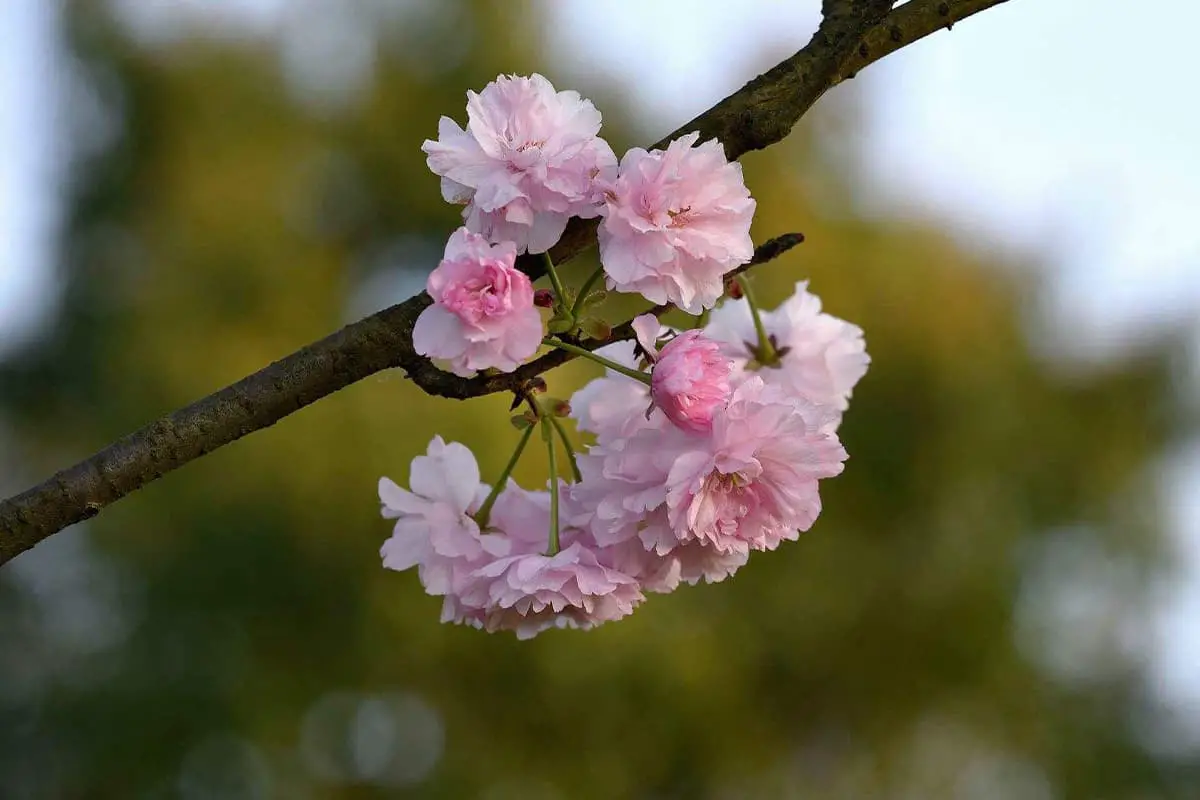
From late March to early April. The flower stalks are thick and long, the young branches are tea-brown, and the small branches are numerous and curve upward.

Peggie was once a high school mathematics teacher, but she set aside her chalkboard and textbooks to follow her lifelong passion for flowers. After years of dedication and learning, she not only established a thriving flower shop but also founded this blog, “Flowers Library”. If you have any questions or wish to learn more about flowers, feel free to contact Peggie.
 English
  العربية
  Bahasa Indonesia
  Deutsch
  Français
  Italiano
  Nederlands
  Português
  Русский
  日本語
日本語