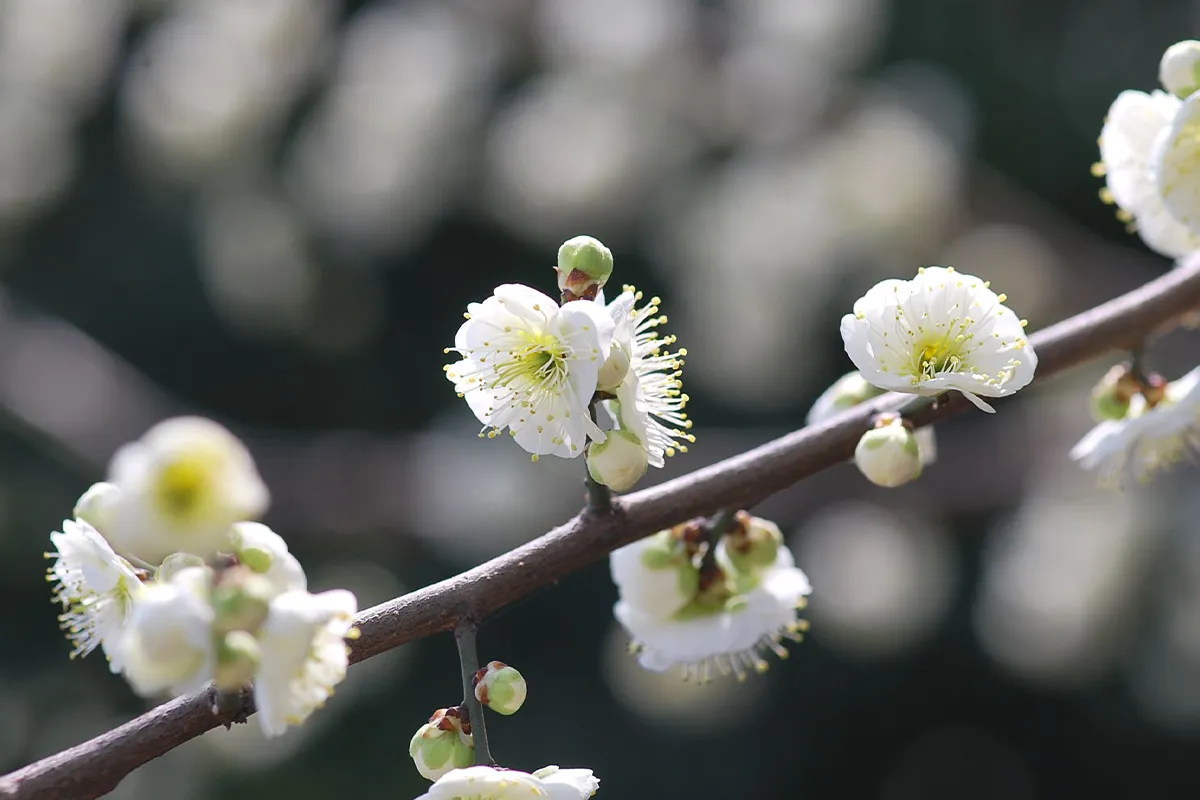
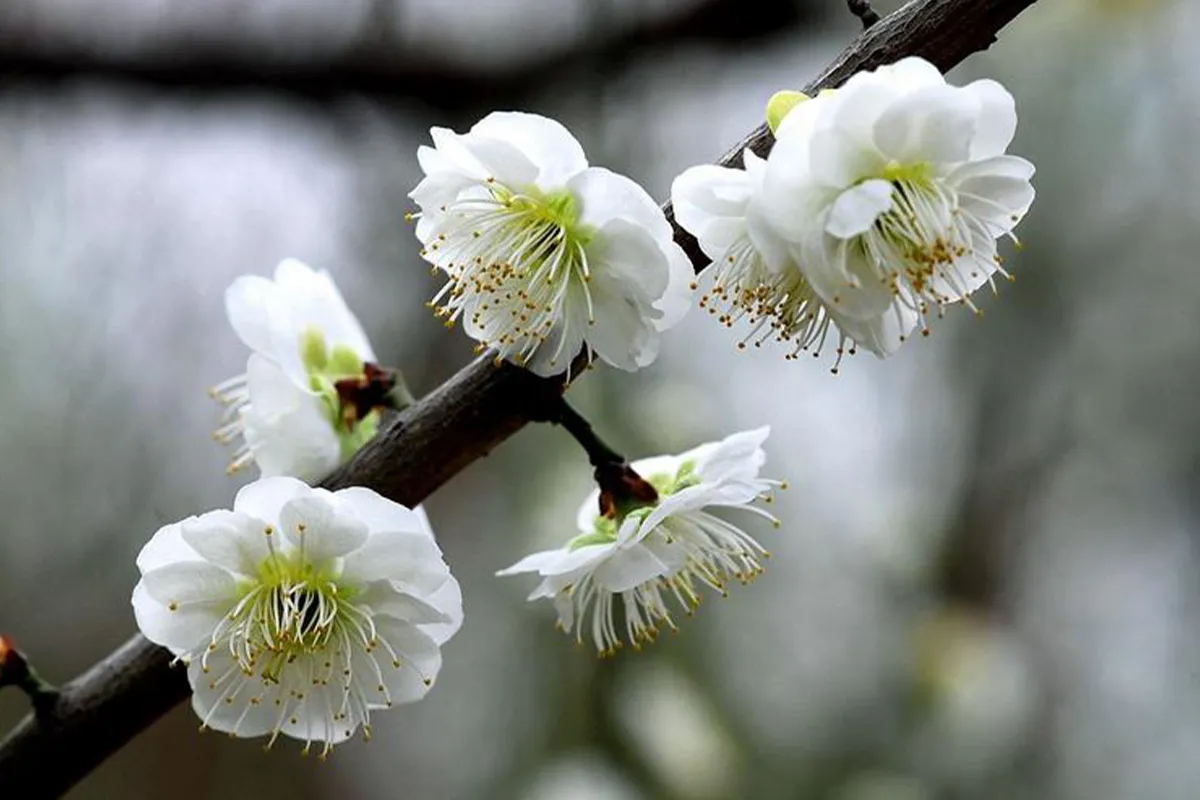
The Green Calyx Plum, commonly known as the Green Plum, is named for its green calyx and white flowers, and greenish twigs. It belongs to the true plum species in the plum flower classification system, specifically the straight branch plum class of the green calyx type.
It is a standout in the plum blossom varieties and has the temperament of a gentleman. The Green Calyx Plum originates from Southwest China and Taiwan, primarily grown in Jiangsu and Zhejiang provinces; it is now found in Sichuan, Hubei, Jiangxi, and other places.
The Green Calyx Plum is one of the few large-flowered types among plum blossom varieties. When in full bloom, the flower diameter can reach about 35cm. The petals are fragrantly staggered, and the overall flower outline resembles a dancing butterfly.
There are dozens of varieties now, including large-flowered green calyx, single-petaled green calyx, and brocade leaf green calyx.
Common Varieties
The flowers can be single-petaled, double-petaled, or multiple-petaled, starting as a faint green color and turning white, with a green calyx, and greenish twigs without a purple halo.
Main Varieties: Li Flower Green Calyx, Variegated Green Calyx, Tai Ge Green Calyx, Long Stamen Green Calyx, Two Green Calyx, Double Petal Green Calyx, Six Green Calyx, Small Green Calyx, Money Green Calyx, Rice Single Green, Long Stamen Single Green, Single Petal Green Calyx, Early Flower Green Calyx, Brocade Branch Green Calyx, Brocade Leaf Green Calyx, Late Green Calyx, Long Observation Green Calyx, Different Flavor Green Calyx, Laurel, Moon Shadow, Single Green Calyx, Large Wheel Green Calyx, Bean Green, Plum Mountain Green Calyx, Long Silk Green Calyx, Large Flower Green Calyx, Brocade Leaf Late Green, etc.
Growth and Distribution
Originating from Southwest China and Taiwan, it is primarily produced in Jiangsu and Zhejiang provinces. It is now found in Sichuan, Hubei, Jiangxi, and other places.
Morphology and Characteristics
The Green Calyx Plum, commonly known as the Green Plum, is named for its green calyx and white flowers, and greenish twigs. It belongs to the true plum species in the plum flower classification system, specifically the straight branch plum class of the green calyx type. It is a standout in the plum blossom varieties.
The original variant is a small tree or shrub, 4-10 meters high; the bark is light gray or greenish, smooth; the twigs are green, smooth and hairless. The leaves are ovate or elliptical, 4-8 cm long and 2.5-5 cm wide, with a pointed tip and a broad wedge-shaped to round base.
The leaf edges often have small sharp serrations, are greyish-green, and are covered with short soft hairs when young, which gradually fall off as they grow, or only have short soft hairs between the veins underneath; the leaf stalk is 1-2 cm long, hairy when young, and falls off when old, often with glandular bodies.
The flowers are single or sometimes two grow from one bud, 2-2.5 cm in diameter, strongly fragrant, and bloom before the leaves; the flower stalk is short, about 1-3 mm long, often hairless; the calyx is usually reddish-brown, but some varieties have a green or green-purple calyx; the calyx tube is wide bell-shaped, hairless or sometimes covered with short soft hair; the calyx lobes are ovate or nearly round, with a rounded tip; the petals are inverted ovate, white to pink; the stamens are short or slightly longer than the petals; the ovary is densely covered with soft hair, and the pistil is short or slightly longer than the stamens.
The fruit is nearly spherical, 2-3 cm in diameter, yellow or greenish-white, covered with soft hair, and sour; the pulp adheres to the core; the core is elliptical, with a round top and a small pointed tip, tapered at the base, slightly flat on both sides, with a slightly blunt abdominal ridge, and has obvious longitudinal grooves on the abdomen and back ridge, and the surface has honeycomb-like holes. Blooming in winter and spring, fruiting in May and June. 2n=16,24.
It is a deciduous small tree, up to 10 meters high. The trunk is purplish-brown, with many vertical mottles. There are often branch spines, and the twigs are green or green-based. The leaves are broad ovate to ovate, with a long tapering or tail tip.
In the early spring of February to March, it blooms before the leaves, the flowers are born in the leaf axils of one-year-old branches, either single or two clustered, single-petaled or multi-petaled, with a faint fragrance.
The drupe is spherical, with a shallow groove on one side, hairy, the fruit ripens in June, and when ripe, it is yellow. The twigs are greenish and without a purple halo.
Living Habits
It prefers the light and thrives in environments with ample sunshine and good ventilation. When in the shade, the tree weakens, and the flowering is sparse or even does not bloom. It prefers warm climates but is cold-resistant. It likes high air humidity and has a certain drought resistance.
It is not strict about soil requirements, but it likes moist and humus-rich sandy loam. When the soil is heavy and drainage is poor, it easily rots the roots and dies.
The Green Calyx has its own characteristics. Common pests and diseases of plum blossoms occur more easily on Gongfen Mei and Zhusha Mei, but less so on Green Calyx Plum.
Also, because the Green Calyx Plum grows robustly, with stout new branches and full leaf buds, the survival rate of grafting is much higher than other varieties.
However, the Green Calyx Plum also has its shortcomings, that is, the flower buds have poor frost resistance, so it is necessary to pay attention to frost protection when a cold wave arrives.
Cultivation Method
Soil
In the south, the plant can be grown outdoors, while in the colder regions of the north, it should be potted and kept indoors for the winter. Planting can occur anytime from after the leaves fall until the spring when the buds sprout.
To improve the survival rate, avoid damaging the root system and transplant with a soil ball. For outdoor planting, choose a location that is sheltered from the wind and faces the sun.
For potting, use a cultivation soil mixed evenly from three parts leaf mold, three parts garden soil, two parts river sand, and two parts well-rotted stable manure.
After planting, water thoroughly once. Place the plant in a shaded area for care, and once it resumes growth, move it to a sunny location for regular management.
Temperature
The plant thrives in warm temperatures with ample sunlight. Apart from the apricot and plum varieties that can withstand -25℃, the plant generally tolerates -10℃. It can also withstand high temperatures, growing even in conditions of 40℃.
It grows best in regions with an average annual temperature of 16-23℃. The plant is very sensitive to temperature, and blossoms when the average temperature in early spring reaches -5-7℃.
Water and Fertilizer
During the growing period, pay attention to watering, keeping the soil in the pot consistently moist. Avoid water stagnation and extremes of wetness or dryness, controlling watering based on the principle of moistening when dry.
On cloudy or low temperature days, water less, otherwise, water more. In summer, watering can be done twice a day, once a day in spring and autumn, and thoroughly once the soil is dry in winter. Fertilizing should also be reasonable.
Apply base fertilizer before planting, and mix in a small amount of dipotassium phosphate. Apply dipotassium phosphate again before the plant blooms, and add well-rotted cake fertilizer once during blooming to supplement the nutrients.
In June, apply a compound fertilizer to promote flower bud differentiation. After the leaves fall in autumn, apply organic fertilizer once, such as well-rotted manure.
Pruning
Shape pruning of outdoor planted plum blossoms can be done within 20 days after blooming. Maintain a natural tree shape as the main form, cutting off crossed branches, upright branches, dead branches, and overly dense branches.
Shorten the lateral branches to promote a profusion of flowers and leaves. After potting the plum blossom, heavy pruning should be done to prepare for bonsai creation.
Usually, plum stumps are used as the scenery, grafting various shapes of plum blossoms. Maintain a certain temperature, and you can see the plum blossoms blooming during the Spring Festival.
If you want it to bloom around May 1st, you need to keep the temperature between 0-5℃ and the environment moist. Move it outdoors in early April, place it in a well-ventilated place with sufficient sunlight, and you should see flowers around May 1st.
Flower Control
The blooming period of potted plum blossoms is generally for home viewing. After the leaves fall in winter, place it indoors, keeping the temperature at 0-5℃.
After New Year’s Day, gradually increase the temperature to 5-10℃, and let it receive full sunlight daily. Regularly spray water on the branches, and the water temperature should be close to the room temperature.
Propagation Method
The most common method is grafting, followed by cutting and layering, and the least used method is sowing. When grafting, you can use peach, wild peach, apricot, wild apricot, and plum seedlings as rootstocks.
Grafting
In the south, plum and peach are often used as rootstocks, while in the north, apricot, wild apricot, or wild peach are commonly used. Plum performs well as a rootstock, especially when old fruit plum trees are grafted to form ancient plum stumps, which is more suitable.
The grafting method usually uses cleft grafting, tongue grafting, side grafting, and approach grafting, generally performed after the rootstock buds in the spring.
Side grafting can also be done in the fall. Approach grafting typically involves grafting old fruit plum nodes with young plum trees, which can be done in both spring and fall. Bud grafting is usually done from June to September, generally using shield budding.
Cuttings
This is suitable for varieties that root easily, such as cinnabar, palace powder, green calyx, bone red, and plain white pagoda. Hardwood cuttings are done after the leaves fall in November, choosing sturdy branches from young mother plants grown that year.
Cut them into 10-15 cm lengths, soak the base cut in 1000-2000 mg/L indolebutyric acid for 5-10 seconds, then insert into sterilized sandy soil. The cutting depth should be 2/3 of the length.
After inserting, water thoroughly, cover with a small greenhouse for insulation, and by March of the following year, it should root and sprout.
Softwood cuttings are usually done from the end of April to May, selecting current-year branches with heels, 10-15 cm long, soaking in 50 mg/L ABT-1 rooting powder for 20 minutes, spraying intermittently, which results in fast rooting and high survival rates.
Layering
Ordinary layering is usually done during winter dormancy or early spring. Take 1-2 year old branches sprouting at the root, make a 1 cm wide ring cut with a sharp knife, bury 3-4 cm in the soil, cover with soil and weigh down with a brick, keeping the soil moist.
By the fall, it can be cut off and transplanted separately. Air layering is usually used for propagating large seedlings, generally done before spring budding or after summer shoots mature.
Peel off a ring of bark about 1 cm wide, fit a plastic film cylinder over the wound, tie it tightly 2 cm below, fill with some sterilized cultivation soil so the branch tightly contacts the soil, then tie the top with string.
After the layer roots in the fall, cut below the plastic film, remove the film, and plant it in a pot with the soil.
Sowing
This is mainly used for breeding new varieties or rootstocks. The seeds mature in June, and after harvesting, the seeds are dried. Sowing can be done in spring or autumn.
Generally, due to the colder climate in the north, spring sowing is predominant, storing seeds in moist sand layers, and sowing around the spring equinox.
Disease prevention
Soil
In the south, it can be planted directly in the ground, while in the colder northern regions, it should be potted and wintered indoors. Planting can take place anytime from after the leaves fall to before the buds sprout in spring.
To increase the survival rate, avoid damaging the root system and transplant with a clump of soil. For ground planting, choose a wind-protected, sun-facing location. For potted plants, use a mixture of leaf mold, garden soil, river sand, and well-rotted manure.
Water thoroughly after planting. Place in a shaded area for maintenance and move to sunlight once growth resumes.
Light and temperature
The plant prefers warm temperatures and abundant light. Apart from apricot and plum varieties that can tolerate temperatures as low as -25℃, most can withstand -10℃. It can grow under high temperatures, even at 40℃.
It grows best in regions with average annual temperatures of 16-23℃. The plant is very sensitive to temperature and blooms when the average temperature in early spring reaches -5 to -7℃.
Water and Fertilizer
Watering and fertilizing should be observed during the growing period. Keep the soil moist but not waterlogged or overly dry. Water when the soil begins to dry.
Generally, water less on cloudy days or when the temperature is low, otherwise, water more. Water twice daily in the summer, once daily in spring and fall, and thoroughly water when the soil is dry in winter.
Apply fertilizer reasonably, add base fertilizer before planting, and mix in a small amount of monopotassium phosphate. Apply monopotassium phosphate again before blooming and well-rotted cake fertilizer during blooming to replenish nutrients.
In June, apply compound fertilizer to promote bud differentiation. After the leaves fall in autumn, apply organic fertilizer like well-rotted manure.
Pruning
Pruning for shaping plum blossoms can be done within 20 days after blooming. Maintain a natural tree shape, cut off crossed branches, upright branches, dead branches, and excessively dense branches. Shorten side branches to promote lush flowering and foliage.
After potting, plum blossoms should be heavily pruned to establish the foundation for bonsai. Maintain a certain temperature and plum blossoms bloom during the Spring Festival.
If you want to see the flowers by “May 1st”, keep the temperature at 0-5℃ in a moist environment, move it outdoors in early April, and place it in a sunny, well-ventilated place for maintenance, then you can see the flowers before and after “May 1st”.
Flower control
Generally, potted plum blossoms are for home view. After the leaves fall in winter, place it indoors, keep the temperature at 0-5℃, gradually warm it to 5-10℃ after New Year’s Day, and fully expose it to light every day, frequently spray water on the branches, and the water should be close to room temperature.
Value and other
The dried buds are round, 4-8 mm in diameter, often with a small stalk at the base. There are 3-4 layers of brown, scale-like bracts. Inside the bracts are 5 sepals, light brown, slightly green, ovate, arranged in an imbricate manner, fused at the base with the receptacle.
There are 5 or more petals, white or yellow-white, closely clasped. Inside the petals are many yellow filamentous stamens. There is a pistil in the center, the ovary is ovate with a slender style. The plant is lightweight. The aroma is fragrant, the taste is light and astringent.
The best flowers are clean, intact, unopened, with green sepals and white flowers, and a clear fragrance. Mainly produced in Jiangsu, Zhejiang, and other places.
The red-crowned variety is called red plum blossom, similar to the white plum blossom, but slightly larger, with a light red double crown, and red sepals. However, white plum blossoms are primarily used for medicinal purposes, while red plum blossoms are less commonly used.


 English
  العربية
  Bahasa Indonesia
  Deutsch
  Français
  Italiano
  Nederlands
  Português
  Русский
  日本語
日本語