The Coronilla varia is a perennial herbaceous plant from the Fabaceae family, characterized by erect and robust stems that can branch out extensively and reach up to 100 centimeters in height.
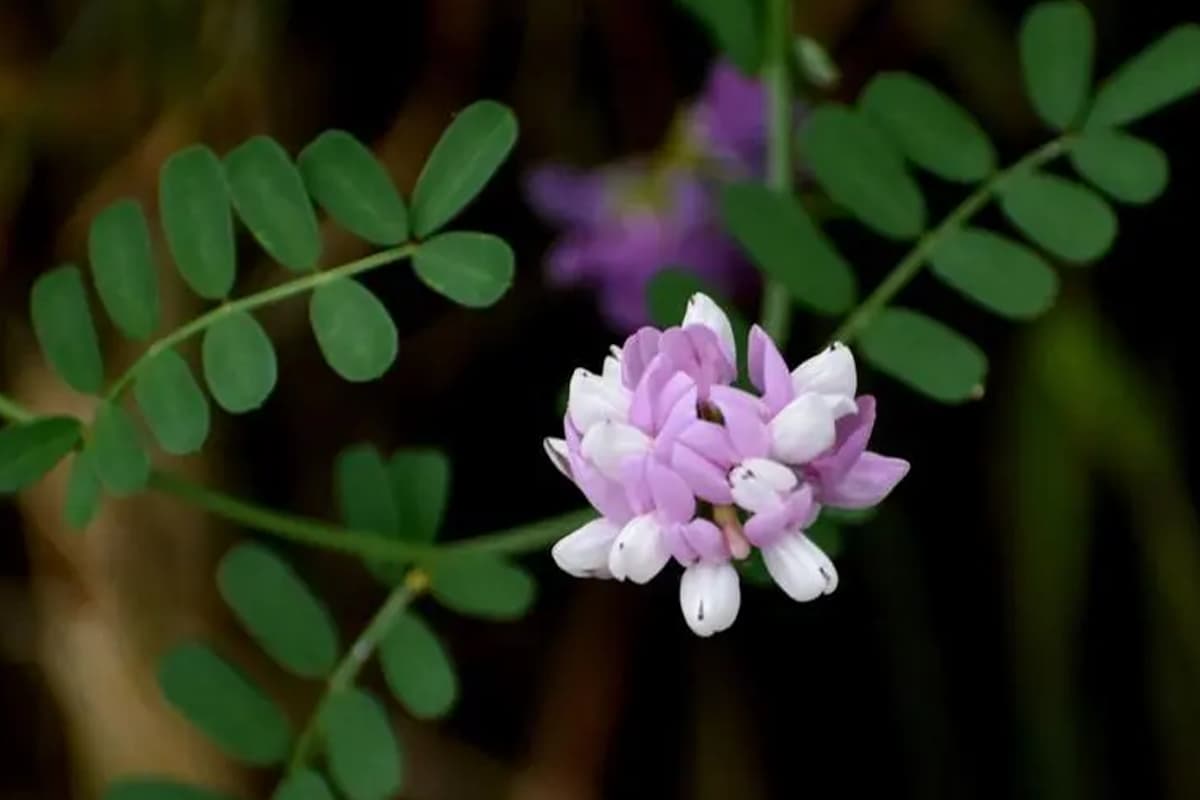
The plant features a white pith, odd-pinnate compound leaves with small, membranous, lanceolate stipules, and short petioles. Its leaflets are thin, paper-like, elliptical or oblong in shape, and hairless on both sides.
The veins are inconspicuous, with small stipules and hairless petiolules. The umbel inflorescences are axillary with flowers densely arranged in a globular shape, and the bracts are lanceolate and persistent.
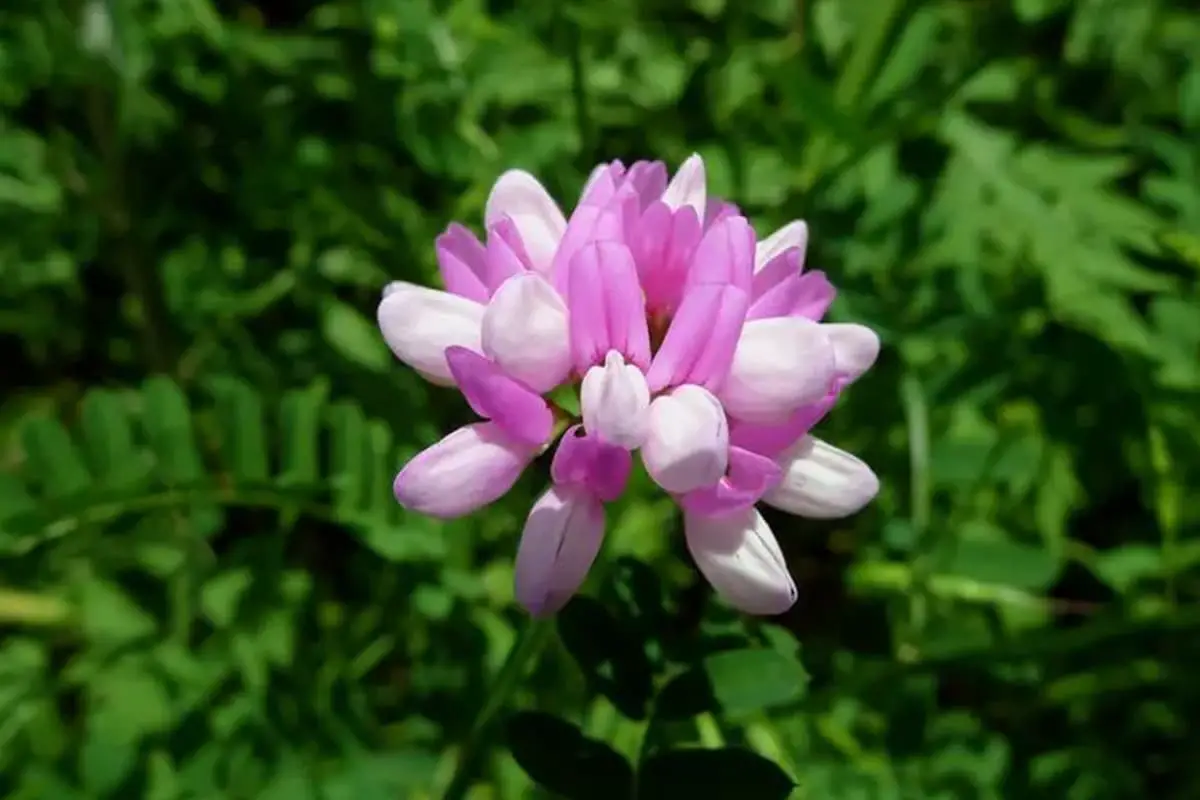
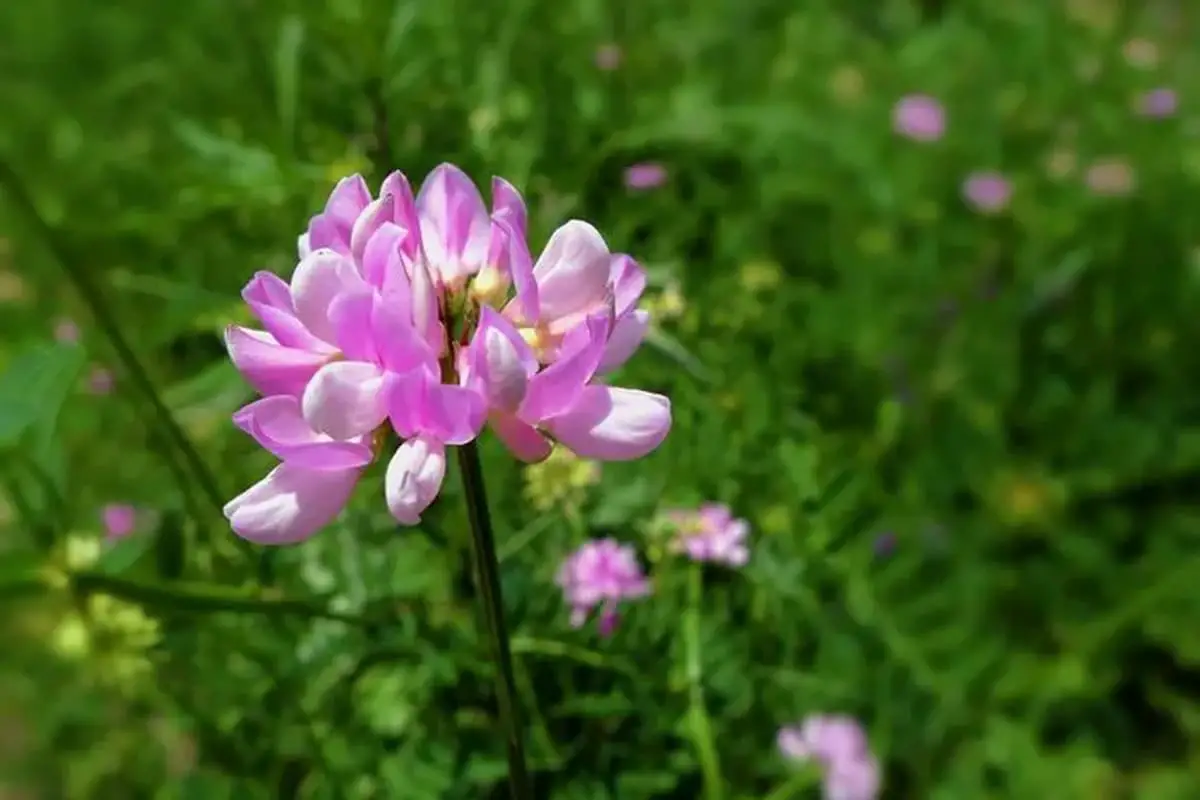
The pedicels are short, the calyx is membranous with teeth shorter than the tube, and the corolla can be purple, pink, or white, with the standard petal nearly circular and the wing petals oblong.
The keel petals end in a beak-like shape, with the beak being purple-black. The pods are slender, cylindrical, and each segment contains a seed. The seeds are oblong to ovoid in shape, and the plant flowers from June to July and bears fruit from August to September.
Native to the Mediterranean region of Europe, Crown Vetch is cultivated in the southern part of Northeast China. The plant is highly resilient, tolerating drought, cold, poor soils, and salinity, though it does not thrive in wet conditions. It can still grow in infertile soil.
The Crown Vetch’s vibrant purple-red flowers make it a popular ornamental plant. Besides its aesthetic value, it is also used medicinally and is an excellent species for soil and water conservation.
The plant’s roots feature numerous nodules, giving it a strong nitrogen-fixing ability, which makes it a beneficial green manure for fertilizing the soil.
I. Morphological Characteristics
In terms of morphology, the Crown Vetch is a perennial herb with erect, sturdy, and extensively branched stems, spreading out and ranging from 50 to 100 centimeters in height.
The stems and twigs are cylindrical with ridges, and the pith is white. Young plants may have sparse white short hairs, which later disappear.
The odd-pinnate compound leaves have 11-17 (-25) leaflets; the stipules are small, membranous, lanceolate, about 3 millimeters long, separate, and hairless. The petioles are short, about 5 millimeters in length and hairless.
The leaflets are thin, paper-like, elliptical or oblong, 15-25 millimeters long and 4-8 millimeters wide, with a short pointed tip at the apex and a nearly rounded base, hairless on both surfaces.
Each side has 4-5 visible lateral veins, but the minor veins are inconspicuous. The petiolules of the leaflets are about 1 millimeter long and hairless.
The umbel inflorescences are axillary, shorter than the leaves, with an overall length of 5-6 centimeters. The main flower stalk is about 5 centimeters long, sparsely covered with small spines.
The flowers, numbering 5-10 (20), are densely arranged in a spherical shape, with two persistent lanceolate bracts. The pedicels are short, and the calyx is membranous with teeth shorter than the tube.
The purple, pink, or white corolla features distinct purple stripes and measures 8-12 millimeters in length. The standard petal is nearly circular, and the wings are oblong.
The keel petals end in a beak-like shape, curved inward with a purple-black beak. The pods are slender, cylindrical, slightly flattened, and four-angled, ending in a persistent beak-like style.
The pod segments are about 1.5 centimeters long, each containing one seed. The seeds are smooth, yellowish-brown, oblong to ovoid, about 3 millimeters long, 1 millimeter wide, with a seed scar of 0.7 millimeters.
The flowering period is from June to July, and the fruiting period is from August to September.
II. Growth Environment
Crown Vetch prefers warm but cold-tolerant conditions, with an optimal growth temperature between 20-25°C. Growth slows down when temperatures exceed 25°C or drop below 19°C.
The minimum germination temperature for seeds is 7-8°C, with the fastest germination and seedling emergence at 25°C. The suitable temperature for flowering is 21-23°C.
The plant is frost-resistant, maintaining a long green period; it is drought-resistant and thrives well in semi-arid regions with annual rainfall around 400 millimeters.
It is adaptable to soil conditions, tolerating moderate acidity and poor soils, and grows well in neutral or slightly alkaline, well-drained soils.
It does not tolerate strong acidity, but seedlings can grow when the soil salt content does not exceed 0.5%, with an optimal pH of 6.8-7.5.
It is cold-resistant, safely overwintering at temperatures between -21 to -30°C in the middle reaches of the Yellow River basin. Plants only begin to yellow when the average temperature in mid-December drops to -3°C.
The plant’s root system is well-developed, allowing it to grow on dry hills, rocky slopes, and sandy beaches.
It has been determined that seedlings can still emerge when the moisture content is 5% at 0-10 centimeters and 10% at 10-20 centimeters in the soil, with a soil bulk density of 1.5 grams per cubic centimeter.
Crown Vetch can tolerate certain high temperatures but does not do well in wet conditions. During hot, dry conditions with a maximum temperature of 36.4°C, its leaves remain dark green, but in poorly drained, waterlogged soils, the roots are prone to rotting and death.
Typically, the plant re-greens in late March, branches in mid-April, buds and blooms in late May, and has a long flowering period. Seed maturation begins at the end of July, and plants remain green even after seeding until late autumn or early winter.
In the Huang-Huai-Hai region of China, the growing period for Crown Vetch is 120-140 days, with a growth period of 210-250 days.
III. Distribution Range
Crown Vetch originates from Southern Europe, the Central and Southern Mediterranean, Southwest Asia, North Africa, and Russia. It is cultivated in many countries across North America and Europe.
IV. Propagation Methods
Sexual
Seed treatment before sowing: Crown Vetch seeds have a high hard seed rate, usually between 40-60%, with some reaching over 80%, which affects the uniformity of seedling emergence. Seed hardening treatment prior to sowing is advisable.
Methods include:
- Soaking the seeds in 80°C water for 3-5 minutes, then cooling them down with cold water, draining, and drying for sowing;
- Immersing seeds in concentrated sulfuric acid for 20-30 minutes, then thoroughly rinsing and drying for sowing;
- Soaking seeds in an ammonium molybdate solution overnight, then draining and drying for sowing. These methods significantly improve seedling emergence rate and uniformity. For the initial planting of Crown Vetch, it is also necessary to inoculate the soil with rhizobia.
Sowing Method: Crown Vetch is best sown in spring or autumn. When sowing in autumn, it is advisable to complete sowing within two months before the first frost, as late sowing may adversely affect the seedlings’ overwintering ability.
For large-scale direct seeding, the general sowing rate is 400-500 grams per mu, with a sowing depth of 2-3 centimeters.
Broadcasting, row sowing, or hole sowing are all suitable, with hole sowing plant spacing preferably at 100 centimeters by 100 centimeters, and row sowing spacing at 100-150 centimeters.
Asexual
In addition to direct seeding, Crown Vetch can also be propagated by root cuttings and division.
Root Cuttings: When the soil begins to thaw or during the rainy season, dig up the root system, cut it into 9-15 centimeter segments, and plant at a distance of 1 meter by 1 meter, with a depth of 3-5 centimeters.
Division: Dig up new root sprouts for transplanting. The method is to insert the dug-up cuttings into the soil, thoroughly water them, and seedlings will emerge within 15-20 days.
V. Cultivation Techniques
Land Preparation and Fertilization
Crown Vetch is vigorous and not demanding of soil quality, thriving in low-yield fields such as high mountain thin soils, gullies and slopes, interstitial forest spaces, inter-rows of fruit trees, and sandy beaches.
However, it should not be planted in acidic soil or low-lying, waterlogged areas. Due to the small size of Crown Vetch seeds and the slow growth rate during the seedling stage, the planting land must be deeply plowed, cleared of weeds, and finely prepared.
In regions where it is possible, sufficient water should be irrigated to facilitate seedling emergence and early growth. Before deep plowing the land, apply 1500-3500 kilograms of organic fertilizer per mu as a base fertilizer.
If the land is poor, apply appropriate amounts of nitrogen and phosphorus fertilizers at the time of sowing to promote seedling growth and development.
Field Management
Cultivation and Weed: Seedlings of Crown Vetch grow slowly and are prone to weed infestation, requiring frequent cultivation and weeding.
When the plants begin to mound, less weeding may be necessary due to their strong weed suppression ability.
From the second year of growth, if the plants are overly dense, some may be removed every other row or plant to improve light and ventilation, promoting flowering and fruiting.
Irrigation and Drainage: Due to the small size of Crown Vetch seeds and the slow growth rate during the seedling stage, pre-sowing irrigation should be conducted according to soil moisture conditions to facilitate emergence and early growth.
For transplanted Crown Vetch, water promptly 1-2 times after transplanting to ensure the survival rate.
Crown Vetch has poor water tolerance, and in poorly drained waterlogged areas, the roots are prone to rot and death. Drain waterlogged plots promptly to maintain suitable soil moisture.
Fertilization: In addition to applying enough base fertilizer before sowing, 5 kilograms of nitrogen fertilizer per mu should be top-dressed during the growth period to promote growth.
For plots producing seeds, to improve seed yield and quality, spray 100 kilograms of a 0.6% potassium dihydrogen phosphate solution per mu on the stem and leaves from budding to early flowering.
VI. Main Value
Feed: Crown Vetch has a high yield and strong regenerative capacity. In the Huang-Huai-Hai region of China, it can be harvested 4-5 times a year, producing 6-8 tons of fresh grass and 1.5-2 tons of hay per mu.
The stems and leaves of Crown Vetch are lush and tender, with a rich leaf volume, and a stem-to-leaf ratio of 1:1.98(-3.47).
The nutritional content is high, with crude protein content at 22.08%, crude fat at 1.84%, crude fiber at 32.38%, and nitrogen-free extract at 34.08% during the peak flowering period.
Ecology: Beyond its use as fodder, Crown Vetch is valued for its extensive root system, strong adaptability, and large coverage, which enables it to rapidly form a grass layer suitable for soil and water conservation.
Additionally, with its abundant root nodules and strong nitrogen-fixing abilities, it is an excellent green manure for soil fertility.
Ornamental and Medicinal Uses: Crown Vetch has a long flowering period of up to five months and serves as an excellent source of nectar.
Moreover, its abundant and vivid flowers, along with its dense foliage, make it an attractive plant for beautifying courtyards and purifying the environment. Apart from its ornamental value, it also has medicinal uses.


 English
  العربية
  Bahasa Indonesia
  Deutsch
  Français
  Italiano
  Nederlands
  Português
  Русский
  日本語
日本語