600+ Types of Flowers A To Z (With Names and Pictures)
Types Of Flowers By Names (A-Z) Types Of Flowers By Color Types Of Flowers By Season Types Of Flowers By Blooming Time 600+ Types of Flowers No. Flower Name No.…

Thalictrum petaloideum, commonly known as Petal-rimmed Meadow Rue, belongs to the Ranunculaceae family and the Thalictrum genus.
The entire plant is hairless, with upper branches. It has several basal leaves with short or slightly longer stems, taking on a tri- to quadri-pinnate or feathered compound leaf structure. The leaflets are herbaceous and display considerable variation in shape.
The terminal leaflets are ovate or broad ovate. The lobes are entire, with flat veins and indistinct vein networks. The flowers are arranged in a corymbiform inflorescence, with a few or several blossoms. Sepals are white and fall off early, having an ovate shape.
There are numerous stamens, with narrowly oblong anthers that have blunt ends. The filaments in the upper part are inversely lanceolate, wider than the anthers.
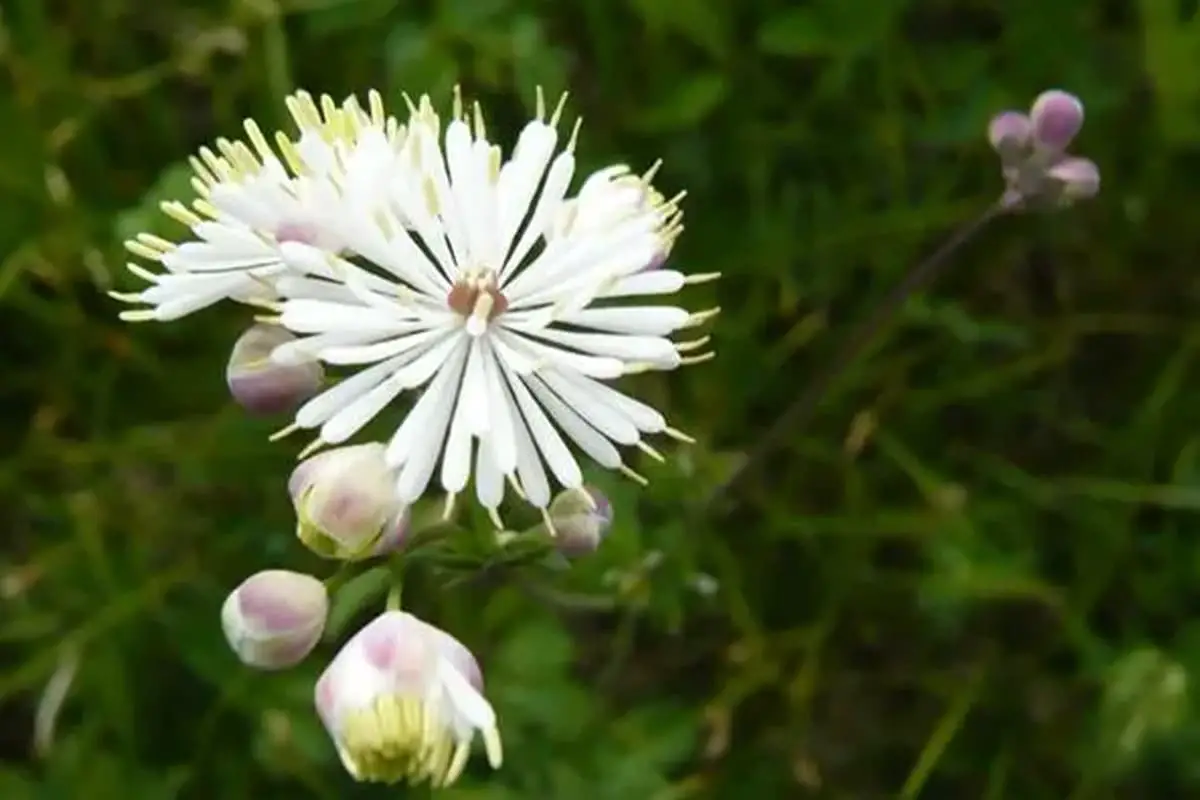
The pistils are sessile, with short styles and a ventral surface densely covered in stigma tissue. The fruit is ovate, preserving its style, and flowers bloom between June and July.
The Petal-rimmed Meadow Rue is found throughout most parts of China, as well as in North Korea and the Siberian region of Russia. It thrives on mountainous grasslands.
This robust plant is cold-resistant, enjoys direct sunlight but can also tolerate partial shade, and prefers moist, fertile soil with good drainage. Propagation can be achieved through seeding or root division.
The roots of the Petal-rimmed Meadow Rue can be used medicinally to treat jaundice-type hepatitis, diarrhea (as recognized in Inner Mongolian traditional medicine), dysentery, exudative dermatitis, and other ailments.

With its sprawling leaves resembling a light frost covering, and its delicate and refined appearance, it is suitable for medicinal gardens or plant community arrangements.
The small and dense flowers of the Petal-rimmed Meadow Rue, with their cascading, freely hanging filaments, are gracefully airy and can also be appreciated as potted ornamental plants.
Thalictrum petaloideum, a plant of the Ranunculaceae family, is entirely hairless. The stem stands 20-80 cm tall, branching at the top. It has several basal leaves, either with short or slightly longer stems, forming tri- to quadri-pinnate or feathered compound leaves.
The leaf blade spans 5-15 cm, while the leaflets, herbaceous in nature, greatly vary in shape. They can be ovate, broad ovate, rhombic, or nearly round, measuring 3-12 mm in length and 2-15 mm in width.
The tips are blunt, bases are rounded to wedge-shaped, with the leaflets either shallowly or deeply tri-lobed. Their lobes are entire, veins are flat, and venation patterns are indistinct. The leaflet stems are 5-7 mm long, and the main leaf stem can reach up to 10 cm, with a sheath at its base.
The corymbiform inflorescence comprises a few or several flowers. Each flower stem is 0.5-2.5 cm long. There are four sepals that are white, fall off early, and are ovate, measuring 3-5 mm.
Numerous stamens stand 5-12 mm tall, with narrowly oblong anthers that are 0.7-1.5 mm long and have blunt ends. The filaments in the upper section are inversely lanceolate and wider than the anthers.
The fruit is ovate, 4-6 mm long, with 8 longitudinal ribs, and retains a style about 1 mm long. The flowering period is between June and July.
Petal-rimmed Meadow Rue (Thalictrum petaloideum) is native to China. The altitudinal distribution is varied: in the regions of Sichuan, Qinghai, and Gansu, it’s found at elevations of 1,800-3,000 meters, in Shanxi and Hebei at 800-1,800 meters, and in the Northeast below 700 meters.
It is also found in North Korea and the Siberian region of Russia, thriving on mountainous grasslands.
The Petal-rimmed Meadow Rue is robust, cold-resistant, enjoys sunlight, tolerates partial shade, and prefers moist, fertile soil with good drainage.
Propagation:
Propagation can be achieved through seeding or root division.
There are approximately 100 species within the same genus, predominantly found in the Northern temperate zones.
Other commonly cultivated ornamental species include: Meadow Rue (T. aquilegifolium), Yunnan Meadow Rue (T. dipterocarpum), Yellow-flowered Meadow Rue (T. flavum), and East China Meadow Rue (T. fortunei).
Suitable for medicinal gardens or community plant arrangements, the Petal-rimmed Meadow Rue has sprawling leaves resembling a light frost cover, and its delicate, refined appearance stands out. Its small, dense flowers, with cascading filaments, add an airy elegance.
It’s ideal for wildflower gardens or natural scenic gardens as an embellishment, and can also be potted for ornamental viewing.
The roots can treat jaundice-type hepatitis, diarrhea (as recognized in Inner Mongolian traditional medicine), dysentery, exudative dermatitis, and other conditions as mentioned in the Ningxia Herbal Medicine Handbook.
In Tibetan medicine: “Zhu Ga Man Ba” utilizes the root, rhizome, and fruit to treat pneumonia, hepatitis, abscesses, dysentery, and leprosy; when applied externally, it acts as a hemostatic, as stated in the “Tibetan Materia Medica”.
“Zhi Ge Er Man Ba” also employs the root and fruit for similar ailments, with external applications to stop bleeding, as noted in the “Qinghai-Tibetan Drug Identification”.
In Mongolian medicine: “Cha Cun Yi Qi Qi Ge” and “Gong Bo Yi Ao Bu Ren” use the root to address jaundice-type hepatitis, stomach pain, diarrhea, dysentery, enteritis, indigestion, red and swollen eyes, pediatric fever, and suppressed measles, as detailed in “Mongolian Medicine”.

Peggie was once a high school mathematics teacher, but she set aside her chalkboard and textbooks to follow her lifelong passion for flowers. After years of dedication and learning, she not only established a thriving flower shop but also founded this blog, “Flowers Library”. If you have any questions or wish to learn more about flowers, feel free to contact Peggie.
 English
  العربية
  Bahasa Indonesia
  Deutsch
  Français
  Italiano
  Nederlands
  Português
  Русский
  日本語
日本語