Peach blossoms, the flowers of the peach tree (Prunus persica), belong to the Rosaceae family. The peach tree is characterized by its elliptic-lanceolate leaves and nearly spherical drupes.
There are two main types: fruit peaches, grown for their edible fruits, and ornamental peaches, cultivated for their beautiful blossoms. Native to central and northern China, peach trees are now widely cultivated in temperate regions worldwide, primarily propagated through grafting techniques.
Physical Characteristics of Peach Blossom
Peach trees are deciduous, reaching heights of 3-10 meters. Their leaves are elliptic-lanceolate to ovate-lanceolate, with finely serrated margins and smooth surfaces. The petioles are 1-2 cm long, often bearing one to several glands.
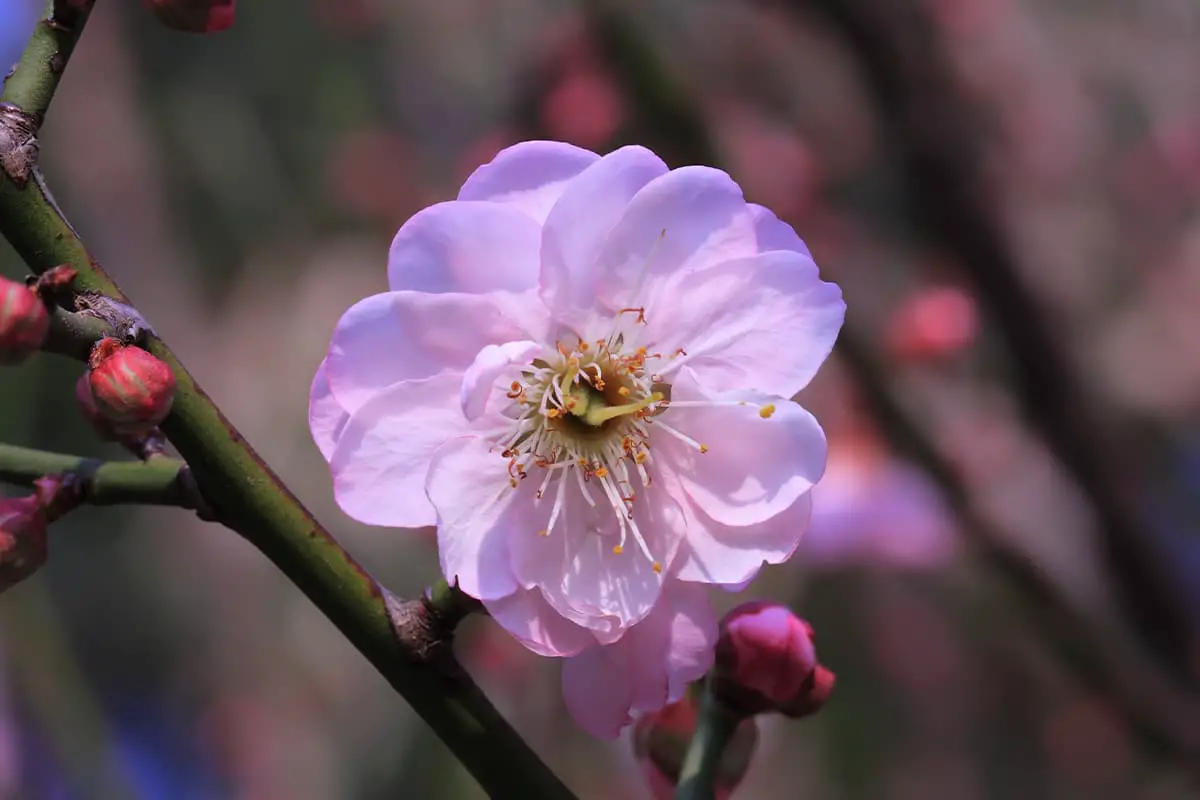
The flowers typically appear singly, blooming as the leaves unfurl. They measure 2.5-3.5 cm in diameter and have short stems. The calyx consists of 5 sepals fused at the base, forming a short, glabrous tube.
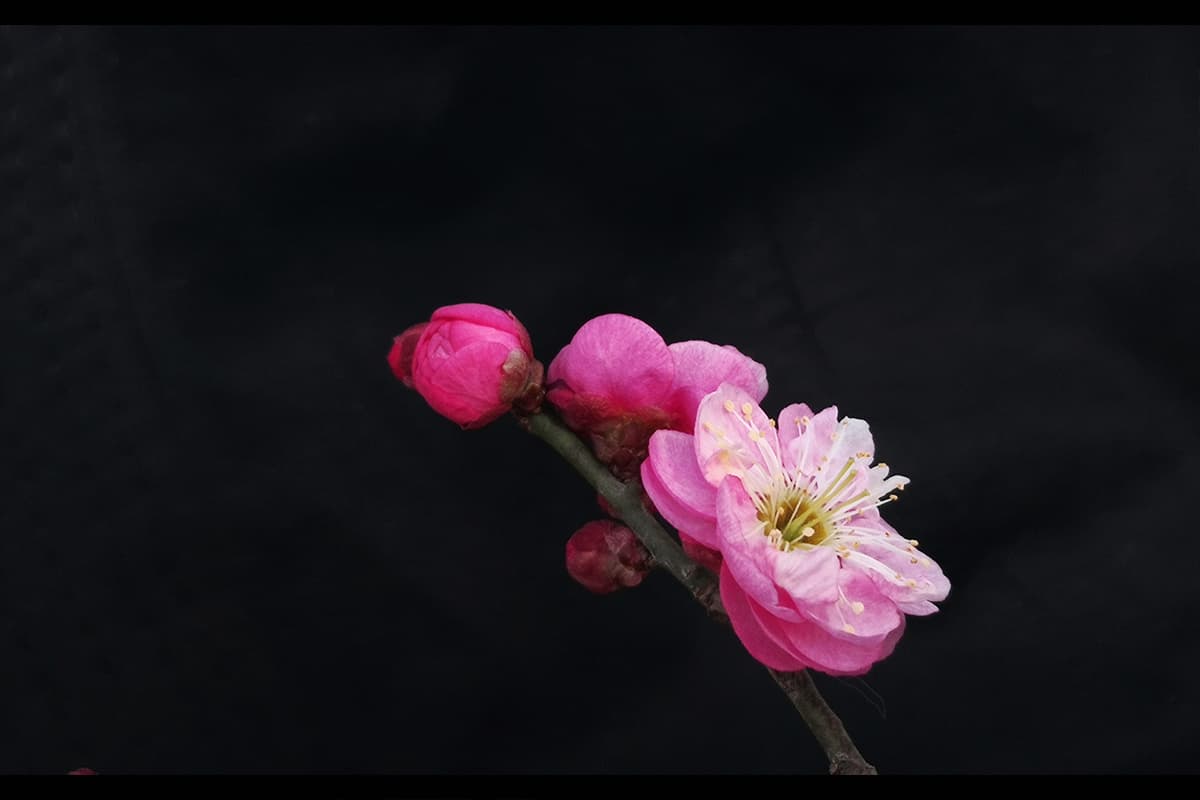
Peach blossoms come in various colors, including white, pink, and red, and can be single, semi-double, or double-petaled. They usually bloom from March to April, depending on the climate and variety.
The tree’s trunk is gray-brown with a rough texture and visible lenticels. Young twigs are red-brown or brown-green and smooth.
The fruit is a drupe, nearly spherical, with a yellow-green color and densely covered in short, velvety hairs. Ripening time varies by cultivar, typically occurring from June to September.
Growing Habits of Peach Blossom
Peach trees thrive in full sunlight and require good air circulation. They prefer well-drained, slightly acidic to neutral soil (pH 6.0-7.0) and are relatively drought-tolerant once established. However, they are highly susceptible to waterlogging, which can cause leaf drop or tree death if persisting for 3-5 days.
These trees are cold-hardy and can withstand winter conditions in East and North China. They perform best in light, loamy soil with moderate moisture levels. Peach trees are intolerant of alkaline or heavy clay soils.
While adaptable to various fertilizer regimes, peach trees have stronger growth and branching habits compared to plums. However, they have a shorter lifespan, typically declining after about 20 years. With proper care, peach trees can live for 20-40 years on average.
When Does the Peach Blossom Bloom?
Peach trees are precocious, often flowering and fruiting within 1-2 years after grafting. They reach peak production at 3-5 years of age. These fast-growing trees can produce 2-4 growth flushes annually.
The trees develop an extensive root system, particularly fine fibrous roots, which facilitates easy transplanting. Flower buds form in groups of 1-3 per node, with minimal stem development. Flowers and leaves emerge almost simultaneously, though leaves fully expand after flowering.
Most peach varieties produce flowers and fruits primarily on long fruiting branches. However, some cultivars, like “Shouxing Peach,” predominantly bloom and fruit on short and medium fruiting branches.
In the middle and lower reaches of East and North China, peach blossoms typically appear in mid to late March, with fruit ripening occurring from June to September, depending on the variety and local climate conditions.
Flower Language of Peach Blossom
In Chinese culture, peach blossoms are strongly associated with love and romance. The phrase “peach blossom luck” refers to the flowers’ perceived ability to bring romantic opportunities. Consequently, the symbolic meaning or “flower language” of peach blossoms is often interpreted as “the captive of love” or “romantic attraction.”
What Are the Varieties of Peach Blossoms?
Peach blossom varieties showcase a diverse range of colors, petal arrangements, and growth habits. Some notable varieties include:
Small white bi peach: Features small white flowers with elliptical petals and brown flower branches with green spots.
Large white bi peach: Exhibits larger white flowers with round petals and green, hairy flower branches.
Five-color bi peach (Gold-sprinkled bi peach): Displays a mix of white, pink, and bicolor flowers on the same tree.
Thousand-petal peach red: Characterized by pink flowers with multiple layers of petals and pink stamens.
Red bi peach: Produces pink, nearly double-petaled flowers on red-brown branches.
Crimson peach: Known for its deep red flowers and purple-brown, wrinkled calyx.
Green flower peach: Features light green petals and blooms later, typically in mid-April.
Weeping bi peach: Exhibits drooping branches with double-petaled flowers in various colors.
Other notable varieties include Shouxing Peach, Purple Leaf Peach, White Bi Peach, Single Pink, Pinxia, Five Treasure Peach, Zhao Shou Red, Green Sepal Weeping Branch, Two-color Peach, Chrysanthemum Peach, and Crimson Peach.
Differences between Peach Blossom and Plum Blossom
Peach blossoms (Prunus persica) and plum blossoms (Prunus mume) can be distinguished by several key characteristics:
Blooming periods: Plum blossoms, considered one of the “three friends of winter,” bloom in late winter to early spring. Peach blossoms follow later, typically blooming in early to mid-spring.
Colors: Plum blossoms exhibit a wider color range, including yellow, white, red, and pink. Peach blossoms are generally more vivid, predominantly pink with some white varieties.
Tree height: Peach trees are generally taller, reaching up to 8m, while plum trees typically grow to about 6m.
Trunk appearance: Peach tree trunks are rough and gray-brown, whereas plum tree trunks are smoother and light gray.
Leaf and flower emergence: Plum blossoms appear before leaf development, while peach blossoms emerge concurrently with or slightly after leaf growth.
Fragrance: Plum blossoms have a stronger, more pronounced fragrance compared to the subtler scent of peach blossoms.
Flower structure: Peach blossoms often have more petals and a fuller appearance than the typically simpler plum blossoms.
Branch structure: Peach trees tend to have a more spreading habit, while plum trees often have a more upright growth pattern.
By observing these differences in timing, appearance, and growth habits, one can more easily distinguish between peach and plum blossoms in gardens and landscapes.
Share
Facebook
Twitter
LinkedIn
Email
Share is Caring.
Peggie
Founder of FlowersLib
Peggie was once a high school mathematics teacher, but she set aside her chalkboard and textbooks to follow her lifelong passion for flowers. After years of dedication and learning, she not only established a thriving flower shop but also founded this blog, “Flowers Library”. If you have any questions or wish to learn more about flowers, feel free to contact Peggie.
Before you go
You May Also Like
We picked them just for you. Keep reading and learn more!
The cherry blossom, deeply adored and widely cultivated in Japan, is designated as the national flower of the country alongside the chrysanthemum, which symbolizes the royal family. The blooming period…
What flowers bloom all year round? What are some of the flowers that can bloom in every season? When cultivating flowers, we can enjoy their beauty for longer if their…
The blooming time of tulips varies depending on the variety and planting time. However, based on the growth habit and cultivation season of tulips, there is a general range. Here,…
When do the tulips bloom in the botanical garden? Tulips usually bloom from March to May, and the ones in the botanical garden typically bloom in March and April each…
It’s already winter in December, and although it’s a season when many plants enter dormancy, there are still some resilient flowers that bloom vibrantly despite the cold. Some well-known flowers…
April, according to the Gregorian calendar, is indeed a beautiful season characterized by lush vegetation, the return of migratory birds, and a profusion of blooming flowers. This period marks the…
What flowers bloom in winter? What blossoms unfurl their petals in the cold season? Who said that only spring is a time for flowers? There’s an array of flowers that…
As we usher in March, nature awakens from its winter slumber. The gentle spring breeze caresses the branches, coaxing dormant buds to unfurl their delicate petals. In Nanjing, the cherry…
Every January, despite the typically cold weather, certain hardy plants showcase their resilience by blooming during this winter month. In this article, we’ll explore ten types of flowers that flourish…


 English
  العربية
  Bahasa Indonesia
  Deutsch
  Français
  Italiano
  Nederlands
  Português
  Русский
  日本語
日本語