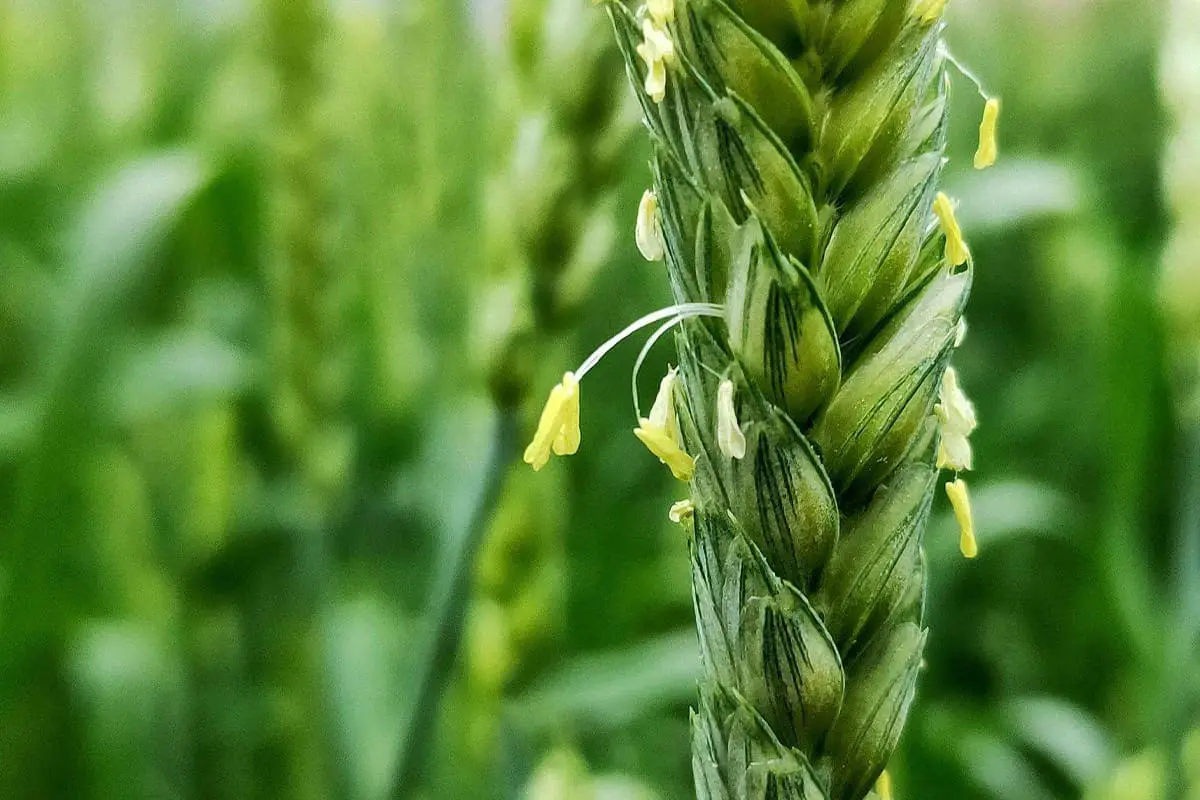
Wheat flowers are arranged in a compound spike inflorescence, commonly known as an ear of wheat. The ear consists of a spike axis and spikelets. The spike axis stands erect without branching, contains numerous nodes, and bears a single spikelet at each node.
Each spikelet comprises 2 glumes and 3 to 9 florets. The wheat flower is perfect (bisexual), consisting of 1 lemma, 1 palea, 3 stamens, 1 pistil, and 2 lodicules. Depending on the cultivar, some have awns on their lemmas, while others are awnless.
Morphology and Characteristics
The wheat flower’s structure is adapted for efficient self-pollination. The lemma and palea enclose and protect the reproductive organs. The three stamens produce pollen, while the single pistil contains the ovary with the potential to develop into a wheat kernel. The two lodicules, small scales at the base of the flower, play a crucial role in flower opening by swelling during anthesis.
Habitat and Behavior
Flowering habits
Wheat flowering, or anthesis, typically occurs 3 to 5 days after heading under normal temperature conditions. Late-heading wheat may flower 1 to 2 days after heading, or even on the same day in high-temperature conditions. Conversely, low temperatures can delay flowering by 7 to 8 days or more after heading.
Diurnal flowering patterns in wheat show peak activity in the morning, with reduced activity in the afternoon and minimal flowering in the early morning and evening. This pattern informs optimal timing for pollen collection and artificial pollination (morning) and emasculation of maternal lines (early morning or evening).
Individual wheat flowers generally remain open for 15 to 20 minutes. The entire ear completes flowering over 2 to 3 days, though some may take up to 8 days.
Flowering Sequence
Wheat exhibits a specific flowering sequence:
- Plant level: Main stem ears flower before tiller ears.
- Ear level: Middle spikelets flower first, followed by upper and lower spikelets.
- Spikelet level: Basal florets bloom before upper florets.
This sequential flowering pattern helps ensure successful pollination and seed set across the plant.
Pollination Method
Wheat is predominantly self-pollinating, with a natural outcrossing rate typically below 1%. However, this rate can vary depending on environmental conditions and cultivar characteristics.
Factors influencing outcrossing rates include:
- Temperature and humidity: High temperatures or drought during flowering can increase outcrossing rates.
- Pollen viability: Wheat pollen remains viable for only a few hours, especially under adverse conditions.
- Stigma receptivity: The stigma often remains receptive longer than pollen remains viable, potentially allowing for cross-pollination if conditions improve.
- Floral morphology: Some wheat varieties have larger glume openings and longer flower opening times, increasing the chance of natural hybridization.
Understanding these flowering and pollination characteristics is crucial for wheat breeding programs and maintaining genetic purity in seed production. The limited window of pollen viability and the predominance of self-pollination have shaped wheat’s evolutionary history and continue to influence modern breeding techniques.


 English
  العربية
  Bahasa Indonesia
  Deutsch
  Français
  Italiano
  Nederlands
  Português
  Русский
  日本語
日本語