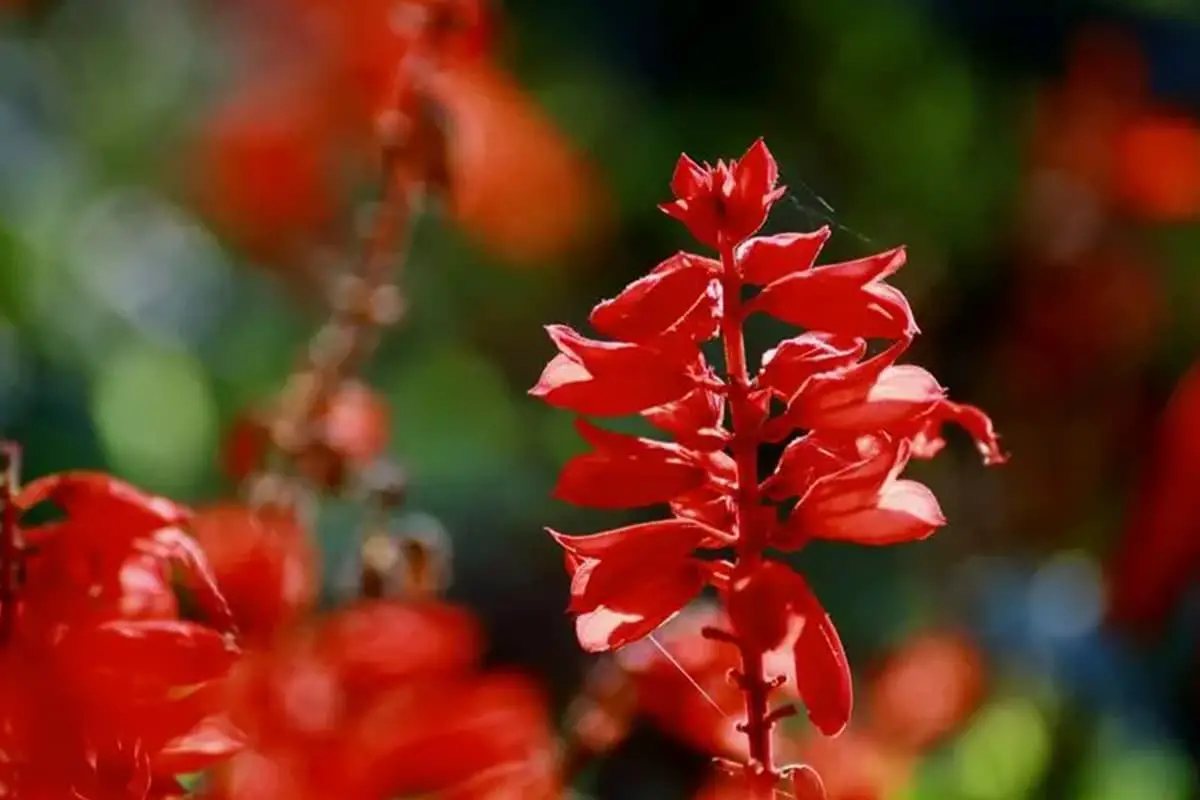
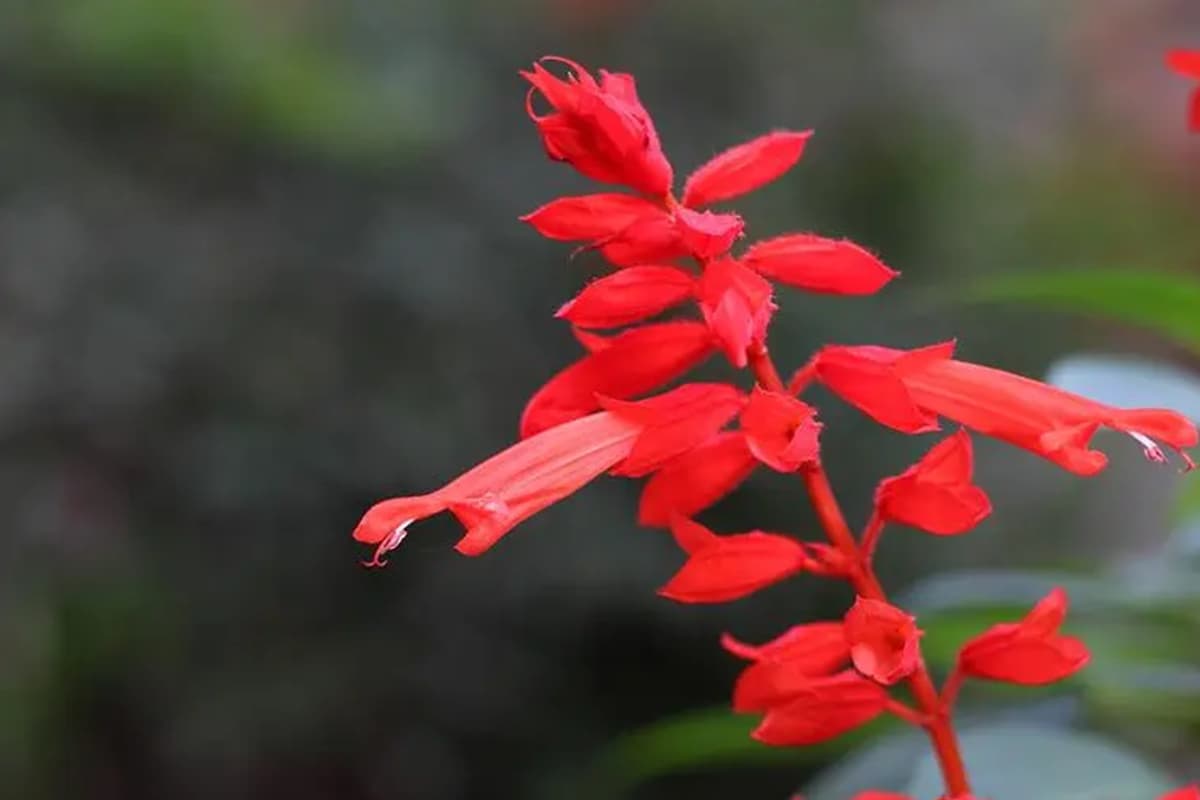
Salvia splendens also known as Firecracker Red, or Ivory Red, is a species of the mint family, characterized by its elongated, bright red inflorescences and prolonged blooming period.
This adaptable plant is one of the most commonly cultivated herbaceous flowers in Chinese cities and gardens. Its whorled inflorescences bear 2-6 flowers, forming a terminal raceme that can exceed 20 centimeters in length.
The bracts are ovate, red, and large, enveloping the flower buds before they bloom, tapering to a caudate tip.
The small nutlets are ellipsoidal, about 3.5 millimeters long, dark brown, with irregular, sparse corrugations at the top and narrow wings along the edges or ridges, with a smooth surface.
Native to Brazil, it is widely cultivated throughout China, preferring warm and sunny environments. It is not frost-hardy but can tolerate partial shade, and is sensitive to frost, high temperatures, waterlogging, and alkaline soils.
Scarlet Sage is commonly used for its red-flowered varieties which, during the crisp autumn season, bloom profusely with vivid colors.
It is often used as the main plant material for flower clusters and beds, as well as in ribbon or natural-style plantings at forest edges.
It pairs beautifully with pale yellow canna lilies, dwarf marigolds, light blue or powder blue water poppies, green chrysanthemums, and dwarf globe thistles in garden compositions.
I. Morphological Characteristics
Scarlet Sage is a sub-shrubby herbaceous plant that can reach up to 90 centimeters in height. Its stems are bluntly quadrangular with shallow grooves and hairless.
The leaves are ovate or triangular-ovate, measuring 2.5-7 centimeters long and 2-4.5 centimeters wide, tapering to a pointed tip, with the base either truncate or rounded, seldom blunt, and serrated along the edges.
The upper surface is green, while the underside is paler with glandular dots, and both sides are hairless. The petioles of the stem leaves are 3-4.5 centimeters long and hairless.
The whorled inflorescences each have 2-6 flowers and form a terminal raceme that can be over 20 centimeters long. The bracts are ovate, red, and large, enclosing the flower buds before they open, tapering to a caudate tip.
The pedicels are 4-7 millimeters long, densely covered with glandular soft hairs tinged with red, and the rachis is minutely soft-haired.
The calyx is bell-shaped, red, about 1.6 centimeters long when the flower opens, enlarging to 2 centimeters after flowering, with glandular soft hairs along the veins on the outside and slightly stiff hairs in the upper half inside.
The calyx is bilabiate, with the upper lip triangular-ovate, 5-6 millimeters long and 10 millimeters wide, ending in a small point, and the lower lip slightly longer than the upper with a deep, 2-lobed cut and triangular lobes tapering to a point.
The corolla is red, 4-4.2 centimeters long, with soft hairs on the outside and hairless inside.
The corolla tube is cylindrical, extending straight and slightly enlarged at the throat, with the bilabiate limb having an erect, slightly inward-curved upper lip that is oblong, 8-9 millimeters long, and about 4 millimeters wide, with a slightly notched tip.
The lower lip is shorter than the upper, with 3 lobes, the central lobe semicircular and the lateral lobes elongate-ovate, longer than the central one.
There are two fertile stamens, almost exserted, with filaments about 5 millimeters long and anther partitions about 1.3 centimeters long, nearly straight, with arms of nearly equal length; the upper arm’s anther lobe is developed, while the lower is sterile and robust, not fused.
The staminodes are short and small. The style is nearly as long as the corolla, with unequally bifurcated tips, the front lobe being longer. The nectary disc is uniform in size.
The small nutlets are ellipsoidal, about 3.5 millimeters long, dark brown, with irregular, sparse corrugations at the top and smooth narrow wings along the edges or ridges.
II. Distribution Range
Scarlet Sage is native to Brazil and is widely cultivated throughout China.
III. Habitat Preferences
Thriving in sunlight and tolerating partial shade, Scarlet Sage prefers loose, fertile, and well-drained sandy loam soil. It is highly sensitive to soil treated with methyl bromide and alkaline soil conditions, growing best in soil with a pH ranging from 5.5 to 6.0.
It has poor cold tolerance, with an optimal growth temperature between 20-25 degrees Celsius. Growth halts below 15 degrees Celsius, and leaves wither and fall off below 10 degrees Celsius.
IV. Growth and Propagation
Scarlet Sage is propagated mainly by sowing seeds or stem cuttings, with sowing being more common. In North China, sowing can occur anytime, while spring is preferred in other regions.
Blooming occurs late for spring-sown plants, around September to October. To advance the blooming period or harvest seeds, seeds should be sown in a greenhouse or warm bed in early March.
A small amount of base fertilizer is added to the seedbed, which is then leveled and soaked with water. After the water seeps away, seeds are sown and covered with a thin layer of soil, germinating in 8 to 10 days.
Flowers bloom about 100 days after planting and last for approximately two months. For stem cuttings, tender branches are used, preferably from March to May or September to October, in conjunction with pinching the tips.
V. Disease and Pest Control
When growing Scarlet Sage in a greenhouse, high temperatures, high humidity, or insufficient light can lead to rot diseases, so temperature control and air circulation are critical.
Additionally, Scarlet Sage is prone to pests like red spider mites and aphids. A preventive measure is to spray with a 1500-fold dilution of dimethoate emulsion.
VI. Main Value
Ornamental Value
The Scarlet Sage is commonly cultivated for its vibrant red flowers, especially during the crisp autumn season. It is a principal choice for flower clusters and beds.
It can also be planted in strip beds or naturally along the edge of forests, often paired with pale yellow cannas, dwarf marigolds, light blue or baby pink water lilies, chrysanthemums, or dwarf globe thistles.
Dwarf varieties of Scarlet Sage are particularly suitable for flower beds, and while the white varieties pair well with red for aesthetic appeal, generally, the ornamental value of white and purple varieties is not as high as the red ones.
VII. Plant Culture
The floral language of Scarlet Sage: Red represents the heart in love, white symbolizes vitality, and purple stands for wisdom.


 English
  العربية
  Bahasa Indonesia
  Deutsch
  Français
  Italiano
  Nederlands
  Português
  Русский
  日本語
日本語