The Red Sun Lotus is a perennial aquatic herb and one of the varieties of the lotus flower. It is named for its vibrant red color, reminiscent of the “reddest sun.” This medium-sized variety features round, shield-shaped leaves with slightly wavy edges, smooth surfaces, and a white powdery substance.
The erect leaves are 27 cm high, with a diameter of 25 cm. The flower stem is 40 cm high, and the flower diameter is 15 cm.
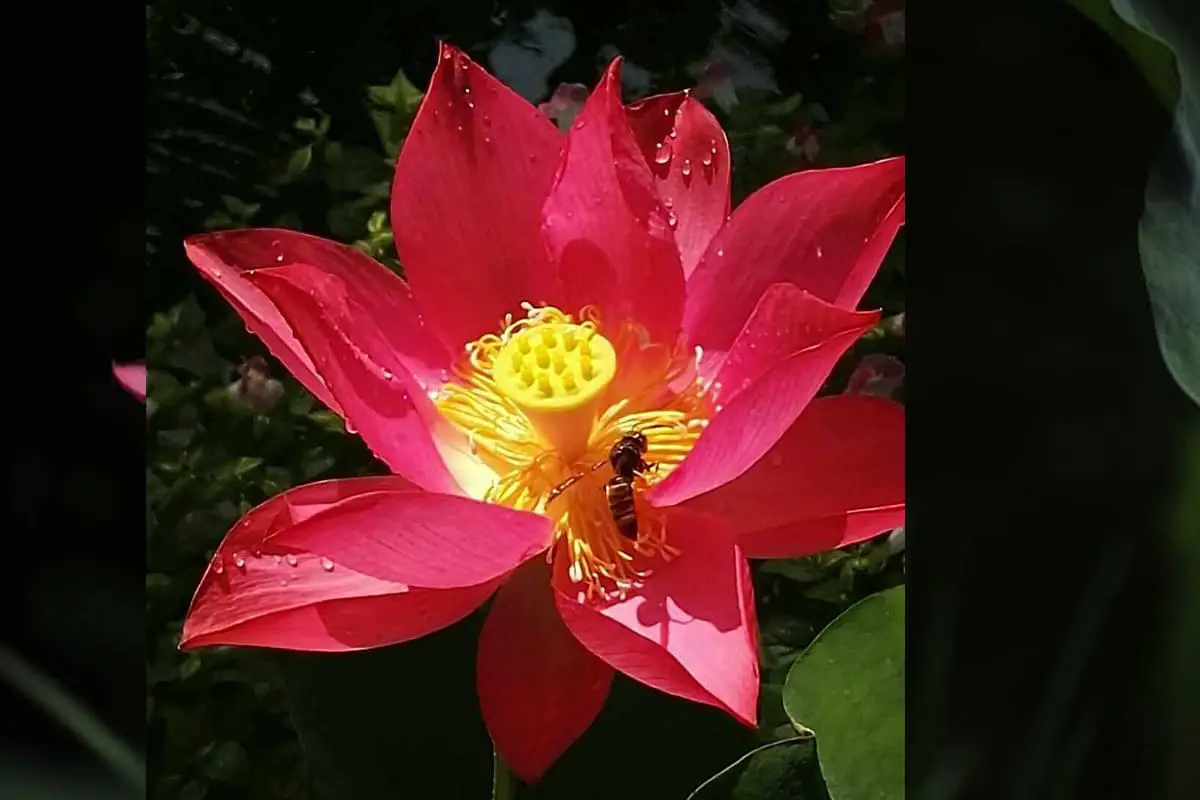
The flower is a double-petal type, with 72 petals that can be red, pink, or white. The petals are rectangular elliptical to inverted egg-shaped. The flower has a bowl shape, and the bud is elongated peach-shaped and deep purple-red.
While the stamen has a few changes in petals, the pistil is normal, but the fruit setting rate is relatively low. The flowering period is from June to August, and the fruiting period is from August to October.
Basic Introduction
The Red Sun Lotus is a variety of lotus flower. It is a perennial aquatic herb with a horizontally growing rhizome that is thick and bulbous between the nodes. It has a large number of longitudinal air passages and grows fibrous adventitious roots downwards.
The leaves are round and shield-shaped, with a smooth surface and white powder. The thick and stout leaf stalk is cylindrical and hollow. The flower is a double-petal type with 72 petals.
The flower has a bowl shape, and the bud is elongated peach-shaped and deep purple-red. The flower is bright red, hence the name derived from the “reddest sun.”
The Red Sun Lotus is an aquatic plant that thrives in relatively stable, calm shallow water, lakes, marshes, and ponds. It loves sunlight and requires full sun during its growth period.
The lotus is extremely intolerant of shade, demonstrating strong phototropism in semi-shaded areas. This cultivated variety is often used in parks and courtyards for ornamental purposes.
Form and characteristics
The Red Sun Lotus is a perennial aquatic herb. Its rhizome grows horizontally and is thick and bulbous between the nodes. It has many longitudinal air passages. The node part is constricted, with black scale leaves growing above and fibrous adventitious roots growing below.
The leaves are round and shield-shaped, measuring between 25-90 cm in diameter. They have slightly wavy edges, a smooth surface, and white powder. The under-side of the leaves has veins radiating from the center, with 1-2 times fork-like branches.
The flowers are beautiful and fragrant, with a diameter of 10-20 cm. The petals can be red, pink, or white. They are rectangular elliptical to inverted egg-shaped, measuring 5-10 cm in length and 3-5 cm in width.
The stamen has a few petal changes, while the pistil is normal, but the fruit setting rate is relatively low. The flowering period is from late June, with fewer flowers, making it suitable for pot planting. The leaves are rather green.
Growth habits
The Red Sun Lotus is planted in ponds or paddy fields. It is an aquatic plant that thrives in relatively stable, calm shallow water, lakes, marshes, and ponds.
The water requirement of the lotus depends on its variety. Large plant varieties require a relatively deep water level, but it should not exceed 1.7 meters. Medium and small plant shapes are only suitable for water depths of 20-60 cm. At the same time, the lotus is very sensitive to water loss.
In the summer, just 3 hours without watering will cause the leaves of the potted lotus to wilt. If water is stopped for a day, the edges of the lotus leaves will scorch, and the flower buds will wither.
The lotus also loves sunlight and requires a full sun environment during its growth period. The lotus is extremely intolerant of shade, showing strong phototropism in semi-shaded areas.
Cultivation Method
Water and Fertilizer Management
Lotus is an aquatic plant that requires water throughout its growth period. In the early stages, the water layer should be controlled at about three centimeters, as too much water can hinder the warming of the soil.
If using tap water, it’s best to store it in a separate container and let it sit for a day or two before use. Summer is the peak growth period for lotus, and the pot should never lack water.
After winter, the soil in the pot should be kept moist to prevent the lotus roots from drying out due to lack of water.
The fertilizer for lotus mainly consists of phosphorus and potassium, supplemented by nitrogen. If the soil is fertile enough, it is not necessary to fertilize throughout the year. Well-rotted cake fertilizer or poultry manure is the ideal fertilizer.
A small pot requires half an ounce, and a large pot can take up to one or two ounces at most. Do not over-fertilize, and make sure to mix the fertilizer thoroughly with the soil.
If the leaves turn yellow and weak during the peak growth period, mix 0.5 grams of urea in the soil, form it into a ball of about 10 grams, and apply one per pot into the center of the soil. The effect can be seen within seven days.
Winter Management
After winter, the pot can be moved indoors or buried beneath the frost layer. In areas north of the Yellow River, in addition to burying it below the frost layer, you should also cover it with agricultural film and keep the soil in the pot moist throughout the winter.
Propagation Methods
Seed Propagation
First, the seed shell must be broken. In May and June, grind the concave end of the seed on a cement floor or rough stone, then soak the seed for germination. The water must be kept clean, changed frequently, and after about a week, the seed will sprout.
After two weeks, transplant the seedlings, allowing one per pot. The water should be shallow, and the lotus leaves should not be submerged. About 90% of the seeds will flower the first year, but the blooms will be few.
Propagation by Division
The best time to transplant the lotus is from mid-March to mid-April. If planted too early, the seed lotus may be affected by cold currents and could freeze. In northern areas, you can cover the lotus with transparent agricultural film when a cold current is expected.
Before planting, mix the pot soil into a paste. When planting, insert the top of the seed lotus at a 20-degree angle into the soil along the edge of the pot. For bowl lotus, it should be about 5 cm deep.
For large lotus, it should be about 10 cm deep, with the head lower than the tail. Lift the tail halfway up to avoid water entering the tail. After planting, place the pot under the sun to allow the surface soil to crack slightly, promoting the full adhesion of the seed lotus and soil.
Then add a small amount of water, gradually deepen the water level as the buds grow, and finally maintain a water layer of 3-5 cm. For pond planting, the initial water level is the same as a potted lotus, but later, the level should not submerge the lotus leaves.
Value and Other Uses
Lotus root is an excellent vegetable and candied fruit. Lotus leaves, flowers, and stamens are also beloved dietary supplements in China.
The food culture of lotus is rich and diverse, with traditional dishes like lotus seed porridge, preserved lotus seeds, lotus root stuffed with meat, lotus leaf steamed meat, and lotus leaf porridge. The leaves can be used as a substitute for tea and as a packaging material.
Lotuses have a strong adaptability to their growing environment. They can thrive not only in large and small lakes and ponds, displaying their vibrant colors, but also in small pots and bowls, enhancing the ambiance.
Cultivated varieties, often grown in pots, are popular for viewing in parks and courtyards.


 English
  العربية
  Bahasa Indonesia
  Deutsch
  Français
  Italiano
  Nederlands
  Português
  Русский
  日本語
日本語