The Paeonia suffruticosa cv. ‘Luoyang Red’ is an exquisite and valuable peony variety, also known as Jiao Bone Peony or Purple Er Qiao.
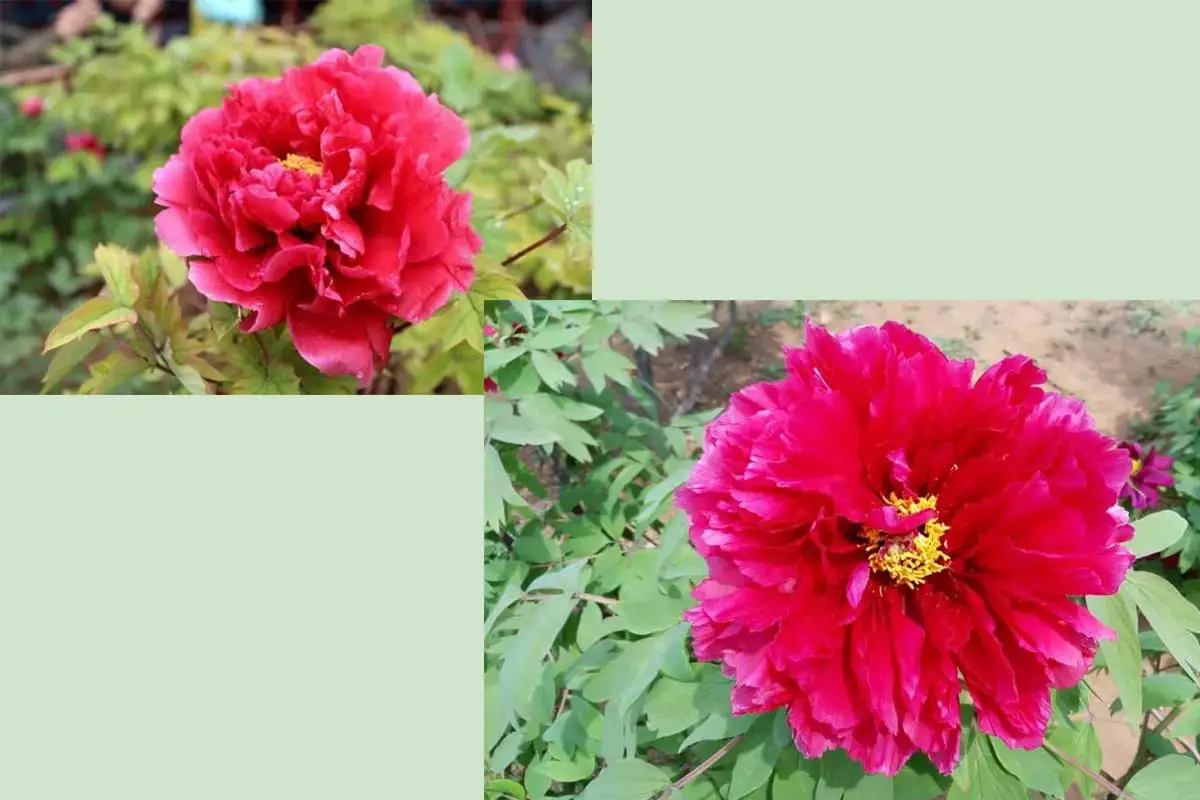
This plant is large, with green leaves, purple flowers, and yellow stamens. The blooms are rose-shaped or chrysanthemum-shaped, demonstrating vigorous vitality and strong adaptability.
It is often referred to as the “ancestor of Luoyang peonies”. The flowers are vibrant purple-red, a prolific variety that can produce hundreds of flowers per plant, fully adorned, earning it the nickname “New Flower Queen”.
I. Basic Introduction
Paeonia suffruticosa cv. ‘Luoyang Red’ is a peony variety, a deciduous shrub. The plant is tall, upright, with thin and stiff branches.
The leaves are broad ovate, green on the surface, hairless, pale green on the back, sometimes with white powder, sparsely short soft hair along the veins or nearly hairless.
The flower is borne at the top of the branch, with 5 bracts of varying sizes; 5 green, broad ovate sepals of different sizes; rose-shaped flowers. The flower buds are round and pointed. The flowers are purple-red and glossy.
The filaments are white at the top, the anthers are elongate, the flower disk is leathery, cup-shaped, and purple-red; the pistils are densely soft-haired. The fruit is elongated, densely covered with yellow-brown hard hair. Flowering period is in May; fruiting period in June.
II. Morphology and Characteristics
Luoyang Red Peony is a deciduous shrub. The plant is tall, upright. The branches are thin and hard, with long year-old branches and long internodes; the scale buds are round and pointed.
Medium-long leaves, hard; broad ovate, 7-8 cm long, 5.5-7 cm wide, green on the surface, hairless, pale green on the back, sometimes with white powder, sparsely short soft hair along the veins or nearly hairless, total leaf stalk about 12 cm long, obliquely extending; lateral small leaves ovate, with many notches, gradually pointed at the end, green leaf surface.
The flower is rose-shaped. The flower buds are round and pointed. The flowers are purple-red and glossy; the diameter is 17 cm x 9 cm.
The petals are multi-layered and hard, neatly arranged, with dark purple spots at the base; some of the stamens often show petalization; the pistils are many and small, the ovary is dark purple-red, occasionally fruiting.
The flower stem is long and hard, and the flower is straight up. Mid-flowering variety.
III. Habitual Behavior
The Luoyang Red peony thrives with a high rate of flowering and abundant sprouting branches. It prefers warm, cool, dry, and well-lit environments.
While the plant enjoys sunlight, it can also tolerate semi-shade, cold, drought, weak alkali, and dislikes waterlogging. It is sensitive to heat and direct sunlight. It grows best in loose, deep, fertile, elevated, well-drained neutral sandy loam.
Poor growth is observed in acidic or heavy clay soils, with a pH value of 6.5-7 being ideal. The plant benefits from ample sunlight, but cannot withstand intense summer sun.
Temperatures above 25℃ will cause the plant to enter a dormant state. The optimal temperature for blooming is 17-20℃.
IV. Cultivation Method
Planting: The soil should be loose, fertile, and neutral to slightly alkaline. Remove broken or diseased roots from the peony seedlings, immerse in insecticide and fungicide, then place in a prepared pot or hole.
The roots should be spread out, and the soil filled to cover half of the pot or hole. Shake the seedling slightly to settle the soil, which should be slightly lower than the pot rim or ground level.
Watering: Thoroughly water the plant after planting. Peonies dislike waterlogging and should be watered as necessary during the growing season. In northern arid regions, water before and after flowering, and before the ground freezes.
After the flowers have bloomed, remove the spent flowers and bury the pot in the ground for easier management.
Applying Fertilizer: After a year of planting, apply fertilizer in the fall, primarily using mature organic fertilizer. This can coincide with loosening the soil, and the fertilizer can be spread or placed in holes.
In spring and summer, use chemical fertilizer, applying it with watering before and after flowering. For potted plants, apply liquid fertilizer with watering.
Pruning: In the first year of planting, cut back the shoots. After sprouting in the spring, leave around five branches and remove the rest to concentrate nutrients and ensure vibrant flowers the following year.
In autumn and winter, remove spent flowers, weak branches, and branches without flowers when tidying the garden. For potted plants, prune to achieve a desired shape.
Cultivating: During the growing season, weed and watch for diseases and pests. In autumn and winter, turn the soil around peonies that are two years or older.
Repotting: After a potted peony has grown for three or four years, repot it into a larger pot with fresh soil or divide it in the fall.
Pesticide Application: Apply a sulfur compound spray before buds appear in early spring, and use an insecticide-fungicide mix in summer, depending on disease conditions, every two weeks. Also, apply a chemical fertilizer and growth regulator with the pesticide.
Forcing Blooms: To time blooms with festivals or celebrations, increase the temperature around the peony about 50 days before the event. Maintain a daily average of around 15℃, and a constant range between 10-25℃.
Keep the plant moist in the early stages, ensure ventilation and light exposure after buds appear, and control temperature after buds form, according to the flowering period.
Regularly apply foliar fertilizer and ensure sufficient water supply. This way, flowers can be seen in both winter and spring.
Viewing: A single peony plant blooms for around 10-15 days, shortening as the temperature rises. At 3-8℃, it can last for a month. For field planting, temporary shelters can be built to block wind and light, prolonging the viewing period.
Potted plants should be moved to places where direct sunlight, temperatures of 5-10℃, and ventilated environments are available. Water as needed, depending on the plant’s appearance and soil moisture.
Avoid watering the flowers to prolong the flowering period. When cutting flowers, cut the stem underwater or cauterize the wound. To prolong the vase life of cut flowers, add preservative or a little sugar to the water.
V. Propagation Methods
Division
The specific method of propagation by division involves digging up a flourishing peony plant and separating it at the junction of the root system. The number of sub-plants divided from each plant depends on the size of the original plant, with larger plants being divided more and smaller plants less.
Generally, every 3-4 branches constitute a sub-plant, and it has a relatively complete root system. Then, a small amount of sulphur powder and mud is used to smear and rub evenly over the wounds on the roots, and it can then be planted separately.
The time for propagation by division is between the autumnal equinox and frost season each year, and it’s best to do it in a timely manner.
At this time, the temperature of the air and soil is relatively high, the peony is in a semi-dormant state, but there is still a quite long period of nutritional growth.
The impact of dividing and planting on root growth is not too serious, and some new roots and a small number of plant buds can still grow after division and planting.
If the division and planting are too late, the root growth will be weak that year, or new roots will not occur. The following spring, the plant growth will be weaker, and if the roots are weak, they will not be drought-resistant and are likely to die.
If division is too early, the high air and soil temperatures can promote rapid growth, which can easily lead to autumn sprouting.
The mother plant of peony division is usually a robust plant cluster. The mother plant used for propagation by division should retain as many root tubers as possible, and all the roots on the new shoots should be retained for growth.
After 5 years, more new shoots can be divided. Such plant seedlings are easy to survive after planting, and the growth is also more vigorous. The more roots are retained, the more vigorous the growth.
Cutting
Propagation by cutting is a method of propagating new plants using the ability of peony branches to easily produce indeterminate roots. It is one of the asexual propagation methods.
The method involves cutting the branches for cutting first, separating them from the mother plant, and then inserting them into the soil or other substrates to root and become new plants.
The branches for cutting propagation of peonies should be selected from the current year’s soil bud branches issued from the root of the peony, or stem branches that are full and free of pests and diseases selected during the shaping and pruning of the peony.
These branches should be 10-18 centimeters long. Peony roots are fleshy roots that prefer dry conditions, dislike dampness, and are drought-resistant.
Therefore, the nursery bed should be located in a well-ventilated and sunny place, and be a raised bed nursery. When cutting, water is applied after each row is inserted, watering thoroughly each time.


 English
  العربية
  Bahasa Indonesia
  Deutsch
  Français
  Italiano
  Nederlands
  Português
  Русский
  日本語
日本語