600+ Types of Flowers A To Z (With Names and Pictures)
Types Of Flowers By Names (A-Z) Types Of Flowers By Color Types Of Flowers By Season Types Of Flowers By Blooming Time 600+ Types of Flowers No. Flower Name No.…

The Lavandula pinnata is a shrub from the Lavender family, standing 30-100 cm tall. It has bi-pinnate deeply lobed leaves that are grey-green in color.
The plant spreads out and blooms deep purple tubular flowers with darker lines, featuring two-lipped petals with the upper lip more developed than the lower.
While the leaves carry a pleasant fragrance, the flowers are scentless. It blooms all year round, but its main flowering period is from November to May or June of the following year. During summer, if the weather becomes too hot, it ceases blooming and enters dormancy.
Originally from the Canary Islands, it is widely cultivated around the world. It thrives in full sunlight but needs shade during the summer. It has a good heat tolerance, but requires good drainage and sunlight. It’s semi-hardy in nature.
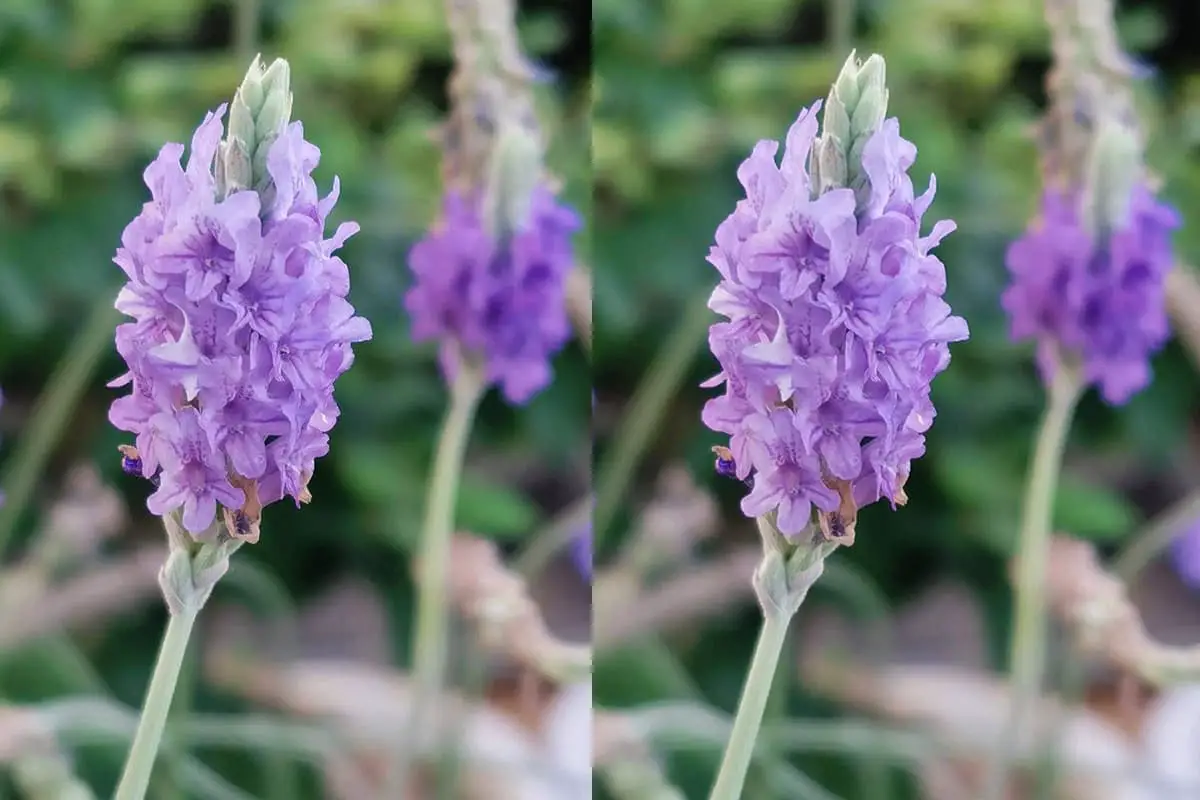
Feathered Lavender plants are often used in landscaping, placed amongst trees and shrubs as ground cover, transition zones for lawns, along roadsides, garden squares, and other such environments. They contribute to a visually pleasing aesthetic.
The Lavandula pinnata is a perennial herb, standing 30-100 cm tall. The whole plant is densely covered with white fuzz. The leaves are bi-pinnate, deeply lobed, and covered with a powdery substance giving them a grey-green appearance.
The plant spreads outwards, with leaves that are linear or inverted lanceolate shaped. The leaves are deeply lobed, giving them a feathery appearance.
The flower stems are long, with inflorescences around 10 cm, and are purplish-red in color. The upper lip of the small flowers is larger, and the base of the flower spike grows a pair of branched spikes, giving it a trifurcate appearance.

The deep purple tubular flowers have darker lines, and two-lipped petals, with the upper lip more developed than the lower. Its fragrance is a strong mix of geranium and rosemary, but it also has a heavy undertone.
While the leaves carry a pleasant fragrance, the flowers are scentless. It blooms all year round, but its main flowering period is from November to May or June of the following year.
During summer, if the weather becomes too hot, it ceases blooming and enters dormancy.
Feathered Lavender and Pinnate Lavender are quite similar. The main distinctions lie in the fact that Feathered Lavender has a more upright plant habit suitable for pot cultivation, with shorter fuzz on its leaves and less noticeable bi-pinnate leaves.
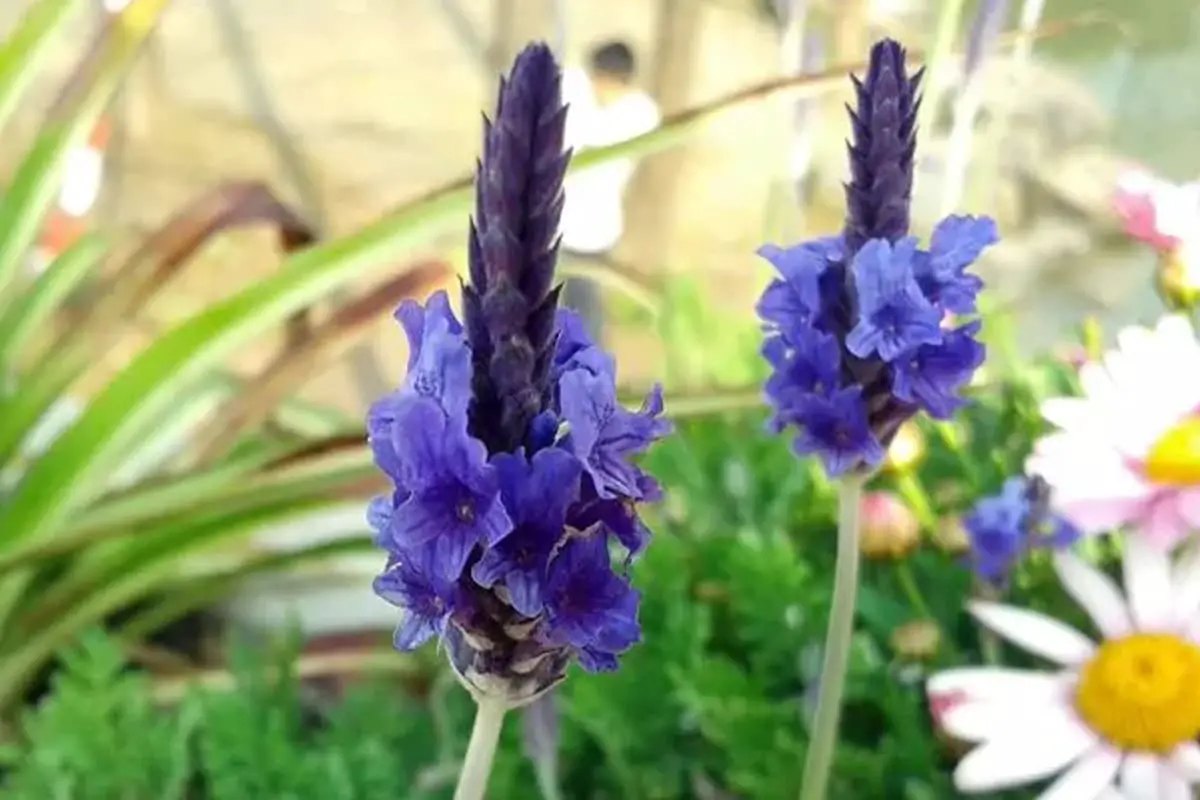
On the other hand, Pinnate Lavender has a plant habit that leans upwards and is more suitable for beautifying courtyards. It has longer fuzz on its leaves and its bi-pinnate leaves are more noticeable.
Feathered Lavender originates from the Canary Islands and is widely cultivated worldwide. It’s a full sun plant that requires good sunlight exposure. It grows poorly in shaded areas but needs to be shaded during the summer.
It’s robust, heat-tolerant, semi-cold resistant, and prefers well-ventilated conditions. A sandy loam soil rich in organic matter is optimal for its cultivation.
Cultivation conditions: The stem segments of annual branches of the Feathered Lavender are used as explants. The basic medium is MS medium, which contains 30 grams/liter of sucrose, 9 grams/liter of agar powder, with a pH value of 5.78-5.8.
The culture room temperature is (25±2)℃, the light exposure time is 12 hours/day, and the illumination intensity is 25-30 micromoles/square meter/second.
Cultivation methods:
Transplantation: When the root of a test tube seedling reaches approximately 0.5 centimeters, move the culture bottle to the greenhouse for seedling hardening for three days. Then, open the bottle cap and continue the hardening process for another 2-3 days.
Remove the seedling, wash away the culture medium from the root with clean water, and transplant it into a mixed substrate of grass charcoal, perlite, and vegetable garden soil at a volume ratio of 1:1:1. After transplanting, spray with a 1000-fold liquid of 50% Carbendazim wettable powder.
Maintain a temperature of 20-30°C and a relative humidity of 60-80% in the greenhouse. After three weeks, water and ventilate normally, gradually transitioning the seedling from artificial control conditions to natural environmental conditions.
Light: Feathered Lavender is robust. Excessive light can cause lignification, but this is less obvious than other varieties.
Temperature: In winter, protection is needed below -5°C. It does not tolerate heavy snow.
Placement: Usually placed in a ventilated area, there is a risk of sudden death if placed indoors or in a damp place in summer.
Cultivation Season: In southern China, the high temperatures and heavy rainfall after May each year are generally not conducive to the growth of lavender. Feathered Lavender is easy to grow in the fall, winter, and spring, so it is less commonly planted in summer.
If it is placed under a rainproof plastic cloth and slightly shaded environment in summer, the plant can still grow well and bloom. For a full and symmetrical plant shape, moderate pruning is needed.
Feathered Lavender has a very high flowering rate and a long flowering period. Continuous flowering between mature plants often forms a vast sea of purple flowers, creating a beautiful scene.
It is a popular ornamental plant in Europe and has become an indispensable landscape plant in some leisure farms or herb restaurants in southern China.
Placed in trees, shrubs as ground cover, transitional zones of lawns and roadside, garden squares, and other environments such as flower beds, flower belts, flower clusters, etc., it has a good ornamental effect.

Peggie was once a high school mathematics teacher, but she set aside her chalkboard and textbooks to follow her lifelong passion for flowers. After years of dedication and learning, she not only established a thriving flower shop but also founded this blog, “Flowers Library”. If you have any questions or wish to learn more about flowers, feel free to contact Peggie.
 English
  العربية
  Bahasa Indonesia
  Deutsch
  Français
  Italiano
  Nederlands
  Português
  Русский
  日本語
日本語