The Prunus triloba, commonly known as the Flowering Almond or ‘Little Peach Red’, is aptly named for its elm-like leaves and flowers that closely resemble plum blossoms. This ornamental shrub or small tree typically reaches a height of 2-3 meters, characterized by spreading branches adorned with numerous short twigs.
The young branches exhibit a grayish-brown hue and may be glabrous or slightly pubescent. Winter buds are small, measuring 2-3 millimeters in length, with purplish-brown scales. The leaves are broad elliptical to ovate, with a distinctive trilobed apex and margins featuring irregular, coarse serrations.
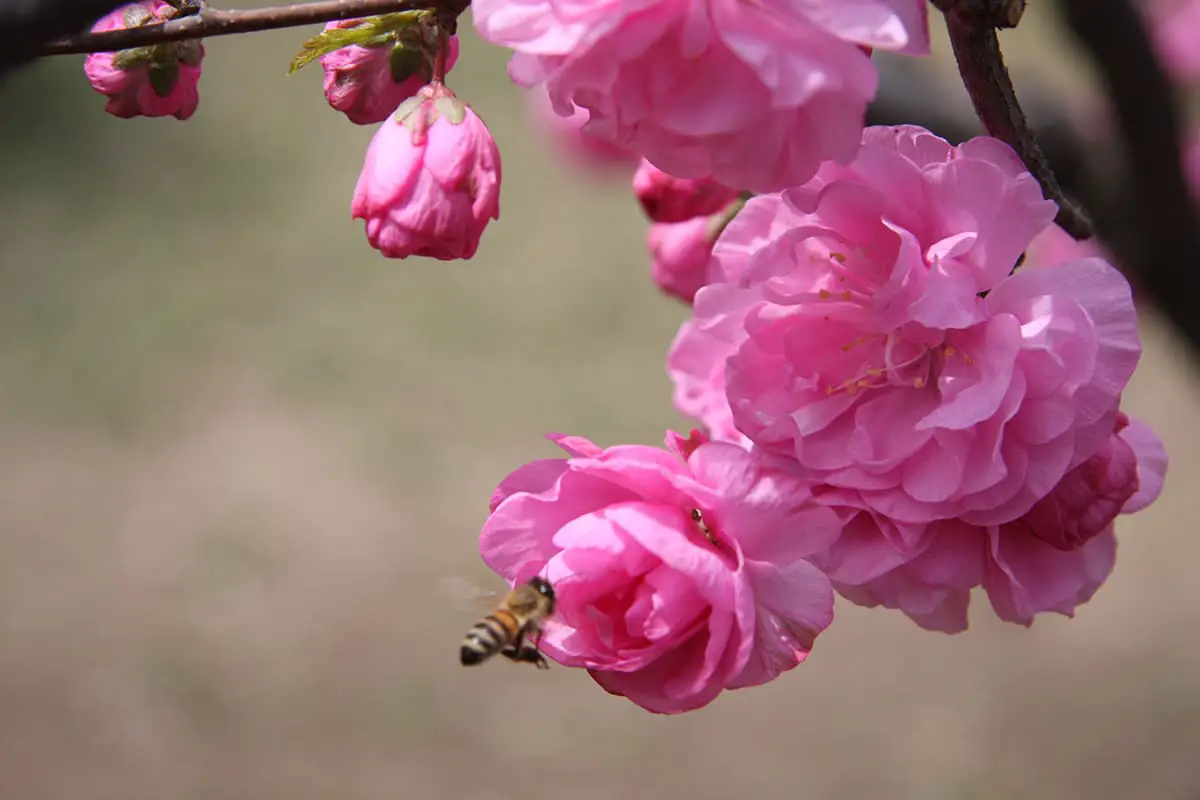
Flowers of the Prunus triloba range from single to double-petaled forms, displaying a captivating purplish-red color. They typically appear in clusters of one to two per leaf axil, blooming in April before the leaves emerge. The fruit is a red, subglobose, and pubescent drupe.
While various cultivars exist, the double-flowered form of Prunus triloba is most commonly cultivated for ornamental purposes. Beyond its aesthetic value, this species also holds medicinal significance. The seeds are traditionally used to alleviate dryness, lubricate the intestines, reduce flatulence, and promote diuresis. The branches are employed in treating jaundice and urinary difficulties.
I. Morphological Characteristics
Leaf arrangement on Prunus triloba varies depending on branch age. Short branches often bear clustered leaves, while year-old branches display alternate leaf arrangements. The leaves measure 2-6 cm in length and 1.5-3 (4) cm in width.
Leaf morphology is characterized by short, gradually tapering tips, often trilobed, with a broad cuneate base. The adaxial surface is sparsely pubescent or glabrous, while the abaxial surface is covered with short, soft trichomes. Leaf margins exhibit coarse or double serrations. Petioles measure 5-10 mm in length and are pubescent.
Flowers, appearing in groups of one to two, precede leaf emergence and measure 2-3 cm in diameter. The pedicel is 4-8 mm long. The calyx tube is broadly campanulate, 3-5 mm in length, and either glabrous or slightly pubescent when young. Calyx lobes are ovate or ovate-lanceolate, glabrous, with minute serrations near the apex.
Petals are suborbicular or broadly ovate, 6-10 mm long, with a rounded apex that may be slightly emarginate. The corolla is pink in color. Stamens number approximately 25-30 and are shorter than the petals. The ovary is densely covered with short, soft trichomes, and the style slightly exceeds the stamens in length.
The fruit is a subglobose drupe, 1-1.8 cm in diameter, with a small apiculate apex. It is red and pubescent, borne on a 5-10 mm long pedicel. The mesocarp is thin and dehisces at maturity. The endocarp (pit) is subglobose with a thick, hard testa, measuring 1-1.6 cm in diameter. It is barely compressed laterally, with a rounded apex and an irregularly reticulate surface.
Phenologically, Prunus triloba flowers from April to May, with fruit ripening occurring from May to July.
II. Growing Environment
Prunus triloba exhibits a preference for full sun exposure but demonstrates some shade tolerance. It possesses remarkable cold hardiness, capable of withstanding temperatures as low as -35℃. While adaptable to various soil conditions, it thrives in neutral to slightly alkaline, fertile soils.
The species boasts a well-developed root system, conferring drought tolerance. However, it is intolerant of waterlogged conditions. Prunus triloba demonstrates strong disease resistance, contributing to its ease of cultivation.
In its natural habitat, this species can be found growing on low to mid-altitude slopes, along ditches, as an understory plant beneath trees and shrubs, or at forest edges. This adaptability to various ecological niches underscores its versatility as both an ornamental and naturalized plant.
III. Growth and Propagation
The seeds of the elm-leaved spirea (Spiraea ulmifolia) typically mature in mid-August. Harvest when the fruit skin turns orange-yellow or red-yellow.
After harvesting, remove the pulp from the fruit and dry thoroughly. Screen the seeds and store them in a breathable container, such as a hemp bag, in a cool, dry, and well-ventilated place.
Elm-leaved spirea can be propagated through grafting, seeding, and layering, with grafting being the most effective method. Plants propagated by grafting can bloom and bear fruit after two to three years of cultivation.
Two primary grafting methods are used: cleft grafting and bud grafting. Suitable rootstocks include peach, elm-leaved spirea seedlings, or apricots. The rootstock should be at least two years old with a base diameter of approximately 1.5 centimeters.
Before grafting, cut the rootstock, leaving a 5-7 centimeter stump above ground level.
Bud grafting: Perform from late August to mid-September. Select a branch with robust, plump buds free from dry tips and pests.
Using a sterilized grafting knife, make a 30-degree upward slanting cut into the woody part 2 centimeters below the bud, extending 1 centimeter above it. Make a horizontal cut 1 centimeter above the bud and carefully remove it.
On the rootstock, 3 centimeters above ground level, cut a “T” shape into the bark, 3 centimeters long and 2 centimeters wide. Gently peel back the bark and insert the bud, ensuring a snug fit. Secure with a narrow plastic strip.
If the bud remains fresh after about 7 days, it has likely survived. Remove the plastic strip after approximately 20 days.
Cleft grafting: In early to mid-March, take an 8-centimeter scion from a one-year-old double-flowered elm-leaved spirea, retaining 3-4 buds.
On the rootstock’s cross-section, make a 4-centimeter vertical cut between the wood and bark. Shape the scion’s lower end into a wedge, about 3.5 centimeters long.
Insert the scion vertically into the rootstock cut, leaving it slightly “exposed,” and wrap tightly with a plastic strip. Mound soil around it to maintain moisture. The graft should take after about 20 days. After a month, carefully remove the soil and plastic strip.
IV. Disease and pest control
Common diseases of the Yulan Magnolia (Magnolia denudata) include black spot disease, crown gall, and leaf spot disease.
Controlling Yulan Magnolia black spot disease:
- Optimize water and fertilization management to enhance plant vigor and disease resistance.
- In late autumn, thoroughly remove and burn fallen leaves.
- Before bud break in spring, apply a 5% Bordeaux mixture as a preventive measure.
- If disease occurs, spray with either a 1:700 dilution of 80% mancozeb wettable granules or a 1:500 dilution of 70% maneb, every seven days. Three to four applications can effectively control the disease.
Controlling black spot disease:
- Select disease-resistant cultivars and implement strict plant quarantine measures.
- During autumn dormancy, remove and burn dead branches, fallen leaves, and other plant debris.
- Improve air circulation and light penetration through regular pruning to reduce disease incidence.
- In spring, as new leaves emerge, apply a 5% difenoconazole solution, a 1:600 dilution of 75% carbendazim, or a 1:400 dilution of 85% mancozeb every 15 to 20 days. Apply three to four times for thorough prevention.
Controlling crown gall:
- Implement strict quarantine measures during seed and seedling transportation and cultivation.
- Control soil-borne pests before planting.
- For infected plants, remove galls using disinfected tools and apply lime sulfur or Bordeaux mixture to the wounds.
Controlling leaf spot disease:
- In winter, remove and burn diseased plant parts during pruning.
- Improve field management, ensuring proper drainage during rainy seasons and balanced fertilization to enhance plant resistance.
- At early disease onset, apply a 1:900 to 1:1400 dilution of 75% thiophanate-methyl wettable powder or a 1:800 dilution of 75% carbendazim wettable powder.
Common pests of the Yulan Magnolia include aphids, spider mites, caterpillars, scale insects, leafhoppers, ambrosia beetles, and longhorn beetles.
Aphid control:
- For severe infestations, apply a tobacco leaf solution (1:10 ratio, soaked for 5 hours) or a 1:1500 dilution of an appropriate insecticide.
- Alternatively, use a solution of detergent, urea, and water (1:3:300 ratio) or specific insecticides like phosmet (1:900 dilution) or imidacloprid (1:14000 to 1:19000 dilution).
Spider mite control:
- Apply a sulfur, salt, and water solution (10:1:1:40 ratio) to prevent overwintering.
- Use a 1:1500 dilution of 40% trichlorfon for active infestations.
Caterpillar control:
- For minor infestations, manually remove and destroy caterpillars and egg masses.
- For major outbreaks, apply a 1:2050 dilution of pyrethrin, a 1:900 dilution of mevinphos, or a 1:1500 dilution of chlorpyrifos during the larval stage.
- Use a 1:1000 dilution of Bacillus thuringiensis (Bt) formulation for caterpillar control.
Additional pest control:
- For leafhoppers, apply a 1:3000 dilution of 2.5% imidacloprid.
- For wood borers, inject a 1:400 dilution of zinc phosphide into boreholes and seal with mud, or apply carbofuran to the root zone.
- For beetle prevention, use a 1:500 dilution of chlorantraniliprole.
V. Primary Value
Medicinal Value
Elm-leaved spirea seeds have properties that can moisturize tissues, lubricate the intestines, reduce flatulence, and promote urination. The branches are used to treat jaundice and urinary difficulties.
Ornamental Value
The Yulan Magnolia, also known as Yulei Mei, derives its name from its elm-like leaves and plum blossom-like flowers.
This deciduous shrub or small tree is highly valued in northern Chinese gardens, streets, and roadsides for its dense foliage and abundant, bright flowers. It demonstrates good tolerance to saline-alkaline soils.
Ideal planting locations include:
- Park lawns
- Roadsides
- Garden corners
- Near ponds or water features
For enhanced visual impact, consider planting Yulan Magnolia:
- Around evergreen trees
- In rockeries
- In mixed plantings with contrasting flower colors
During its spring and autumn blooming seasons, the Yulan Magnolia creates a spectacular display, making it an invaluable plant for garden design and urban landscaping. Its vibrant flowers and attractive form contribute significantly to the aesthetic appeal of various landscape settings.




 English
  العربية
  Bahasa Indonesia
  Deutsch
  Français
  Italiano
  Nederlands
  Português
  Русский
  日本語
日本語