600+ Types of Flowers A To Z (With Names and Pictures)
Types Of Flowers By Names (A-Z) Types Of Flowers By Color Types Of Flowers By Season Types Of Flowers By Blooming Time 600+ Types of Flowers No. Flower Name No.…

The Bingjiao, a perennial aquatic herb, is a variety of lotus introduced in April 2001 from the Wuhan Botanical Research Institute in China.
This variety boasts lush, dark green leaves, standing 28 cm tall and spanning 25 x 28 cm in diameter. Its flower stalks are 32 cm high, with a flower diameter of 10 cm. The flowers are double-layered, bowl-shaped, with 90 petals.
The flowers are yellow, with the inner wheel featuring green variant petals. Its blooming period begins in early June, producing a dense array of flowers, up to 10 per pot, and has a relatively long flowering period.
It is cultivated in ponds or paddy fields. As an aquatic plant, it thrives in relatively stable, calm, shallow waters, marshes, wetlands, and ponds. The water requirements of the lotus depend on its variety. Large varieties require deeper water levels, but not exceeding 1.7 meters.
Medium and small varieties are suitable for water depths of 20-60 cm. The lotus is very sensitive to water loss. In the summer, if the plant is not watered for 3 hours, the lotus leaves in the pot will wilt; if the water is stopped for a day, the edges of the lotus leaves will burn, and the flower buds will wither.
Lotuses also love light and need a full-light environment during the growing period. They are extremely intolerant of shade, displaying a strong phototropism when grown in semi-shaded areas.
This perennial aquatic herb has a horizontally growing rhizome, which is thick, with enlarged internodes, numerous longitudinal air pores, and constricted nodes. It bears black scale leaves above and adventitious roots below.
The leaves are shield-shaped, 25-90 cm in diameter, with wavy margins, smooth surfaces, white powdery substances, and leaf veins radiating from the center, with 1-2 forked branches. The leaf stalk is thick, cylindrical, 1-2 meters long, hollow, and scattered with small thorns.
The flower stalk is as long or slightly longer than the leaf stalk and also scattered with small thorns. The flowers are 10-20 cm in diameter, beautiful, and fragrant.
The petals are red, pink, or white, rectangular to elliptical, 5-10 cm long, 3-5 cm wide, gradually smaller from the outside in, sometimes turning into stamens, with blunt or slightly pointed tips.
Anthers are linear, filaments are slender, attached below the torus; the stigma is extremely short, with a terminal style; the torus (lotus chamber) is 5-10 cm in diameter.
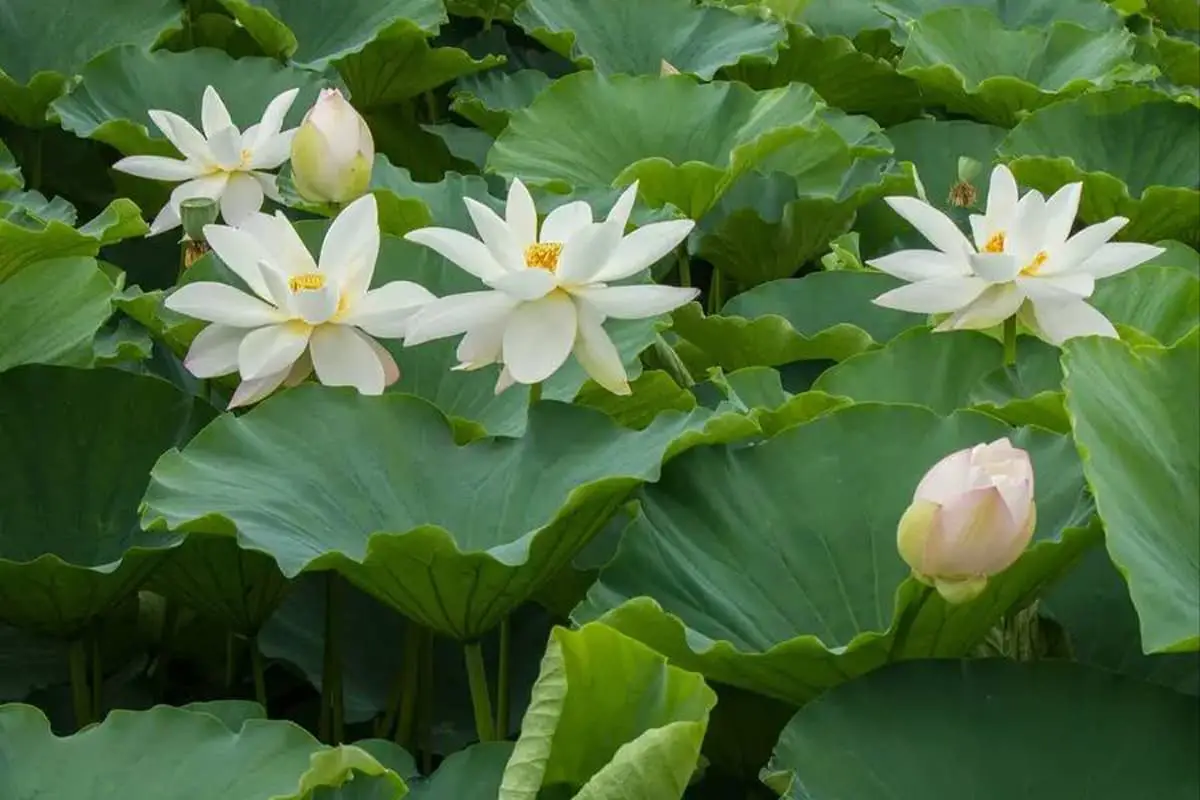
The nuts are elliptical or ovate, 1.8-2.5 cm long, with leathery, hard fruit skin, dark brown when ripe; seeds (lotus seeds) are ovate or elliptical, 1.2-1.7 cm long, with red or white seed coats. The flowering period is from June to August, and the fruiting period is from August to October.
This variety was introduced from the Wuhan Botanical Research Institute in China in April 2001. It is small-sized with lush, dark green leaves, standing 28 cm tall and spanning 25 x 28 cm in diameter. The flower stalks are 32 cm high, with a flower diameter of 10 cm.
The flowers are double-layered with 90 petals, bowl-shaped. The flower buds are green, round peach-shaped. The flowers are yellow, with the inner wheel featuring green variant petals. The stamens are partly petaloid, and the pistils are normal.
The yellow flowers, set against the backdrop of dark green leaves, appear even more elegant and enchanting. Its blooming period begins in early June, producing a dense array of flowers, up to 10 per pot, and has a relatively long flowering period.
As an aquatic plant, the lotus requires water throughout its growth period. In the early stages of growth, the water level should be maintained at about three centimeters. Too much water can hinder the increase of soil temperature.
If using tap water, it is best to let it sit in a separate container for one or two days before using. During the summer, the peak growth period for the lotus, the plant should never lack water.
After winter arrives, the soil in the pot should remain moist to prevent the lotus root from drying out due to lack of water.
The primary fertilizers for lotus are phosphorus and potassium, supplemented with nitrogen fertilizer. If the soil is rich, there is no need to fertilize throughout the year. Composted cake fertilizer, chicken, duck, and goose manure are ideal fertilizers.
Half an ounce can be applied in a small pot and a maximum of one to two ounces in a large pot. It is essential not to over-fertilize and to thoroughly mix the fertilizer with the soil.
During the peak growth period, if the leaves turn yellow and weak, you can use 0.5 grams of urea per box mixed into the soil, roll it into a ball of about 10 grams, apply one ball per pot, and place it in the soil in the middle of the pot. The effect will be seen in seven days.
After winter arrives, you can place the pot indoors or bury it below the frozen soil layer. In regions north of the Yellow River, in addition to burying it below the frozen soil layer, you need to cover it with agricultural film. Throughout the winter, the soil in the pot should remain moist.
First, you need to break the shell. From May to June, grind the concave end of the seed on a cement floor or rough stone, then soak the seed for germination. Keep the water clean and change it often.
The seed will sprout in about a week, and after two weeks, you can transplant the germinated seed. Each pot should have one plant, and the water level should be shallow.
Do not submerge the lotus leaves in water. Approximately 90% will bloom in the first year, but there won’t be many flowers.
The best time to turn the pot and plant lotus roots is from mid-March to mid-April. Planting too early can be affected by cold weather, and the lotus roots can easily be damaged by frost. In northern regions, transparent agricultural film can be used as a cover during cold weather.
Before planting, the pot soil should be mixed into a paste. When planting, the lotus root top should be inserted into the soil at a 20-degree angle along the edge of the pot. The depth should be about 5 centimeters for bowl lotus and about 10 centimeters for large lotus plants.
The tail should be raised, with the lower half lifted to prevent water from entering the lotus root tail. After planting, place the pot under the sun to let the surface soil crack slightly, which benefits the complete adhesion of the lotus root and soil. Then, add a small amount of water.
After the buds grow out, gradually deepen the water level, and finally maintain a water layer of 3-5 centimeters. The water level during the early stage of pond planting should be similar to the potted lotus, and later, the level should not submerge the lotus leaves.
Lotus root is an excellent vegetable and candied fruit. Lotus leaves, lotus flowers, and lotus stamens are also beloved medicinal dietary foods among Chinese people.
The lotus food culture is rich and colorful, including traditional lotus seed porridge, preserved lotus pods, lotus seed powder, lotus root slices stuffed with meat, steamed meat in lotus leaf, and lotus leaf porridge. The leaves can substitute for tea and also serve as packaging material.
The lotus has a strong adaptability to its growth environment. It can bloom beautifully not only in large and small lakes and ponds but also in very small pots, enhancing the environment. Cultivated varieties are often used in the form of potted lotus for viewing in parks and courtyards.

Peggie was once a high school mathematics teacher, but she set aside her chalkboard and textbooks to follow her lifelong passion for flowers. After years of dedication and learning, she not only established a thriving flower shop but also founded this blog, “Flowers Library”. If you have any questions or wish to learn more about flowers, feel free to contact Peggie.
 English
  العربية
  Bahasa Indonesia
  Deutsch
  Français
  Italiano
  Nederlands
  Português
  Русский
  日本語
日本語