600+ Types of Flowers A To Z (With Names and Pictures)
Types Of Flowers By Names (A-Z) Types Of Flowers By Color Types Of Flowers By Season Types Of Flowers By Blooming Time 600+ Types of Flowers No. Flower Name No.…

The Lycoris, scientifically known as “Red Spider Lily”, also known as Manjusaka or Mandala, is a monocotyledonous plant in the order Liliales, family Amaryllidaceae, and genus Lycoris. The Lycoris flower comes in two colors, red and white. Legend has it that the red Lycoris blooms in hell, while the white Lycoris blossoms in heaven.
The flower of the Lycoris looks like a dragon’s claw and has a bulb shaped like an onion head; its leaves grow in clusters, are slender, and have pointed ends resembling garlic leaves. The leaves are fleshy, ribbon-like, and appear green with a white powder. Its calyx is solitary, and the umbellate inflorescence is terminal. It blooms before leafing out, with the flowering period being from August to September.
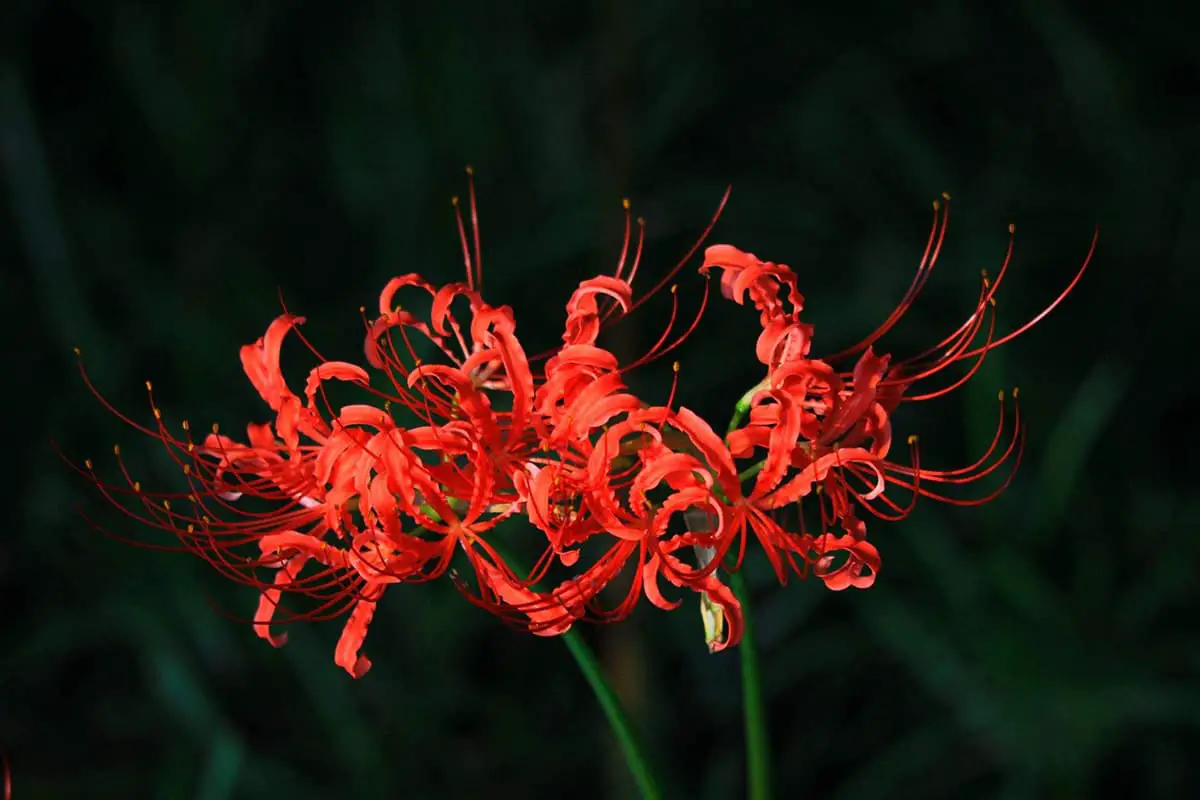
The Lycoris flower comes in two colors, red and white. Legend has it that the red Lycoris blooms in hell, while the white Lycoris blossoms in heaven.
The red Lycoris, also known as Manjusaka, is native to the Yangtze River basin in China and is distributed in the middle and lower reaches of the Yangtze River and in some parts of southwestern China. There are many folk tales about the Lycoris flower. There are also songs and novels named after the Lycoris flower.
The Lycoris flower is the devil’s gentleness. In Japanese folklore, it is a flower that voluntarily plunged into hell but was sent back by the demons, yet it still lingers on the road to the underworld. The demons, out of pity, agreed to let it bloom on this road, providing guidance and comfort to the souls departing from the human world. Both the snow-white and blood-red Lycoris represent death.

It is said that the Mandala blooms on the road to heaven, while the Manjusaka spreads on the path to hell. They both represent death, one symbolizes a different interpretation of death: rebirth; while the other represents the wandering and hesitation of pain and regret: falling. Therefore, there is only a thin line between heaven and hell. The difference between angels and demons is nothing more than color and the meanings they carry.
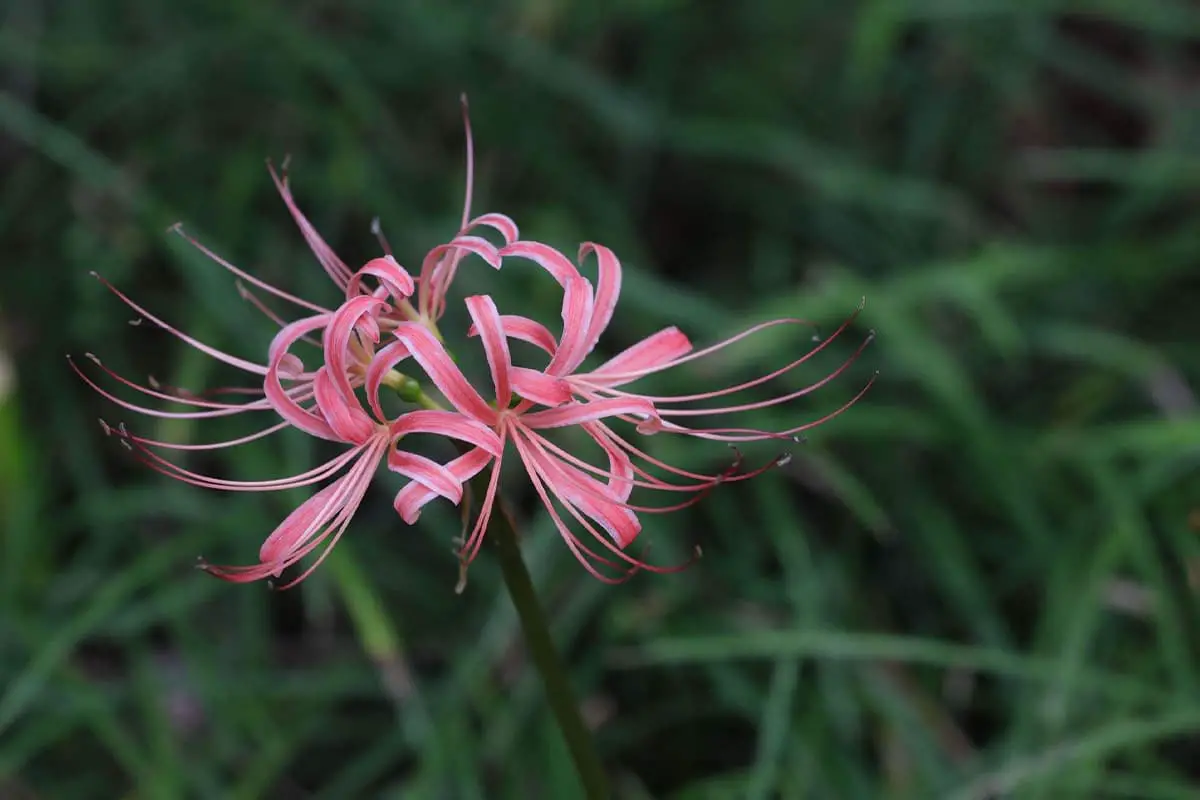
The wild species grow in dark, damp places and are planted in red soil, hence they are frost-tolerant, shade-loving, and can withstand a maximum average daily temperature of 24°C; they like moisture, are also drought-tolerant, and prefer slightly acidic soil.
Loose, fertile humus soil is the best. If the soil is fertile and drains well, the flowers will be particularly lush. Furthermore, Manjusaka enjoys growing in graveyards, hence it is also known as the death flower.
It is widely distributed across East Asia, including countries like Vietnam and Malaysia. It is speculated that the varieties in Japan were transported to the island of Kyushu from China over two thousand years ago.
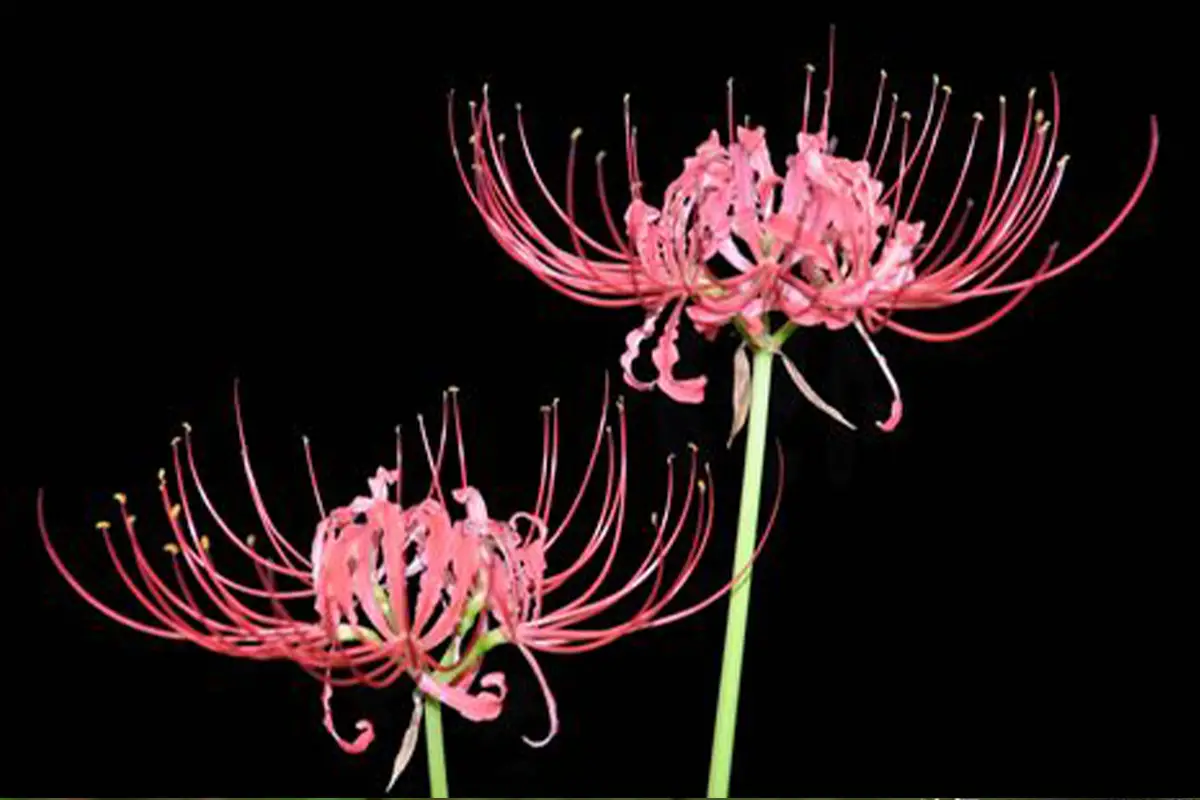
The Lycoris flower is a perennial herb in the Amaryllidaceae family. The flowers resemble dragon claws. It has a bulb that looks like an onion head; its leaves grow in clusters, slender with pointed ends, resembling garlic leaves. They are fleshy, ribbon-like, green with a white powder; the solitary calyx produces terminal umbellate inflorescences.
At the transition of summer and autumn, the flower stem breaks through the soil, with 5 to 7 flamboyantly red flowers (white varieties also exist) on the terminal umbellate inflorescence. The petals curl back like dragon claws. It blooms before the leaves grow. The leaves do not fall in winter, but they drop and the plant goes dormant in summer. Because the flowers and leaves never meet, Lycoris is also known as the “heartless” flower.

There is no yellow Lycoris. The yellow one is the Golden Spider Lily, scientifically named Lycoris aurea. The flowering period is different: its originally lush green leaves silently wilt at the beginning of summer, disappearing without a trace.
Then, in midsummer, its flower stem suddenly sprouts from the ground, blooming unique and golden flowers that delight and surprise people, hence its name. Its symbolism is also better, representing happiness. It just looks very similar to the Lycoris, after all, they belong to the same family.
Lycoris likes a cooler environment and cannot grow for a long time in places with strong light. During maintenance, it should be placed in a semi-shaded environment. During the summer when the light is strong, it needs to be shaded with a light-blocking net. In winter, it is placed on the window sill to receive more sunlight.
The optimal growth temperature for Lycoris is 14-22 degrees Celsius, and it is usually planted in winter and spring. It is not suitable for growth in overly damp environments. During the summer, timely measures should be taken to cool the flowers; when the temperature is too high in winter, the pot should be moved indoors for timely insulation.
It needs an adequate amount of water to support its growth. During its growing period, water it once every 1-2 days to replenish its moisture. In winter, its water demand decreases, and at this time, watering should be reduced to avoid freezing or waterlogging.
Before planting or repotting, organic fertilizer can be added to the soil as a base fertilizer. During the growth period, additional fertilization is also needed, with one application each time. Phosphorus and potassium fertilizers should be applied before flowering to promote blooming and ensure the quantity and quality of the flowers.
Division propagation is the most straightforward method. After flowering or during dormancy, dig out the plant and separate the small bulbs next to the mother bulb for planting. It can start flowering after about 1-2 years.
Because its seeds do not undergo dormancy, they should be sown immediately after harvesting. At 20 degrees Celsius, you can see the radicle emerge after about 15 days. In a natural environment, it takes approximately 4 to 5 years from sowing to flowering.
According to traditional Chinese medical records, the bulb of the red spider lily has a warm nature and a pungent and bitter taste. It is poisonous, and when used as a medicine, it induces vomiting, reduces phlegm, reduces swelling, relieves pain, and detoxifies. However, if consumed inadvertently, it could cause poisoning, leading to symptoms such as vomiting and diarrhea. In severe cases, it can cause paralysis of the central nervous system and is life-threatening.
According to pharmacological research, the main medicinal components of the red spider lily bulb are various types of lycorine and galantamine. Lycorine and its derivatives have certain anti-cancer activities and can also reduce inflammation, relieve fever, sedate, and induce vomiting. They are effective against amoebic dysentery as well.
Galantamine is a reversible acetylcholinesterase inhibitor used for paralysis caused by central nervous system diseases such as poliomyelitis and myasthenia gravis. These ingredients can be extracted on a commercial scale.
Legends of Lycoris
Legend 1
It is said that the Lycoris blooms on both sides of the road to the underworld. The color of the flowers is as brilliant and red as blood. The Lycoris has flowers without leaves and is the only scenery in the dark hell, guiding the souls who have left the human world to the direction of hell.
The fragrance of the flower possesses a magical ability to call upon the memories of the dead. After the soul crosses the river of oblivion, it will forget all the memories of its previous life. All past memories will be left on the other shore.
Legend 2
It is rumored that Lycoris flowers bloom for a thousand years and fall for a thousand years. The flowers and leaves never meet each other. Two demons guard the Lycoris, the flower demon Manju and the leaf demon Sahua.
They guarded the Lycoris for more than a thousand years, but they never saw each other because when the Lycoris flowers, there are no leaves, and when there are leaves, the flowers have fallen. The flower and the leaf have never appeared together. The two demons missed each other and were deeply tortured by this pain.
Finally, one day, they violated God’s rules and secretly met. As the flowers and leaves appeared at the same time, the bright flowers of Manju and Sahua were set off by the tender green leaves and bloomed extraordinarily charming. This scene alarmed all things between heaven and earth, and naturally the gods knew it too. In the end, Manju and Sahua were thrown into reincarnation and were never allowed to be together, suffering the pain of reincarnation life after life.
The Symbolism of Lycoris
Lycoris has many symbolic meanings, generally symbolizing the separation of life and death, the gentleness of demons. It is a flower that blooms on the road to the underworld, guiding the soul and demons on a bright path, and also symbolizes death, the love of despair. If Lycoris blooms in a corner, it represents that someone will go to hell or heaven.
1. Separation of life and death
Lycoris generally symbolizes the separation of life and death. Lycoris is a very magical plant. Whenever it blooms, the leaves will wither, and when the flowers wither, the leaves will reappear. The two cannot see each other at the same time, which has a very profound meaning.
2. The gentleness of demons
Lycoris is said to be a flower that is full of flowers on the road to the underworld. It has unique ornamental value. Lycoris also symbolizes the gentleness of demons, guiding the soul and demons who leave the world on a bright path, giving them comfort.
3. Death
There are two colors of Lycoris, red and white. It is said that the white Lycoris is the road to heaven, and the red Lycoris is the road to hell, so Lycoris symbolizes death. Once Lycoris blooms in a corner,
4. Love of Despair
The flowers of Lycoris are bright and beautiful. The daughter of Yama loves Lycoris the most. So what is the symbolism of Lycoris? In fact, Lycoris also symbolizes the love of despair, representing love like the flowers and leaves of Lycoris, deeply in love with each other, but they can never meet in this life.
The Flower Language of Lycoris
The color of Lycoris is not only blood red, but there is also a pure white Lycoris. The flower language of white is completely opposite to that of red. “Endless thoughts, desperate love, a letter from heaven” is the flower language of white Lycoris, while the flower language of red Lycoris is “endless love, the omen of death, the call of hell.”

Peggie was once a high school mathematics teacher, but she set aside her chalkboard and textbooks to follow her lifelong passion for flowers. After years of dedication and learning, she not only established a thriving flower shop but also founded this blog, “Flowers Library”. If you have any questions or wish to learn more about flowers, feel free to contact Peggie.
 English
  العربية
  Bahasa Indonesia
  Deutsch
  Français
  Italiano
  Nederlands
  Português
  Русский
  日本語
日本語