600+ Types of Flowers A To Z (With Names and Pictures)
Types Of Flowers By Names (A-Z) Types Of Flowers By Color Types Of Flowers By Season Types Of Flowers By Blooming Time 600+ Types of Flowers No. Flower Name No.…

The Lagerstroemia speciosa, is a member of the Lythraceae family and genus Lagerstroemia. This large deciduous tree can grow up to 82 feet tall; its bark is grey and smooth. The twigs are cylindrical, either glabrous or sparsely covered with chaffy hairs.
The leaves are leathery, ranging from broadly oval to elliptical or rarely lanceolate, notably large, blunt or shortly pointed at the tip, with a broad wedge-shaped to rounded base, and hairless on both surfaces.
The fruit is a capsule, either spherical to oblong-elliptical, brownish-grey, containing numerous seeds. The Queen’s Crape Myrtle blooms from May to July and bears fruit from October to November.
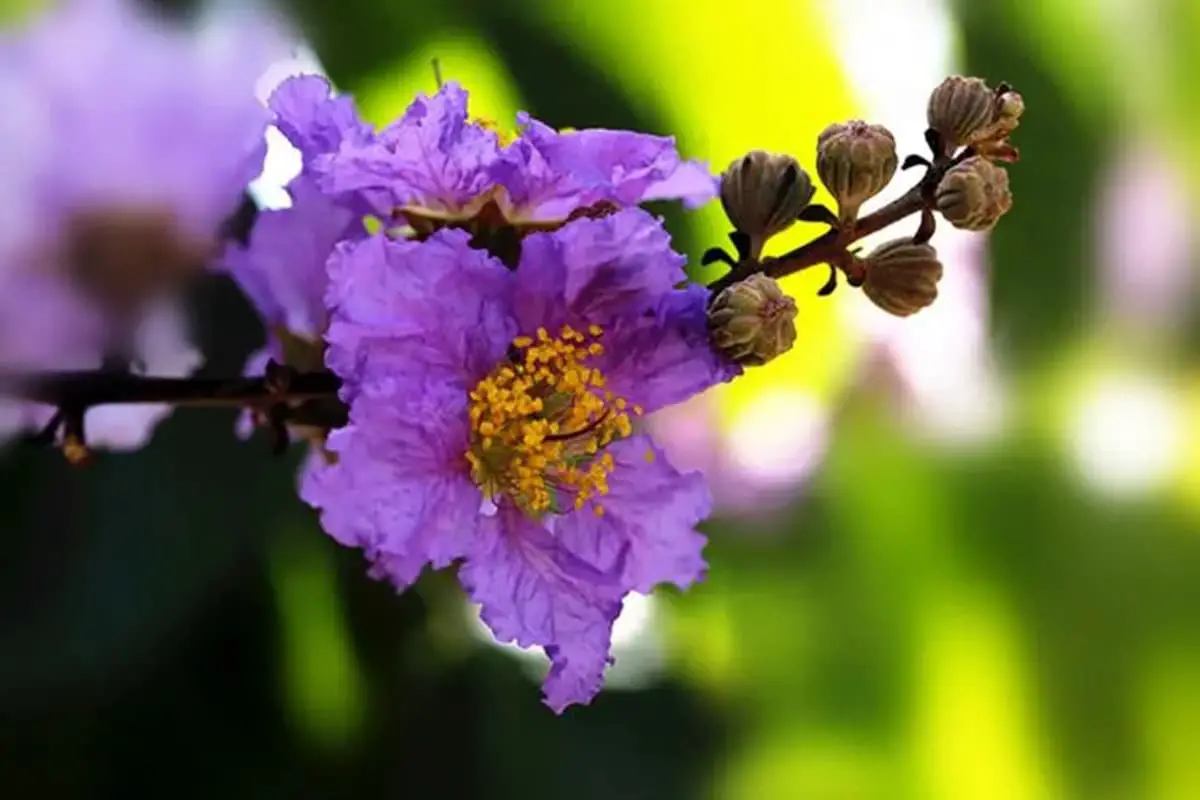
It is commonly cultivated in gardens for its ornamental beauty; its wood is hard, rot-resistant, with a bright red hue, frequently used for furniture, boats, bridges, utility poles, railway sleepers, and in construction, and it is equally valued underwater, with economic importance comparable to that of boxwood; its bark and leaves are used as laxatives; the seeds have anesthetic properties; and its roots, which contain tannins, are used as astringents.
The Queen’s Crape Myrtle is a large tree, reaching up to 82 feet in height, with smooth, grey bark. The twigs are cylindrical and either hairless or lightly chaffy.
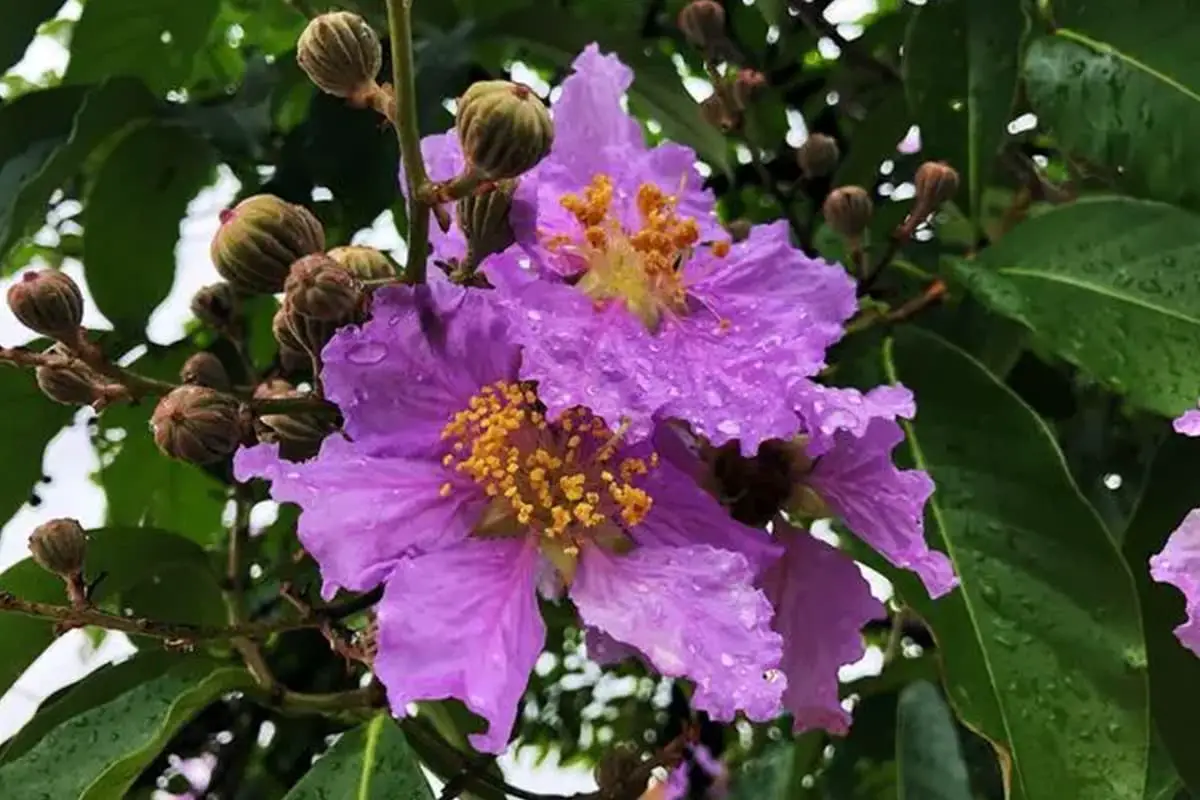
The leaves are substantial, leathery, ranging from broadly oval to elliptical or infrequently lanceolate, 4 to 10 inches long and 2.4 to 4.7 inches wide, with a blunt or short pointed tip, a broad wedge-shaped to round base, and hairless on both surfaces.
The veins are paired from 9 to 17 on each side, arched and connected at the leaf margin; the leafstalks are robust, 0.24 to 0.59 inches long.
The flowers are pale red or purple, about 2 inches in diameter, with terminal panicles 6 to 10 inches long, sometimes reaching up to 18 inches; the pedicels are 0.4 to 0.6 inches long, with the flower axis, pedicels, and outside of the sepals all covered in a dense yellow-brown chaffy tomentum; the sepals have 12 ribs, chaffy, about 0.5 inches long, six-parted, with triangular segments that are reflexed and glabrous inside, with scale-like appendages; the petals are six in number, near-round to oblong-elliptical inverted egg-shaped, 1 to 1.4 inches long, almost unwrinkled, with short claws, around 0.2 inches long; there are numerous stamens, about 100-200; the ovary is spherical, with 4-6 compartments, hairless, and the style is 0.8 to 1.2 inches long.
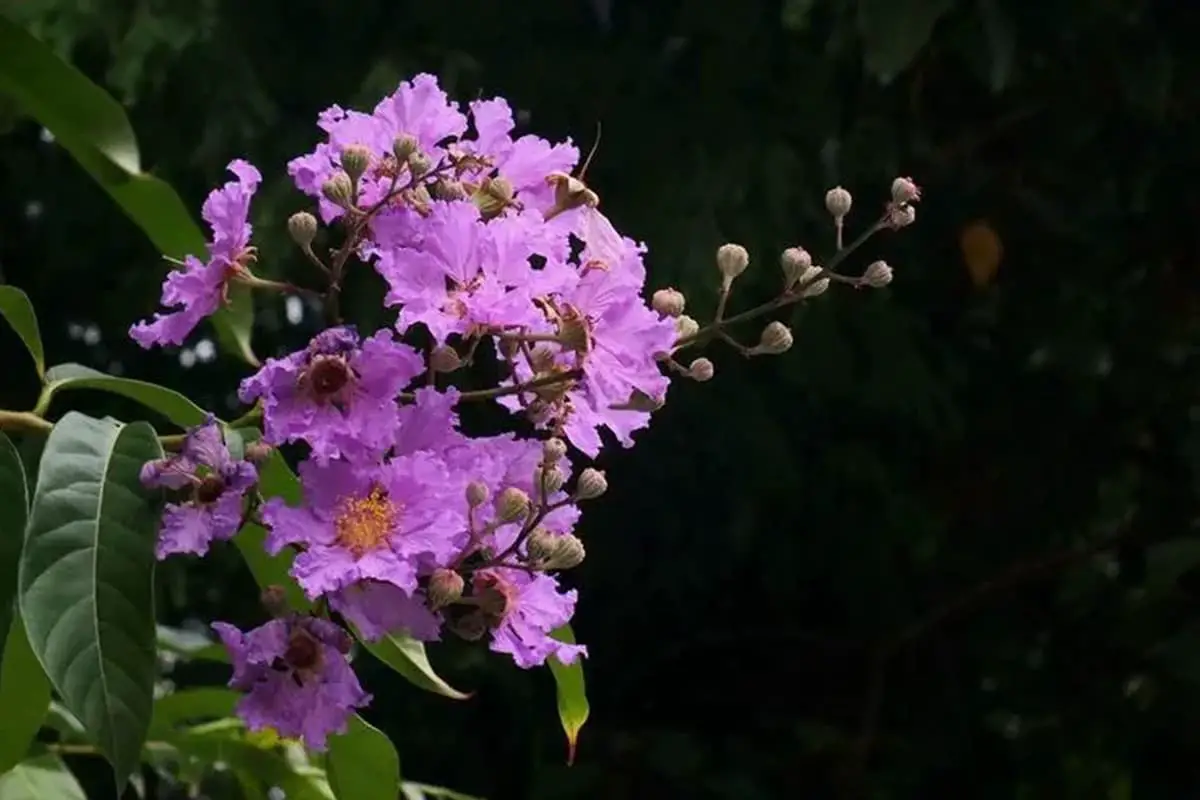
The fruit is a capsule, spherical to oblong-elliptical, 0.8 to 1.5 inches long, about 0.8 inches in diameter, brownish-grey, and splits into six parts; the seeds are numerous, 0.4 to 0.6 inches long.
The flowering period is from May to July, and the fruiting period is from October to November.
The Queen’s Crape Myrtle thrives in warm, humid conditions, prefers sunlight but tolerates light shade, and grows best in calcareous soils.
It is distributed in Sri Lanka, India, Malaysia, Vietnam, and the Philippines.
The bark and leaves of the Queen Crape Myrtle can be used as a laxative; its seeds have anesthetic properties; and its roots contain tannins, which can be used as astringents.
Pharmacology: Observations of various plant extracts on the glucose uptake by Ehrlich ascites carcinoma cells identified Queen Crape Myrtle as one of the plants that promote uptake.
Two triterpenoid compounds, corosolic acid and maslinic acid, have been isolated from it. Corosolic acid, in particular, enhances glucose transport and therefore exhibits hypoglycemic activity.
Used Parts: Roots and flowers are used medicinally.
Harvesting and Processing: Roots are harvested in autumn and winter, washed, sliced, and dried. Leaves are collected in summer and autumn and dried.
Functions: Used to heal sores, detoxify, cool the blood, and stop bleeding; the roots are used for carbuncles and swellings; bark and leaves are used as a laxative; seeds have anesthetic effects.
Queen Crape Myrtle leaves have hypoglycemic, antioxidant, and antifungal activities, with the primary activity being hypoglycemic.
External Use: Apply the appropriate amount directly to the skin; or apply the powdered form; or use the decoction for washing. It has hypoglycemic, antioxidant, and antifungal activities, with the primary activity being lowering blood sugar.
Main Therapeutic Usage: Used for carbuncles and swelling. For external use: apply the appropriate amount directly to the skin; or use the powdered form.
Chemical Components: Ten compounds have been isolated from the petroleum ether fraction of Queen Crape Myrtle leaves through silica gel and Sephadex LH-20 column chromatography.
These compounds are: ① ursolic acid, ② corosolic acid, ③ alphitolic acid, ④ asiatic acid, ⑤ β-sitosterol, ⑥ dotriacontanol, ⑦ daucosterol, ⑧ taraxasterol acetate, ⑨ β-sitosterol acetate, and ⑩ (2α,3β)-urs-12-ene-2,3,28-triol.
Regularly used in furniture, boats, bridges, utility poles, railway sleepers, and construction, the timber is said to be economically comparable to rosewood; it is also used as underwater timber.
The plant is valued for its strikingly beautiful and long-lasting flowers. It is suitable for planting in various types of gardens and green spaces. It is also used for street greening and as a potted plant for its aesthetic appeal.
The flowers are large and beautiful, commonly cultivated in gardens for their ornamental value; the wood is hard, highly resistant to decay, and has a reddish, lustrous appearance.

Peggie was once a high school mathematics teacher, but she set aside her chalkboard and textbooks to follow her lifelong passion for flowers. After years of dedication and learning, she not only established a thriving flower shop but also founded this blog, “Flowers Library”. If you have any questions or wish to learn more about flowers, feel free to contact Peggie.
 English
  العربية
  Bahasa Indonesia
  Deutsch
  Français
  Italiano
  Nederlands
  Português
  Русский
  日本語
日本語