Hibiscus tiliaceus: Unveiling Nature’s Resilient Beauty
The Hibiscus tiliaceus is an evergreen shrub or tree that grows 4-10 meters tall and blooms from June to August. Its bark fibers are used for making ropes, while the…

Hibiscus sabdariffa is an annual herbaceous plant in the Malvaceae family. It grows up to 1-2 meters tall, with stems and branches that are pale purple in color.
The lower leaves are ovate, while the upper leaves are palmate with lanceolate lobes. The base of the leaf is nearly round or broadly wedge-shaped, and both sides are hairless.
The plant is usually evergreen or semi-evergreen shrub. The fruit is ovoid, and the seeds are kidney-shaped. It blooms from July to October, with the fruit ripening in November and December.
Roselle is native to Africa and is commonly found in tropical and subtropical regions with short daylight hours. It thrives in humid and hot conditions, and can tolerate drought and acidic soils. The most common method of propagation is through seed sowing.

The roots, fruits, and seeds of Roselle are used in traditional medicine and have therapeutic effects on cardiovascular diseases, arteriosclerosis, and hypertension. Roselle can be brewed into tea or used to make beverages.
It has a sour taste and can also be used to extract natural pigments for the food industry. It has various benefits, such as clearing heat, nourishing the skin, fading dark spots, and relieving alcohol intoxication.
It can be planted in clusters or as individual plants in parks, gardens, and can be used as hedges or potted for ornamental purposes. The seeds can be pressed for oil, which can be used for industrial and culinary purposes.
The calyx is used as a raw material for beverages and food. The stem bark fiber can be used as a textile raw material, while the remaining woody parts can be used for papermaking. The flower symbolizes tranquility and waiting, earning it the nickname “Plant Ruby.”
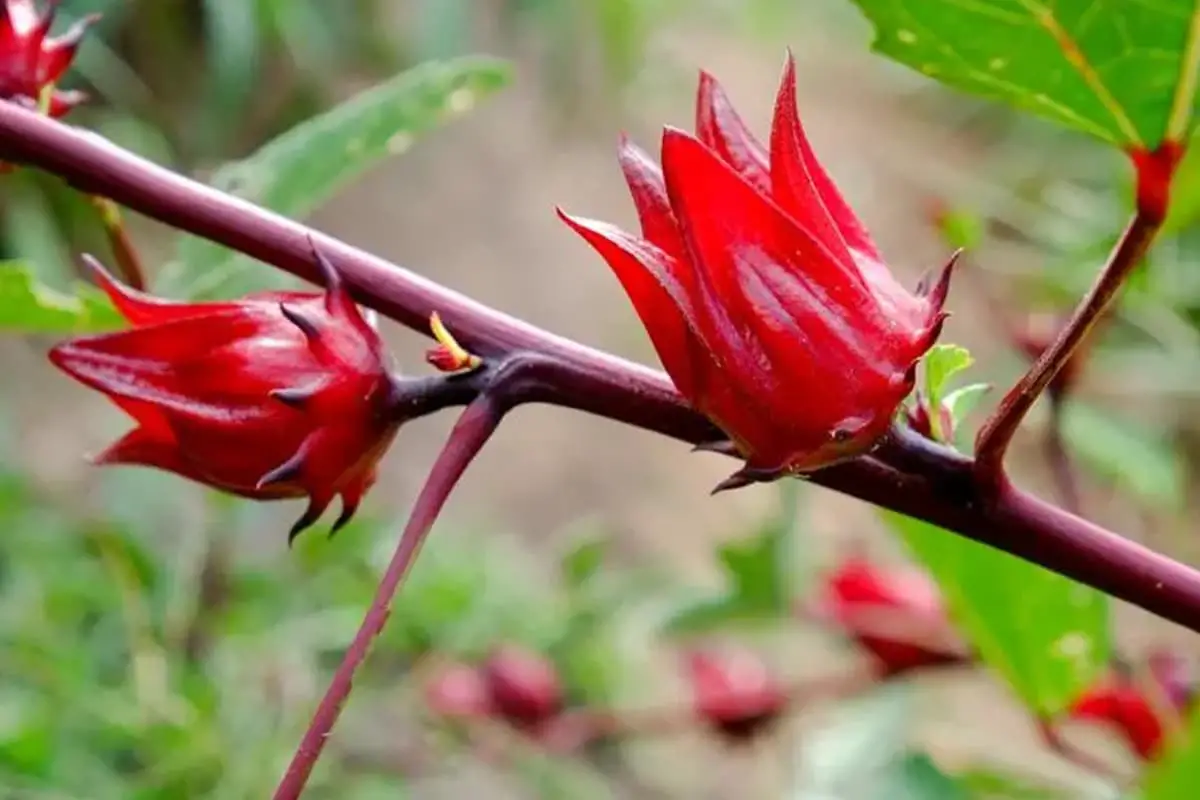
Roselle, an annual herbaceous plant in the Malvaceae family, is an evergreen or semi-evergreen shrub. It grows up to 1-2 meters tall and has pale purple, hairless stems.
The leaves are heteromorphic, with ovate, undivided lower leaves and palmate, deeply lobed upper leaves. The lobes of the upper leaves are lanceolate in shape, measuring 2-8 centimeters in length and 5-15 millimeters in width.
They have serrated edges, a blunt or gradually pointed tip, and a rounded to wide-wedge-shaped base. Both sides of the leaves are hairless, with 3-5 main veins and glandular midribs on the dorsal side.
The leaf stalks are 2-8 centimeters long and sparsely covered in long, soft hairs. The stipules are linear, approximately 1 centimeter long, and sparsely covered in long, soft hairs.
The flowers are solitary and axillary, almost sessile. There are 8-12 small bracts, red in color, fleshy, lanceolate in shape, measuring 5-10 millimeters in length and 2-3 millimeters in width.
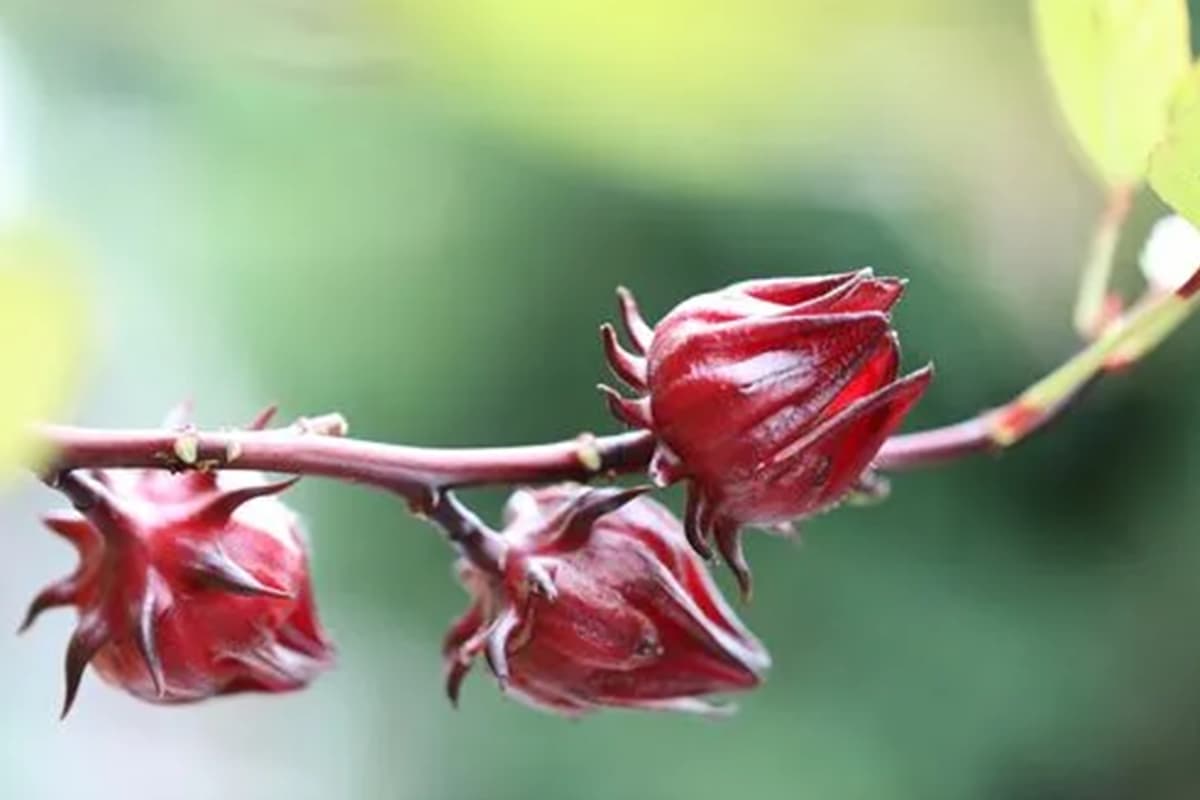
They are sparsely covered in long, stiff hairs and have a spine-like appendage near the apex, fused with the base and sepals. The calyx is cup-shaped, pale purple, with a diameter of approximately 1 centimeter.
It is sparsely covered in prickles and coarse hairs, with the base fused for about one-third of its length. The calyx lobes are triangular and gradually pointed, measuring 1-2 centimeters in length.
The flowers are yellow, with a deep red base on the inner surface, and have a diameter of 6-7 centimeters. The fruit is ovoid, with a diameter of approximately 1.5 centimeters, densely covered in coarse hairs, and divided into 5 locules.
The seeds are kidney-shaped and hairless. It blooms from July to October, and the fruit ripens from November to December.
Branches and Leaves:
Stems and branches are pale purple in color. The lower leaves are ovate, while the upper leaves are palmate with lanceolate lobes. The lobes are nearly round or wide-wedge-shaped at the base, and both sides of the leaves are hairless. The stipules are linear.
Flowers and Fruits:
The flowers are solitary and axillary, almost without stalks.
Branches and Leaves:
The twigs are hairless or sparsely covered in star-shaped hairs. The leaves are nearly round or broadly ovate, with a pointed or shortly acuminate tip. The base is heart-shaped, and the margins are either entire or finely toothed. The stipules are elongated and shed early.
Flowers and Fruits:
The flowers are solitary, arising from leaf axils, or arranged in axillary or terminal cymes. The calyx is cup-shaped.
Roselle is native to Africa and tropical regions in the eastern hemisphere. It is cultivated in tropical areas worldwide and is commonly found in tropical and subtropical regions. It grows in hilly and flat areas below 600 meters in latitude below 30°N.
Roselle prefers a warm climate and is sensitive to cold and early frost. The average annual temperature ranges from 19-23°C. The total accumulated temperature (≥15°C) during the growing season is more than 240 days.
The average date of the first frost is December 1st. It thrives under short daylight conditions and prefers abundant sunlight. It prefers moist and humid conditions, can tolerate drought, but is sensitive to waterlogging.
It can grow in poor and acidic soils, with moderate soil requirements. Except for clayey and alkaline soils, it can generally grow in various types of soils. It thrives in newly cultivated land with deep, loose, fertile, sandy loam soil that is slightly acidic to slightly acidic.
Roselle is typically propagated by seed. Sowing is done from late April to early to mid-May. It is best to select a sunny day after rain.
Dig holes with a spacing of 1 meter x 1 meter, 10-15 centimeters wide, and approximately 10 centimeters deep. Sow 4-5 seeds per hole, with a sowing depth of 3 centimeters and a soil cover of 0.5-1 centimeter.
The seeding rate is approximately 0.6 kilograms per acre. Seedlings emerge in approximately 7 days. Thin the seedlings to a height of around 15 centimeters, leaving one strong seedling per hole.
Roselle is drought-tolerant and adaptable, making it suitable for cultivation in various locations, such as in front of houses, along fields, roadsides, slopes, fallow land, intercropping systems, and orchards.
It thrives in sunny areas with deep, well-draining sandy loam soil, but should be avoided in low-lying, wet areas with heavy clayey soil.
While Roselle can grow without the application of basal fertilizer in general soil conditions, it may result in fewer flowers and lower yields.
To achieve high yields and enhance resistance, apply 2,000 kilograms of well-rotted stable manure or compost per acre as a basal fertilizer. After applying the fertilizer, plow and harrow the soil to make it fine and level.
Select a sandy loam soil near a water source with good drainage and irrigation for the nursery. After thorough cultivation, apply 2,500 kilograms of well-rotted compost or farmyard manure per acre as a basal fertilizer, and mix it well with the soil.
Create ridges that are 1.3-1.6 meters wide and 25-30 centimeters high for sowing or line sowing. Use a seeding rate of 40-50 kilograms per acre, which can provide seedlings for planting in 100 acres of farmland.
When the seedlings reach a height of 15-25 centimeters, transplant them on a rainy or cloudy day when the soil is moist. Dig holes that are 30 centimeters deep, with a spacing of 0.8 meters x 0.8 meters or 1 meter x 1 meter, and plant one seedling per hole.
After planting, water the seedlings promptly during dry periods to ensure their survival. Pay attention to drainage during the rainy season and take precautions against seed rot.
Weed regularly and loosen the soil during the growing season to maintain soil looseness. Remove weeds and replant any missing seedlings when the seedlings reach a height of 15 centimeters.
Perform the first weeding and fertilization when the plants reach a height of 30 centimeters, combining it with hilling. Subsequent weeding should be done 2-3 times as needed, considering weed growth and soil compaction.
Roselle is nutrient-tolerant, so in addition to applying sufficient basal fertilizer, timely fertilization is necessary. During the seedling stage, nitrogen fertilizer should be the main focus.
From bud formation to the enlargement of calyx and fruit, phosphorus and potassium fertilizers should be emphasized.
For direct sowing, fertilization should be done 20 days after the seedlings have established, with ammonium sulfate applied at a rate of 10-15 kilograms per acre, at a distance of 5-6 centimeters from the plant.
The second fertilization should be applied around the time of bud formation, between the plants, and covered with soil. Apply 50-100 kilograms of well-rotted oil cake or calcium superphosphate per acre, or 1,000-1,500 kilograms of human urine and excrement.
When 70% of the plants show flower buds, promptly remove the apical bud and remove poorly developed flower buds to promote fruit development. During the flowering period, foliar fertilization is an effective measure to increase yields.
Mix 0.25 kilograms of potassium dihydrogen phosphate, 2 kilograms of urea, and 300 kilograms of water and spray it onto the plants on a sunny day between 8:00-10:00.
Add a small amount of insecticide to prevent spot formation on the calyx during processing and improve the quality of the calyx for market purposes.
Root rot is the main disease affecting mature Roselle plants. It occurs from the 4th branching stage to the fruiting stage, with a disease incidence rate of 13-37%. The disease is soil-borne, with the seeds and cultivation soil carrying the pathogens.
It is most severe during the rainy season from April to June when the soil is heavy and humidity is high, leading to the plants becoming elongated and susceptible to disease.
The affected areas exhibit yellow-brown sunken lesions, which eventually cause rotting of the root and stem, longitudinal cracking of the outer skin, exposure of the internal fibers, and overall wilting of the plant.
To control this disease, soak the seeds in a 400-fold dilution of 50% carbendazim for 10 minutes before sowing.
During the disease outbreak, spray a mixture of an 800-fold dilution of carbendazim and a 500-600-fold dilution of trichoderma every 7-10 days for 2-3 consecutive times.
The tender leaves and petioles of Roselle are used in Western cuisine as a salad. The calyx can also be consumed. The seeds can be pressed for oil, with an oil yield of 14-18%.
The flowers are rich in vitamin C and have excellent nutritional value. Roselle can be brewed into tea or used to make beverages. It has a sour taste and can also be used to extract natural pigments for the food industry.
It has various benefits, such as clearing heat, relieving heatstroke, nourishing the skin, fading dark spots, and relieving alcohol intoxication.
The stem bark fiber is tough and can be used to make ropes. The woody part of the stem can be used as raw material for papermaking. The fleshy flowers can be processed into delicious juices, jams, jellies, and wines.
The processing is easy, and these food items can be homemade in households. Pigments can be extracted from the flowers for use in candies and beverages, as they have good stability.
The seeds can be pressed for oil, which can be used for industrial and culinary purposes. The calyx is a raw material for beverages and food. The stem bark fiber can be used as a textile raw material.
The roots, fruits, and seeds of Roselle are used in traditional medicine and have therapeutic effects on cardiovascular diseases, arteriosclerosis, and hypertension.
They have diuretic properties, promote bile secretion, lower blood viscosity and blood pressure, and stimulate intestinal peristalsis.
Roselle flowers are purple-red in color, with bright and beautiful corollas and calyxes. They can be planted in clusters or as individual plants in parks, gardens, etc.
They can also be used as hedges or potted plants for ornamental purposes. Roselle is an ornamental plant that beautifies the environment.
The flower symbolizes tranquility and waiting. It is also known as the “plant ruby.”

Peggie was once a high school mathematics teacher, but she set aside her chalkboard and textbooks to follow her lifelong passion for flowers. After years of dedication and learning, she not only established a thriving flower shop but also founded this blog, “Flowers Library”. If you have any questions or wish to learn more about flowers, feel free to contact Peggie.
 English
  العربية
  Bahasa Indonesia
  Deutsch
  Français
  Italiano
  Nederlands
  Português
  Русский
  日本語
日本語