Hibiscus schizopetalus, commonly known as the Fringed Rosemallow, is an evergreen shrub that can reach a height of up to 3 meters. Its slender branches often droop and are smooth and hairless.
The leaves are elliptical or oblong, with toothed margins and are hairless on both sides. Its stipules are lanceolate, approximately 2 millimeters long, and usually fall off early.
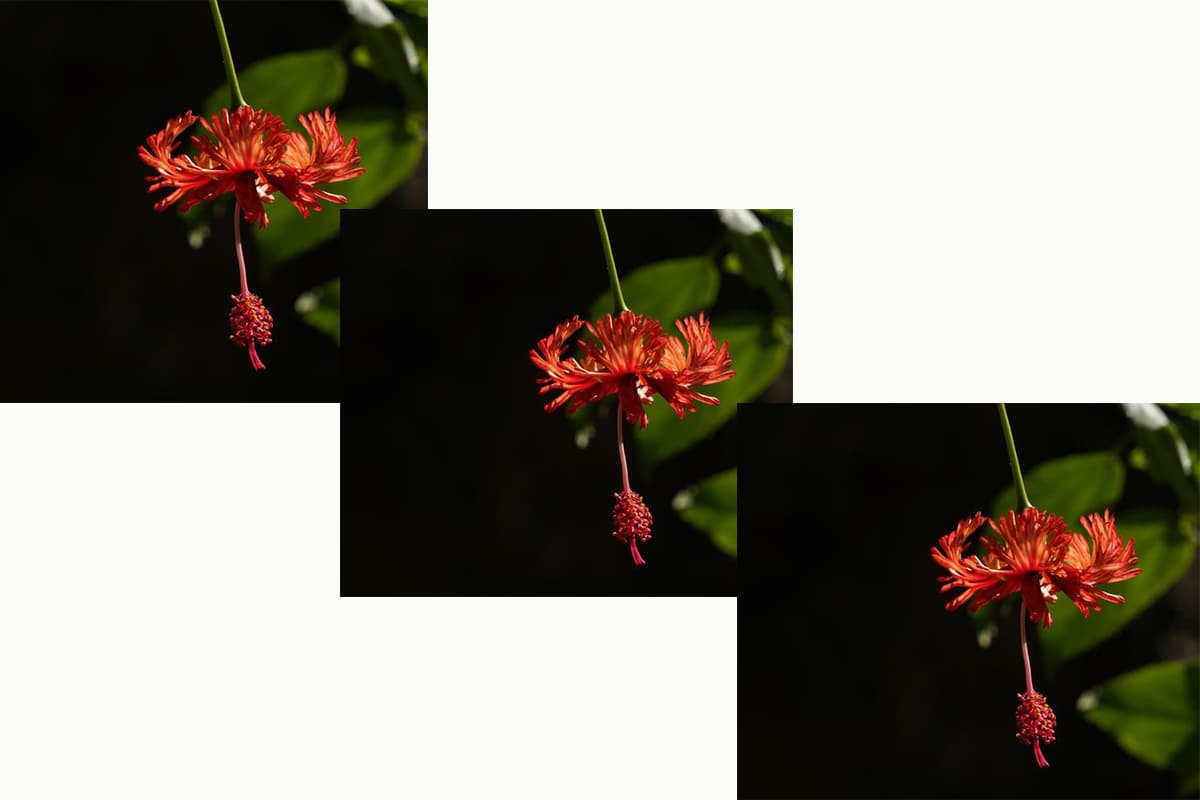
The solitary flowers are located at the ends of the branches between the leaf axils. The sepals are tiny, only about 5 in number, and are lanceolate in shape. The petals are red, about 5 centimeters long, deeply and finely split into a tassel-like form and curved upwards.
The staminal column is long, protruding, and drooping, about 9-10 centimeters long and hairless. The capsule fruit is cylindrically elongated, about 4 centimeters long, and approximately 1 centimeter in diameter.
The Fringed Rosemallow blooms all year round and is native to tropical East Africa.
It is a common ornamental plant in tropical countries; it is also frequently used as a hedge due to its pruning tolerance. The Fringed Rosemallow is a beautiful ornamental plant, with large, vibrant red flowers that bloom for an extended period.
Morphological Features:
The Fringed Rosemallow is an evergreen shrub that can grow up to 3 meters tall. Its slender branches often droop and are smooth and hairless. The leaves are elliptical or oblong, measuring 4-7 cm long and 1.5-4 cm wide, with a short pointed or gradually tapering tip and a blunt or broad-wedged base.
The margins of the leaves are toothed, and they are hairless on both sides. The petioles are 1-2 cm long and are covered with stellate soft hairs. The stipules are lanceolate, about 2 millimeters long, and usually fall off early.
The solitary flowers are located at the ends of the branches between the leaf axils. The flower stalk is slender, drooping, 8-14 cm long, smooth and hairless or with fine hairs, with a knot in the middle.
The sepals are tiny, only about 5 in number, and are lanceolate in shape, 1-2 mm long, and covered with fine hairs. The calyx is tubular, about 1.5 cm long, sparsely covered with fine hairs, with 5 shallow teeth, and often split on one side.
The petals are red, about 5 cm long, deeply and finely split into a tassel-like form and curved upwards. The staminal column is long, protruding, and drooping, about 9-10 cm long and hairless. The pistil branches are 5 in number and hairless.
The capsule fruit is cylindrically elongated, about 4 cm long, and about 1 cm in diameter. The plant blooms all year round.
Distribution Range:
The Fringed Rosemallow is native to tropical East Africa. It’s a common ornamental plant in tropical countries and is also frequently used as a hedge due to its pruning tolerance. It is found in Taiwan, Fujian, Guangdong, Guangxi, and southern Yunnan, all of which are cultivated.
Growing Environment:
The Fringed Rosemallow is a strong sun-loving plant that thrives in warm and humid conditions. It requires plenty of sunlight and isn’t tolerant of shade, cold, or drought. In the Yangtze River basin and northern regions, it can only be grown in pots and must be kept in greenhouses or other protected areas at temperatures of 12-15°C during winter.
If the room temperature falls below 5°C, the leaves will turn yellow and fall off; if it falls below 0°C, the plant will suffer from frostbite. The Fringed Rosemallow is tolerant of pruning and branches vigorously. It can adapt to a wide range of soil types but grows best in slightly acidic loam with a pH of 6.5-7 and rich in organic matter.
Growth and Propagation:
Cutting:
Cuttings can be taken from May to October, and during the winter, it should be done in a greenhouse. The survival rate is higher during the rainy season. The best cuttings are semi-woody ones that are one year old and about 10 cm long.
The lower leaves should be cut off, leaving the top leaves. The cut end should be flat. The cuttings should be planted in a sand bed and kept at a high air humidity. The room temperature should be 18-21°C. Roots should appear 20-25 days after planting.
Treating the base of the cuttings with 0.3%-0.4% indolebutyric acid for 1-2 seconds can shorten the rooting period. When the roots are 3-4 cm long, the cuttings can be transplanted into pots.
Grafting:
This should be done during spring and autumn. It is often used for Fringed Rosemallow varieties that are difficult to propagate by cutting or root slowly, especially double-flowered varieties with a low survival rate from cutting. Both scion grafting and bud grafting can be used.
The rootstock is a single-flowered Fringed Rosemallow. Grafted seedlings can sprout branches and bloom in the same year.
Pest and Disease Control:
Leaf Spot Disease:
Leaf spot disease is a fungal disease. It often occurs when the weather turns cold in late autumn, especially in northern regions where the plants are not stored in time. The initial symptoms are pale yellow and red-yellow spots on the leaves.
As the disease progresses, the spots expand to form circular or elliptical spots. Under relatively humid conditions, black granular matter can appear on the spots, which are the conidia of the pathogen. In the later stages, the leaves dry up and fall off.
The key to controlling this disease is to protect the plants from cold. When the temperature drops sharply after autumn, protective measures should be taken. On this basis, spraying with a 500-800 times diluted solution of mancozeb or a 1500 times diluted solution of ammonium carbonate can achieve good control effects.
Stem Rot Disease:
Stem rot disease is a serious fungal disease with a wide range of occurrence. The disease often occurs during the rainy season, and the disease is severe under high temperature and heavy rain conditions. The pathogen often infects from the junction of the root and stem of the plant.
In the early stage of the disease, the symptoms are not very obvious, only the cortex of the affected part is wrinkled and slightly dark brown, but the tissue under the skin has begun to rot and turn brown. When the disease spot encircles the stem, the plant dries up and dies.
From the leaf surface, in the early stage of the disease, the leaves wilt, and yellow-brown dry spots appear on the edges, which gradually spread inward. In the later stage, the leaves dry up and fall off.
The key to controlling this disease is to prevent heavy rain from washing the plants for a long time, and to apply a 200-500 times diluted solution of carbendazim to the dry stem about every 10 days before and after the rainy season. Experiments have shown that this method has a very good control effect.
Root-Knot Nematode Disease:
This is also a widely distributed and serious disease. From the above-ground part of the plant, in the early stage of the disease, the leaves grow weakly, and red-brown dry spots appear on the edges. They spread inward, and in the later stage, the leaves dry up and fall off.
From the underground part of the plant, it can be found that there are large and small tumor-like substances between the roots of the plant. At the beginning, they are smooth and flesh-colored, and later they become rough and brown, hiding pear-shaped female nematodes the size of a needle tip.
The control of this disease is quite difficult. If there are few plants, the soil can be replaced. The soil must be exposed to the sun for a long time, and the old soil should not be used again. For more plants, aldicarb granules can also be applied. For a 5-inch pot, about 0.5 grams can be buried.
Main Value:
The Fringed Rosemallow is a beautiful ornamental plant, with large, vibrant red flowers that bloom for an extended period. Potted Fringed Rosemallow is one of the best plants for decorating holiday parks, flower beds, hotels, venues, and households.
Leaves: Swelling reduction. Used for axillary abscesses. Fringed Rosemallow is often planted by the pool, in front of pavilions, along roads, and by walls in the south. It blooms with big red flowers all year round, which is very lively.
In the Yangtze River basin and the north, it is often used to decorate balconies or small gardens in pots. Under sufficient light conditions, the viewing period is particularly long. It is also one of the main flowering potted plants placed in public places in summer and autumn.


 English
  العربية
  Bahasa Indonesia
  Deutsch
  Français
  Italiano
  Nederlands
  Português
  Русский
  日本語
日本語