600+ Types of Flowers A To Z (With Names and Pictures)
Types Of Flowers By Names (A-Z) Types Of Flowers By Color Types Of Flowers By Season Types Of Flowers By Blooming Time 600+ Types of Flowers No. Flower Name No.…

Hibiscus Mutabilis: It blossoms from August to November. The Hibiscus, a shrub or small tree, is native to the Yellow River region and the eastern and southern parts of China. Its flowers are white, pink, or red, emerging bright and beautiful, and hence, it’s also called “Wood Hibiscus”.
The Hibiscus flower changes three times a day, and therefore, it’s also known as the “Triple-change Flower”. It begins to bloom in late autumn and remains vibrant even in frost, earning it another name, the “Frost-resistant Flower”.
Both the flowers and leaves are used in traditional medicine due to their heat-clearing, detoxifying, swelling-reducing, pus-draining, and blood-cooling effects. The Wood Hibiscus is also the city flower of Chengdu, representing delicate beauty, chastity, and purity.
The Wood Hibiscus (original variant) is a deciduous shrub or small tree, 2 to 5 meters high. All the twigs, leaf stalks, flower stalks, and calyxes are densely covered with fine cotton hair mixed with star-shaped hair.
Its leaves are broad ovate to round ovate or heart-shaped, 10 to 15 cm in diameter, often 5 to 7 lobed. The lobes are triangular and gradually tapering at the ends, with bluntly rounded serrations.
The tops are sparsely covered with star-shaped fine hair and spots, while the bottoms are densely covered with star-shaped fine velvet hair. The leaf stalks are 5 to 20 cm long, and the stipules are lanceolate, 5 to 8 mm long, often falling early.
The flowers are solitary and located at the branch ends. The flower stalks are about 5 to 8 cm long, with nodes near the end. The sepals are bell-shaped, 2.5 to 3 cm long, with 5 lobes.
The flowers start white or light red and later turn deep red, about 8 cm in diameter. The petals are nearly round, 4 to 5 cm in diameter. The stamen column is 2.5 to 3 cm long, hairless.
The capsules are flat spherical, about 2.5 cm in diameter, covered with light yellow stiff hair and cottony hair. The seeds are kidney-shaped, with long soft hair on the back.
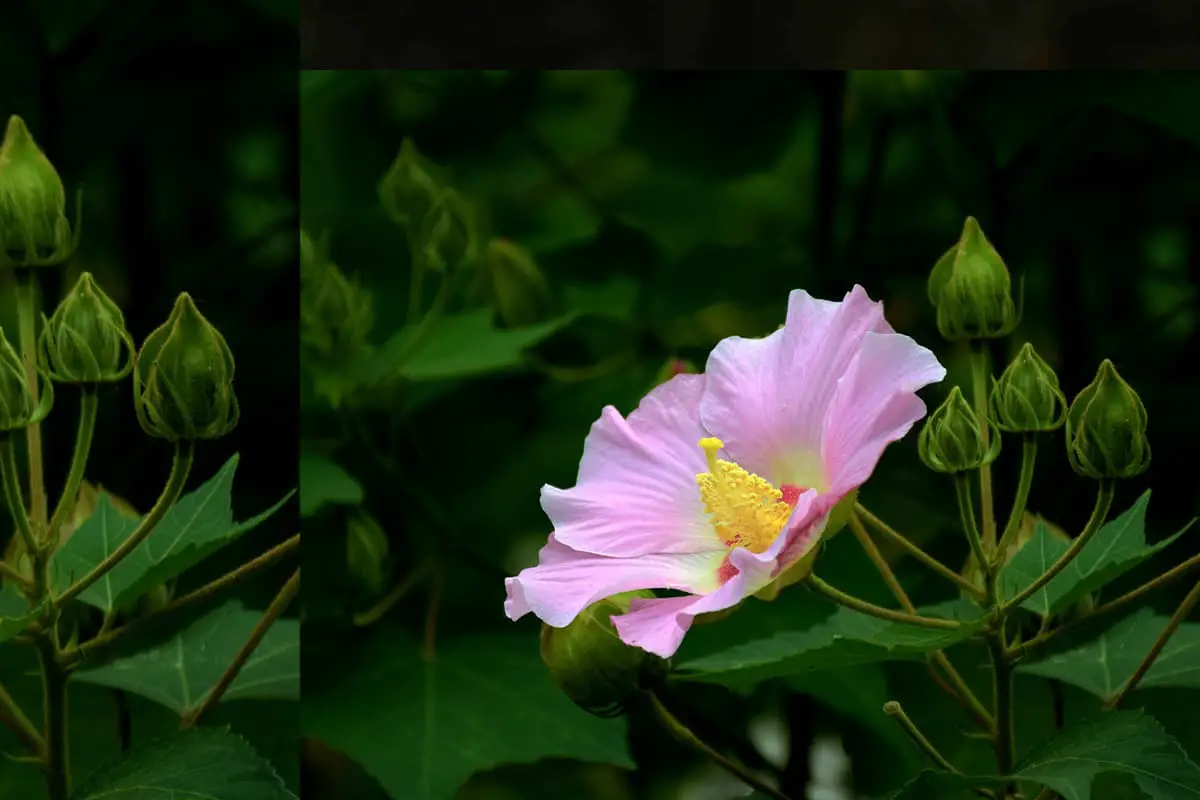
The Wood Hibiscus loves light and can tolerate slight shade. It prefers a warm and humid climate and is not cold-resistant. In regions north of the Yangtze River, the above-ground parts often die from frost in the winter, but new shoots can sprout from the roots in the next spring, and the plant can flower normally in the fall.
It likes fertile, moist soil with good drainage. It grows fast and has strong tillering. It is highly resistant to SO2 and has some resistance to Cl2 and HCl.
It’s found in Japan and Southeast Asia.
The propagation of the Wood Hibiscus includes cutting, layering, and dividing.
Cutting
This is often done at the end of autumn or the beginning of winter. After the plant sheds its leaves, cut the branches 5 to 10 cm from the ground into 10 to 15 cm cuttings. Bundle every 50 cuttings together and store them in a trench (pit) dug on the windward side facing the sun.
The trench should be 40 cm deep and 50 cm wide. Arrange the bundles vertically in the pit and cover them with 10 to 20 cm of clean, moist sand. Keep the sand wet. By the next spring, the base will have formed healing tissue, and the cuttings can easily survive.
You can also cut the branches for propagation in March or April. The cuttings should be healthy and full one-year branches, each 10 to 15 cm long. Insert them about half their length into the sand.
In northern regions, cover them with plastic film to keep them warm and moist. They can take root in about a month.
Layering
This is done from June to July. Bend the outer branches of the plant and press them into the soil. As they root easily, they do not need to be wounded. They can root in about a month and be separated from the mother plant in two months.
Dig them up with their roots, pot them, and let them overwinter in a greenhouse or cellar. Plant them the next spring.
Dividing
This is done from February to March. After digging out the plant’s roots, separate them and use the wet soil dry planting method. After planting, compact the soil and water it thoroughly after 5 days. The plant grows quickly, and by October, it can flower.

Punch-hole fertilization is used, which involves evenly punching holes and applying fertilizer near the tree crown. Before the flowers bloom, urea and suitable phosphate fertilizer should be applied, about 0.5kg per plant, spread at the base of the tree crown. Then water it, which can make the flower color more vibrant.
During the bud sprouting period in spring, Hibiscus syriacus needs to meet its water requirements, especially in the dry season in the north, it needs frequent watering. In the hot summer season in Hunan, it should be watered more to maintain moisture.
In places where water is scarce, straw can be used for cover, which has a good moisturizing effect. With the drop in temperature, after autumn, the amount of water should be reduced appropriately. Generally, water should be controlled appropriately when the flower buds are translucent in order to control leaf growth and concentrate nutrients on the flowers.
The management of Hibiscus syriacus cultivated in the open air in Hunan is extensive because the natural rainfall pattern roughly coincides with its water demand, except during the hot summer season. At other times, its water needs are basically met.
For Hibiscus syriacus grown in pots, it is advisable to choose a larger porcelain pot or plain burnt pot. The soil in the pot should be loose and fertile, with good drainage and air permeability, and there should be enough water during the growing season. In winter, move it to a sheltered and sunny place to ensure its full dormancy.
Hibiscus syriacus is cold-resistant and likes sunlight. In cold areas, it should be planted in a windward and sunny place. If it is excessively shaded, its growth will slow down, the branches will be slender, and this will affect flower bud differentiation.
A little shade should be added in the hot summer. During the bud and flowering period in autumn, sufficient light is needed. If the light is insufficient at this time, coupled with continuous rain, it can easily cause flowers and buds to fall off.

You can spray 1-2 times with 80% Dipterex emulsion oil 500-900 times liquid or 50% Endosulfan emulsion oil 1000 times liquid.
You can use Leptophos or Oxidized Leptophos 1000-1500 times liquid or 2.5% Rotenone 1000-1500 times liquid, spray once every 7-10 days, 2-3 times in total.
This mainly harms the leaves, causing the plant to weaken and the leaves to turn yellow and wilt prematurely. In the early stage, multiple small spots appear on the front of the leaves, then the small spots merge into large white powdery spots without obvious edges, and black-brown particles are produced in the white powder at the end of autumn.
Control method: At the end of autumn, remove the diseased plants and burn them; at the beginning of the disease, spray with 25% of Fungus-ning 2000 times liquid or 70% Methyl Tobujin wettable powder 1500 times liquid.
Newly hatched larvae gather on the back of leaves, eating leaf flesh and leaving only the upper epidermis. 3rd instar larvae disperse to feed, mature larvae pupate on the back of leaves; before winter, 3rd instar larvae overwinter under the bark.
Control method: In winter, scrape off the overwintering larvae under the bark, in early and mid-June, spray with 20% DDT emulsion oil 2500 times liquid, or 20% Cypermethrin 2500 times liquid, or 90% Trichlorfon 1000 times liquid.
Both adults and nymphs suck the juice of plants, causing the affected leaves to have tiny self-points. In severe cases, the whole leaf turns pale and falls off prematurely, affecting the normal growth and ornamental value of the plant.
Adults lay eggs in the main veins of the back of the leaf, new shoots or inside the petiole, nymphs inhabit the back of the leaves, like to climb and jump, and have a habit of doing horizontally.
Control method: Clear the weeds around the plant, eliminate the overwintering places, and reduce the number of pests in the second year; before the first peak of occurrence, spray with 50% Endosulfan, 50% Phoxim, Pyrethroid insecticides each 1500 times liquid, or 50% Malathion 1500 times liquid.

Both adults and nymphs harm by sucking the juice from tender buds, leaves, and tender branches, leading to gradual wilting of the branches.
Control method: Before the adults lay eggs in late September, apply medicine on the branches to prevent egg-laying. During the nymphs’ harmful period, spray with 50% Cyhalothrin 500 times liquid or 2.5% Bromocyclen 2000 times liquid.
They harm the leaves of the plant. The affected leaves initially show yellow-white small spots, which gradually expand to the whole leaf, causing the leaves to curl, turn yellow and fall off.
Control method: Spray with 40% Oxidized Leptophos 1000-5000 times liquid. When spraying, aim at the back of the leaves, and pay attention to spraying the inner part and the middle and lower leaves.
Varieties
After long-term cultivation, Hibiscus syriacus has formed different varieties. The common ones are: White Hibiscus syriacus, with white flowers; Drunken Hibiscus, double-petal, the flowers are pure white when they first bloom, and then turn deep red, which is a rare and valuable variety.
Variants
Double-petal Hibiscus syriacus (Variant)
This variant differs from the original variant in that it has double-petal flowers.
It is mainly used for garden viewing.
The stem bark of the hibiscus contains 39% cellulose, a fiber that is flexible, water-resistant, and white. It is used for textiles, rope-making, cabling, manufacturing hemp substitutes and raw materials, and papermaking.
Ancient people also used the juice of freshly crushed hibiscus flowers as a dye for silk curtains, a practice that resulted in the famous “hibiscus curtains.”
Soil and Slope Protection
The hibiscus plays a significant role in ecological protection against soil erosion. Its elaborate root system, which includes roots that stretch deep into the soil, constantly increases the contact area between the roots and the soil.
This in turn significantly enhances the strength of the soil’s adhesion to the roots, contributing to the stability of slopes.
Air Purification

The twigs, leaves, petioles, and sepals of the hibiscus are densely covered with stellate hairs and short soft hairs, which effectively absorb solid particles floating in the air. Moreover, the hibiscus has strong resistance to SO2 and some resistance to Cl2 and HCl.
It is not only an excellent ornamental tree for gardens but also an ideal species for greening and purifying the environment around factories. It is suitable for planting in locations that require a clean environment with minimal dust, such as precision instrument factories, water plants, and television factories.
Like other garden plants, the hibiscus has branches, stems, buds, and leaves that follow natural growth patterns, resulting in different forms throughout the four seasons.
The vibrant green shoots in spring symbolize vitality; the dense green foliage in summer provides refreshing shade; the frost-resistant blooms in autumn add a dash of color and beauty; and in winter, the bare branches and stems stand out, heralding new life in the silence. Each season offers its own charm and intrigue.
The hibiscus flower’s color changes with the intensity of sunlight, causing variations in the concentration of anthocyanin in the petals. In the morning, the flowers are white or light red, but they turn deep red from noon to afternoon.
This color change is often referred to as “three drunken hibiscus” or “color-changing hibiscus.” Some hibiscus flowers have petals that are half silver-white and half pink or purple, a variety known as “mandarin duck hibiscus.”
Thanks to advancements in horticultural technology, multi-colored hibiscus flowers have been cultivated, featuring petals with colored edges, stripes, blocks, and spots, resulting in larger flowers with longer blooming periods.
Hibiscus flowers can also be used in cooking, producing a smooth and refreshing taste. They can be cooked with chicken to make hibiscus chicken slices, bamboo shoots to make snow clam soup, or glutinous rice to prepare “hibiscus porridge.” They can also be mixed with flour and fried in oil, then served with soft bone soup.
Primary function
Hibiscus has various medicinal properties, including clearing heat, detoxifying, reducing swelling, draining pus, cooling blood, and stopping bleeding. It can be used to treat lung heat cough, excessive menstruation, leucorrhea; externally, it can be used to treat boils, mastitis, lymphadenitis, mumps, burns, snake bites, and injuries from falls.

Peggie was once a high school mathematics teacher, but she set aside her chalkboard and textbooks to follow her lifelong passion for flowers. After years of dedication and learning, she not only established a thriving flower shop but also founded this blog, “Flowers Library”. If you have any questions or wish to learn more about flowers, feel free to contact Peggie.
 English
  العربية
  Bahasa Indonesia
  Deutsch
  Français
  Italiano
  Nederlands
  Português
  Русский
  日本語
日本語