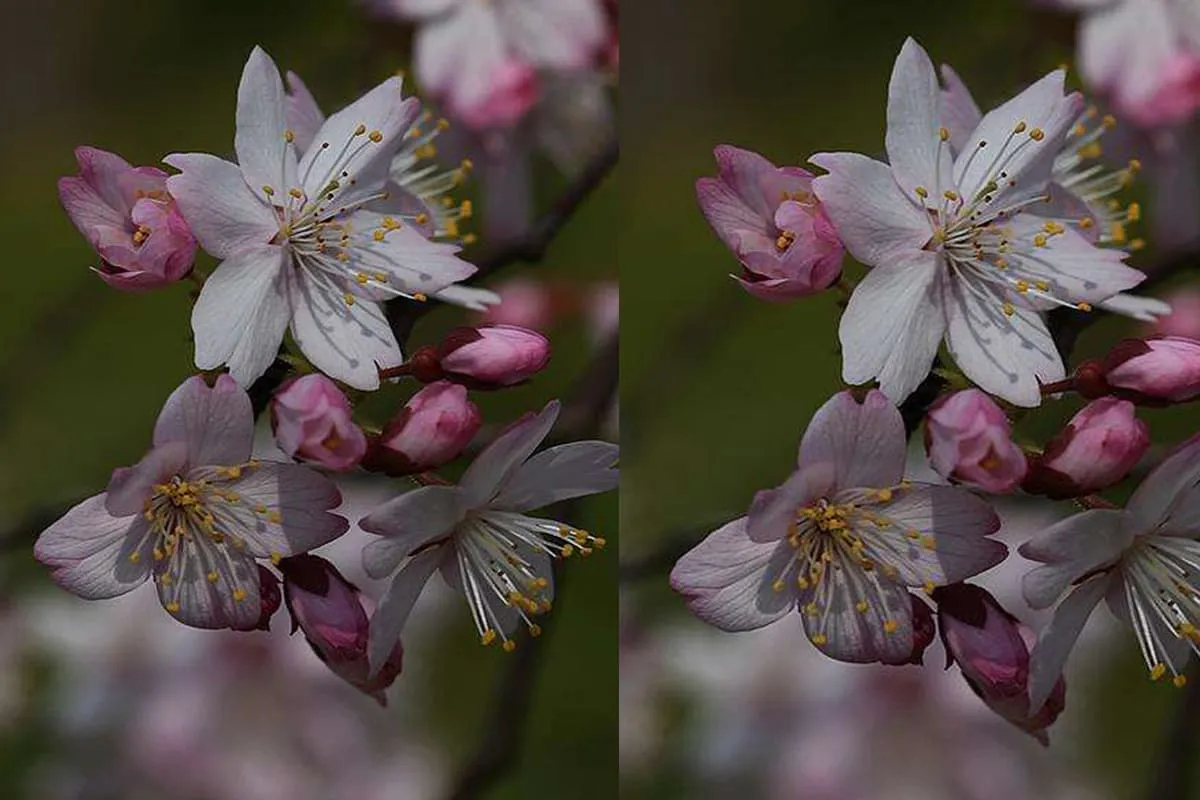
The Early Spring Cherry, native to China, grows in the provinces of Anhui, Zhejiang, and Jiangxi. This endangered plant blooms before its leaves appear, or occasionally blooms alongside them, typically showcasing two blossoms, though sometimes only one or three.
Its tender leaves display hues of green and reddish-brown, and it is renowned for its dense, petite, and charming blossoms.
As propagation typically occurs through seeding, the flowers on different plants can vary in color, ranging from light purple-red to pink and white, making it one of the most beautiful early-blooming cherry trees.
Basic Information
The Early Spring Cherry (scientific name: Cerasus discoidea Yu et Li) is a small deciduous tree that grows 2-3.5 meters tall with a bark that is grey-white in color. Its young branches are purplish-brown and covered with sparse soft hair, or are hairless after shedding.
Its winter buds are ovoid and hairless. Its leaves are ovate-oblong or elongated elliptical, dark green on top with sparse soft hair, and light green underneath, densely covered with soft hair when young. The flowers are pink and the stamens number between 32 and 40.
Its fruits are red, roughly 1 centimeter in diameter when ripe, with a slightly ridged surface. The flowering period is in March, and the fruiting period is in May.
Growth and Distribution
It grows in mountain valleys and forest streams, at altitudes of 200-1100 meters. It is found in the provinces of Anhui, Zhejiang, and Jiangxi in China.
Morphology and Characteristics
The Early Spring Cherry is a small deciduous tree, standing 2-3.5 meters tall, with grey-white bark. The winter buds are ovoid and hairless. The leaves are ovate-oblong or elongated elliptical, dark green on top, and light green underneath, densely covered with soft hair when young.
The flowers are pink, and the stamens number between 32 and 40. The fruit is red and roughly 1 centimeter in diameter when ripe, with a slightly ridged surface. The flowering period is in March, and the fruiting period is in May.
Planting Method
Before planting, level the ground and dig a pit 0.8 meters in diameter and 0.6 meters deep. Fill the pit with 10 centimeters of organic fertilizer. Place the seedling in the pit, ensuring that its roots stretch outward.
After filling the pit with soil, gently pull the seedling upward to allow the roots to spread. Make sure the planting depth is about 5 centimeters above the top layer of the seedling’s roots.
After planting, water thoroughly, and stake the tree to prevent it from being blown over by strong winds.
Watering
The seedling is prone to drought damage after planting. In addition to thoroughly watering it at planting time, water every 8-10 days thereafter to keep the soil moist but not waterlogged.
After watering, loosen the soil in a timely manner and cover the ground lightly with grass to reduce water evaporation.
Fertilization
The cherry tree should be fertilized twice a year, preferably with acidic fertilizer. One application should be in winter or early spring, using organic fertilizers such as bean cake, chicken manure, and mature compost.
The second application should be after the flowers have fallen, using quick-acting fertilizers such as ammonium sulfate, ferrous sulfate, and superphosphate.
Pruning
The main purpose of pruning is to remove wilted branches, overgrown branches, overlapping branches, and branches infested with pests or diseases.
After pruning, disinfect the wounds promptly with medication to prevent bacterial infection and rot.
Flower Preservation
July-August is the peak period for cherry bud differentiation.
Through reasonable tree body structure, increasing ventilation and light, and improving leaf photosynthetic efficiency, balance can be achieved between nutritional growth and reproductive growth, providing sufficient nutrients for bud differentiation.
Frost damage during the flowering period can be mitigated by using smoke, watering, and flower preservative sprays. Pay close attention to weather forecasts and changes in field temperature during the flowering period.
Disease and Pest Control
Gall Aphid
The adult and nymph aphids cluster on leaves and young buds, sucking their sap and causing the edges of the affected leaves to roll backwards into tube-like shapes. They multiply throughout the year, overwintering as eggs in crevices on the year-old branches or at the pruning cuts.
In early April of the following year, the overwintered eggs hatch. From spring to autumn, the aphids reproduce asexually, peaking in late June. In October and November, sexual aphids appear, mate, and lay eggs to overwinter.
Control Method: Refer to the control method for Chrysanthemum aphids. Thorough spraying is recommended, covering all branches and leaf buds, aiming for complete eradication and no recurrence.
Red Spider Mites
The pests feed by piercing leaf tissues and sucking out the sap, causing damage to chlorophyll. The leaves show grey-yellow spots or patches, turn orange, and fall off, sometimes completely.
Control Method: If only a few leaves are affected, they can be removed. If many leaves are affected, it’s best to apply pesticide early. Commonly used products include Acaricide, Trichloroacaricide, Rogor, Flower Insecticide, and Quick Kill Dimethoate.
Scale Insects
These pests damage leaves, branches, and fruits. Scale insects are generally wingless females and larvae that attach to branches, leaves, or fruits for their entire lives, causing leaves to yellow, twig tips to wilt, and overall weakening of the tree. They also induce sooty mold.
Control Method: In winter, spray a 40-50x solution of motor oil emulsion to kill overwintering female insects. During the peak hatching period of the larvae, a 1000-1500x solution of a 1:1 mix of 40% Oxidized Rogor, 40% Speed Kill, or 40.7% Lesbon with 80% Dipterex can be sprayed three times in succession. Alternating use of these products has been shown to be effective.
Gummosis
Gummosis is mainly caused by frost, freezing, pests, hail, excessive or insufficient moisture, improper fertilization, excessive pruning, overbearing, heavy clay soil, or overly acidic soil.
If it is caused by moth larvae burrowing into the trunk to lay eggs, the eggs can be removed with a sharp knife. At the same time, improve the soil and strengthen water and fertilizer management.
Root Knot Disease
Root knot disease can prevent the roots of affected trees from growing properly. No matter how much fertilizer is applied, the tree remains unhealthy. It’s important to promptly remove the tumors, disinfect the soil, and improve the soil with leaf mold, charcoal powder, and microbes.
Brown Spot Disease
This disease occurs from May to June, presenting as purple-brown spots on the leaves which gradually enlarge into circles. The affected parts of the leaves dry up and shrink into holes.
The fungi overwinter on diseased branches and leaves, with the optimal development temperature being 25-28°C. They spread by wind, with rainy seasons favoring infection.
When the tree is weak, drainage is poor, and ventilation and light are insufficient, the disease becomes severe.
Control Method: (1) Strengthen cultivation management, prune properly, and pay attention to removing diseased branches. Timely cleanup and incineration of diseased leaves create a clean growing environment for the plant.
(2) Before new shoots sprout, spray a 3-5x solution of Lime Sulfur. During the disease period, spray a 16x solution of Bordeaux mixture or a 1000-2000x solution of 50% Benlate Wettable Powder, or a 600-800x solution of 15% Thiram Zinc.
Leaf Blight
In summer, circular greenish-yellow spots appear on the leaves, which later turn brown and produce scattered black spots. The diseased leaves die but do not fall off.
Control Method: In areas where the disease is severe during the growing season, from late June to October, spray once every 10 days. A few consecutive sprays can effectively prevent and control the disease.
Commonly used drugs include a 1:1:100 solution of Bordeaux mixture, a 500-800x solution of 50% Topaz, a 1000x solution of 50% Polyoxin Wettable Powder (or a 600-800x solution of 40% Gel Suspension), a 1000-1500x solution of 50% Benlate, or a 500x solution of 65% Thiram Zinc. These can be chosen or alternated.
Value and Other
Main Value
Cherry blossoms are bright and beautiful with lush foliage, making them an important flowering tree species in early spring, often used for landscape appreciation. They can be planted in groups, or on slopes, courtyards, roadside, or in front of buildings.
When in full bloom, the tree is spectacular with its multitudes of gorgeous flowers, resembling clouds and mists.
They can be grown in large quantities to create a “sea of flowers” landscape, in clusters of three to five to create brocade groups in green spaces, or planted alone, forming a “red point in the green” artistic image. Cherry blossoms can also be used as walkway trees, hedges, or made into bonsai.
Differentiation of Close Species
The Winter-flowering Cherry and Short-stalked Cherry are similar in appearance. The difference lies in the latter’s leaf edges and stipules having conical glands at the tips of their serrations, and the bract edges are often torn, with long-stalked glands at the tips of the splits.
In the past, many people mistakenly identified this species as the Tailed Cherry. The difference lies in that the glands at the tips of the serrated edges of the leaves, stipules, and bracts of this species have no stalks, are disc-shaped, and the flowers are in pairs, rarely one or three.
The leaves have sparse soft hairs on both upper and lower surfaces, which can be used for differentiation.


 English
  العربية
  Bahasa Indonesia
  Deutsch
  Français
  Italiano
  Nederlands
  Português
  Русский
  日本語
日本語