600+ Types of Flowers A To Z (With Names and Pictures)
Types Of Flowers By Names (A-Z) Types Of Flowers By Color Types Of Flowers By Season Types Of Flowers By Blooming Time 600+ Types of Flowers No. Flower Name No.…

The Large-Leaf Early Cherry, also known as the Japanese Early Cherry, is a sight to behold during its peak blooming season.
Its vibrant and plentiful blossoms create a spectacular display, resembling clouds of crimson and pink. It can be planted en masse to create a “sea of flowers” landscape, or in smaller clusters to add splashes of color to green spaces, forming “bouquets”.
When the petals of the Japanese Early Cherry fall, the filaments remain for several days, looking like a red cloud from afar, a unique feature. Additionally, its leaves are hairy, providing a soft texture to the touch, which is a characteristic of wild cherry trees.
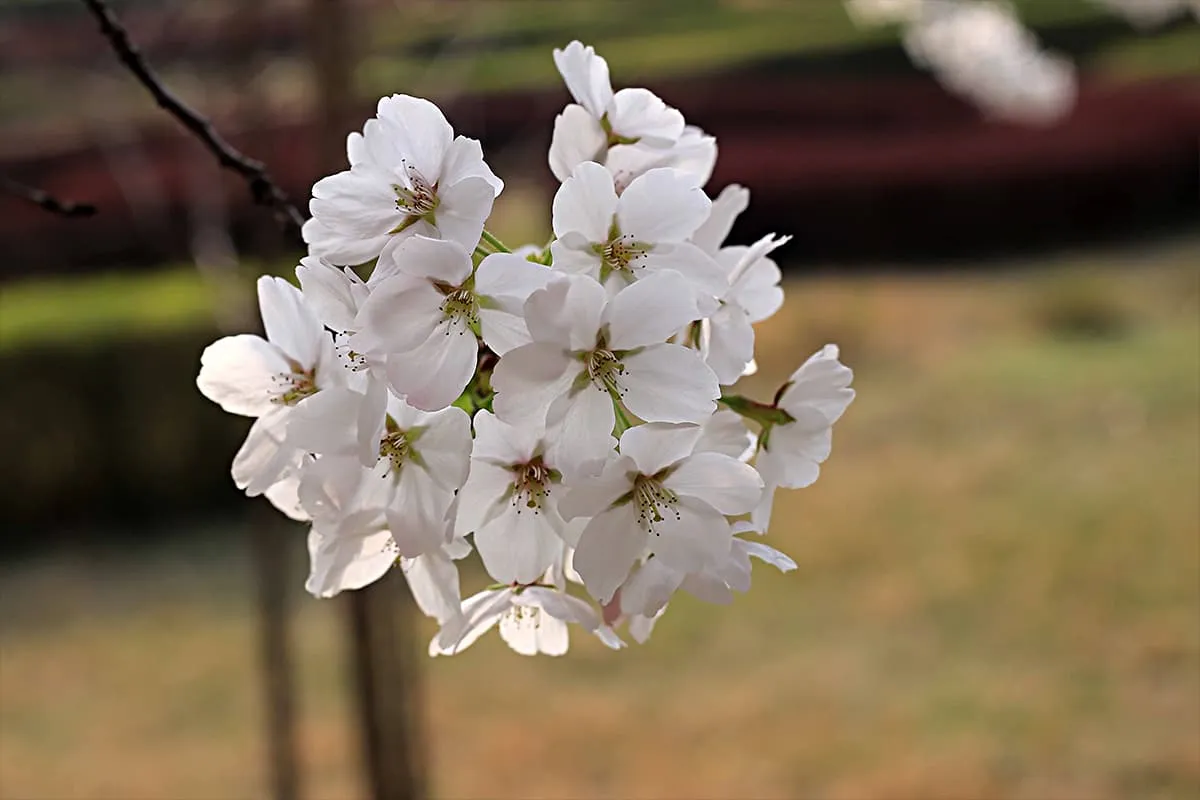
The Large-Leaf Early Cherry, a deciduous tree of the Rosaceae family, grows 3-10 meters tall with gray-brown bark. Its twigs are gray, young branches are green, and all are densely covered with white short hairs. The winter buds are oval-shaped with sparse hairs at the tip.
The leaves are oval to elongated oval in shape. The inflorescences are umbrella-shaped, blooming simultaneously with the leaves between March and April.
The petals are light pink and inverted oval in shape. The fruiting period is in June, with the drupe being oval and black. It is of high ornamental value.
The Large-Leaf Early Cherry originated in Japan and is now widely distributed in temperate areas of the northern hemisphere.
Large-Leaf Early Cherry (Original Variant) (Scientific name: C.subhirtella var.subhirtella.): It is found in Zhejiang, Anhui, Jiangxi, Sichuan, and other places. It is cultivated, originating from Japan.
Weeping Large-Leaf Early Cherry (Variant) (Scientific name: C.subhirtella var. pendula): Also known as Weeping Cherry. The branches and leaves form an arch shape with drooping twigs. The calyx tube is nearly smooth and hairless. It is cultivated in Taiwan, China.
The Large-Leaf Early Cherry originated in Japan and is now widely distributed in temperate areas of the northern hemisphere.
The Large-Leaf Early Cherry, a deciduous tree, grows 3-10 meters tall with gray-brown bark. Its twigs are gray, young branches are green, and all are densely covered with white short hairs. The winter buds are oval-shaped with sparse hairs at the tip.
The leaves are oval to elongated oval in shape, 3-6 cm long and 1.5-3 cm wide. The tip gradually narrows and the base is wide and wedged. The edges have fine sharp teeth and double teeth. The upper surface is dark green, hairless or with sparse hairs along the midrib.
The lower surface is light green, covered with white sparse hairs, especially dense along the veins. The veins are nearly parallel with 10-14 pairs.
The leaf stalk is 5-8 mm long and covered with white short hairs. The stipules are brown, extremely narrow, linear, shorter than the leaf stalk, and the edges have sparse glandular teeth.
The inflorescences are umbrella-shaped with 2-3 flowers that bloom simultaneously with the leaves. The general bracts are inverted oval, about 4 mm long, 3 mm wide, sparsely hairy on the outside, and fall off early.
The flower stalk is 1-2 cm long and covered with sparse vegetable soft hairs. The calyx tube is tubular, slightly jug-shaped, 4-5 mm long, 2-3 mm wide, slightly enlarged at the base, narrowed at the neck, covered with white sparse hairs on the outside, and the calyx lobes are long oval, sharply pointed at the tip, with sparse teeth, nearly equal in length to the calyx tube.
The petals are light pink, inverted oval, and concave at the tip. There are about 20 stamens. The pistil base has sparse hairs.
The drupe is oval, black, with slightly ridged surface; the fruit stalk is 1.5-2.5 cm long, covered with sparse hairs, and slightly enlarged at the top. It flowers from March to April and fruits in June.
The Large-Leaf Early Cherry prefers sunlight and a warm, humid climate. It is not demanding in terms of soil conditions, but loose, fertile, well-drained sandy soil is best. It does not tolerate saline-alkali soil.
Its root system is shallow and does not tolerate waterlogged low-lying areas. It has a certain degree of cold and drought tolerance. It has weak resistance to smoke and wind.
The Large-Leaf Early Cherry is typically found at altitudes between 620 and 1,100 meters.
The planting of Large-Leaf Early Cherry can be carried out in early spring or after leaf fall in late autumn. Compared to spring, autumn planting has a higher survival rate, earlier budding, and can also enable it to bloom. Spring planting should be done before early spring budding.
After planting, the flower buds should be removed to reduce nutrient consumption and ensure survival. When planting Large-Leaf Early Cherry in spring, it is best to carry a soil ball, with the diameter of the soil ball being 8 to 10 times the diameter of the trunk or ground.
In autumn, it can be planted without a soil ball, but the planting time should be shortened as much as possible. At planting time, an appropriate amount of well-fermented and fermented ring fertilizer should be applied as base fertilizer.
The base fertilizer should be thoroughly mixed with the subsoil to avoid fertilizer damage. It is worth noting that autumn planting should be moderately deep, with the planting depth being 3 to 5 cm higher than the soil ball or root. In spring, it should be level with the soil ball or soil mark.
Overly deep planting can easily cause bud suffocation. After planting, water should be poured immediately, a second watering should be done after two days, and a third watering should be done after three days.
After the Large-Leaf Early Cherry enters normal management, some sesame sauce residue and about 100 grams of sulfur-ammoniated fertilizer can be applied each year after flowering.
This fertilizer can timely replenish the nutrients consumed by flowering. In the fall, when the leaves fall, some well-fermented and fermented ring fertilizer or compost can be applied.
This fertilizer can make the plants grow more branches and leaves, have larger and more colorful flowers, and have a longer flowering period the following year. For some plants with weaker growth and smaller branches and leaves, while applying root fertilization, foliar fertilization can also be performed on the plants.
Different fertilizers can be applied according to different growth periods. In spring, a 0.5% urea solution can be applied. In summer, 0.2% dipotassium phosphate can be applied. In autumn, to prevent excessive growth of branches, fertilizer is generally not applied.
The Large-Leaf Early Cherry likes a moist environment. Before budding in early March in spring, water should be poured once to turn green.
This water must be sufficient and thorough. This can lower the ground temperature, delay germination, effectively prevent the harm of late spring cold, and also timely provide the water needed for plant budding.
In the North China region, the spring monsoon is strong and lasts for a long time, and the plant transpiration volume is large, so water should be appropriately poured in April and May.
For plants planted in lawns, they can be watered together when watering the lawn, and no additional watering is needed. In summer when there is more precipitation, water should be drained in time to prevent root rot due to excessive water.
However, in case of drought and less rain, appropriate watering is very necessary. The plants planted in the year can also be sprayed on the leaves when the climate is relatively dry. Spraying is generally done before 9 o’clock in the morning and after 5 o’clock in the afternoon.
In autumn, if it is not particularly dry, water is generally not poured, because excessive water can lead to excessive growth of branches, which is not conducive to the safe overwintering of plants. Before winter, sufficient watering should be combined with fertilization to pour antifreeze water.
This water is generally suitable from late November to early December, and the specific time depends on the temperature of the year. Watering too early or too late will not have the effect of cold prevention.
The common propagation method of Large-Leaf Early Cherry is grafting. The rootstocks can be peach, hairy peach, apricot, cherry, hairy cherry, and plum blossom.
Grafting can adopt budding and branch grafting. Moreover, grafting plum blossoms on peach rootstocks not only has a high survival rate, but the plants also grow vigorously and have a strong disease resistance. Budding is generally carried out in July and August.
The buds to be grafted must be robust, full, and free of diseases and pests. Branch grafting generally adopts the bark grafting method, which is carried out from mid to late March to early April.
After flowering and before budding in early spring, dead branches, weak branches, and excessively long branches should be pruned to avoid heavy pruning and maintain a round crown. It is mainly propagated by sowing, cutting, and grafting.
Care should be taken not to let the embryo dry out when propagating by sowing, and it should be sown or stored in wet sand until the following spring. Grafted propagation can use cherry and cherry seedlings as rootstocks.
Cherry blossoms mainly need protection against gummosis and root-knot disease, as well as pests such as aphids, red spiders, and scale insects.
Gummosis is caused by moths laying eggs inside the tree trunk, which can be addressed by using a sharp knife to remove the eggs, improving soil conditions, and strengthening water and nutrient management.
Root-knot disease disrupts normal root growth, leaving the tree unwell despite fertilization. It’s essential to promptly remove the root tumors, sterilize the soil, and improve soil conditions with leaf mold, charcoal powder, and microbes.
Pest prevention should be prioritized for aphids, red spiders, and scale insects, with 3 to 4 pesticide sprays annually. The first spray should be done before flowering, the second after flowering, and the third between July and August.
(1) Strengthen cultivation management, prune branches appropriately, and ensure diseased shoots are cut and leaves are cleaned and incinerated promptly to provide a clean growing environment for the plant.
(2) Before new shoots sprout, spray 3 to 5 Beauveria bassiana sulfur compounds. During disease outbreaks, spray 160 times Bordeaux mixture or 50% Benlate WP at 1000 to 2000 times dilution, or 15% Daisen zinc at 600 to 800 times dilution.
Landscaping
The large-leaf early cherry has high aesthetic value. When in full bloom, the flowers are plentiful and beautiful, filling the tree with a spectacular display that resembles clouds or mist.
The trees can be planted in large groups to create a “sea of flowers” landscape, or a few trees can be planted together in green spaces to form a “brocade group.” Single trees can also be planted to create a picture of “a red dot in a sea of green.”
Medicinal Use
The bark and wood of the cherry blossom contain Gentianic acid 5-glucoside and 5-sorbose glucoside (Sakurarin), cherry glycoside, and D-catechin. The stems and leaves contain quercetin 3-hemihexoside.
The tender leaves contain coumarin, trans-para-hydroxycinnamic acid glucoside, and cyanogenic glycoside. The seeds contain 32% fatty oil, mainly containing a-linolenic acid, beta-sitosterol, used for cough, fever, and other symptoms.
Skin Care
Cherry blossoms have good pore-tightening and oil-balancing effects, and they are rich in natural vitamins A, B, and E. Cherry leaf flavonoids also have beautifying effects, strengthen mucous membranes, and promote carbohydrate metabolism, making them an ideal flower for maintaining youthful skin.
Cherry blossoms soften and brighten the skin, making them an important ingredient in skincare products. Cherry blossoms usually need to be extracted and refined.
Experts have used high-tech extraction techniques to refine cherry blossoms into a delicate oil. A component in the cherry blossom extract, called cherry blossom enzyme, is commonly used for acne treatment.
The large-leaf early cherry can also be used for hedges and bonsai cultivation. It is also an excellent cut flower, with branches that can last for nearly half a month. Its leaves are also a popular food packaging material.

Peggie was once a high school mathematics teacher, but she set aside her chalkboard and textbooks to follow her lifelong passion for flowers. After years of dedication and learning, she not only established a thriving flower shop but also founded this blog, “Flowers Library”. If you have any questions or wish to learn more about flowers, feel free to contact Peggie.
 English
  العربية
  Bahasa Indonesia
  Deutsch
  Français
  Italiano
  Nederlands
  Português
  Русский
  日本語
日本語