The Jasminum nudiflorum, also known as Winter Jasmine, Yellow Jasmine, or Golden Belt, is a deciduous shrub that grows to a height of 30-100 centimeters.
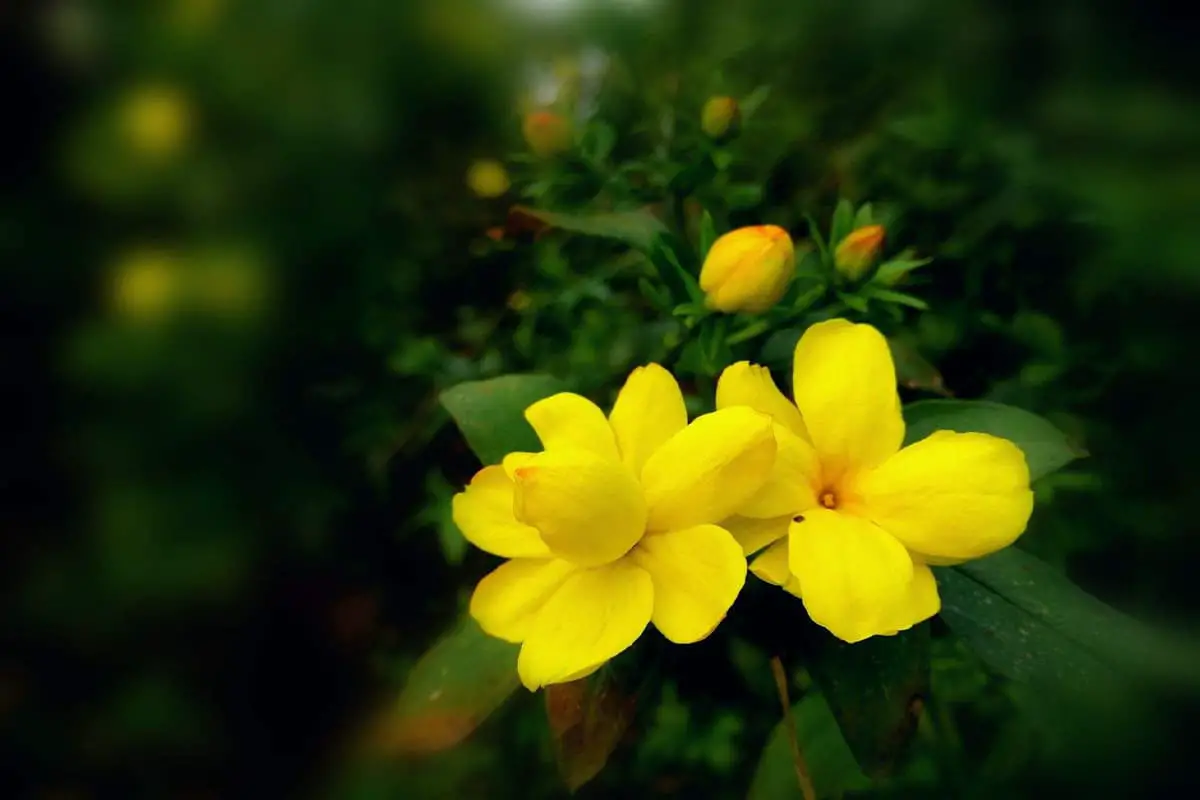
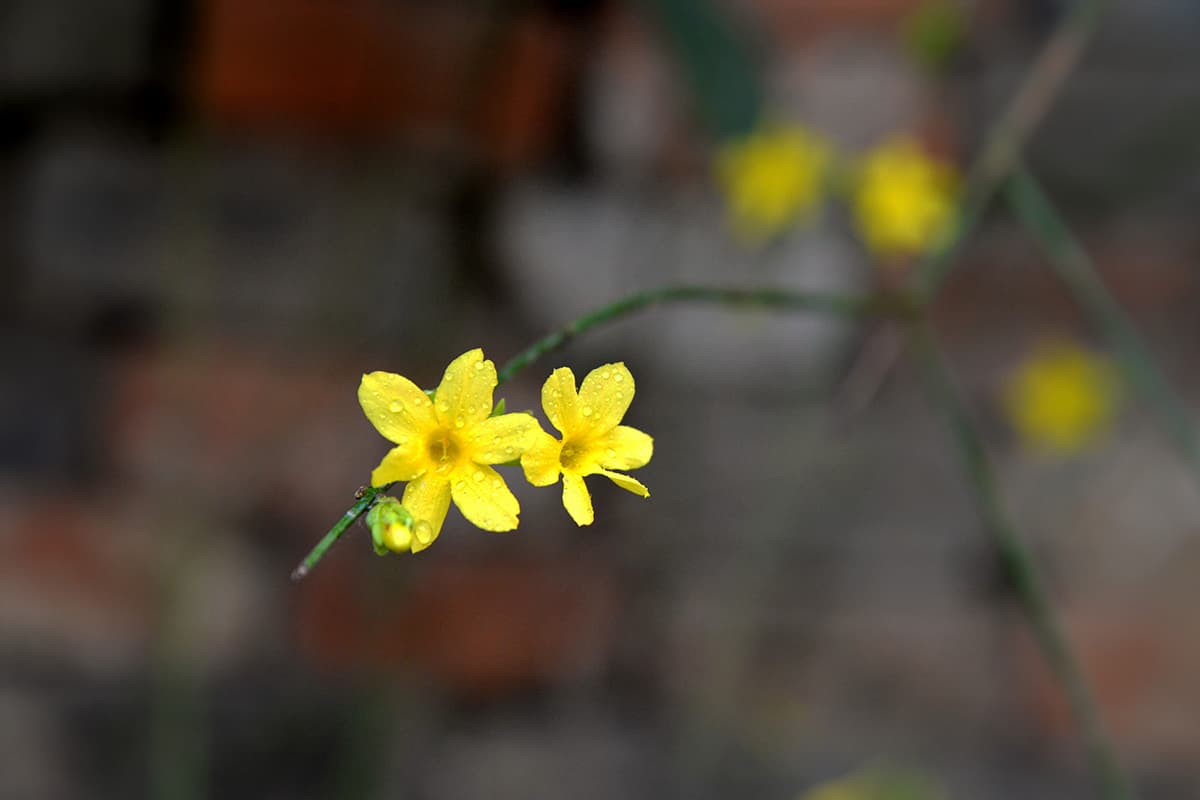
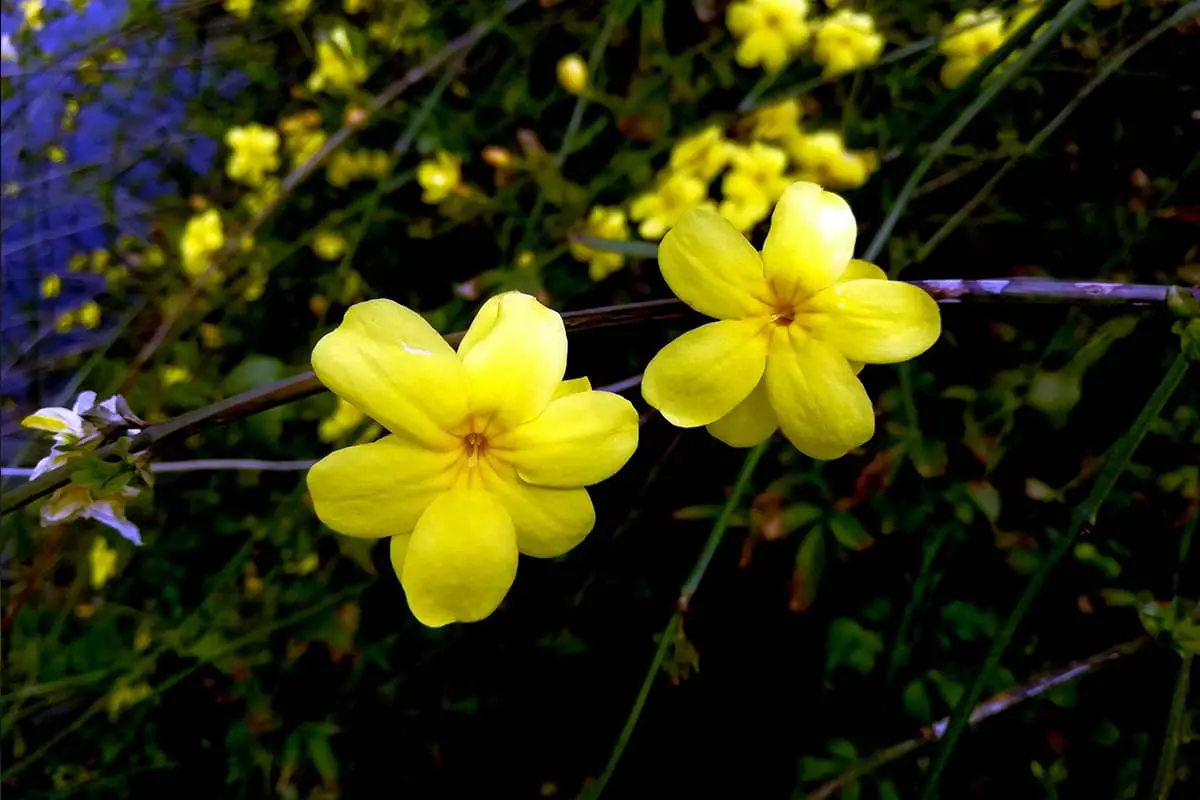
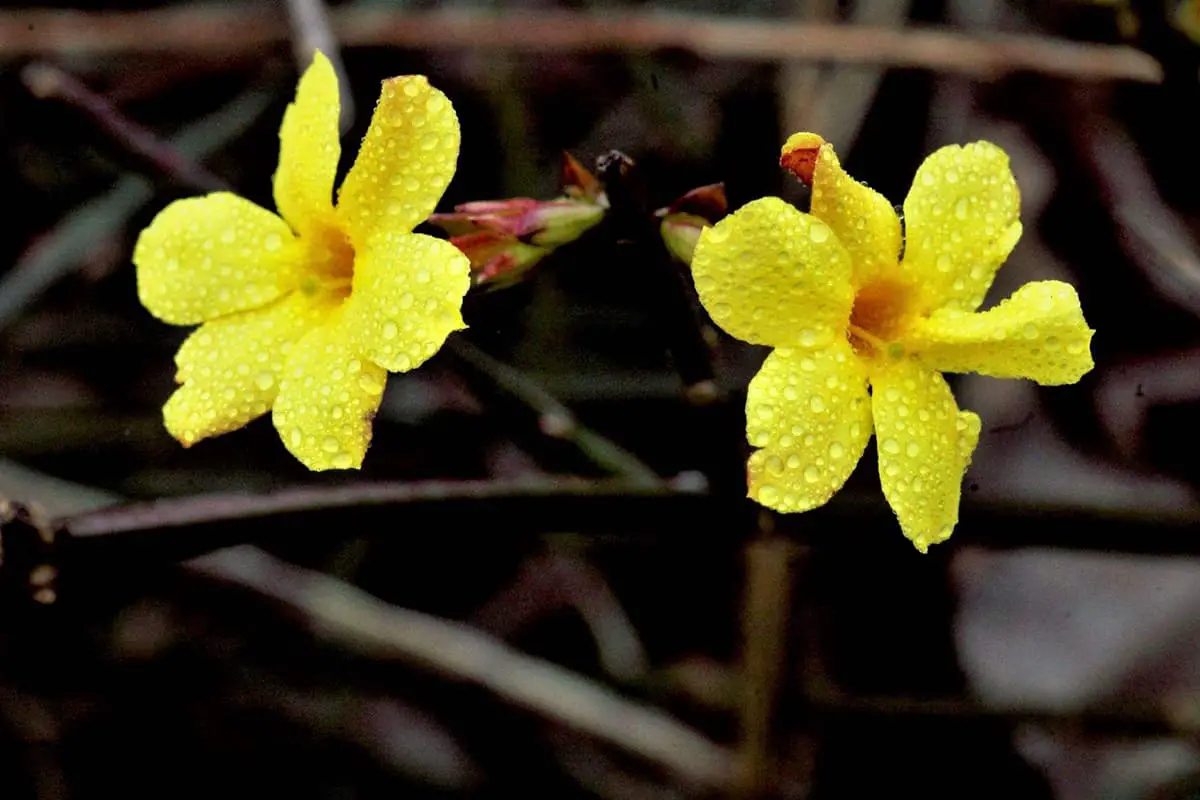
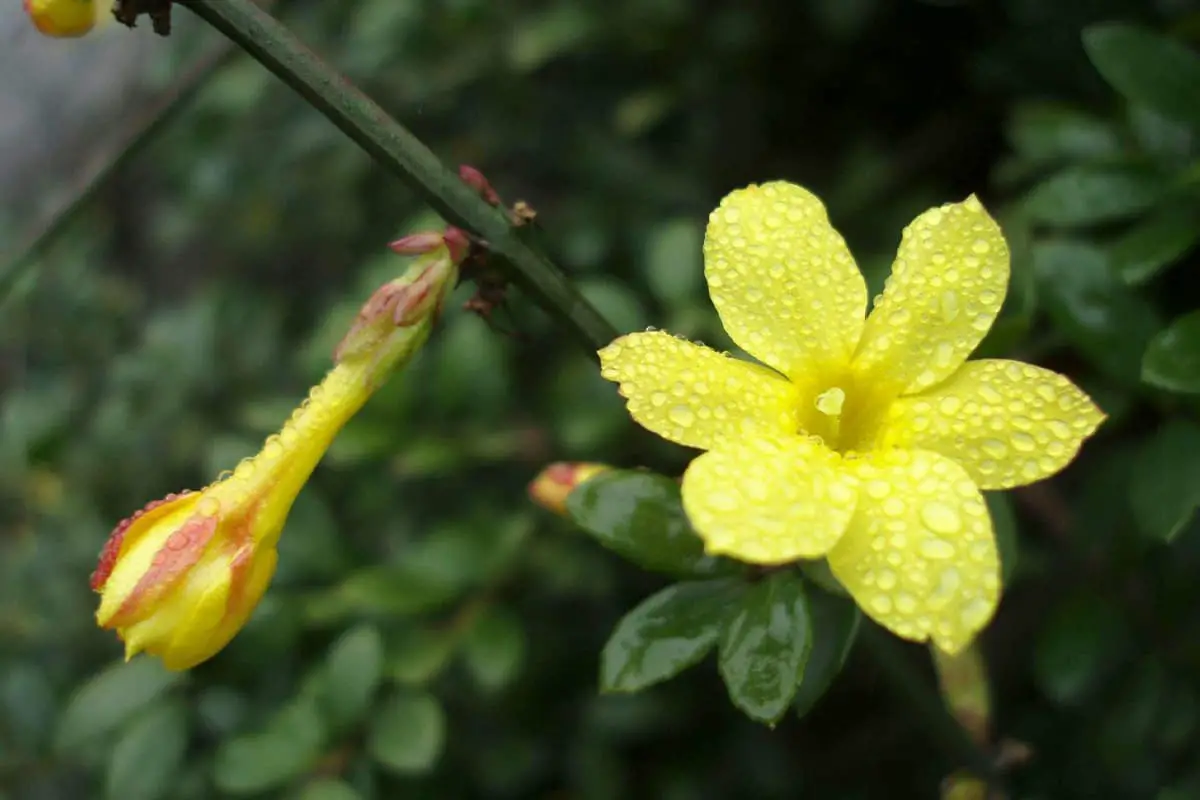
The flowers bloom singularly on last year’s branches, before the leaves, emitting a delicate fragrance. They are golden-yellow with a hint of red, blooming from February to April.
Named for its early bloom among other flowers, the arrival of its blooms signifies the coming of a spring filled with blossoming flora. Winter Jasmine, along with plum blossoms, daffodils, and camellias, are collectively known as the “Four Friends of the Snow.”
This plant is not only admired for its elegant and charming color but also its remarkable resilience to harsh cold, adaptability to diverse soils and climates, making it a favorite among people.
I. Morphological Features
Winter Jasmine is a deciduous shrub, growing upright or spreading, reaching heights of 0.3-5 meters, with drooping branches. The branches are slightly twisted, smooth, hairless, with quadrangular twigs, somewhat winged.
The leaves are opposite, trifoliate, often with single leaves at the base of the twig; the leaf axis is winged, the petiole is 3-10 millimeters long, hairless; the leaflets and leaflets are slightly hairy when young, and only have cilia at the edge when old; the leaflets are oval, long oval or elliptical, narrow elliptical, rarely oblong, the tip is acute or blunt, with a short pointed head, the base is cuneate, the leaf margin is revolute, the midrib is slightly depressed on the upper side, prominent on the lower side, the lateral veins are not obvious; the terminal leaflets are larger, 1-3 cm long, 0.3-1.1 cm wide, sessile or the base extends into a short petiole, the lateral leaflets are 0.6-2.3 cm long, 0.2-11 cm wide, sessile; the single leaves are oval or elliptical, sometimes nearly round, 0.7-2.2 cm long, 0.4-1.3 cm wide.
The flowers bloom singly in the leaf axils of last year’s twigs, rarely at the top of the twigs; the bracts are leaf-like, lanceolate, oval or elliptical, 3-8 mm long, 1.5-4 mm wide; the pedicels are 2-3 mm long; the calyx is green, with 5-6 narrow lanceolate segments, 4-6 mm long, 1.5-2.5 mm wide, the tip is acute; the corolla is yellow, 2-2.5 cm in diameter, the corolla tube is 0.8-2 cm long, the base diameter is 1.5-2 mm, gradually enlarging upwards, with 5-6 segments, oblong or elliptical, 0.8-1.3 cm long, 3-6 mm wide, the tip is acute or rounded. It blooms in June.
II. Growing Environment
This plant prefers sunlight, can tolerate moderate shade, and is slightly cold-resistant. It does not thrive in waterlogged conditions. It can overwinter in open fields in both the North China region and Yanling.
It requires a warm and humid climate, loose, fertile, and well-drained sandy soil. It grows vigorously in acidic soil, but poorly in alkaline soil. The plant has strong root sprouting ability. Branches that touch the ground easily root.
III. Distribution Range
It grows in shrubs on mountain slopes, at altitudes of 800-2000 meters. It is widely cultivated in China and around the world.
IV. Growth and Propagation
Mainly propagated by cutting, but can also be propagated by layering or dividing. Cutting: Can be done in spring, summer, and autumn. Cut semi-woody branches that are 12-15 cm long and insert into sandy soil. Keep the soil moist and it should root in about 15 days.
Layering: Bury longer branches shallowly in sandy soil without injuring them. They should root in 40-50 days and can then be separated from the parent plant and transplanted in the spring of the following year.
Dividing: Can be done when buds sprout in spring. When transplanting in spring, cut back some of the branches above ground and keep the original soil. Dry planting is also possible, i.e., watering thoroughly after inserting the cuttings into a prepared seedbed.
Cutting can be done from mid-October to mid-November or in spring. After rooting, the plant can be transplanted or propagated by division or layering.
V. Disease and Pest Control
Floral Leaf Disease
Symptoms: This systemic disease is caused by the Cucumber Mosaic Virus (CMV). Symptoms include smaller, malformed leaves with dark green streaks or yellowing. Infected plants may not flower, or if they do, the flowers are also small and deformed with streaks.
The disease is mainly transmitted by peach aphids and cotton aphids. The primary source of infection are diseased plants in the surrounding weeds.
Control Methods: First, timely weed removal is necessary to reduce the source of infection. Next, early prevention and control of aphids should be carried out to eliminate the virus carrier.
Brown Spot Disease
Symptoms: This disease, caused by fungi of the Phylum Ascomycota, often occurs on Primroses. Infected plants have brown spots on their leaves. The disease is spread by airborne spores carried by wind and rain.
Control Methods: The disease can be controlled by spraying a 70% solution of the fungicide Carbendazim at the onset of the disease.
Grey Mold Disease
Symptoms: This is a common disease of Jasminum nudiflorum, occurring throughout the country. After infection, the whole plant turns yellow and dies. The disease mainly infects leaves, tender stems, and floral organs, often manifesting at the leaf tips or edges.
Initially, leaves show water-soaked spots, which gradually enlarge, turn brown and decay. In the later stages, a gray-yellow mold layer forms on the surface of the disease spots. When the stem is infected, the disease spots turn brown and gradually rot.
Infected floral organs also turn brown, decay and fall off. The characteristic feature of this disease is the presence of a gray mold layer in damp conditions. The disease overwinters as sclerotia in diseased debris and soil.
It is easily spread in temperatures around 20°C with high air humidity, through wind, rain, tools, and irrigation water. The disease is most severe in greenhouses in late winter and early spring.
Control Methods: Maintain reasonable planting density. Ensure good ventilation to reduce air humidity. Remove diseased leaves and plants in time to reduce the source of infection.
At the onset of the disease, spray a solution of either 50% Carbendazim or 50% Hymexazol diluted 1500 times in water. It is best to alternate this with a 500 times diluted solution of 65% Captan to prevent resistance.
Spot Disease
Symptoms: This disease primarily harms the leaves of plants. It spreads from the lower part of the plant upward. The disease spots are usually 3 to 4 millimeters in diameter, brown and, when severe, cause leaf death and defoliation.
The disease is caused by Pseudomonas syringae. The fungus overwinters on diseased debris as mycelium or conidia and seeds can also carry the fungus, becoming the initial source of infection in the second year.
The disease primarily spreads through airborne conidia and rainwater, with frequent reinfections during the growing season.
Plants are more susceptible to the disease in warm, humid weather and when nitrogen fertilizer is applied excessively. The disease generally begins in July and is prevalent from August to October.
Control Methods: Breed disease-resistant varieties, strengthen fertilizer and water management, apply more organic fertilizer and phosphorus and potassium fertilizer, and avoid excessive use of nitrogen fertilizer.
At the onset of the disease, spray a solution of 70% Methotoprin diluted 1000 times and 75% Carbendazim diluted 1000 times, or use a 1:1:100 Bordeaux mixture.
Leaf Spot Disease
Symptoms: This disease often occurs on leaves and flower stalks. Initial symptoms are water-soaked, irregular spots along the leaf veins, which later turn yellow and brown. As the disease spots enlarge, the leaf edges dry up. In severe cases, the lower leaves die off.
Control Methods: Strengthen cultivation management, breed disease-free seedlings, and disinfect the seedbed soil. Greenhouses should be ventilated in time to reduce air humidity.
Remove diseased plant debris in time. After the onset of the disease, spray a solution of 50% Copper Soap diluted 500 times or a solution of 72% Agricultural Streptomycin diluted 4000 times.


 English
  العربية
  Bahasa Indonesia
  Deutsch
  Français
  Italiano
  Nederlands
  Português
  Русский
  日本語
日本語