600+ Types of Flowers A To Z (With Names and Pictures)
Types Of Flowers By Names (A-Z) Types Of Flowers By Color Types Of Flowers By Season Types Of Flowers By Blooming Time 600+ Types of Flowers No. Flower Name No.…

Clivia Miniata, known as the Large-Flowered Clivia or Giant Leaf Lily, is a perennial herbaceous plant of the Amaryllidaceae family and Clivia genus.
Originating from southern South Africa, it’s predominantly an ornamental flower. Its flowering period extends from 30 to 50 days, primarily in winter and spring, with blooms also appearing from New Year’s Day to around the Chinese Spring Festival. It’s a semi-shade-loving plant, avoiding strong light and high temperatures, and favoring cool conditions.
Clivia Miniata boasts numerous varieties, with its leaves shiny and dark green, and its large, vibrant flowers. Aesthetically pleasing, it combines the beauty of its flowers, leaves, and fruit, making it a favorite among flower enthusiasts and a common sight in many households.
Clivia, also known as Sword-Leaf Lily or Giant Leaf Lily, is another perennial herbaceous plant from the Amaryllidaceae family and Clivia genus, originating from southern South Africa. It’s also mainly an ornamental flower. Its blooming period spans 30 to 50 days, primarily during winter and spring, while also blossoming around New Year and the Spring Festival.
Preferring a semi-shaded environment, it avoids strong sunlight and high temperatures, thriving in cool conditions. Its optimal growth temperature ranges from 15 to 25℃, and growth ceases below 5℃. The plant favors rich, well-draining, and moist soils, avoiding dry conditions. With its high ornamental value, Clivia is often found in greenhouses across China for viewing. Propagation is through division or seeds.
Other varieties with similar benefits include the Drooping Clivia (C.nobilis), widely cultivated in greenhouses worldwide with diverse flower colors. Clivias can live for several decades or even longer. It is the city flower of Changchun.
To date, five types of Clivia have been discovered: the Drooping Clivia, Large-Flowered Clivia, Fine-Leaf Clivia, Stalked Clivia, and the Strange Clivia. Additionally, a variety called the Marsh Clivia was discovered in 2004 in southern Natal. Only these six types of Clivia are recognized by the South African Clivia Association.
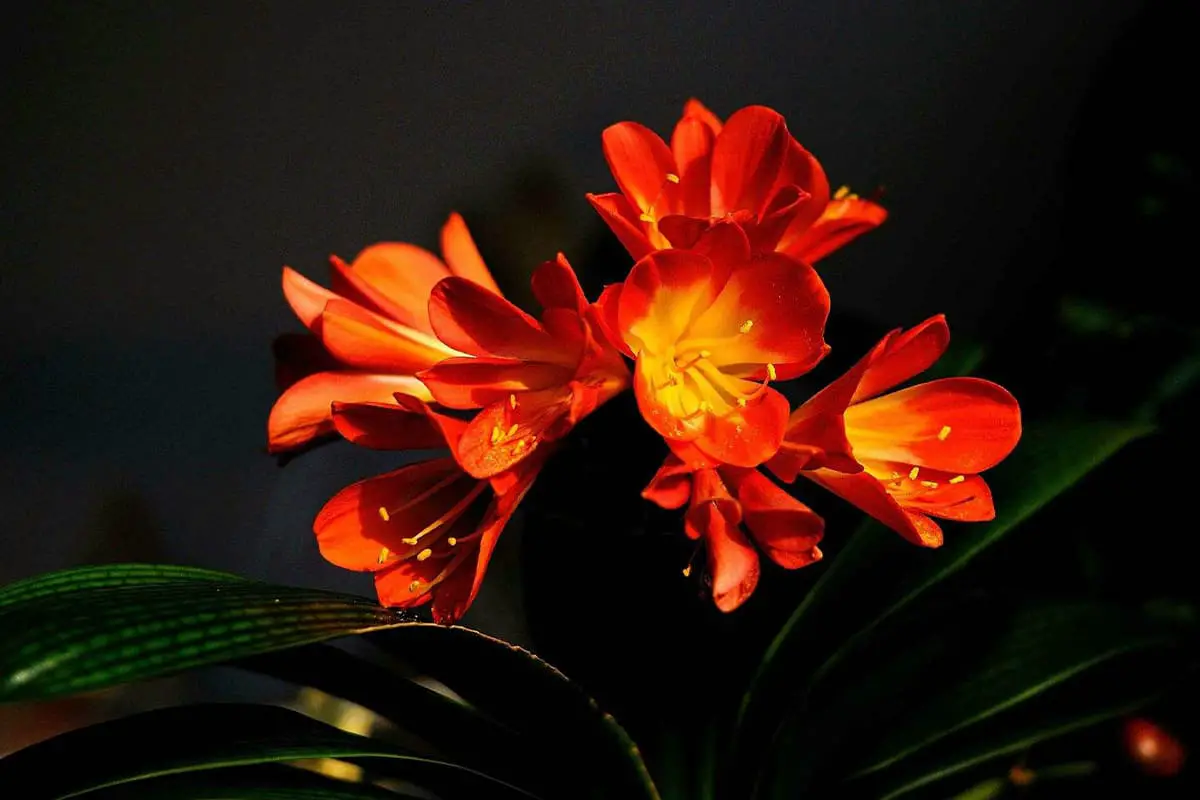
The leaf width of this variety generally doesn’t exceed 50mm, and rarely reaches 90mm. The flowers can have thin petals or wide petals, resembling a trumpet. The inner petals are generally wider than the outer ones.
The color of the flowers is typically orange with a yellow-white core, although colors range from very light to dark red. The lightest and darkest flower colors are relatively rare. A typical flower bud contains around 20 flowers, sometimes reaching up to 40. The berries hold 1-20 seeds, typically fewer than 10.
The Large-Flowered Clivia is a perennial herb. Its fleshy roots are white and unbranched. Leaves are numerous, leathery, alternate, neatly arranged in a fan shape, and evergreen. The stem is a shortened stem. Its flowers are limited and arranged in an umbel shape.
The flower stalk is flat, fleshy, and solid. The small flowers have a stem, funnel-shaped, and colors vary from orange-yellow, pale yellow, orange-red, light red, to deep red. Immature fruit is green, maturing to purple-red. The seeds are large and spherical.
This plant typically stands 80-130 millimeters tall. It has bright green, very narrow leaves that stretch 350-900 millimeters in length and 25-60 millimeters in width, with sharp tips. The blooming period extends from late fall into winter.
The blossoms are usually a vibrant orange, with a distinct green at the tip of each petal. Other color variants range from yellow to red. The blossoms arc downwards, but not as dramatically as in Stalked Clivia or Pendulous Clivia. Each berry typically contains 1-2 seeds, maturing over 12-15 months.
The height of this plant varies from 500 to 1500 millimeters. The mature plant has an above-ground stem, reaching a length of 1 meter, and even up to 3 meters under exceptional conditions. Its leaves are soft, flat, and sharp, bowing at about 35-70 millimeters wide and 30-60 centimeters long.
The plant usually flowers in spring and summer. The blooms hang downward in a pendulous manner, with an orange hue and green tips. The round, red berries contain 1-4 seeds, and are about 9-13 millimeters in diameter. The seeds typically mature in winter, approximately 6 months after pollination.
Only officially recognized as a species in 2004, the Swamp Clivia, like all other Clivia species, is indigenous to South Africa and is often found in sandy acidic soils.
The Swamp Clivia is a larger species that can grow up to 1.8 meters tall and, in swampy areas, occasionally reaches a staggering 4.5 meters in root length. The leaves are flexible with smooth edges, rounded tips, and a pale white stripe down the middle. The length of the leaves usually falls between 30 and 120 centimeters, with a width of 3-9 centimeters, and a typically colorless base.
The Swamp Clivia usually flowers from March to August, with each inflorescence bearing 15-40 small, pendulous, trumpet-shaped flowers with green tips and orange petals. The flower stalk transitions from red to green. The spherical, red fruit typically contains no more than 4 seeds, taking 12 months to mature.
The robust Yellow Clivia prefers warm, humid, semi-shaded environments, and requires well-drained, fertile loamy soil. It is not cold-resistant. In the South China region, it can be arranged in flower beds or used as cut flowers. In East China and areas north of the Yangtze River, it is usually kept as an indoor potted plant, appreciated for its leaves and flowers.
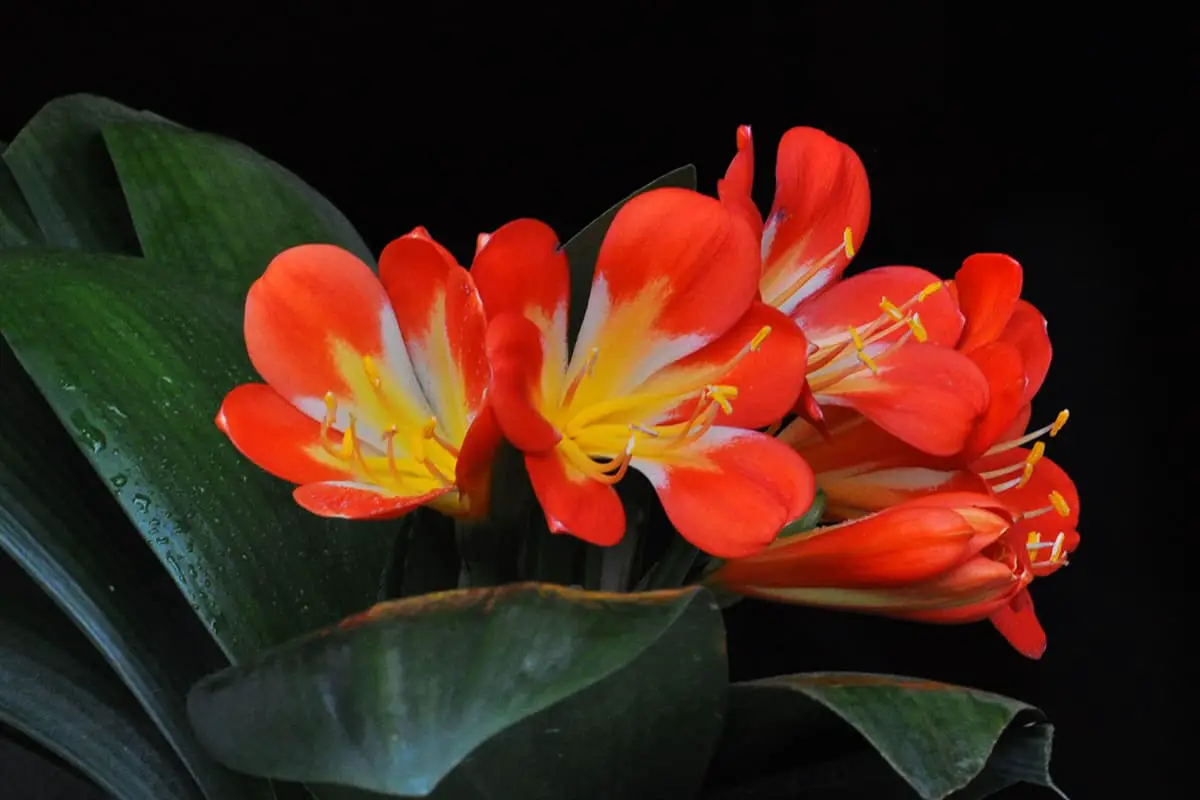
The Quaint Clivia was discovered in the Northern Cape Province of South Africa. It grows in humus-filled crevices on rocky mountain slopes, either individually or in clusters. The areas where the Quaint Clivia thrives usually feature semi-arid Mediterranean climates with a winter rainy season.
All leaves display a white stripe down the middle, setting this species apart from other Clivias. Its seeds mature in just 5 months. The Quaint Clivia was officially recognized in February 2001. This Clivia is still found in specially protected natural areas today.
When cultivating Quaint Clivia, it is important to note its preference for humus-rich soil and semi-shaded environments. Given its love for semi-arid conditions, it requires a relatively dry environment during the summer.
Its leaves are very tough and rough, ribbon-shaped, approximately 300-800 millimeters long and 25-50 millimeters wide. The tips of the leaves are very blunt. The inflorescence generally carries 20-60 small, pendulous flowers. They are usually a dark tangerine color, with green petal tips.
However, flower colors also range from a soft yellow to dark red. The fruit typically contains 1-2 seeds, with a red skin that takes about 9 months to mature. The young seedlings sprouted from the seeds have very narrow leaves, about 1.5 millimeters thick.
The growth period of the Pendulous Clivia is very long. From a single seed to blooming, it requires 8 to 10 years, or even longer. Given the characteristics of the flowers, they are very easily confused with Garden Clivias. Due to its very long growth cycle, it’s speculated that the “Pendulous Clivia” that was once popular in China might have actually been Garden Clivia.
Clivia is native to the tropical regions of southern Africa and grows under trees. Therefore, it fears both intense heat and cold, preferring a semi-shaded and humid environment, and strong direct sunlight should be avoided.
The optimal temperature for growth is between 18-28℃. Below 10℃ or above 30℃, growth is inhibited. Clivia likes a well-ventilated environment and deep, fertile, loose soil. It thrives in loose, fertile, slightly acidic organic soil. Clivia is a famous greenhouse flower, suitable for indoor cultivation.
Clivia is native to the subtropical mountain forests in the southern part of Africa, where it’s a perennial evergreen herbaceous plant. Two species have been introduced from Europe and Japan, and they’re also found in the UK and the US, where they are commonly cultivated.
Clivia has a fleshy, fibrous root system that is milky white and very robust. Its roots are thick and fleshy. The base of the Clivia stem forms a pseudobulb as the bases of the leaves expand and wrap around each other.
The leaves, which are neatly arranged in two alternating rows, emerge from the short stem at the root. They are wide, ribbon-shaped, rounded at the top, hard, thick, glossy, and veined. The basal leaves are thick, sword-like, leathery, dark green, glossy, ribbon-shaped, 30-50 centimeters long (up to 85 centimeters), 3-5 centimeters wide, narrowing at the bottom, arranged alternately, and have a whole margin.
The flower stalk emerges from the leaf axils, generally flowering when it reaches about 15 leaves if grown from a seed. The flower stalk is about 2 centimeters wide; the small flowers have stems and are arranged in an umbel at the tip of the stalk.
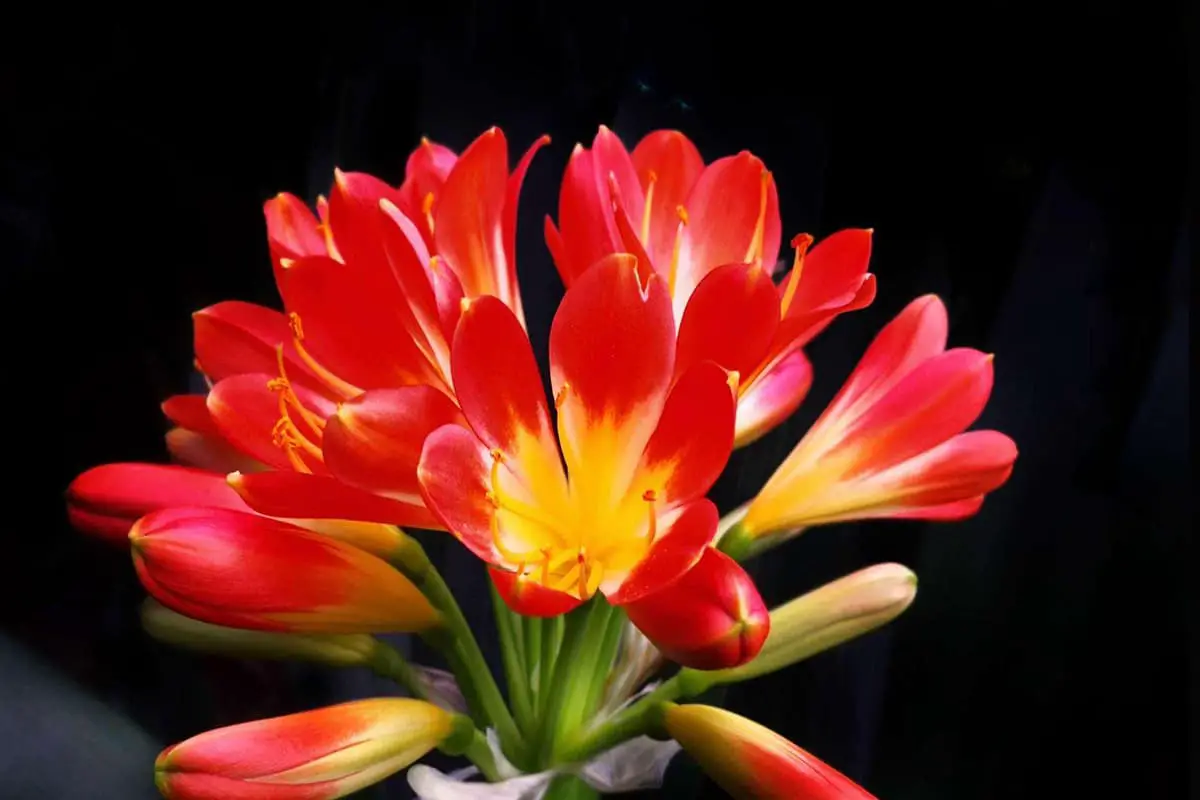
The flowers are funnel-shaped, upright, and come in shades of yellow, orange-yellow, or orange-red. The umbellate inflorescence is terminal, with several bracts arranged like roof tiles. Each inflorescence has 7-30 flowers, with some carrying more than 40. The six floral segments are fused. Pendulous Clivia flowers hang slightly and are narrowly funnel-shaped.
The flower stalks are 2.5-5 centimeters long; the flowers face upward, are funnel-shaped, and a bright red color, slightly yellow on the inside; the floral tube is about 5 millimeters long, with the outer tepals ending in a slightly convex tip and the inner tepals slightly concave, slightly longer than the stamens; the pistil is long and slightly protrudes from the flower.
The berries are purple-red, broadly ovate. The blooming period is from New Year’s Day to the Spring Festival, mainly in spring and summer, but it can bloom all year round, sometimes even in winter, and also blooms in summer, around June and July. The fruit matures around October, is a berry, and is purple-red. Both the flowers and leaves are beautiful.
As mentioned earlier, Clivia is native to the tropical regions of southern Africa and grows under trees. It’s afraid of both intense heat and cold, prefers a semi-shaded and humid environment, and avoids strong direct sunlight.
The optimal temperature for growth is between 18-28℃, with growth inhibited below 10℃ or above 30℃. Clivia likes a well-ventilated environment and deep, fertile, loose soil, and it grows well in loose, fertile, slightly acidic organic soil. It’s a famous greenhouse flower suitable for indoor cultivation.
There is a certain correlation between the roots and leaves. When new roots and leaves sprout, new leaves also emerge, and the roots are eliminated.
As long as the leaves do not wilt, maintain soil moisture during maintenance. Be careful not to overwater, let it dry out, or water too frequently, then new roots will grow again, and the plant can survive. Damaged leaves can also affect the roots.
Under normal circumstances, Clivia blooms once a year, generally when it has more than twelve leaves. If the indoor temperature is appropriate, it can bloom around the Spring Festival. Known as the flower of wealth and honor, mature Clivia generally blooms once a year, it’s rare for it to bloom twice a year, and blooming three times is extremely rare.
Choosing the right seedling is the first step to successfully cultivating Clivia. The seedling doesn’t have to be big, but try to choose one with bright, thick leaves. The clearer the leaf veins, the better. If the vein pattern can be clearly seen or even felt, then this Clivia can be considered a top-quality variety.
The choice of soil is also very important. Generally, loose, fertile, sandy soil is suitable. After the first year of cultivation, the potting soil should be replaced every year to avoid yellowing of the Clivia leaves due to soil compaction.
Clivia prefers indirect light. Generally, in winter, it can be placed directly in a sunny place, but in other seasons, it should receive scattered light. Especially in the summer, you need to be careful to provide shade to avoid direct sunlight, which can cause plant burns.
Watering Clivia has always been a big issue. Many people either overwater or underwater, which leads to root rot or yellow leaves in Clivia.
In fact, Clivia doesn’t need to be watered very often, because its fleshy root system can store some moisture. Generally speaking, the Clivia sold in flower markets is grown in very loose soil like pine needles, and these Clivia need to be watered about once every 3 to 5 days.
If you’re growing Clivia in heavy, sticky garden soil, you only need to water it once every 1 to 2 weeks, because the water in the soil doesn’t evaporate well, and too much water can lead to waterlogging. Of course, the scientific method of watering is to water when the top 2 to 3 cm of soil is dry, and then thoroughly water the Clivia.
Fertilize more often in spring and autumn. This is when growth is vigorous and the need for nutrients is greater. Apply a weak liquid fertilizer about once every half a month, or use fermented, ripe cake fertilizer. If the plant is in the growth stage, add 2 to 3 more applications of phosphorous liquid fertilizer.
The method of pollination is as follows: when the flower splits after 2-3 days, the buds mature and there is mucus secretion on the pistil, it’s time to pollinate. When pollinating, dip a new brush in the pollen of the stamen and gently shake it onto the pistil.
To increase the rate of fruit set, you can pollinate once between 9-10 am and 2-3 pm. About 8-9 months later, the seeds mature. When the fruit skin gradually changes from green to dark purple, you can cut off the fruit cluster, and after 10-20 days, peel out the seeds.
Before sowing, soak the seeds in warm water at 30-35℃ for 20-30 minutes, then take them out and dry them for 1-2 hours (if you can soak them in a 10% sodium phosphate solution for 20-30 minutes, wash them clean, then soak them in clean water for 10-15 hours, it would be even better), then sow them in the culture soil.
After sowing, put the flower pot in an environment with a room temperature of 20-25℃ and a humidity of about 90%, and about 1-2 weeks later, the embryonic root will sprout.
Before starting seed propagation, you need to prepare the cultivation soil first. There are many materials that can be used to make cultivation soil, but one that is relatively easy to obtain is loose soil taken from the surface of the forest, which is rich in fully decomposed organic matter. This can be mixed with one-third clean fine sand.
Clivia prefers slightly acidic soil, with a pH value of 6-6.5 being appropriate. The timing requirements for propagating Clivia by seeding are not strict; seeding can be done in spring, autumn, and winter. However, temperature is an important factor, and it is best to sow at temperatures of 20-25℃, which meets the temperature requirements for bud germination.
Breeding substrate: You can use planed wood shavings, sawdust, or fine sand, some also use decomposed leaves, but it’s best to use planed wood shavings or sawdust. Then find a plastic basket, or you can use a breathable pottery pot.
For example, with planed wood shavings as the base soil, first disinfect it, then soak the disinfected wood shavings in water, put them in the basket, press them down, and level them.
Seeds: Put the seeds in warm water, about 20-30 degrees, soak for 30 minutes, or an hour, then one by one, place the seeds with the small eye facing down, space them out, and arrange them in order.
After arranging, cover the seeds with 2-3 cm of planed wood shavings, and gently press it flat and tidy.
After the above steps are completed, spray water through the soil, and place the basket in a ventilated and breathable place.
Flower asexual reproduction includes cuttings, division, layering, grafting, and other methods, but Clivia generally only uses division propagation, and this method is more common for Clivia.
When dividing, first remove the mother plant of Clivia from the pot, remove the old soil, and find the buds that can be divided. If the offspring is growing on the edge of the mother plant and the plant is small, you can hold the bulb part with one hand and pinch the base of the offspring with the other hand, tear it a little, and you can break the offspring away from the mother plant; if the offspring is robust and not easy to break off, you should use a prepared sharp small knife to cut it off.
Do not force a break to avoid damaging the young plant. After the offspring is cut off, immediately apply dry charcoal powder to the wound to absorb the liquid and prevent rot. Then, plant the offspring. When planting, the planting depth should bury the base bulb of the offspring, and the part close to the seedlings should be slightly higher, and cover it with disinfected sand.
After planting, water it immediately, and after 2 weeks when the wound is healed, add another layer of cultivation soil. Generally, new roots will grow in 1-2 months, and flowers will bloom in 1-2 years. The Clivia propagated by the division method has stable inheritance and can maintain various characteristics of the original species.
Before starting seed propagation, you need to prepare the cultivation soil first. There are many materials that can be used to make cultivation soil, but one that is relatively easy to obtain is loose soil taken from the surface of the forest, which is rich in fully decomposed organic matter. This can be mixed with one-third clean fine sand.
Clivia prefers slightly acidic soil, with a pH value of 6-6.5 being appropriate. The timing requirements for propagating Clivia by seeding are not strict; seeding can be done in spring, autumn, and winter. However, temperature is an important factor, and it is best to sow at temperatures of 20-25℃, which meets the temperature requirements for bud germination.
Breeding substrate: You can use planed wood shavings, sawdust, or fine sand, some also use decomposed leaves, but it’s best to use planed wood shavings or sawdust. Then find a plastic basket, or you can use a breathable pottery pot. For example, with planed wood shavings as the base soil, first disinfect it, then soak the disinfected wood shavings in water, put them in the basket, press them down, and level them.
Seeds: Put the seeds in warm water, about 20-30 degrees, soak for 30 minutes, or an hour, then one by one, place the seeds with the small eye facing down, space them out, and arrange them in order.
After arranging, cover the seeds with 2-3 cm of planed wood shavings, and gently press it flat and tidy.
After the above steps are completed, spray water through the soil, and place the basket in a ventilated and breathable place.
Flower asexual reproduction includes cuttings, division, layering, grafting, and other methods, but Clivia generally only uses division propagation, and this method is more common for Clivia.
When dividing, first remove the mother plant of Clivia from the pot, remove the old soil, and find the buds that can be divided. If the offspring is growing on the edge of the mother plant and the plant is small, you can hold the bulb part with one hand and pinch the base of the offspring with the other hand, tear it a little, and you can break the offspring away from the mother plant; if the offspring is robust and not easy to break off, you should use a prepared sharp small knife to cut it off.
Do not force a break to avoid damaging the young plant. After the offspring is cut off, immediately apply dry charcoal powder to the wound to absorb the liquid and prevent rot. Then, plant the offspring. When planting, the planting depth should bury the base bulb of the offspring, and the part close to the seedlings should be slightly higher, and cover it with disinfected sand.
After planting, water it immediately, and after 2 weeks when the wound is healed, add another layer of cultivation soil. Generally, new roots will grow in 1-2 months, and flowers will bloom in 1-2 years. The Clivia propagated by the division method has stable inheritance and can maintain various characteristics of the original species.
Clivia, due to unsuitable cultivation conditions, often causes the invasion of pathogens, leading to diseases. Mild cases affect its ornamental value, and severe cases lead to plant death. Therefore, it is very necessary to diagnose the types of Clivia diseases early and take prevention and treatment measures in a timely manner.
Leaf Wilt Disease
The disease occurs at the tender leaf tip, and the symptoms develop from top to bottom. When severe, the entire leaf turns yellow and wilts. This disease is due to a physiological disease caused by over-fertilization or overwatering, known as root rot or root neck rot, which is a serious disease caused by a fungus invading the root.
If the plant is over-fertilized, you need to change the pot soil, put a layer of fine sand under the root, and the pot soil should be loose and decomposed leaf soil, with a neutral pH. If it’s overwatered, you need to control the watering amount and remove the yellow leaves, and the plant can still recover to normal growth.
Leaf Spot Disease
This is when yellow small spots occur on the leaves, the disease spots enlarge, and the diameter can reach about 3?5 millimeters, round; the disease spots spread and merge into one, the leaves will wilt and turn yellow.
Another type is large spots on the leaves with irregular shapes, yellow-brown to gray-brown, slightly ringed, and black spots appear on the back of the disease spots in the later stage. Both of the above diseases are due to poor ventilation, with scale insects parasitizing, causing the growth of the plant to weaken.
The prevention and treatment methods are: applying 0.5% potassium permanganate solution to the disease spots, or spraying with 50% carbendazim 1000 times liquid; if the disease is severe, you need to remove the affected leaves, burn them, and use sterile cotton wool to absorb the wound.
Bacterial Rot Disease
This disease is caused by mechanical damage or the harm of scale insects, leading to bacterial invasion, harming the leaf sheath and leaf heart. You should cut off the rot, use defatted cotton to absorb the wound, and then apply 0.02% streptomycin.
Treatment of Clivia Root Rot
When Clivia is divided, the wound is not disinfected and is infected by bacteria; or during cultivation, excessive watering, poor soil permeability, over-concentrated fertilization, and the use of unripe fresh fertilizer are all common causes of Clivia root rot.
In adult Clivia, if individual roots rot, it will show that some leaves are dry, the leaves turn black, and fall off. Find out the cause, overcome it, and stop the root rot from continuing.
When many roots rot, most of the leaves will fall off, leaving only the small center tongue leaves. When it’s severe, the plant will become unstable, shaking with a gentle touch.
At this time, when you remove the pot, you can see that some of the fleshy roots have completely rotted, and some are half-rotten. The rotten roots only leave a layer of shriveled membrane skin, and after a while, the skin will also become soft and rotten. When this happens, all the soil should be shaken off, and the roots should be washed clean with water.
The rotten roots should be carefully removed, and the rotten parts should be cut off with clean scissors. Then soak the roots in a 0.1% concentration of potassium permanganate solution for disinfection. After 5 minutes, take out the roots, rinse off the disinfectant with water, dip a small amount of sulfur powder or wood ash, and after the surface is dried indoors, repot the plant.
When repotting, it should be shallow, and it is enough to bury the stem disc. The pseudobulbs should be exposed to the surface, which is conducive to root development. After watering once, keep it in a semi-shade for maintenance. Later, spray more or add a plastic film cover to try to make the air humidity higher and water less.
Maintain a temperature of around 20℃ until you see the growth of the small tongue leaves. At this time, new roots have been issued, and it can be transferred to normal water and fertilizer management. For small seedlings with few roots and very tender, if root rot occurs, the roots will rot quickly and the leaves will droop.
In these cases, you should remove the plant from the pot in time, clean the residue on the stem disc that has not yet rotted, rinse, disinfect, and after the surface is dry, insert it into the plain sand soil according to the cutting method.
In an environment of 20-25℃, keep it shaded, maintain a high air humidity and the moistness of the cutting soil, let it send out new roots, wait for the leaves to recover vitality, and promptly repot it with leaf mold soil.
The common pest of Clivia is scale insects. When pests occur, scale insects often gather on the tender shoots of the leaves, sucking the leaf juice, secreting a large amount of bacteria, turning the stems and leaves into a moldy black color, causing soot disease, and causing the leaves to wilt.
This insect reproduces strongly, can occur multiple generations in a year, a female adult insect can often reproduce hundreds of insects, if not treated in time, it can cause death.
Control methods: Prevention should be the main focus. You should often check the plant body and find pests, treat them early to prevent them from spreading. The control of scale insects can be done manually and with medicine. If only one or two leaf shoots are found to be infested, you can manually scrape them off, use a sharp stick or bamboo to pick off the insect body.
If a large number of nymphs appear, you can use a 1000-fold solution of 25% imidacloprid to spray and kill, or you can use a 40% diazinon emulsion with 1000-1500 times water to make a solution to spray. Generally, spraying 1-2 times can kill them.
In addition, it’s important to note that earthworms can also become pests of Clivia. During the juvenile stage of Clivia plants, their fleshy roots are very tender and weak. If there are earthworms in the pot soil, they often burrow everywhere, causing damage to the tender roots, disrupting the function of Clivia’s nutrient absorption, causing the plants to stop growing or causing root rot.
The control method is: To pay frequent attention to whether there are round soil particles on the surface of the pot soil. If found, you can immediately irrigate with a solution made of 50% diazinon emulsion and 1500-2000 times water. If earthworms appear after irrigation, remove them immediately; repeat the same process after a week, and you can eliminate the earthworms.
Economic Value
The value of Clivia refers to the relationship between human needs and the attributes of Clivia, that is, Clivia can satisfy people’s multiple needs for beautifying rooms, cultivating sentiment, purifying air, and promoting health. It adds elegance and grandeur to your living space, enriching and adding radiance and charm to people’s lives.
It is beautiful and tolerant of shade, suitable for indoor pot decoration, ideal for viewing leaves and flowers, and is an ideal potted flower for arranging venues and decorating hotel environments. It also has the function of purifying air and medicinal value, making it a choice variety for people.
Ornamental Value
Clivia, with its elegant and beautiful plant shape, bright and erect leaves, large and colorful flowers, and bright red fruits, is known for its beauty in leaves, flowers, and fruits. It has the reputation of being beautiful in one season, being admired for its fruits in three seasons, and admired for its leaves in all four seasons.
Its flowering period lasts for forty to fifty days, and it can bloom in early spring, making it an important festive flower. Clivia is a perennial evergreen herb, with excellent leaves, flowers, and fruits, and its leaves are even more admirable than its flowers.
The purpose of Clivia flowering is to pollinate, fertilize, set fruit, and become a berry to reproduce offspring. The fruit needs about 8-9 months of growth time to grow from small to large, change from green to red, and the seeds can mature. Therefore, Clivia has the reputation of being admired for its fruits in three seasons.
In the Clivia family, the Guo Yi Cai Lan and Guo Yi Clivia are both prides of the Clivia family, both domestically and abroad. Their leaves have obvious distributions of green, yellow, white, light green, dark green, and gray colors.
The green, yellow, and white are distinct, shiny and charming, with a sense of three-dimensionality, transparency, and freshness, and they have extremely high ornamental value.
Environmental Value
1. Clivia absorbs carbon dioxide and releases oxygen
During the growth and development of Clivia, although it can absorb water and mineral nutrients from the soil to synthesize organic substances (such as amino acids, amides, etc.), it’s not sufficient for its overall physiological activities.
It must carry out photosynthesis using sunlight, temperature, carbon dioxide, and water. This has extremely important significance for the growth and development of Clivia, beautifying rooms, purifying indoor air, and enhancing people’s physical health.
2. Clivia absorbs dust
The body of the Clivia plant, especially its large and thick leaves, has many stomata and trichomes, which can secrete a large amount of mucus. Through air circulation, it can absorb a large amount of dust, soot, and harmful gases, filtering the indoor air, reducing the dust content in the indoor space, and making the air clean. Therefore, Clivia is praised by people as an ideal “absorber” and “dust remover”.
3. Beautifying the Room
Placed at the door, it shows the owner’s gentleman style. As soon as guests enter the door and see Clivia, they immediately understand the style the host aspires to. It is evident that Clivia is an excellent spokesperson.
Placed on the dining table, it beautifies the indoor environment. When not eating, placing a small pot of Clivia on the dining table makes the entire dining room look elegant, reflecting the host’s desire for an elegant life from another perspective.
Medicinal Value
Clivia is both beautiful and useful, and the entire plant can be used as medicine. In addition to beautifying the environment, it also has certain medicinal value. Clivia plants contain lycorine and clidine, as well as trace elements such as selenium.
Medical workers use Clivia plants containing these chemical components for scientific research and have used them to treat cancer, hepatitis, liver cirrhosis ascites, and poliovirus. Experiments have proven that lycorine extracted from Clivia leaves and roots not only has antiviral effects, but also resists cancer.
Experiments have shown that lycorine mainly exhibits a significant inhibitory effect on the aerobic or anaerobic fermentation of cancer cells.
Lycorine carries a positively charged quaternary salt, which can bind to negatively charged tumor cells, and negatively charged phenolic ions can enter positively charged tumor cells, thereby resisting cancer.
Lycorine is mainly used in the treatment of gastrointestinal tumors, such as gastric cancer, liver cancer, esophageal cancer, and it also has certain efficacy for lymphoma and lung cancer.
The Language of Clivia Flowers
The flower language of Clivia represents the humility, gentleness, and politeness of a gentleman, as well as wealth, nobility, and elegance. This is because its elegant and noble posture, like a humble and polite gentleman, has been loved by people since ancient times. It can be given to people around who have gentlemanly demeanor.
The Symbolism of Clivia
Its thick and smooth leaves stand upright like a sword, symbolizing a strong, unyielding, and noble character. Its full bloom and brilliant colors symbolize wealth, good luck, prosperity, and happiness, which is why people widely cultivate it.
The reason why Clivia is particularly loved is not only because of its bright and beautiful flowers, but also because it has a shining point that other flowers cannot compare: it has not only eye-catching flowers, but also appreciable shiny green leaves, as if waxed, crystal clear, radiant. Therefore, many experts in appreciating flowers believe: even without gorgeous flowers, the leaves of Clivia, like emeralds, are already beyond the reach of some ornamental foliage plants.

Peggie was once a high school mathematics teacher, but she set aside her chalkboard and textbooks to follow her lifelong passion for flowers. After years of dedication and learning, she not only established a thriving flower shop but also founded this blog, “Flowers Library”. If you have any questions or wish to learn more about flowers, feel free to contact Peggie.
 English
  العربية
  Bahasa Indonesia
  Deutsch
  Français
  Italiano
  Nederlands
  Português
  Русский
  日本語
日本語