600+ Types of Flowers A To Z (With Names and Pictures)
Types Of Flowers By Names (A-Z) Types Of Flowers By Color Types Of Flowers By Season Types Of Flowers By Blooming Time 600+ Types of Flowers No. Flower Name No.…

The Cirsium japonicum, a member of the Asteraceae family, is native to Korea, Japan, and Taiwan. It thrives in altitudes ranging from 400 to 2,100 meters, typically found in wastelands, grasslands, hillside forests, roadsides, shrubberies, fields, forest edges, and along streams.
It is also cultivated for medicinal purposes. The plant produces purple or rose-colored flowers with slender corolla tubes and unevenly sized lobes.
The achene is elongated oval in shape, with feathery pappus slightly shorter than the corolla, and dark grey in color. It blooms from June to August. The flower symbolizes caution, rigor, gravitas, and silent love.
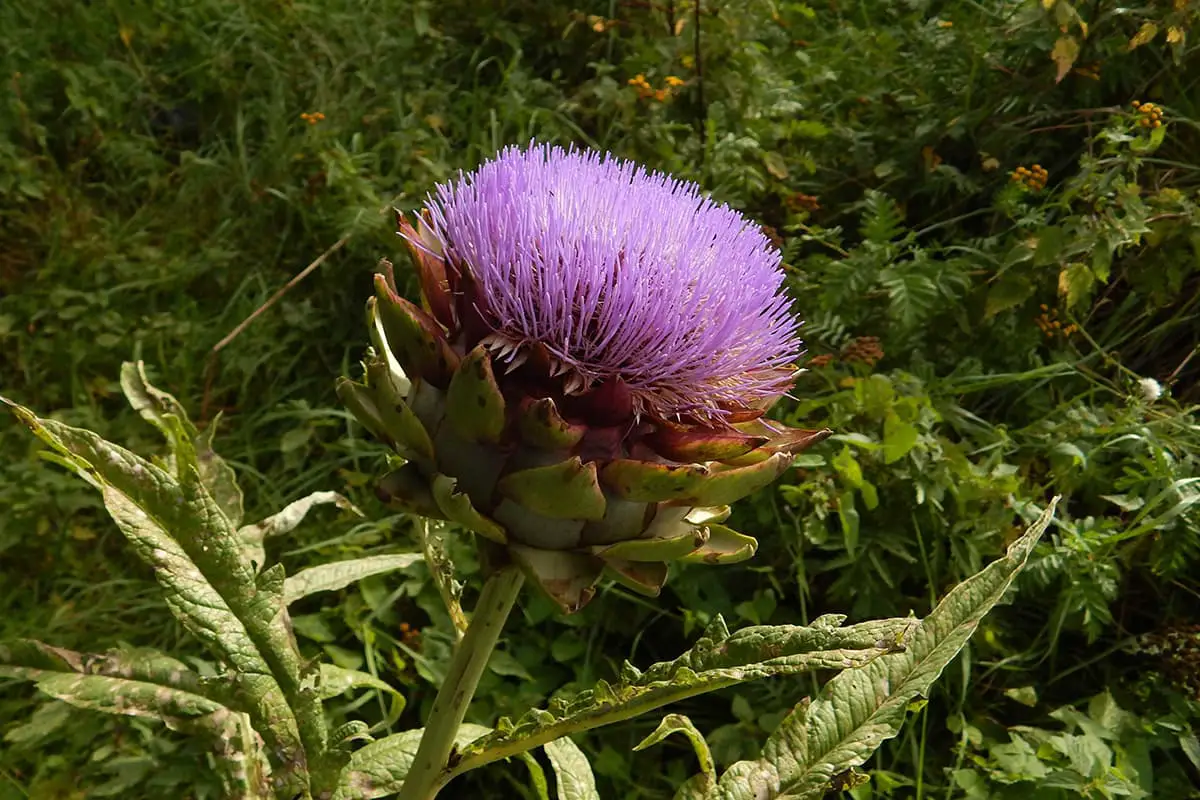
This perennial herb has a spindle-shaped or radish-like taproot, up to 7 mm in diameter. The stem is erect, measuring 30(100)-80(150) cm, either branched or unbranched, with dense or sparse multicellular long septate hairs on all branches.
The lower part of the capitulum is greyish-white, covered with dense woolly hairs and multicellular septate hairs.
The plant has white filamentous hairs at the base. The basal leaves are petiolate and do not wither during flowering, they are lanceolate or ovate-elliptic, 15-30 cm long, green on the surface and sparsely covered with long hairs.
The backside along the veins has long hairs, while the edges are pinnately divided, with 5-6 pairs of elongated oval lobes with spiny edges.
The middle leaves are elongated oval, sessile, embracing the stem, with pinnately deep-divided edges with spines, while the upper leaves gradually reduce in size.
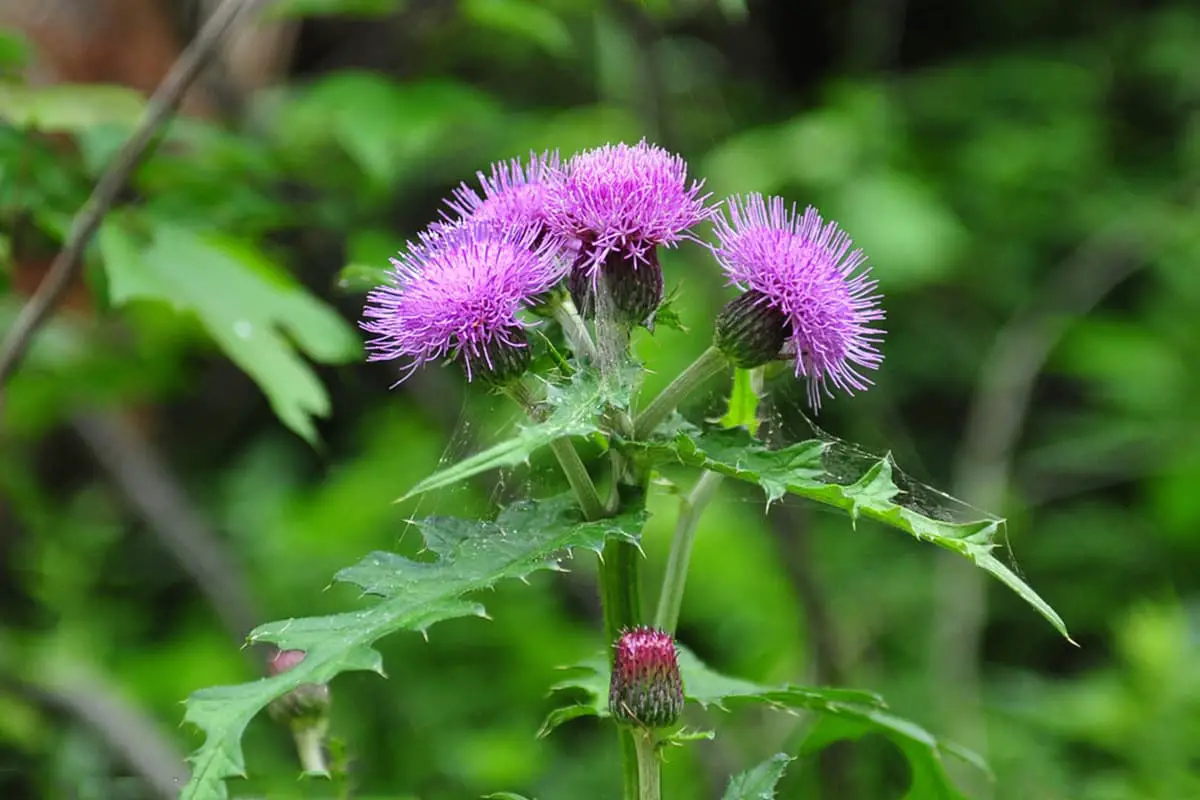
The capitulum is terminal and spherical; the involucre is 3.5-2 cm long and 3-4 cm wide, with cobwebby hairs on the outside and multilayered linear-lanceolate involucre bracts.
The outer layers are shorter than the inner ones, with pointed tips and short spines; the innermost layer is longer and spineless. The flowers are purple or rose-colored, with slender corolla tubes and uneven lobes.
The achene is elongated oval, with feathery pappus slightly shorter than the corolla, dark grey in color. It blooms from June to August. When a leaf of Cirsium japonicum is broken, a white milky liquid flows out.
The plant has an astonishing regenerative ability; if its stem is broken, new buds sprout directly from the broken surface.
The basal leaves are larger, oval, long ovate, elliptic or long elliptic, 8-20 cm long, 2.5-8 cm wide, pinnately deeply divided or almost completely divided, gradually narrowing to a short or long winged petiole, with spiny and serrate edges on the petiole wing.

The marginal lobes are 6-12 pairs, with the middle lobes larger and the downward and lateral lobes gradually smaller, all lobes are sparsely or densely arranged, ovate-lanceolate, semi-elliptic, oblique triangular, long triangular or triangular-lanceolate.
The width varies greatly, ranging from 3 cm wide to as narrow as 0.5 cm, with small, uneven serrations along the edges, or larger serrations that make the entire leaf appear distinctly doubly divided.
The tip of the spines can be as long as 6 mm or as short as 2 mm, with small, dense or almost no spines along the serrated edge. The terminal lobe is lanceolate or long triangular.
The leaves gradually decrease in size from the base upwards, similar in shape to the basal leaves and equally divided, but sessile, with the base enlarged to half-clasp the stem.
All stem leaves are the same color on both sides, green, with sparse multicellular long or short septate hairs along the veins on both sides, or almost hairless.
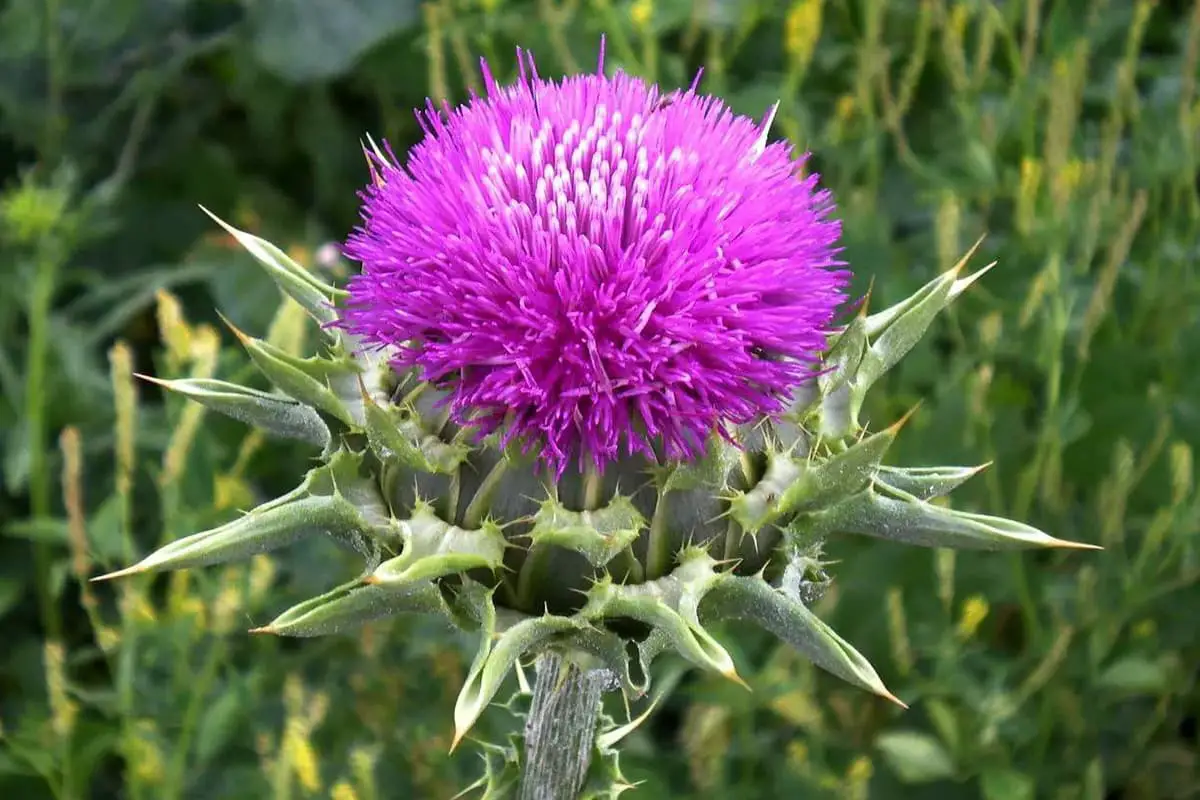
The corymbose inflorescence stands upright, with few drooping, and a few grow at the end of the stem with an extremely short inflorescence, not arranged in an obvious inflorescence pattern, and few have single corymbs growing at the stem end.
The general involucre is bell-shaped, with a diameter of 3 cm. The involucral bracts are arranged in about 6 layers, arranged like roof tiles, gradually lengthening towards the inner layer.
The outer and middle layers are ovate-triangular to elongated triangular, 0.8-1.3 cm long and 3-3.5 mm wide, with a gradually pointed apex and 1-2 mm long needle thorns; the inner layer is lanceolate or linear-lanceolate, 1.5-2 cm long and 2-3 mm wide, with a gradually pointed apex in the form of a soft needle.
All the bracts have slightly rough hair on the outside and sticky glands along the midrib.
The achene is flattened, obliquely wedge-shaped to inverted lanceolate, 4 mm long and 2.5 mm wide, with an oblique truncate apex. The florets are red or purple, 2.1 cm long, with a corolla lip 1.2 cm long, unevenly 5-shallowly lobed, and a tube 9 mm long.
The pappus is light brown, multilayered, joined at the base to form a ring, and falls off as a whole; the pappus bristles are stiff and feather-like, up to 2 cm long, and the inner layer is spindle-shaped or tapered towards the apex. The flowering and fruiting period is from April to November.
It grows in forest slopes, forest edges, shrubs, grasslands, wastelands, fields, roadside or streamsides, at an altitude of 400-2100 meters.
It is distributed in Japan and Korea. The type specimen was collected from Japan.
The whole plant is used medicinally to treat hemorrhage due to heat, the leaves treat blood stasis, and it is used externally to treat malignant sores.
The whole plant contains alkaloids and volatile oils. Fresh leaves contain high levels of inulin. Its root is used in medicine for its blood cooling, hemostatic, stasis dispelling and swelling reducing effects.

Peggie was once a high school mathematics teacher, but she set aside her chalkboard and textbooks to follow her lifelong passion for flowers. After years of dedication and learning, she not only established a thriving flower shop but also founded this blog, “Flowers Library”. If you have any questions or wish to learn more about flowers, feel free to contact Peggie.
 English
  العربية
  Bahasa Indonesia
  Deutsch
  Français
  Italiano
  Nederlands
  Português
  Русский
  日本語
日本語