600+ Types of Flowers A To Z (With Names and Pictures)
Types Of Flowers By Names (A-Z) Types Of Flowers By Color Types Of Flowers By Season Types Of Flowers By Blooming Time 600+ Types of Flowers No. Flower Name No.…

Albizia julibrissin, also known as the “Mimosa Tree” or the “Silk Tree”, is a deciduous tree from the Rosales order, Fabaceae family, and Albizia genus. The Mimosa Tree can reach heights of up to 16 meters, with an expansive crown.
Its smaller branches have ridges and angles, and its young branches, inflorescences, and leaf axils are covered with velvet or short soft hairs. The tree’s stipules are linear lanceolate and its leaves are small and early-falling.
The flowers are pink with a tubular calyx that measures 3 millimeters in length. The corolla is 8 millimeters long with triangular lobes that are 1.5 millimeters long.
The stamens measure 2.5 centimeters in length. The blooming period is from June to July, making it an ideal city street or ornamental tree.
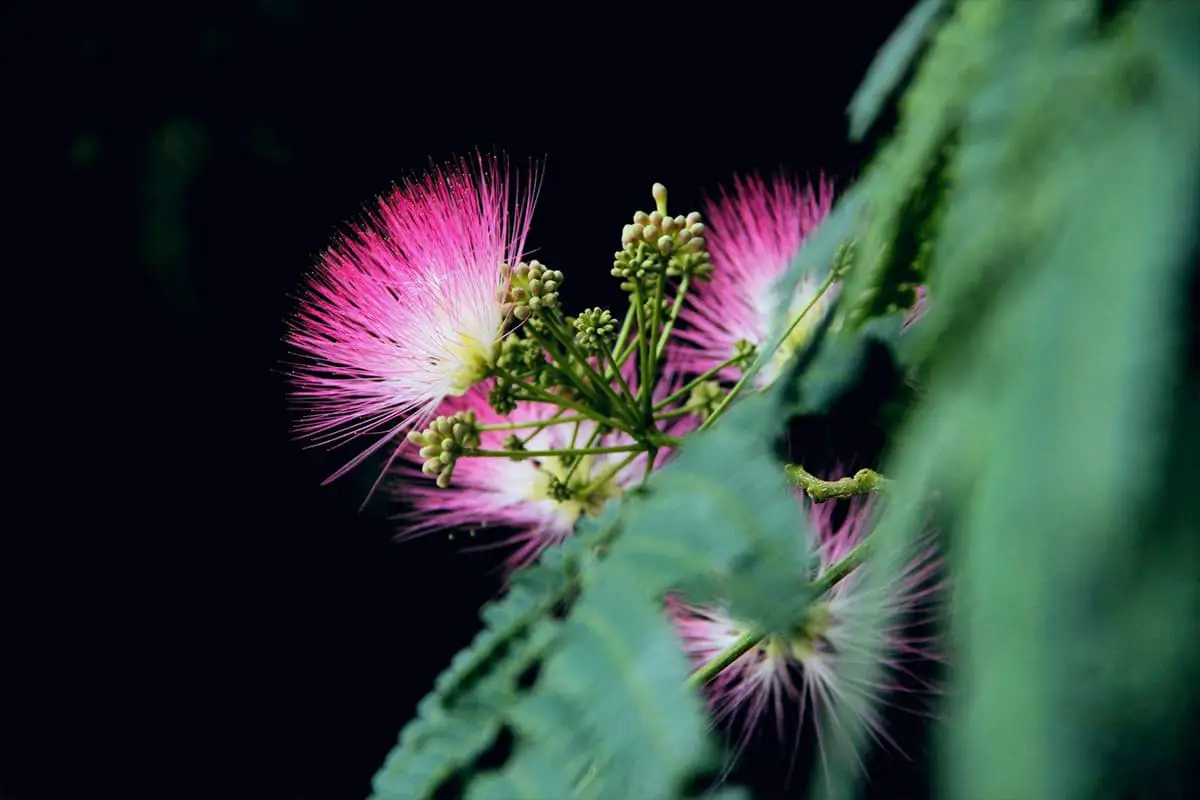
The Silk Tree (Albizia julibrissin Durazz.), also known as the Mimosa Tree or the Silk Flower, is a deciduous tree that blossoms in the summer. It has a head-shaped inflorescence, united petals, and multiple stamens that are light red in color.
The pods are flat and do not split. The tree can grow between 4 and 15 meters tall with an open crown. Young branches, inflorescences, and leaf axils are covered with velvet or short soft hairs.
The stipules are linear lanceolate. The head-shaped inflorescence is arranged in a cone at the top of the branches. The flowers are pink and bloom from June to July, while the fruiting period is from August to October.
The tree favors sunlight and can withstand dry, barren conditions. The wood is reddish-brown with a straight grain and a fine structure.
However, it can easily crack when dry. It can be used to make furniture and sleepers. The bark can be used to produce rosin. It is native to China, Japan, Korea, and North Korea.
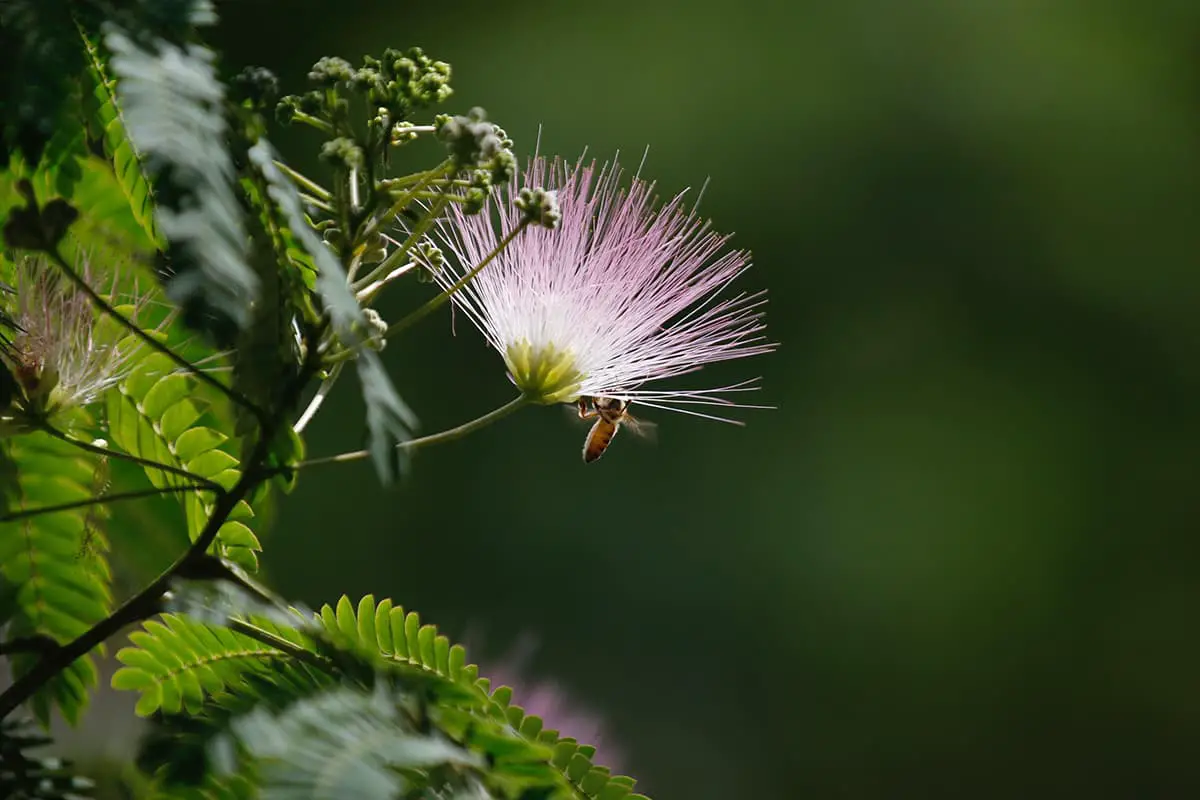
The main varieties of Albizia include the Albizia, Golden Albizia, Large-leaved Albizia, American Albizia, Hainan Albizia, White-flowered Albizia, Qiaojia Albizia, Broad-podded Albizia, Hairy-leaved Albizia, Fragrant Albizia, and Yunnan Albizia, among others.
Mountain Albizia is a deciduous shrub or small tree that grows between 3 and 8 meters tall. Its branches are dark brown and covered with short soft hairs. The flowers bloom from May to June, starting white and turning yellow later on.
The flowers have distinct pedicels. It is found in various regions of China such as North, West, South, and Southwest China, and is also found in countries like India, Vietnam, and Myanmar.
It often grows on hillside shrubs and sparse forests. It grows quickly, can withstand poor soil and drought, and its beautiful flowers make it suitable for landscape planting.
Fragrant Albizia is an evergreen tree that grows between 5 and 15 meters tall. The small branches are initially covered in soft hairs. It has bipinnate leaves, with 2 to 4 pairs of pinnae, and 6 to 14 pairs of leaflets that are oval-shaped and 2 to 3 centimeters long.
It blooms from April to July, with light yellow flowers that have a fragrance and do not have a pedicel. It is a common plant in low-altitude sparse forests, likes acidic soil, and is a heliophilous tree species.
It is planted in Guangdong, Guangxi, Fujian, Yunnan, and other places in China, and is also found in India and Malaysia.
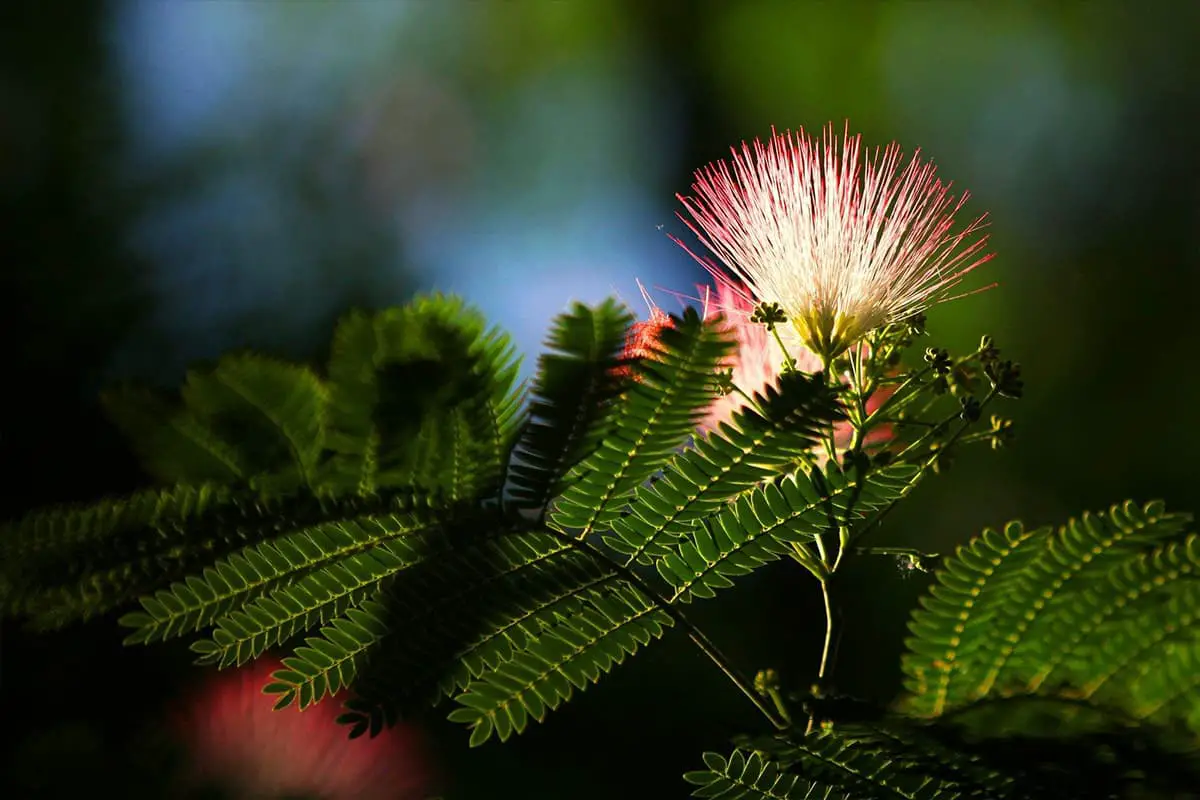
Golden Albizia is a shrub or small tree that grows between 2 and 4 meters tall. The bark is brown and rough, with many branches. The stipules are needle-like and the leaflets are linear oblong.
It blooms from March to June, with yellow flowers that have a fragrance. The petals are fused into a tube. Golden Albizia can be pruned into various shapes such as oblique, straight, double-stemmed, jungle, and exposed-root styles.
Because of its beautiful shape, it is a common ornamental tree species. It is also an economic tree species, as its flowers can be used to extract essence and its wood is very hard, suitable for making valuable utensils.
Silver Albizia grows between 2 and 6 meters tall. Young branches are covered with short soft hairs, while old branches are smooth and hairless. The stipules are triangular, with 4 to 8 pairs of pinnae.
It blooms from April to July, with white flowers. The calyx is 3 millimeters long and the petals are narrowly inverted lanceolate and 5 millimeters long. Its main side branches are hard and thorny, and the tree shape is beautiful.
It can be planted in schools, parks, courtyards, communities, etc. It prefers to grow in a warm and humid climate, and the suitable temperature for its growth is 20-30℃. It grows slowly at low temperatures.
Purple-leaved Albizia is a deciduous tree that grows up to 16 meters tall. The bark is smooth and grayish-brown. The crown is a wide umbrella shape, and the branches are flat. The bipinnate compound leaves are even and opposite.
The young leaves are purple to purplish-red, while the old leaves are dark green. It blooms from June to August, with light purplish-red flowers. Purple-leaved Albizia is often planted as a landscaping tree and is suitable for planting in courtyards, roadsides, hillsides, etc.
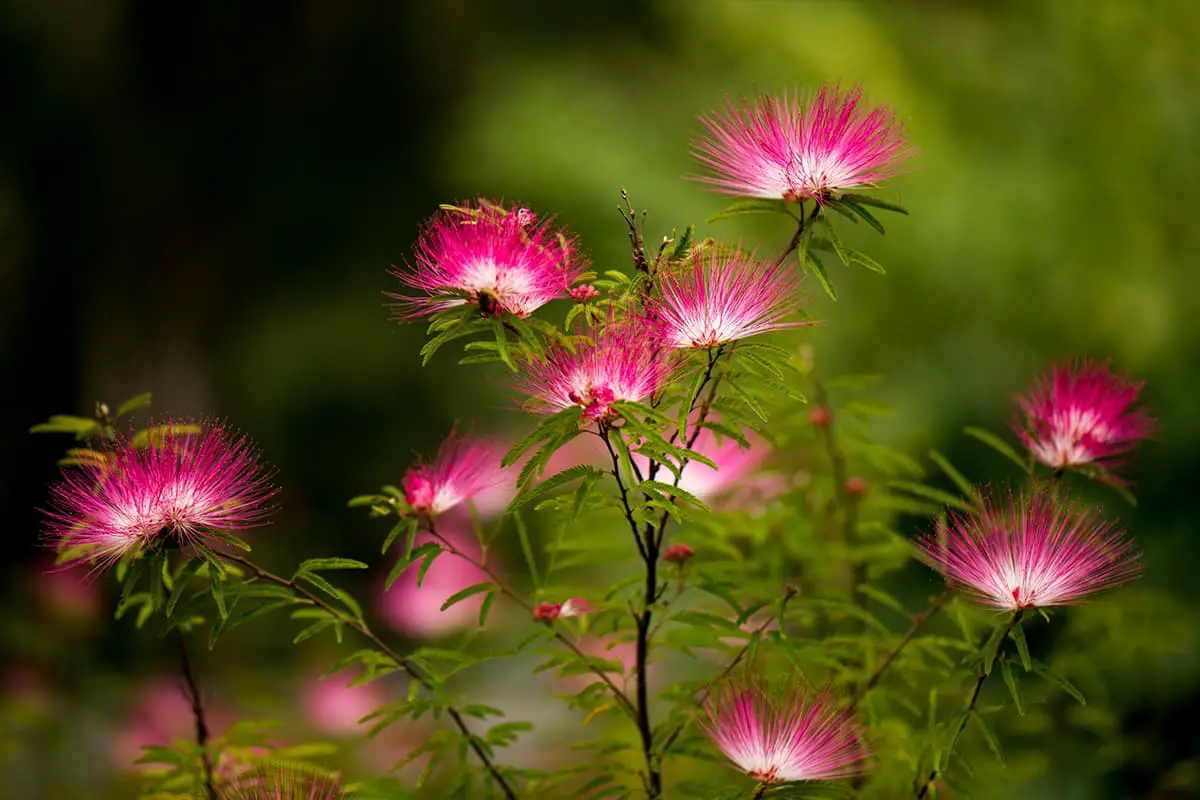
The Albizia tree thrives on hillsides or in cultivation. It prefers warm, humid, and sunny environments, and has strong adaptability to climate and soil.
It thrives best in well-drained, fertile soils, but it can also tolerate poor, dry soils and arid climates, although it is not flood-tolerant. Its growth is rapid.
It enjoys light, warmth, and can withstand cold, drought, poor soil, and mild salinity. It also has strong resistance to harmful gases like sulfur dioxide and hydrogen chloride.
The tree is found in Korea, Japan, Vietnam, Thailand, Myanmar, India, Iran, East Africa and Southern America, and throughout Central and East Asia.
The Albizia is a deciduous tree, reaching up to 16m in height. The trunk is gray-black, with young branches, inflorescences, and leaf axes covered in downy or short soft hairs.
Its stipules are linear-lanceolate, smaller than the small leaves, and fall off early. The bipinnate leaves are alternate, with the total leaf petiole measuring 3-5cm. There are glands at the base and top pair of pinnae. The pinnae have 4-12 pairs, and sometimes up to 20 pairs in cultivation.
The leaflets have 10-30 pairs, are linear to oblong, measuring 6-12mm in length and 1-4mm in width, leaning upward, with a small tip at the apex, marginal hairs, and sometimes short soft hairs on the underside or only the midrib. The midrib is close to the upper edge.
The headlike inflorescences are arranged in a conical panicle at the top of the branch. The flowers are pink, with a tubular calyx that is 3mm long. The corolla is 8mm long, with triangular lobes measuring 1.5mm.
The calyx and corolla are both covered in short soft hairs. There are numerous stamens, fused at the base, with slender filaments. The ovary is superior, with the style almost the same length as the filaments, and a cylindrical stigma.
The pods are strap-shaped, measuring 9-15cm in length and 1.5-2.5cm in width, with young pods having soft hairs and mature pods being hairless. The flowering period is from June to July, and the fruiting period is from August to October.
Care Methods
Cultivation Techniques
Noise Sensitivity
Albizia trees do not favor noise and dust during their growth, so control the surrounding noise level and avoid cultivating in areas with severe air pollution.
Moderate Watering
While Albizia trees can tolerate drought, they can’t withstand flooding. During the care period, avoid overwatering to prevent waterlogging, which could affect root respiration and cause root rot.
Minimal Pruning
Albizia trees are shallow-rooted species with weak budding power, so try not to prune during regular care and allow them to maintain a normal growth rate.
The acacia is often propagated by seed. Seeds are collected in September and October, selecting pods that are full and free from disease and pests. The pods are then air-dried to remove the seeds, which are stored in a dry, well-ventilated area to prevent molding.
In the spring, seedlings are grown. Before sowing, the seeds are soaked for 8-10 hours. Furrow sowing is used, with furrows 60cm apart, and the soil is covered to a depth of 2-3cm. After sowing, the soil is kept moist, and the seeds should sprout in about 10 days.
Approximately 150kg of seeds are required per square meter. After the seedlings have emerged, weeding, loosening the soil, and fertilizing should be intensified.
The seedlings are transplanted in the spring or fall of the second year, with a plant spacing of 3-5m. For 2-3 years after transplanting, weeding and soil loosening should be carried out each spring and fall to promote growth.
In March or April of the following year, the seeds must be treated before they can be sown. Because the acacia seed coat is hard, to ensure uniform germination and quick emergence, the seeds should be soaked in a 0.5% solution of potassium permanganate in cold water for 2 hours, 2 weeks before sowing.
The seeds are then rinsed with clean water and soaked in hot water at about 80°C for 30 seconds (no more than 1 minute, or germination will be affected).
The seeds can be sown 24 hours later. Using this method, the germination rate can be 80%-90%, and the seedlings grow strong and are less prone to disease.
Yellow Leaves: The acacia is sensitive to air circulation. If it is kept in an environment with poor air circulation for a long time, the leaves may turn yellow or even fall off. It should be moved to an environment with good air circulation as soon as possible.
Wilt Disease: This is a disease that can cause serious harm to the acacia. The main symptoms are yellowing leaves, followed by wilting branches that gradually infect the whole plant, eventually leading to death. At the onset of the disease, professional pesticide should be purchased and used promptly and consistently.
Medicinal Value
Acacia flowers contain acaciin and tannins, and have the effects of relieving depression, calming the mind, regulating qi, stimulating the appetite, and relieving pain.
They are used for restlessness, depression, insomnia, forgetfulness, and eye inflammation caused by wind-heat. They can calm the internal organs, harmonize the mind, and brighten the complexion.
They have good effects on strengthening the body, calming, soothing, and beautifying, and are excellent for treating neuroasthenia.
Ornamental Value
Acacia can be used as a landscape tree, street tree, scenic area landscaping tree, waterfront greening tree, factory greening tree, and ecological protection tree, etc.
Flower Language of Acacia
Since ancient times, people have had the custom of planting acacia trees next to their homes and ponds, symbolizing marital harmony, family unity, peacefulness towards neighbors, and friendly coexistence.
Acacia flowers are often given to couples who have had arguments, or placed under their pillows, wishing them harmony, happiness, and a more fulfilling life.
If misunderstandings arise between friends, they can also give each other acacia flowers, symbolizing reconciliation and goodwill.
Symbolic Meaning of Acacia

Peggie was once a high school mathematics teacher, but she set aside her chalkboard and textbooks to follow her lifelong passion for flowers. After years of dedication and learning, she not only established a thriving flower shop but also founded this blog, “Flowers Library”. If you have any questions or wish to learn more about flowers, feel free to contact Peggie.
 English
  العربية
  Bahasa Indonesia
  Deutsch
  Français
  Italiano
  Nederlands
  Português
  Русский
  日本語
日本語