Tulips, with their elegant and refined beauty, are like nobility among the myriad of spring blossoms.
Since as early as the 17th century, they have graced the royal gardens of the Ottoman Empire, grown specifically for the aristocratic gaze. Which variety of tulip do you find the most appealing?
I’ve gathered a list of the top ten most beautiful tulip varieties for you, including Parrot Tulips, Viridiflora, Darwin Hybrids, Lily-flowered, Triumph, Double Late, and Greigii. Let’s explore them together.
1. Parrot Tulips
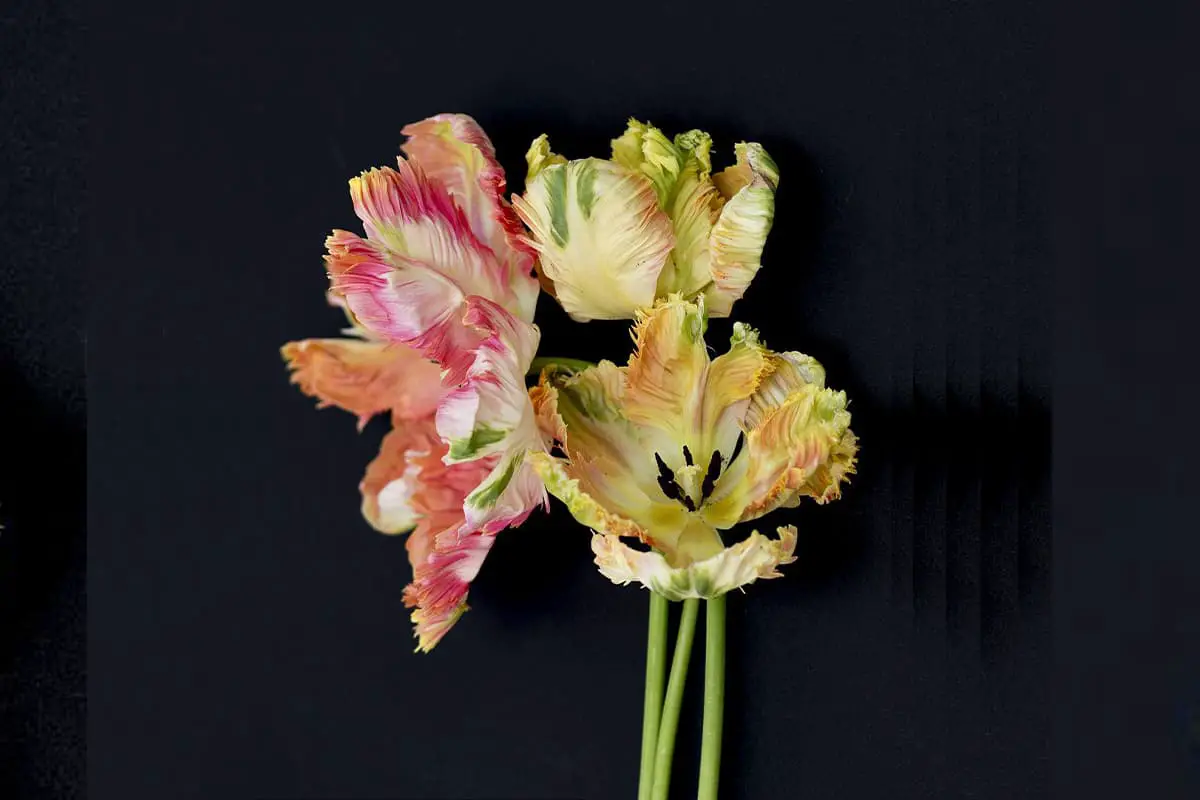
Most of the tulip’s stunning colors are found within the Parrot Group. These tulips are named for their resemblance to parrots, with their multi-colored, vibrant petals and feathery, fan-like fringes that curl and twist outwards, making for breathtaking cut flowers.
These vivid tulips are often depicted in European floral paintings. Notable varieties include Magic Parrot, Caribbean Parrot, Rococo Parrot, Black Parrot, and Apricot Parrot.
2. Viridiflora Tulips
The Viridiflora Group of tulips, partly green-petaled, is one of the most beautiful varieties, with plants of a moderate to shorter height of 20-50 cm.
These tulips are usually considered novel due to their uniqueness and are prized by enthusiasts for their refined beauty. As the name suggests, their blossoms are green, often combined with a second, complementary color, which looks simply stellar in arrangements.
Famous varieties include Artist, Green Wave, Green Star, Spring Green, and Night Rider.
3. Darwin Hybrid Tulips
A must-have in the list of the most beautiful tulip varieties is the Darwin Hybrid Group, a crossbreed of the Foster and Kaufmann types, classified as mid-season bloomers.
Their flowers are luxuriously tall and goblet-shaped, large and brightly colored, often with a different colored blotch at the base of the petal. The robust plants stand 50-70 cm tall, with long stems making them excellent for cutting.
They are typically perennial, making them one of the best types of tulips to grow year after year. Well-known varieties include Pink Impression, Burning Heart, Van Eijk, Best Red, and Best Yellow.
4. Lily-flowered Tulips
The Lily-flowered Group of tulips are generally more valuable, with pointed and curved petals that taper to a point and curl backward, creating a unique silhouette.
These slender, trumpet-shaped tulips grow on narrow stems and can elegantly bend and sway even in a light breeze. They resemble lilies in their shape, and their vibrant colors make them one of the most elegant tulip varieties.
Renowned varieties include Aladdin, China Pink, Dutch Chic, Marilyn, Mona Lisa, and Ballerina.
5. Triumph Tulips
Undoubtedly, one of the most common tulip varieties is the Triumph Group. This group is the largest within the tulip family and boasts the broadest color range, all with medium-length stems.
They need frost protection in areas where temperatures drop below 7°C, and they can also grow well in containers. Triumph tulips originated from crosses between the Single Early Group and the Darwin Hybrid Group.
They are single-flowered, with large and vibrant goblet-shaped blossoms. Notable varieties include Apricot Fox, Helmar, Dreaming Maid, Rem’s Favorite, and Early Glory.
6. Double Late Tulips
The Double Late Group, also known as peony-flowered, is considered the most beautiful tulip variety. These tulips have many petals, resembling peonies or ranunculus. The plants have a medium to tall height, upright stems, and bright flowers, making them excellent cut flowers.
Double Late Tulips bloom later than their earlier counterparts, usually featuring rounder flowers that are typically taller. They bloom in a variety of colors and patterns in May, sometimes even unfolding like roses.
Renowned varieties include Cretaceous, Ice Cream, Mount Tacoma, Verona, Abigail, and Orange Princess.
7. Greigii Tulips
Many people believe the Greigii Group is the most beautiful tulip variety. They originated from wild tulip populations native to the Caribbean, the Aral Sea region, and Tian Shan.
These tulips are captivating even before their flowers open, thanks to their leaves, often spotted with purple or brownish-purple stripes, and remain attractive even after the flowers have faded. The bell-shaped, goblet-like flowers typically open to reveal their interior colors.
Famous varieties include Pinocchio, Vanilla Cream, Quebec, Little Red Riding Hood, Easter Surprise, and To Alice.
8. Fosteriana Tulips
The Fosteriana Group, also known as the Fostery Queen, includes Foster’s Tulip and hybrids between Foster’s Tulip and other varieties like the Darwin Hybrid Group, Single Early Group, and Triumph Group.
This variety belongs to the early-flowering series. The flowers are particularly large, with a rich array of colors from white, yellow, pink, to dark red. Some varieties have colored edges or flame-patterned hearts.
Their leaves are curled, sometimes striped or spotted, making them precious gems suitable for pot cultivation. Notable varieties include Solfatare, Purissima, Orange Brilliant, Exotic Emperor, and Angelique.
9. Fringed Tulips
Fringed Tulips, also known as Lace Tulips, belong to the Fringed Group. This variety is a single-flowered type, with very fine edges on the petals that have clear barbs or needle-like protrusions, resembling tassels.
This fringed layer adds a rebellious and playful touch to them. They bloom in the mid to late season, with various stem types and predominantly warm colors of red and yellow.
They make excellent cut flowers and are suitable for forcing in early spring. Famous varieties include Swan Wings, Crystal Star, Lambada, Santander, and Cummins.
10. Kaufmanniana Tulips
The Kaufmanniana Group, also known as the Water Lily type, originates from Kaufmann’s Tulip, an early to mid-season flower.
Its bell-shaped corolla in wild varieties is golden yellow with red stripes on the outside, while the varieties have a multitude of flower colors. Most of them have large blossoms; some have mottled or striped leaves.
This hybrid variety blooms early, often with stripes on the petals. Because the plants are short, they are best grown on the edges of rock gardens and flower beds.
Renowned Kaufmanniana Tulip varieties include Fashion, Coronation, Stresa, Concerto, Giuseppe Verdi, and Shakespeare.
Share
Facebook
Twitter
LinkedIn
Email
Share is Caring.
Peggie
Founder of FlowersLib
Peggie was once a high school mathematics teacher, but she set aside her chalkboard and textbooks to follow her lifelong passion for flowers. After years of dedication and learning, she not only established a thriving flower shop but also founded this blog, “Flowers Library”. If you have any questions or wish to learn more about flowers, feel free to contact Peggie.
Before you go
You May Also Like
We picked them just for you. Keep reading and learn more!
Jasmine, a beloved ornamental flower, has captivated gardeners and enthusiasts for centuries. Originally native to tropical and subtropical regions of Asia, particularly Persia (modern-day Iran), jasmine was introduced to many…
1. Multiflora Wisteria (Wisteria floribunda) Wisteria floribunda, commonly known as Japanese Wisteria or Multiflora Wisteria, is indeed a top recommendation among the beautiful wisteria varieties. This stunning species stands out…
Carnations, with over 2,000 years of cultivation history in Europe, are among the most widely used flowers in the world. Their popularity stems from their long-lasting blooms, diverse color range,…
The plum blossom, revered as the foremost among China’s top ten famous flowers, embodies the virtues of nobility, resilience, and humility in traditional Chinese culture. Its ability to bloom in…
In traditional Chinese culture, the lotus (Nelumbo nucifera) symbolizes purity, nobility, harmony, love, marital bliss, prosperity, and spiritual enlightenment, making it one of the most revered and auspicious plants. Its…
Roses are indeed among the most cherished and iconic flowers in the world, with a rich history spanning millennia. Their beauty and diversity have captivated gardeners, artists, and flower enthusiasts…
Determining the exact number of osmanthus varieties is indeed challenging, given the complex taxonomy and numerous cultivars within the genus Osmanthus. The four major lineages you mentioned – Gold Osmanthus,…
The gardenia, with its pure white blossoms, abundant fragrance, evergreen leaves, dense foliage, and diverse leaf shapes, holds considerable aesthetic appeal and has always been beloved. But what variety of…
The Begonia is renowned as the “banquet of the nation,” commonly used for urban greening and beautification. It’s also a popular choice for creating bonsai, and its cut branches can…






 English
  العربية
  Bahasa Indonesia
  Deutsch
  Français
  Italiano
  Nederlands
  Português
  Русский
  日本語
日本語