600+ Types of Flowers A To Z (With Names and Pictures)
Types Of Flowers By Names (A-Z) Types Of Flowers By Color Types Of Flowers By Season Types Of Flowers By Blooming Time 600+ Types of Flowers No. Flower Name No.…

Punica granatum, also known as pomegranate, is a deciduous shrub or small tree. The bark of the pomegranate tree is gray-brown with flaky peeling.
Its young branches are smooth, yellow-green, often quadrangular, and the branch ends are often prickly, with no apical bud. The pomegranate flowers are singularly or clustered, rectangular or ovate. The new leaves are tender green or bronze.
The flowers bloom at the top of the branch or the leaf axil, with a bell-shaped calyx, fleshy, 6-lobed at the tip, smooth surface with a waxy texture, and orange-red in color. The petals are red or white, with 5 to 7 in number, single or double petals. The pomegranate is native to Central Asia, namely Iran and Afghanistan.
The pomegranate is not only admired for its flowers, but also its fruit. Small potted pomegranates can be used for decorating windowsills, balconies and living rooms. Larger potted plants can be used to decorate public spaces and venues.
Pomegranate flowers, fruits, peels, and roots can all be used for medicinal purposes. The taste of the flower is sour and can be used to reduce heat and stop bleeding.
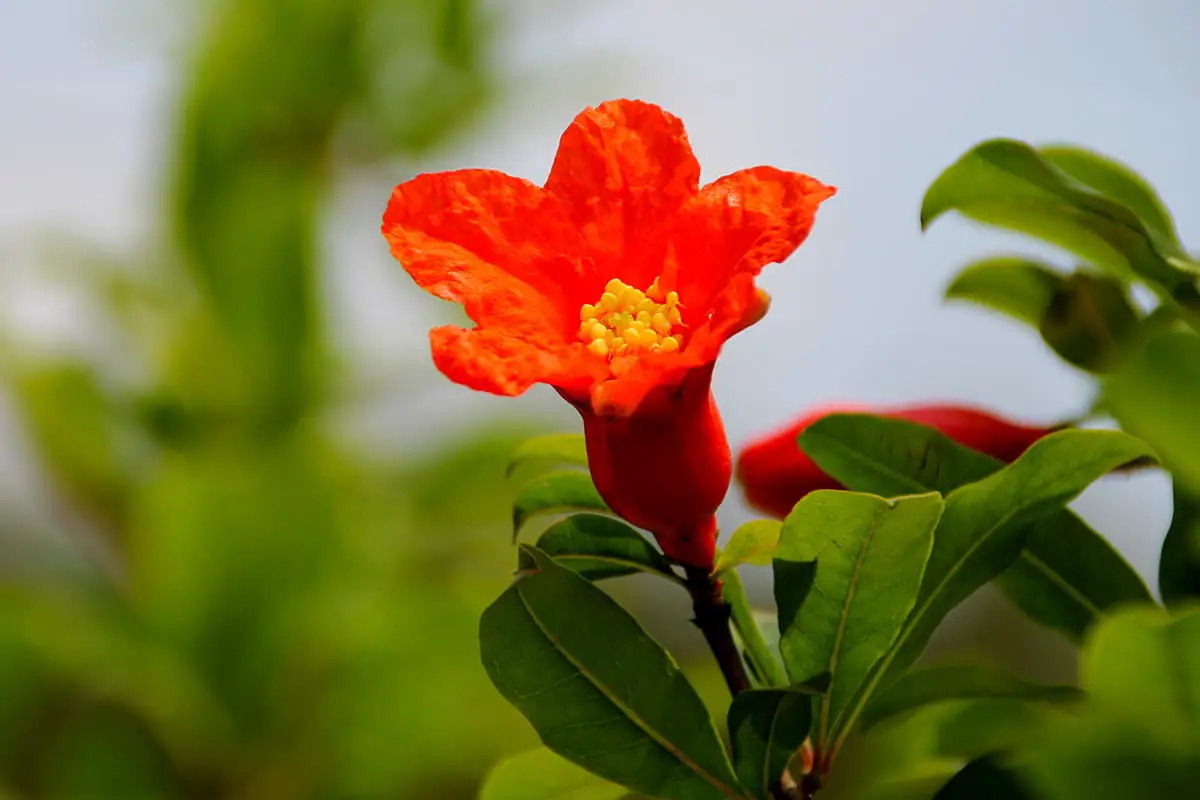
The pomegranate (Punica granatum) is a deciduous shrub or small tree. The tree can grow between 2 to 5 meters, and can reach up to 7 meters. The bark of the tree is gray-brown with flaky peeling.
The branches are smooth, yellow-green, often quadrangular, and the branch ends are often prickly, with no apical buds. The leaves are singular or clustered, rectangular or ovate, ranging from 2 to 8cm in length, smooth leaf surface, short stem, and the new leaves are tender green or bronze.
The flowers bloom at the top of the branch or the leaf axil, with a bell-shaped calyx, fleshy, 6-lobed at the tip, smooth surface with a waxy texture, and orange-red in color. The petals are red or white, with 5 to 7 in number, single or double petals. The fruit is spherical and yellow-red.
The pomegranate is a dioecious plant, with both male and female flowers on the same tree. Both male and female flowers are beautiful.
The base of the male flower is smaller, with a blunt triangle on the side, and the flower will fall off after blooming. The base of the female flower is obviously swollen (visible when the flower blooms), and only female flowers bear fruit.
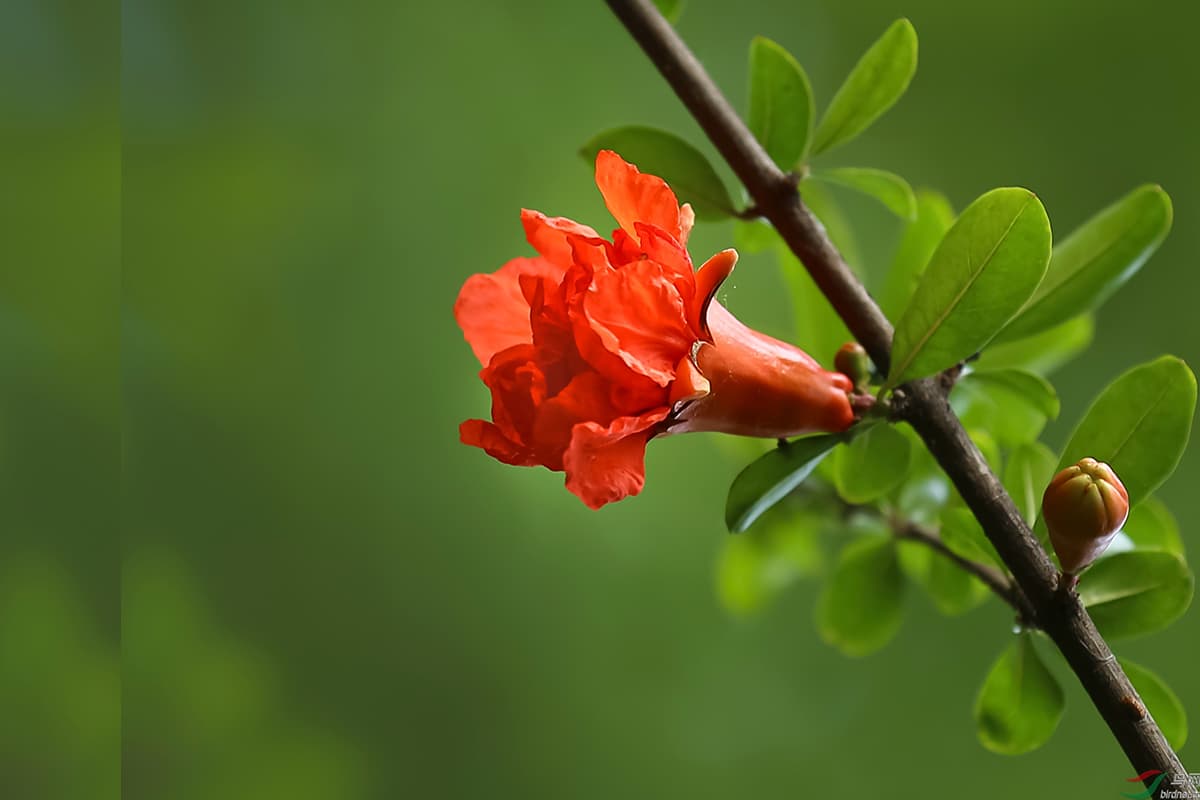
Pomegranate prefers plenty of sunshine and a dry environment. It is cold-resistant, drought-resistant, not tolerant to flooding, and does not like shade. It is not strict about soil requirements, but fertile, loose, and nutrient-rich sandy loam soil is the best.
Pomegranate flowers are commonly propagated through cutting, division, and layering. For cutting, select two-year-old branches in spring or semi-woody branches in summer. Roots will form 15 to 20 days after cutting.
For division, in early spring, around April, when the buds start to sprout, dig up and separate strong root suckers. For layering, both spring and autumn are suitable.
No need to make a wound, before the buds sprout, press the root part of the branch into the soil, cut off from the mother plant after rooting in the summer, and seedlings will be formed in the autumn.
For outdoor cultivation, choose a place with sufficient light and good drainage. During the growth process, it is necessary to diligently remove root suckers and prune dead branches, diseased branches, dense branches, and overly long branches to facilitate ventilation and light.
For potted plants, it is best to plant shallowly and control watering, it is better to be dry than wet. During the growth period, it is necessary to pick the heart, control the growth of nutrient branches, and promote the formation of flower buds.

The most common diseases are leaf wilt and grey mold, which can be treated by spraying with a 1000x solution of 70% methyl tobujin wettable powder. Pests include caterpillars, scale insects, and aphids, which can be eliminated by spraying with a 1000x solution of 55% kill-borer pine emulsion.

Pomegranate flowers are appreciated for both their blooms and their fruits. Small potted plants are suitable for windowsills, balconies, and interior decor, while larger pots can be used to decorate public spaces and venues. Planted pomegranates are suitable for landscaping in scenic areas.
Pomegranate has a long history of medicinal use, as documented in various ancient medical texts.
Through clinical practice, physicians over the ages have found pomegranate to have cooling properties, aiding in heat reduction, detoxification, stomach health, lung moisturization, intestinal astringency, and hemostasis.

The most commonly used part of the plant for medicinal purposes is the pomegranate peel, often roasted before use. Pomegranate flowers can help stop nosebleeds and vomiting of blood, and excessive vaginal discharge.
They can also be used to treat otitis media. Pomegranate leaves aid in digestion and can be used to treat eye diseases and skin conditions.
Modern medical research has found that pomegranate peel contains “pomegranate root bark alkaloid”, which can inhibit various bacteria and fungi.
Sour pomegranate, rich in tannin, has astringent and bactericidal effects, and can be used to treat diarrhea and fever, as well as to stimulate appetite and aid digestion. The bark of the pomegranate tree contains alkaloids that can expel tapeworms and roundworms.

Dietary benefits: astringent, anti-diarrheal, hemostatic, lung-moisturizing, and cough-suppressing. Used to treat chronic diarrhea due to deficiency-cold, enteritis, dysentery, rectal bleeding, prolapse of rectum, uterine bleeding, tapeworm disease, and roundworm disease.
Flowers: treat hematemesis, nosebleeds. Externally, a suitable amount can treat otitis media.
Leaves: treat acute enteritis. Pomegranate, sour and astringent, warm in nature, has the effects of moistening the intestines and stopping diarrhea, stopping bleeding, and expelling parasites.
According to pharmacological research reports, it inhibits dysentery bacillus, typhoid bacillus, E.coli, and tuberculosis bacillus. The root (including the root bark) contains iso-punicine, mannitol, organic acids, etc., which inhibit E.coli, staphylococcus aureus, pseudomonas aeruginosa, and various pathogenic fungi.

Peggie was once a high school mathematics teacher, but she set aside her chalkboard and textbooks to follow her lifelong passion for flowers. After years of dedication and learning, she not only established a thriving flower shop but also founded this blog, “Flowers Library”. If you have any questions or wish to learn more about flowers, feel free to contact Peggie.
 English
  العربية
  Bahasa Indonesia
  Deutsch
  Français
  Italiano
  Nederlands
  Português
  Русский
  日本語
日本語