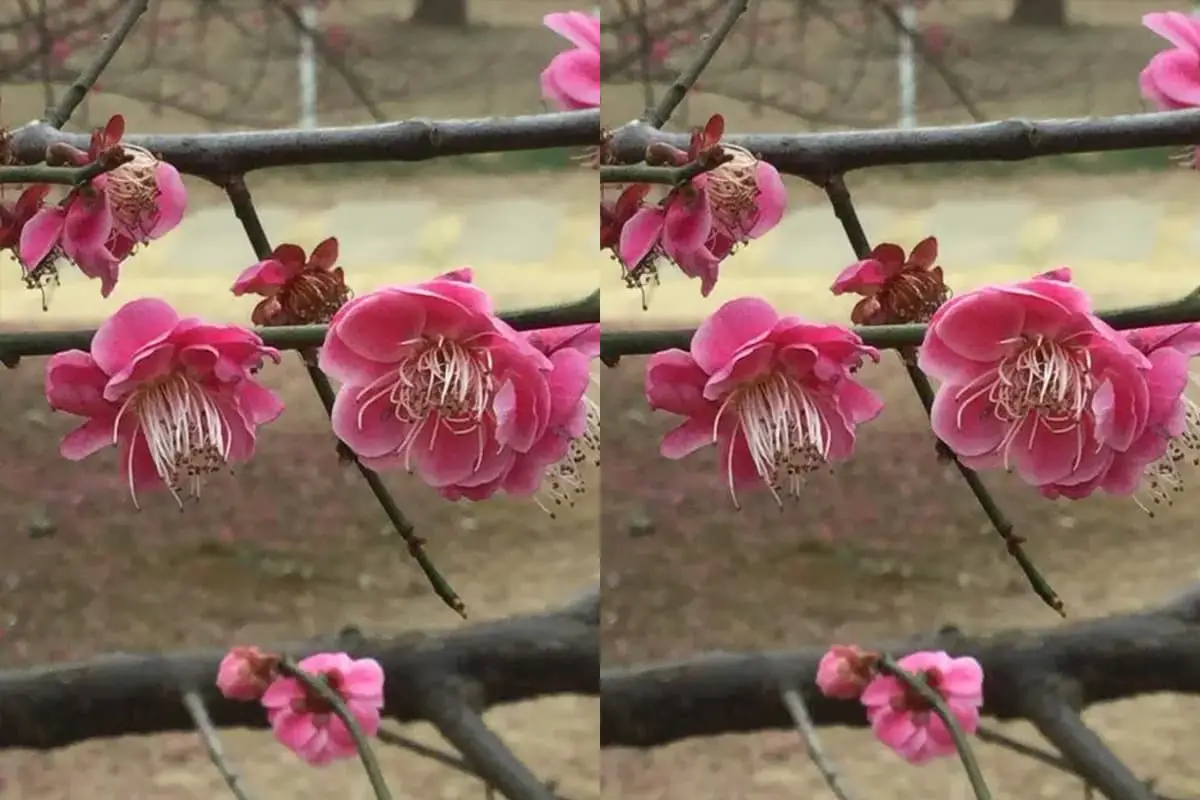
The Prunus mume, commonly known as Japanese apricot or Chinese plum, belongs to the Prunus genus within the Rosaceae family. The Palace Pink Plum, a cultivar of Prunus mume, is classified under the True Plum lineage and Straight Branch Plum category. This ornamental variety is renowned for its semi-double to fully double blooms in varying shades of pink to red.
The Palace Pink Plum is highly esteemed for its ancient tree form, elegant flowers, dense blooming habit, and light pink coloration. One of its most distinguishing features is the rich, refreshing fragrance it emits, setting it apart from many other ornamental plums.
Within the Palace Pink Plum group, there are three major types: Large Palace Pink Plum, Fu Pink Plum, and Ningxin Plum. The Large Palace Pink Plum is particularly famous for its large, round flowers and is considered a representative cultivar of this lineage.
I. Growth and Distribution
Prunus mume is native to the southwestern mountainous regions of China, but has been widely cultivated throughout East Asia for centuries. The Palace Pink Plum, as a cultivated variety, can be found in gardens, parks, and ornamental plantings across its suitable climate range.
II. Morphology and Characteristics
The Palace Pink Plum is a deciduous tree that can reach heights of up to 10 meters. Its trunk exhibits a brownish-purple color with distinctive longitudinal patches. The twigs are thin, hairless, and predominantly green.
Leaves are broadly ovate to ovate, with a long or tail-like apex and a broadly cuneate or nearly round base. The leaf margins are finely serrated, and only the veins on the underside of the leaf bear hairs.
Flowers bloom in winter or early spring before leaf emergence, a characteristic known as hysteranthous flowering. The blossoms range from semi-double to fully double, with colors varying from light pink to deeper reddish hues. This similarity in flower color and type to the Cinnabar Plum led to both being referred to as “Red Plums” in ancient times.
The fruit is spherical and yellowish-green, ripening in May and June. However, it’s important to note that Palace Pink Plum is primarily grown for its ornamental flowers rather than fruit production.
III. Living Habits
The Palace Pink Plum thrives in warm, slightly humid climates. It demonstrates some cold resistance, allowing it to survive moderate winter temperatures. This cultivar is relatively adaptable to various soil conditions, showing tolerance to poor soil quality. However, for optimal growth and flowering, well-drained, fertile soil is preferable.
IV. Cultivation Method
For cut-flower production, Palace Pink Plums are typically cultivated outdoors in large plots. The recommended planting spacing is 3 meters by 3 meters, promoting air circulation and sunlight penetration. The main stem is kept low, at about 30 centimeters, requiring frequent pruning to maintain shape and encourage new growth.
To enhance flower production, additional fertilizers should be applied to promote the growth of numerous long branches suitable for harvesting. A balanced, slow-release fertilizer applied in early spring and mid-summer can support healthy growth and abundant flowering.
Forcing techniques can be employed to manipulate blooming times for specific holidays:
- For May 1st blooms:
- In winter, move potted plants with plump flower buds to a cold room just above 0°C.
- In early April, gradually move them outdoors.
- Harvest cut flowers on May 1st.
- For October 1st blooms:
- When branches reach about 30 centimeters, withhold water and apply extra fertilizers.
- Remove all leaves and subject plants to alternating low and high temperature treatments.
- Cut flowers will be ready for harvest on October 1st.
During the flowering period, place plants in areas with abundant sunlight to gradually increase temperature. Avoid sudden temperature rises and maintain air humidity through regular misting. After the flower buds show color, move plants to a cooler location to extend the bud period to 10-12 days.
The optimal time for harvesting is when the flower buds are translucent. After harvesting, grade and package the flowers based on branch length for sale.
V. Propagating Methods
Palace Pink Plums can be propagated through various methods:
- Grafting: Splice grafting, side grafting, and approach grafting are common techniques, typically performed in spring or autumn.
- Cutting: Hardwood cuttings are often used. Treating cuttings with 500 mg/kg of indolebutyric acid can significantly improve the survival rate.
- Layering: Performed in spring, this method involves peeling 1-2 year old sprouts near the root, burying them 3-5 cm deep in soil, and separating them from the mother plant in late autumn.
- Seeding: Used primarily for breeding new varieties and propagating rootstocks in large numbers.
VI. Value and Other Information
The Palace Pink Plum’s ancient tree form and beautiful flowers make it an excellent choice for ornamental planting in courtyards, lawns, and on gentle slopes. It can be planted as a specimen tree, in clusters, or in groups for varied landscape effects.
In traditional East Asian horticulture, the plum blossom is often paired with pine and bamboo, collectively known as the “Three Friends of Winter.” This combination symbolizes perseverance and resilience, as these plants thrive during the cold months when other plants are dormant.
Beyond its ornamental value, Prunus mume has historical significance in traditional medicine and cuisine in East Asia, though the Palace Pink cultivar is primarily prized for its aesthetic qualities.



 English
  العربية
  Bahasa Indonesia
  Deutsch
  Français
  Italiano
  Nederlands
  Português
  Русский
  日本語
日本語