600+ Types of Flowers A To Z (With Names and Pictures)
Types Of Flowers By Names (A-Z) Types Of Flowers By Color Types Of Flowers By Season Types Of Flowers By Blooming Time 600+ Types of Flowers No. Flower Name No.…

The Heteromorphic Mussaenda is a climbing shrub belonging to the Rubiaceae family and the genus Mussaenda. The twigs are gray-brown, leaves are opposite, thin papery, leaf blade ovate or elliptic-ovate, apex tapering, base short pointed, upper side green, lower side pale white; stipules fall off early.
The many branched umbellate inflorescences are terminal, with many flowers, small bracteoles are lanceolate, with short soft hairs, calyx tube is long-cylindrical, all calyx lobes are enlarged into petal-like bracts; flower leaves are ovate-elliptical, corolla lobes are ovate, short tapering, attached to the corolla tube, stamens are short; the pistil is hidden, the style is linear, 4 mm long.
It blooms in June. It is endemic to China and is listed as a national level I protected plant. It is an endangered species. It is distributed in Guangxi, China; it climbs on the canopy of forests.
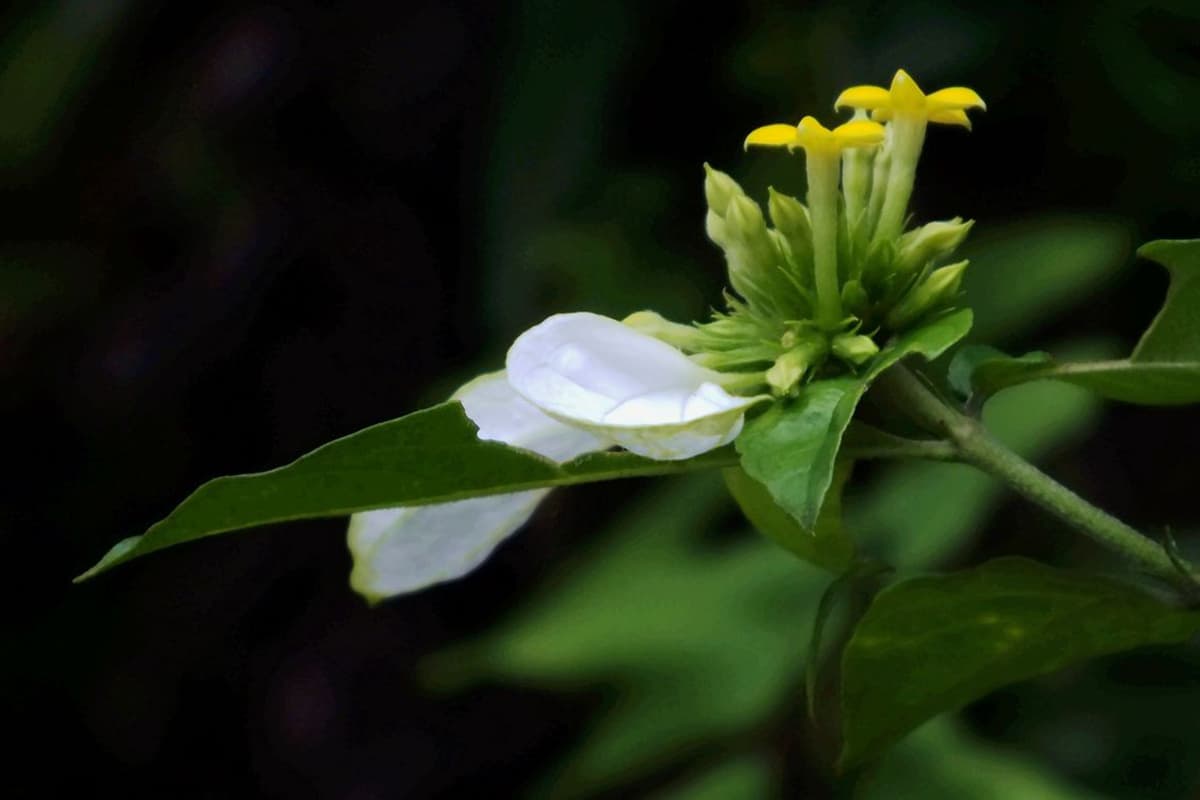
Mussaenda shikokiana Makino, a climbing shrub in the Rubiaceae family, is characterized by its gray-brown twigs and sparse covering of prostrate soft hairs. As it matures, it loses its hair. The leaves are oppositely arranged and are thin and papery, ovate or elliptical, 13-17 cm in length, and 7.5-11.5 cm in width.
The leaves taper at the top and have a short taper at the base. Both sides have sparse short soft hairs, with the top being green and the underside being pale white. There are 8-10 pairs of lateral veins that slightly arch upwards. The petioles are 2-2.5 cm long and slightly covered in short soft hairs. The stipules fall off early.
The plant has many terminal, multi-branched cymes with numerous flowers covered with slightly prostrate short soft hairs. The bracts fall off early, and the small bracts are lanceolate, gradually tapering, up to 1 cm long, with short soft hairs, and fall off. The pedicels are 2-3 mm long. The calyx tube is cylindric and about 5 mm long, with prostrate stiff hairs.
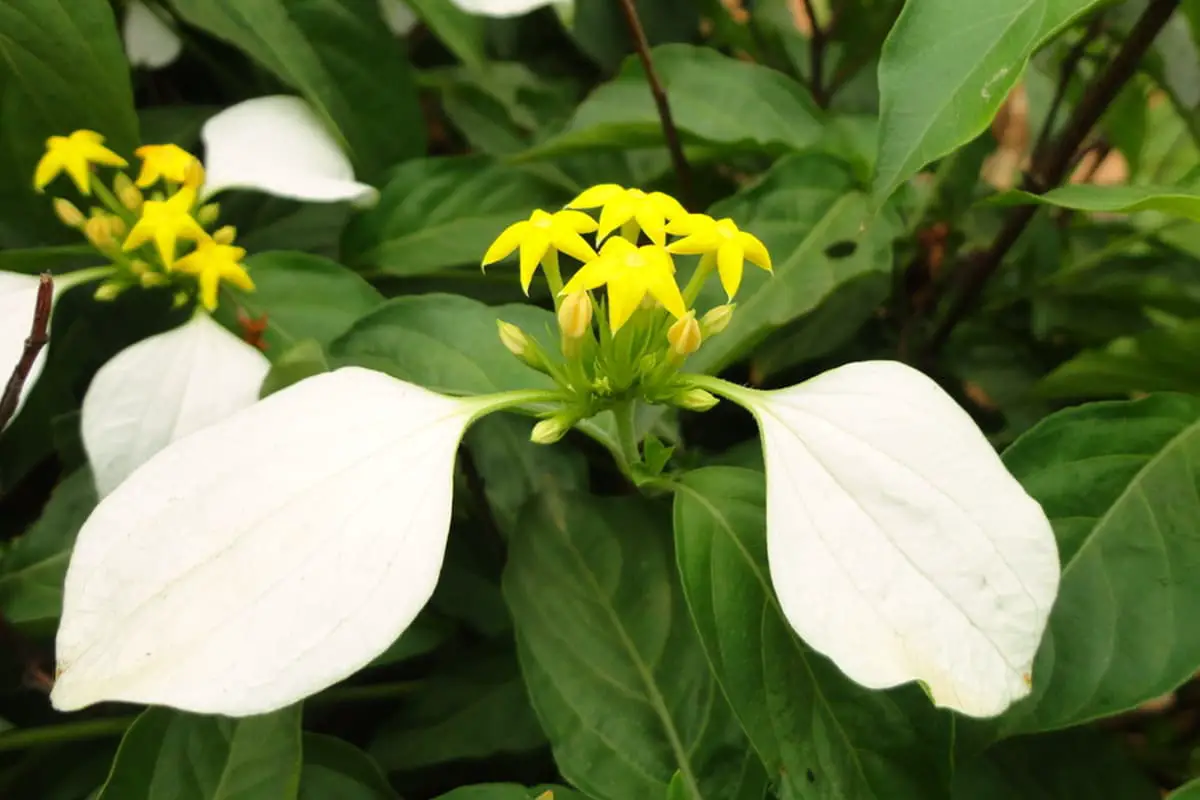
All five calyx lobes enlarge into petal-like bracts. The bracts are ovate-elliptical, 2-4 cm long, 1.5-2.5 cm wide, with short taper at the top and the base, 5 longitudinal veins, edges and veins are more or less covered in short soft hairs, and the stalk is 1.5-2.5 cm long. The corolla tube is about 1.2 cm long, 4 mm wide, expanding at the top, densely covered with prostrate short soft hairs on the outside, and densely covered with yellow club-shaped hairs on the upper inside.
There are 5 corolla lobes, ovate, shortly acuminate, about 3 mm long, with short soft hairs on the outside and yellow pustules on the inside. There are 5 stamens, attached to the corolla tube, the anthers are 3 mm long, and the filaments are short. The pistil is about 6 mm long, enclosed, with a 2-lobed, linear stigma, 4 mm long.
The berries (only immature ones seen) are 4 mm long. The flowering period is in June. This species is endemic to China and listed as a state-protected plant. It is a rare species distributed in Guangxi, China. It climbs on the canopy of forests.

Mussaenda shikokiana Makino mainly grows in places where the valley soil is moist and the sunlight is abundant, climbing on the trunks of middle and lower trees. It is rarely seen in dense forests or shrubs. The average annual temperature of its habitat is 17°C, the average temperature in January is 8.3°C, and the average temperature in July is 24°C. The annual rainfall is about 1800 mm. The soil is yellow soil, with a pH of 4.5-5.5.
Mussaenda shikokiana Makino is endemic to China and is found in Guangxi. It often grows in sparsely forested mountains at about 400 meters above sea level, by roadsides, in mountain valleys, shrubs by streams, and at the edges of forests.
Further research is needed. Seed propagation and cutting propagation methods can be used. So far, no research has been conducted on the artificial cultivation of this species. Observations in the wild suggest that the fruit is easily damaged by pests, and seeds are extremely rare.
The general propagation methods of Mussaenda shikokiana Makino are by seeding or cutting.
For field cultivation of Mussaenda, it should be planted on sandy or loamy soil that does not accumulate or flood water. The soil is required to be permeable, retain water and fertilizer, and have certain irrigation and drainage conditions.
After spreading 1500-2000 kg of manure per acre, plow and rake the soil to prepare the ridges. The ridges should be 1.7 meters apart, with the ridge face being 1.2 meters wide, the trench being 0.5 meters wide, the middle trench being at least 0.25 meters deep, and the side trenches being at least 0.3 meters deep. Drainage outlets should also be prepared.
The seedlings should be fertilized when dry. 7-10 days after transplanting, timely seedling fertilization should be applied, using a 1% urea aqueous solution or clear manure water. If no base fertilizer was applied at the time of planting, it can be supplemented at this stage by opening trenches in the rows, with organic or compound fertilizers being the main type.
Weeding and topdressing should be combined with intertilling one month after planting. At this time, each acre should be top-dressed with 20 kg of urea or 30 kg of compound fertilizer mixed with an equal amount of urea. After the fertilizer is evenly spread in the rows, it can be mixed with soil or applied in trenches. When applied in trenches, the fertilizer should not contact the seedlings. At this stage, soil should be timely piled up in traditional seedling cultivation methods.
Intertilling, topdressing, and earthing up should be performed 45-60 days after planting, and when the seedlings are 30 cm tall, timely topdressing and earthing up should be carried out to promote rapid growth of Mussaenda. The method is to spread manure or apply compound organic fertilizer in the rows after loosening the surface soil, then clean the trench mud and cover the fertilizer and the lower part of the seedling.
Mussaenda shikokiana Makino is a positive plant. Whether it is planted in the ground or potted, it needs to be placed in an environment with full or half sun exposure. When the seedling has 3-5 pairs of leaves, it can be potted or bagged. The potting soil or bagged soil should be loamy or sandy loamy soil that drains well and is rich in humus. A
fter transplanting, water thoroughly to help root establishment. Because the roots are damaged during transplanting, to adjust the water balance in the body and reduce evaporation, it is necessary to pinch the seedlings or remove leaves. The temperature is between 20℃ and 30℃, the branches and leaves grow quickly, and the soil needs to be kept moist. A dose of decomposed fertilizer can be applied once a month.
As the seedlings grow, repeated pinching is needed to make the plant shorter and fuller. During growth, overlong branches can be thinned, and according to the styling needs, they can be guided and shaped. At the same time, dead branches, old branches, dense branches, leggy branches, and pest-infected branches should be timely pruned to improve the conditions of ventilation and light penetration.
After flowering, the remaining branches should be promptly pruned to reduce nutrient consumption and promote re-flowering. During the growing period, sufficient light should be given, water should be controlled, and water should be sprinkled on the leaves in hot summer to lower the temperature. Weeding should be diligent in improving the air conditions of the soil.
During the bud stage, spray the flower buds with a bud-strengthening solution, the flower color will be bright, and the flowering period will be extended. Thin fertilizer should be applied frequently, or foliar topdressing can also be adopted, with attention to strengthening the management of N, P, and K fertilizers.
After each bud removal, water thoroughly, apply weak fertilizer water a week later, and increase the application of P, K fertilizer appropriately to promote the growth of new shoots and flourish flowering. During the seedling stage, apply more phosphorus and potassium fertilizers, and apply thin fertilizers frequently during the bud stage. Foliar topdressing can also be adopted.
For adult plants, apply phosphorus fertilizer twice during flowering. After flowering, timely pruning is needed to control the growth of branches. When the winter temperature is below 0℃, the plant is prone to defoliation. If the low temperature lasts for a long time, it can cause the above-ground part to wither and die. Therefore, both open field planting in the south and potted plants in the north should pay attention to keeping warm in winter to ensure the plant’s safe overwintering.
Root: Dispels wind, reduces qi, resolves phlegm, reduces inflammation, and relieves pain. Used for rheumatic joint pain, back pain, cough, and snake bites.
Stems, leaves: Sweet, bitter, cold. It has the effects of clearing heat, detoxifying, reducing swelling and draining pus, and is used for colds, throat swelling and pain, high fever in children, difficulty in urination, dysentery, and unnamed swelling and toxins.
The plant contains a sticky substance that can stick to birds, hence the name “Bird Sticky Glue”. Mussaenda shikokiana Makino has abundant branches and large leaves. It can be planted with other shrubs in the garden, or it can be planted in patches on sparsely wooded grassland.
Conservation Value: This species is a very rare species in the genus Mussaenda in China. Most species in this genus have one sepal lobe that is often enlarged into a petal-like form, while this species has all five sepal lobes enlarged into white petal-like forms. Its special morphology has certain scientific significance for studying its taxonomic position and the phylogenetic relationships within and between species.
After many years of investigation, only 6 of the 9 targeted species (Xianhu Cycas, Ginkgo, Southern Yew, United Columbine, Arbor Tree, and Primrose) were actually surveyed. No wild populations of Water Pine, Heteromorphic Mussaenda, and Taiwan Cycas were found. Now, an analysis of the status of national level I key protected plant resources in Guangdong Province is being conducted.
Conservation Measures: Dayao Mountain has been designated as a nature reserve. Extensive surveys should be carried out to determine whether it has already become extinct. If it can be found, it should be protected and cultivated through introduction.
To protect the rare plant species and their genetic diversity in eastern Guangdong, it is first necessary to protect the natural environment and ecosystems on which they depend, pay attention to the protection of plant habitats, and provide the most suitable habitat conditions so that the species can be effectively preserved.
Therefore, for mountains where rare plants are more concentrated and diverse, such as Phoenix Mountain, Wanfeng Mountain, Jiaoshuikeng in Chaoan, Xianjiaji in Raoping, Wugengfu in JieXi, and Lotus Mountain in Lufeng, it is suggested to establish natural reserve areas.
For areas where rare plant species form single populations, such as natural Cunninghamia in Chaoan, Slat Tree and Cycas fern in Raoping, and Heteromorphic Mussaenda in Lufeng, ecological protection points should be designated and logging should be prohibited.
Conservation Suggestions: Accelerate the construction of nature reserves and natural reserve areas. The most effective way to enhance the in situ conservation of rare and endangered plants is to establish nature reserves and protect endangered species and their habitats. Establish nature reserves as much as possible in areas where national level I key protected plants are located.
For fengshui forests and water source forests that are sporadically distributed and too small to establish nature reserves, natural reserve areas can be established. Ruyuan County has established a county-level natural reserve for red beans in Hongyun Town, where the distribution of Southern Yew is more concentrated, and has specially arranged for forest rangers to manage it.

Peggie was once a high school mathematics teacher, but she set aside her chalkboard and textbooks to follow her lifelong passion for flowers. After years of dedication and learning, she not only established a thriving flower shop but also founded this blog, “Flowers Library”. If you have any questions or wish to learn more about flowers, feel free to contact Peggie.
 English
  العربية
  Bahasa Indonesia
  Deutsch
  Français
  Italiano
  Nederlands
  Português
  Русский
  日本語
日本語