8 Flowers That Start With W
Weigela Coraeensis Weigela coraeensis, a deciduous shrub from the Caprifoliaceae family, can grow up to 3-5 meters tall. It features arching branches with smooth, light brown bark. The leaves are…

The Malus hupehensis, a member of the Rosaceae family and genus Malus, is a deciduous tree that can grow up to 8 meters tall.
The young branches are initially covered with short soft hairs, which soon fall off, while mature branches turn a purple to purplish-brown hue.
The ovate winter buds come to a sharp point, with sparsely distributed short soft hairs along the margins of the scales, and are a dark purple color.
The fruit is oval or nearly spherical, about 1 centimeter in diameter, displaying a yellow-green color with a slight reddish blush, and its sepals fall off.
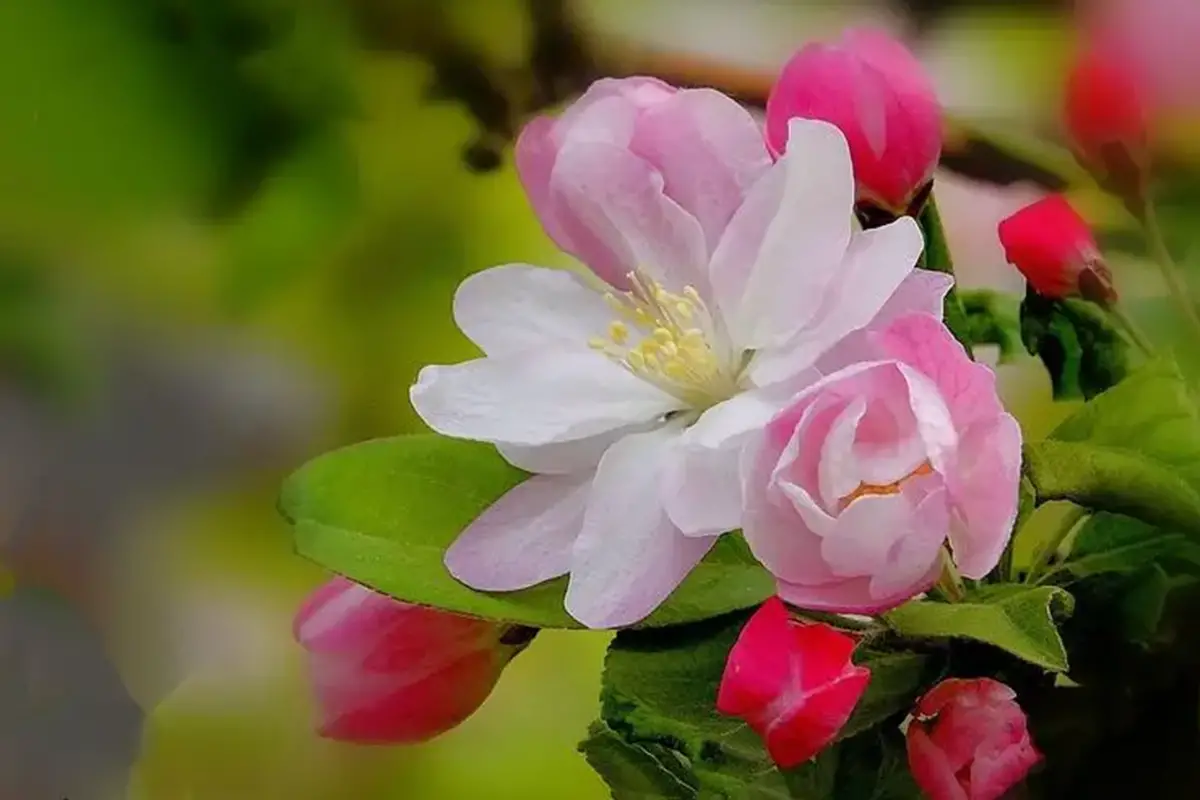
The fruit stems are 2-4 centimeters long, and the petals are inversely ovate, about 1.5 centimeters in length, with a short claw at the base, and are pale pink or nearly white.
The blooming season is from April to May, with fruits maturing from August to September.
This tree is found on mountain slopes and in valley thickets in regions such as Sichuan and Hubei, where it is propagated through root suckers and used as a rootstock for apple trees due to its ease of reproduction and high graft survival rate.
In spring, the trees are adorned with pale pink blossoms, and in autumn, they bear plentiful fruit, making them a beautiful species for ornamental use.
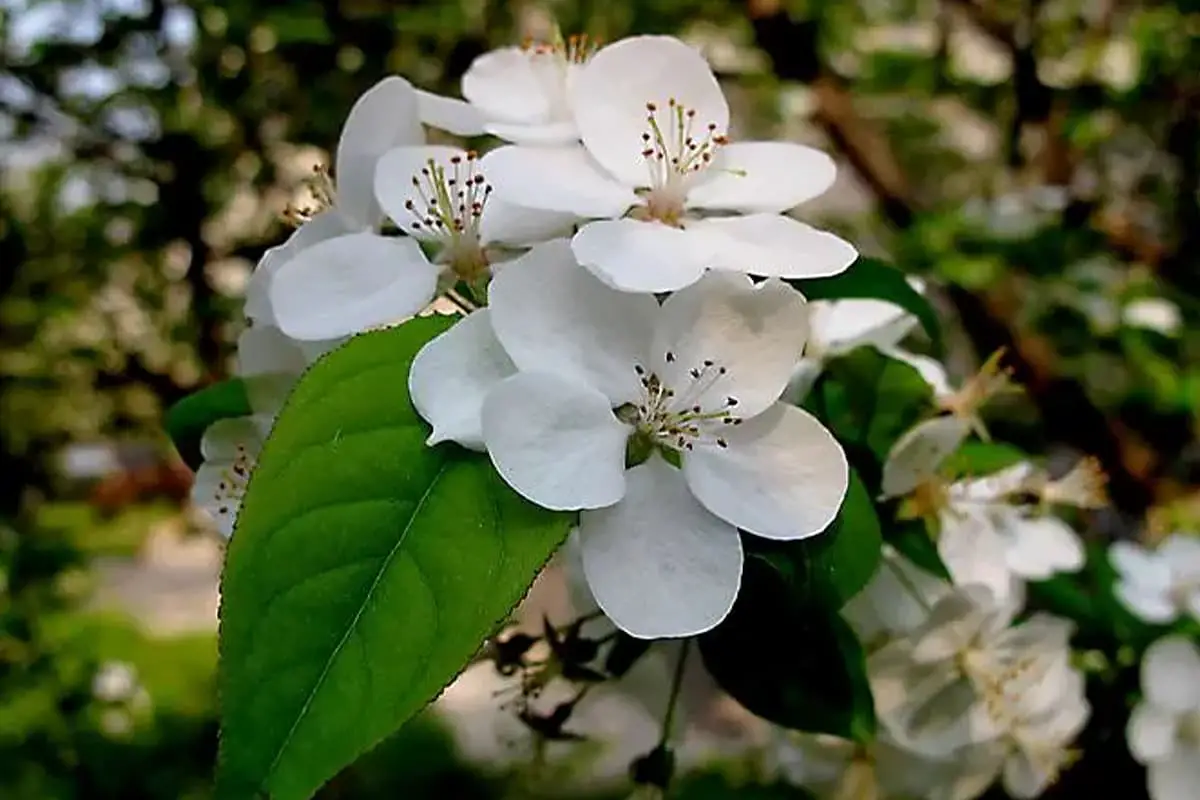
The Malus hupehensis is a tree that reaches up to 8 meters in height. The young twigs have short soft hairs that quickly fall off, and the mature branches are purple to purplish-brown.
The leaf buds are ovate with a sharp tip and a margin of sparse short soft hairs, dark purple in color.
The leaves are ovate to ovate-elliptical, 5-10 centimeters long and 2.5-4 centimeters wide, tapering to a pointed tip, with a broadly cuneate to nearly rounded base and finely serrated edges.
When young, the leaves have sparse short soft hairs, which soon fall off, leaving them hairless and often a purplish-red color; the petioles are 1-3 centimeters long and lose their sparse short hairs over time.
Stipules are herbaceous to membranous, linear-lanceolate, tapering to a pointed tip, and have sparse soft hairs, falling off early.
The inflorescence is a corymb with 4-6 flowers; the pedicels are 3-6 centimeters long, either glabrous or with some long soft hairs; the bracts are membranous, lanceolate, and fall off early.
The flowers are 3.5-4 centimeters in diameter; the calyx tube is either glabrous or has some long soft hairs on the outside; the sepals are triangular-ovate, tapering to a pointed tip or sharp point, 4-5 millimeters long, glabrous on the outside, softly hairy on the inside, slightly purplish, and equal to or slightly shorter than the calyx tube.
The petals are inversely ovate, about 1.5 centimeters long, with a short claw at the base, and are pale pink or nearly white.
There are 20 stamens with varying lengths, about half the length of the petals; usually there are three, sometimes four pistils with long villous bases, slightly longer than the stamens.
The fruit is oval or nearly spherical, about 1 centimeter in diameter, yellow-green with a slight reddish blush, and the sepals fall off; the fruit stems are 2-4 centimeters long. The flowering period is from April to May, and the fruiting period is from August to September.
This tree grows on mountain slopes and in valley thickets, at altitudes of 50-2900 meters.
The Malus hupehensis is an exceptionally adaptable fruit and ornamental tree species that thrives in sunlight.
It is flood-tolerant, drought-resistant, cold-hardy, and resistant to diseases and pests. It can withstand temperatures as low as -21°C and has a certain tolerance for salinity.
The Malus hupehensis is primarily used for its root suckers as rootstock for apple trees, which are easy to propagate and have a high rate of successful grafting.
The dried young leaves can be used as a tea substitute, which has a slightly bitter taste, commonly known as “flower red tea.”
In spring, the trees are covered with pale pink flowers, and in autumn, they bear an abundance of fruit, making them highly attractive as ornamental trees.

Peggie was once a high school mathematics teacher, but she set aside her chalkboard and textbooks to follow her lifelong passion for flowers. After years of dedication and learning, she not only established a thriving flower shop but also founded this blog, “Flowers Library”. If you have any questions or wish to learn more about flowers, feel free to contact Peggie.
 English
  العربية
  Bahasa Indonesia
  Deutsch
  Français
  Italiano
  Nederlands
  Português
  Русский
  日本語
日本語