600+ Types of Flowers A To Z (With Names and Pictures)
Types Of Flowers By Names (A-Z) Types Of Flowers By Color Types Of Flowers By Season Types Of Flowers By Blooming Time 600+ Types of Flowers No. Flower Name No.…

Robinia pseudoacacia, commonly known as Black Locust or False Acacia, is a deciduous tree belonging to the legume family (Fabaceae) and the Robinia genus. Native to the eastern United States, it has been widely introduced to Asia and Europe due to its numerous beneficial qualities.
This fast-growing tree typically reaches heights of 10-25 meters, featuring thick bark that ranges from gray-brown to dark brown. Black Locust blooms between April and June, producing fragrant white flowers in pendant racemes. The fruit is a flat, brown legume pod containing 4-10 seeds, which matures from August to September.
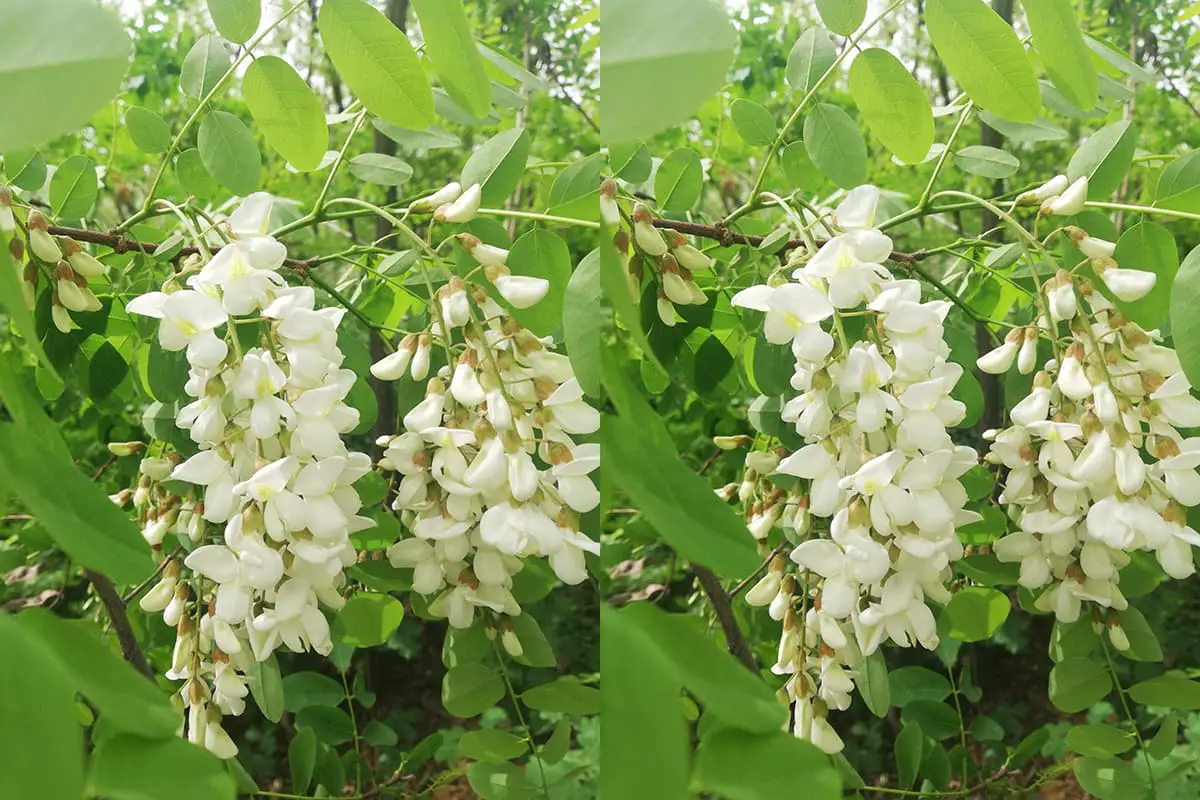
Robinia pseudoacacia L. is characterized by:
Black Locust thrives in temperate climates with average annual temperatures of 8-14°C and annual rainfall of 500-900 mm. It is cultivated between 23° and 46° North latitude and 86° and 124° East longitude.
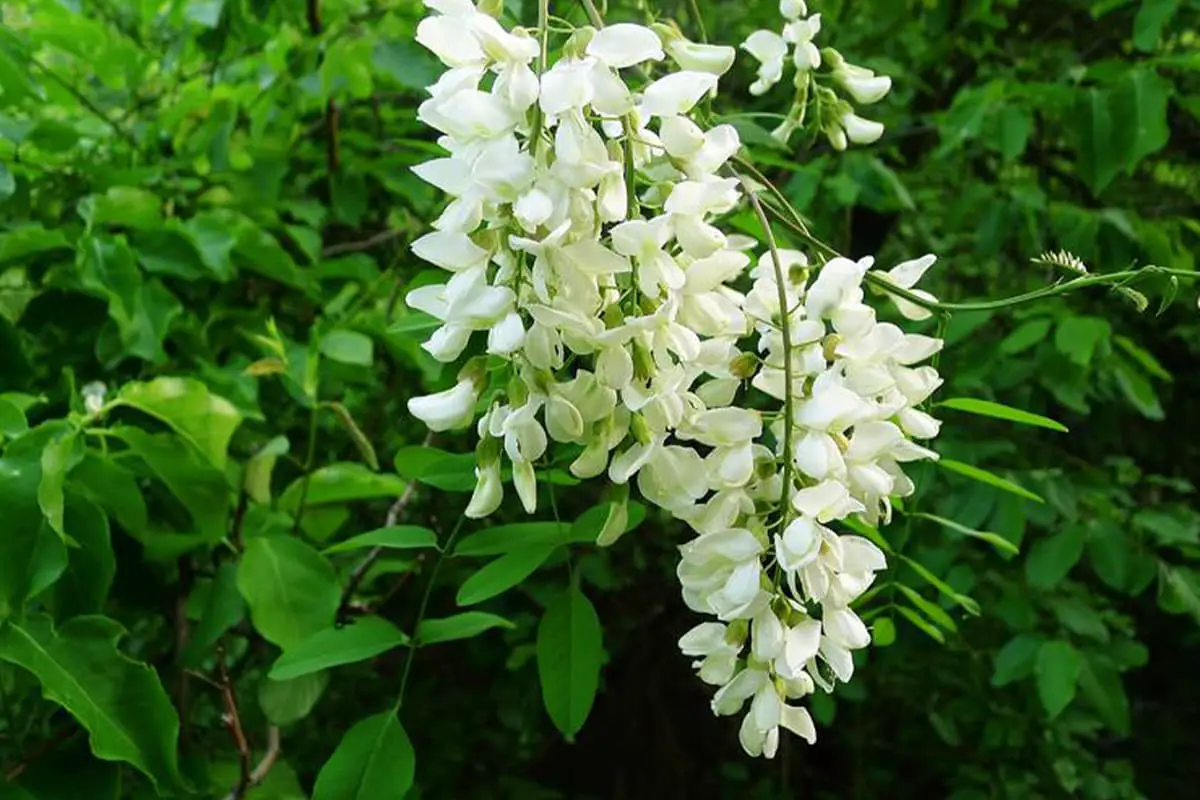
The Black Locust (Robinia pseudoacacia) is a temperate tree species that thrives in areas with an average annual temperature of 8-14°C and annual rainfall between 500-900 millimeters. It exhibits rapid growth in coastal regions with high air humidity.
This species is particularly sensitive to soil moisture conditions. In areas with high groundwater levels or excessive moisture, growth is slow, and the tree becomes susceptible to diseases such as root rot and shoot dieback, potentially leading to mortality.
While possessing moderate drought tolerance, the Black Locust prefers deep, fertile, loose, and moist soils. It adapts well to loam, sandy loam, sand, or clay soils, and can grow normally in neutral, acidic, and saline-alkali soils with salt content below 0.3%. However, it struggles in waterlogged, poorly ventilated clay soils, which may prove fatal.
As a heliophyte, the Black Locust requires full sun exposure and does not tolerate shade well.
Native to the eastern United States, the Black Locust has been widely cultivated between 23°-46° N latitude and 86°-124° E longitude. It was introduced to Europe and Africa in the 17th century, where it has since naturalized in many areas.
The Black Locust is a deciduous tree reaching heights of 10-25 meters. Its bark ranges from gray-brown to black-brown, with shallow to deep longitudinal fissures, rarely smooth.
Young twigs are gray-brown, angular, and minutely pubescent, becoming glabrous with age. The tree features stipular spines up to 2 cm long and small, pubescent winter buds.
Leaves are pinnately compound, 10-25 (-40) cm long. Leaflets are typically paired, elliptic to oblong-elliptic or ovate, measuring 2-5 cm long and 1.5-2.2 cm wide. They have rounded tips with a slight concavity and a small mucro. The base is rounded to broadly cuneate, with entire margins. The upper surface is green, while the lower is gray-green. Young leaflets are short pubescent, becoming glabrous over time. Leaflet petioles are 1-3 mm long, and the stipules are needle-awn-shaped.
Inflorescences are axillary racemes, 10-20 cm long, pendulous, bearing numerous fragrant flowers. Bracts are caducous. Pedicels measure 7-8 mm long. The calyx is obliquely campanulate, 7-9 mm long, with five triangular to ovate-triangular, densely pubescent teeth.
The corolla is white. The standard petal is nearly orbicular, 16 mm long and about 19 mm wide, with a concave apex, rounded base, and a yellow basal spot. Wing petals are obliquely ovate, approximately 16 mm long, with a rounded auricle on one side. Keel petals are falcate-triangular, as long as or slightly shorter than the wings, fused along the anterior edge, with a blunt apex.
There are ten diadelphous stamens, with nine fused and one free. The ovary is linear, about 1.2 cm long, glabrous, with a 2-3 mm long stipe. The style is lanceolate, about 8 mm long, curved upward, and hairy at the tip. The stigma is terminal.
Pods are brown, sometimes with reddish-brown spots, linear-elliptic, 5-12 cm long, 1-1.3 (-1.7) cm wide, flat, with an upward-curved apex and a short beak. A narrow wing runs along the ventral suture. The persistent calyx remains attached. Each pod contains 2-15 seeds.
Seeds are brown to black-brown, slightly glossy, occasionally spotted, and nearly reniform. They measure 5-6 mm long and about 3 mm wide, with an off-center, round hilum.
Flowering occurs from April to June, with fruiting from August to September.
The Black Locust demonstrates poor wind resistance, making it susceptible to wind damage, uprooting, leaning, or uneven crown development when planted in exposed areas. However, it exhibits robust sprouting capabilities, both from the stump and through root suckering, allowing for rapid regeneration after damage or cutting.
(1) Soaking: Locust seeds have thick, hard shells with poor water permeability. To improve germination rates, shorten germination periods, and ensure uniform seedling emergence, seeds must be processed before planting.
Pour warm water (about 55°C) into a container holding the seeds, stirring until the water is cool enough to touch. Soak overnight and collect the swollen seeds with a sieve.
Repeat this process with hotter water (around 85°C) once or twice for the remaining hard seeds until most have swollen.
For persistently hard seeds, wrap them in gauze and immerse in boiling water for 5 minutes, then quickly transfer to cool water and soak overnight.
(2) Germination: To ensure uniform and rapid seedling emergence, pre-germinate the seeds. Place swollen seeds in a bamboo basket, cover with a damp cloth, and keep in a well-ventilated, sunny, or warm area.
Rinse seeds with clean water twice daily. When about one-third of the seeds have cracked open to reveal a white interior, they are ready for planting.
(1) Planting Time: Generally, plant seeds in March when temperatures are low, which is conducive to seed germination.
(2) Planting Method: Thoroughly water containers filled with nutrient-rich soil, allowing it to settle. Make a hole in the soil with a stick and place three germinated seeds per container. Cover with fine sandy soil until seeds are no longer visible.
Water seedlings every three days, adjusting frequency based on weather conditions. One month after emergence, thin and weed the seedlings. Keep only one seedling per container after thinning.
To prevent wilting disease, spray a 1-2% ferrous sulfate solution every 10 days. For aphid prevention, use a 0.05% insecticide solution.
(1) Afforestation Season: Plant in early March, before leaf budding, but no later than April. Choose cloudy days or after light rain when soil is moist.
(2) Afforestation Density: Plant locust trees slightly denser than other broad-leaved species due to their high branching and curved stems. Ideal spacing is 2m x 1m, with 330 plants per acre.
(3) Ground Preparation: Prepare land from the end of the rainy season until March. Use the fish scale pit method: dig semi-circular pits (1-1.5m long, 0.5-1m wide, at least 30cm deep) along contours on slopes. Create a soil ridge at the bottom and fill with topsoil.
(4) Planting: Position seedlings correctly and press soil firmly around sides. After watering, cover with film, leaving a 7-10cm gap for seedling growth. Cover film with 2cm of soil to prevent wind damage.
(1) Soil Management: Maintain loose soil and remove weeds every 15-30 days, depending on the growth stage.
(2) Pest and Disease Control: For general pest prevention, spray a 40% Lequ Liquor solution (1:1500 dilution). For wilt disease, use a 50% Thiram solution (1:300-400 dilution). Spray a 0.5-1% Bordeaux mixture or 1-2% ferrous sulfate solution every 15 days to prevent wilt disease in seedlings.
(3) Pruning and Leaf Removal: Begin when seedlings reach 60-70cm, repeating every 20 days until mid-August. Prune more leaves from larger seedlings, less from medium ones, and none from small seedlings. Maintain a minimum height of 50cm after pruning.
(4) Watering and Fertilizing: Keep soil consistently moist, watering 3-5 times annually in the Kuandian area. Avoid waterlogging and ensure proper drainage. Fertilize once during the seedling stage, preferably in early to mid-July, using 15-20 kg of ammonium sulfate per acre. Cease fertilizing and watering by the end of July to prevent overly rapid growth and maintain wood quality.
Selecting a site for planting
Choose a sheltered, sun-facing nursery site with flat terrain and good irrigation. Before planting, apply 2,470 kg/ha of organic fertilizer, along with 124 kg/ha each of ammonium bicarbonate and calcium superphosphate.
After tilling and leveling, spread a 100:1 mixture of bran and phorate insecticide bait to prevent soil pests. Create north-south oriented beds 1.5 m wide, 12 m long, with 50 cm wide ridges. Ensure the bed surface is level with the ground.
Cutting and arranging the roots
Select high-quality varieties like Lu Ci 74068, using one-year-old seedling roots 0.2-0.5 cm thick. Cut into 3-5 cm segments and group by thickness.
Bundle roots in hundreds and store in moist sand to maintain viability. Alternatively, cut, classify, and arrange roots simultaneously.
In early March, evenly arrange 300-350 root segments per square meter in prepared beds, avoiding overlap. Water thoroughly, cover with 1 cm of fine soil, construct a greenhouse with plastic film, seal edges, and dig drainage ditches.
Inducing germination in the hotbed
Maintain bed surface temperature at 20-25°C to promote germination. Sprouting begins in 15-20 days, with uniform seedling emergence after about 30 days.
Avoid watering during early cool periods. From late March, as temperatures rise and exceed 30°C at midday, ensure proper ventilation and cooling to prevent sunscald.
After seedling emergence, maintain humidity through light watering and occasional afternoon immersion. Regulate bed temperature and humidity through ventilation for optimal seedling growth.
When seedlings reach 5 cm, begin hardening off. Remove film two days before transplanting to acclimate seedlings to open field conditions.
Transplanting Seedlings
Prepare a flat seedbed with good irrigation. Apply 2,470 kg/ha of organic fertilizer, plus 124 kg/ha each of ammonium bicarbonate and superphosphate.
After mechanized plowing and harrowing, create north-south ridges 60 cm wide, with 30 cm wide and 25 cm deep furrows, extending 25 m.
Transplant 5-10 cm high seedlings in batches from late April to early May, as root sprouting is uneven. Continue sprouting smaller seedlings in the hotbed.
Transplant on cloudy days or after 3 PM on sunny days to avoid midday heat stress.
Water the bed before transplanting. Use a small shovel to remove soil blocks with seedlings. Plant immediately if the soil block disintegrates.
Create 5-8 cm deep holes with straight walls. Plant seedlings against the wall, water after covering with soil. Plant two rows per ridge, 45 cm between rows and 30 cm between plants, achieving about 12,100 plants per hectare.
Water daily for a week post-transplanting. In mid-May, apply 37 kg/ha of urea and flood irrigate.
In mid-June, apply an additional 37-49 kg/ha of urea and irrigate again. Regularly loosen soil and remove weeds to promote growth.
Spray seedlings with a 1% solution of oxidized leuconostoc during bud break and active growth periods to prevent aphid damage.
This management ensures nursery trees grow over 2.5 meters tall, suitable for planting and afforestation.
Seed Treatment
Harvest seeds when pods turn reddish-brown and dry. Sun-dry, remove pod skin, husks, and impurities. Seed yield is 10-20% of pod weight, with 1000-seed weight around 20 grams and 80-90% germination rate.
To break seed dormancy, soak in 60-80°C water for 5-10 minutes, then cool to 30-40°C. Remove floating debris and bad seeds. Soak good seeds for 24 hours, then dry slightly. Sieve out unswollen seeds and re-soak swollen ones.
Place swollen seeds in a basket, cover with a damp jute bag, and keep in a warm, sunny spot. Rinse twice daily with warm water. Seeds are ready for sowing in 4-5 days when sprouting begins.
Selecting Land, Land Preparation and Fertilization
Choose high, fertile sandy loam soil with good drainage. Soil salt content should be below 0.2%, with groundwater over 1 meter deep. Use irrigated or flat mature land with deep soil. Avoid waterlogged or barren areas.
Rotate black locust with other species like poplar or pine to prevent wilt disease. Avoid heavy clay soils.
Thoroughly cultivate the land. Fertilize in fall, harrow in spring for moisture retention, and sow after irrigating in early May.
Sowing
Sow around the “Grain Rain” period (late April) to avoid late frost damage. Both ridge and field-style sowing are suitable, with field-style more common.
Level the nursery ground and create furrows 30-40 cm apart, 1.0-1.5 cm deep. Ensure furrow bottoms are flat and consistent in depth. Evenly distribute seeds, cover with 1-2 cm of soil, and gently compress.
Emergence occurs in 6-8 days, with a sowing rate of 60-90 kg/ha.
Field Management
Watering: Delay watering until uniform seedling emergence. Maintain moderate soil moisture, loosening soil to increase temperature and promote germination. Avoid overwatering to prevent seedling decay or yellowing. First water in early June, then every 20 days. Pause after early July watering to promote wood formation and winter hardiness. Perform final winter watering in late November.
Fertilizing: Apply 45-75 kg/ha of urea with first watering after seedling establishment. In late June, apply nitrogen and phosphorus compound fertilizer twice (75-195 kg/ha) with watering. Stop fertilizing in early August. Apply 3,700-6,180 kg/ha of mature base fertilizer during winter tillage or early spring harrowing. During spring land preparation, deep plow (over 25 cm), harrow finely, and level. Mix 18.5 kg/ha of ferrous sulfate powder with 1.2 kg/ha of 5% chlorpyrifos and 40 parts fine soil for soil disinfection.
Soil Loosening and Weeding: Cultivate after watering or rain to maintain loose, weed-free soil.
Cold Protection and Overwintering: One to two-year-old seedlings are susceptible to frost and spring wind damage. Dig up one-year-old seedlings in autumn for fall afforestation or winter false planting, using them for spring afforestation in the second year.
Transplanting and Cultivating Large Seedlings
For large seedlings needed in urban settings, transplant in Yuanzhou District from late April to early May.
Transplanting density depends on desired specifications and seedling age. For four-year-old transplants, use 50 cm by 100 cm spacing. Increase spacing for older seedlings.
Use pit planting for black locust transplantation. Prune above-ground parts and damaged roots before transplanting, maintaining root length at 20-30 cm. Plant with root slurry, keeping the root collar level with the ground.
Post-transplantation, ensure timely watering, fertilization, soil management, and cold protection, especially for flat-cut seedlings.
Conduct proper pruning, bud removal, and branch trimming, retaining strong upright branches as the main trunk.
The main diseases affecting the Robinia pseudoacacia (Black Locust) include Fusarium wilt, and the primary pests include the locust borer (Megacyllene robiniae).
Prevention methods:
① For Fusarium wilt, improve soil drainage and aeration around affected trees. Remove and destroy infected plant material. Apply a balanced fertilizer to promote tree vigor. In severe cases, use systemic fungicides as recommended by a certified arborist.
② For locust borers, maintain tree health through proper care and pruning. Apply insecticides containing permethrin or carbaryl to the trunk and main branches in late summer, targeting adult beetles before they lay eggs. Always follow label instructions and local regulations when using pesticides.
The Black Locust (Robinia pseudoacacia) offers multiple benefits in landscaping, environmental protection, and various industries.
Ornamental value
The Black Locust is a valuable ornamental tree with high aesthetic appeal. It features a broad, spreading canopy, pinnately compound leaves that provide dappled shade, and fragrant white flowers in pendulous racemes during late spring.
It serves well as a street tree, shade tree, or for greening urban areas, industrial sites, and erosion-prone slopes.
Ecological value
Black Locust is an excellent species for soil stabilization and erosion control. Its extensive, shallow root system effectively binds soil. As a nitrogen-fixing legume, it improves soil fertility. The tree also demonstrates considerable tolerance to air pollution, making it valuable for urban environments.
Edible value
Black Locust flowers are edible and have a sweet, pea-like flavor. They can be used in salads, fritters, or to make syrups and jellies. However, it’s crucial to note that other parts of the tree, including seeds and bark, are toxic and should not be consumed.
Medicinal value
Various parts of the Black Locust have been used in traditional medicine, though modern applications are limited due to potential toxicity. The bark and leaves contain compounds with antioxidant and anti-inflammatory properties. However, medicinal use should only be under professional guidance.
Industrial use
Black Locust wood is highly valued for its durability and rot resistance. It’s used in furniture making, particularly for outdoor applications, as well as for fence posts, mine timbers, and railroad ties. The wood also has a high fuel value, making it excellent for firewood.
The tree’s fast growth rate, coupled with its nitrogen-fixing ability and adaptability to poor soils, makes it valuable for reforestation projects and biomass production.
Symbolism of the Black Locust
In the language of flowers, the Black Locust symbolizes love beyond the grave and affection. Its white blossoms represent purity and elegance.
In some cultures, the Black Locust is associated with protection and safety, likely due to its thorny branches and durable wood.
Native American tribes, particularly the Cherokee, considered the tree sacred and used it in their traditional practices.
In literature and folklore, the Black Locust often represents resilience and adaptability, reflecting its ability to thrive in various environments.
The tree’s rapid growth and spreading nature have also made it a symbol of prosperity and abundance in some contexts.

Peggie was once a high school mathematics teacher, but she set aside her chalkboard and textbooks to follow her lifelong passion for flowers. After years of dedication and learning, she not only established a thriving flower shop but also founded this blog, “Flowers Library”. If you have any questions or wish to learn more about flowers, feel free to contact Peggie.
 English
  العربية
  Bahasa Indonesia
  Deutsch
  Français
  Italiano
  Nederlands
  Português
  Русский
  日本語
日本語