600+ Types of Flowers A To Z (With Names and Pictures)
Types Of Flowers By Names (A-Z) Types Of Flowers By Color Types Of Flowers By Season Types Of Flowers By Blooming Time 600+ Types of Flowers No. Flower Name No.…

Narcissus pseudonarcissus, commonly known as the wild daffodil or Lent lily, is a perennial herbaceous plant belonging to the Amaryllidaceae family. This species is the wild ancestor of many cultivated daffodil varieties and is notable for its distinctive yellow flowers that herald the arrival of spring.
Root: Narcissus pseudonarcissus has a fibrous root system that emerges from the basal plate of the bulb. The roots are white, fleshy, and cylindrical, lacking secondary roots. They are brittle and do not regenerate if damaged. The root epidermis consists of a single layer of cells, while the cortex is composed of thin-walled cells arranged in an elliptical pattern.
Bulb: The bulb is ovoid to broadly ovate in shape, covered with a brownish papery tunic. Internally, it comprises several layers of fleshy, white scales that store nutrients. The basal plate at the bottom of the bulb serves as the point of origin for roots and the new shoot.
Leaves: The leaves are basal, linear, and flat, emerging from a greenish-white tubular sheath at the top of the bulb. They measure 20-40 cm in length and 8-15 mm in width, with a blunt tip. The leaves have a distinctive blue-green color due to a waxy coating, which helps reduce water loss. Typically, each plant produces 5-9 leaves, though some may have up to 11.
Flower Stem: The flower stem, or scape, grows from within the leaf cluster and usually reaches a height equal to or slightly taller than the leaves. It is hollow, cylindrical, and green, with a waxy surface. Each bulb typically produces 1-2 scapes, though some cultivars can produce up to 8-11.
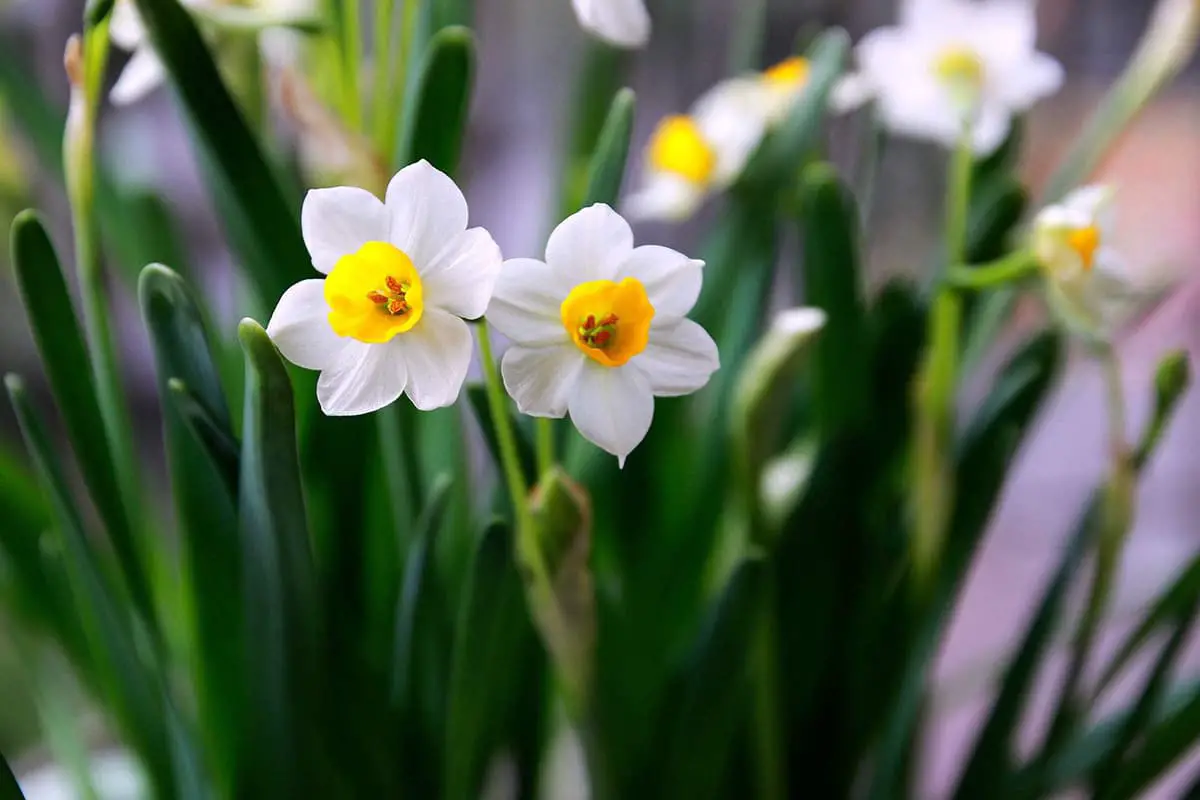
Flowers: The flowers are borne in a solitary or umbel-like cluster at the top of the scape, with 1-2 flowers being most common in wild specimens. Each flower is subtended by a papery spathe. The perianth consists of six tepals, which are typically pale yellow to golden yellow. The corona, a distinctive feature of daffodils, is trumpet-shaped and a deeper yellow than the tepals. It measures about half the length of the tepals.
Reproductive Organs: The flower contains six stamens attached to the inside of the perianth tube. The anthers are basifixed. The ovary is inferior and three-chambered, with numerous ovules in each chamber. The style is slender with a three-lobed stigma.
Fruit: The fruit is a capsule that splits along three lines when mature. However, as many cultivated forms are triploid, they are often sterile and do not produce viable seeds.
Single Petal Type: This cultivar features a pale green corolla and yellow calyx, with six petals surrounding a golden pseudo-corona in the center, reminiscent of a cup. Its fresh and pleasant fragrance has earned it the poetic names “Golden Cup and Jade Stand” and “Narcissus Wine Cup”.
The blooming period typically lasts about two weeks. A variant with a white pseudo-corona, multiple flowers, and slightly narrower leaves is known as “Silver Cup and Jade Stand”.
Double Petal Type: This variety, also known as “Hundred-Leaf Narcissus” or “Jade Delicacy”, is characterized by its double-petaled structure. It boasts 12 white petals curled into a cluster, with the corolla transitioning from light yellow at the base to pale white at the tips. Unlike the single petal type, it lacks a distinct pseudo-corona.
While its flowering period is longer, lasting about three weeks, it is generally considered less aesthetically pleasing than the single petal type and has a milder fragrance. This form is a genetic variant of the standard narcissus.
Narcissus is a fall-planted bulbous perennial that thrives in greenhouse conditions. It requires abundant sunlight but can tolerate partial shade. While hardy in many aspects, it is not frost-resistant. The plant enters dormancy in July-August, during which its leaves wither.
This dormant period is crucial for flower bud differentiation within the bulb. Narcissus exhibits a distinct growth cycle: active growth in fall and winter, blooming in early spring, and resting in summer.
These plants prefer warm, humid climates and thrive in fertile, well-draining sandy soils. Their optimal growing conditions include cool temperatures during early growth stages, mild frost tolerance in the middle stage, and warmer conditions in the later stage.
Ideal climate conditions for narcissus cultivation include mild winters without severe cold, summers without extreme heat, and abundant rainfall in spring and autumn.
For optimal growth, narcissus pots should be placed in a location that receives ample sunlight during the day. Sufficient light is crucial for photosynthesis, which supports the development of wide, upright leaves with a vibrant green color and fragrant flowers. Insufficient light can result in tall, thin, weak leaves with a yellowish tint, and may inhibit flowering.
The ideal soil for narcissus is a deep, loose, fertile alluvial sandy loam. Proper soil pH is critical for nutrient uptake and overall plant health; narcissus prefers slightly acidic to neutral soil with a pH range of 5.0 to 7.5.
This is the most common propagation method for lilies. Bulblets develop on both sides of the parent bulb, connected only at the base, and can easily detach.
In autumn, these bulblets are separated from the parent bulb and planted individually. They will produce new flowering-size bulbs in the following year or two, depending on the species and growing conditions.
Scales are the fleshy, modified leaves that make up the lily bulb. They can be carefully removed from the parent bulb and used for propagation. This method is particularly useful for rare or expensive lilies.
To propagate from scales:
Double scaling is an advanced propagation technique that maximizes the number of new bulbs produced from a single parent bulb. It’s based on the principle that each pair of scales contains at least one dormant bud.
Process:
This method can be performed year-round but is most successful between April and September. The survival rate of transplanted bulblets is high, often 80-100%.
Tissue culture is a highly specialized propagation method used for rapid multiplication of lilies, especially for commercial production or conservation of rare species.
Procedure:
This method offers a 100% survival rate when transplanting to field conditions and can also have antiviral effects when using bud tips as explants.
Each of these propagation methods has its advantages and is suited to different situations, from home gardeners to commercial growers. The choice of method depends on the lily species, available resources, and desired outcome.
After annual bulb harvesting, select larger market-ready bulbs. Immediately plant or reserve smaller side bulbs for September or October planting. Early planting generally promotes better root development.
For planting, use larger bulbs in single or wide rows. Single row spacing: 6×25 cm; wide row spacing: 6×15 cm. After 3-4 continuous rows, leave a 35-40 cm gap before repeating. Dryland cultivation requires minimal maintenance beyond 2-3 water and fertilizer applications. Single row planting is often integrated between other crops.
Bulb selection is critical, requiring pest and disease-free specimens with bright, smooth outer scales and clear veins. Bulbs are categorized into three cultivation levels based on size and age:
Plant from late September to early October. Planting distances:
Plant bulbs with leaves extending into row spacing. Planting depth:
Post-planting:
Maintain water level below bulbs, keeping bulbs in soil and roots in water.
Cultivation period: 6-7 months
By implementing these refined cultivation techniques, you can produce high-quality narcissus bulbs suitable for both commercial and ornamental purposes.
The quality of a daffodil bulb significantly influences the number and fragrance of its flowers. Selecting a good bulb is crucial for growing beautiful potted daffodils.
When choosing daffodil bulbs, consider their shape, color, firmness, and size:
Shape: High-quality daffodil bulbs are typically large, flat, and firm. The bulb’s skin should have wide vertical stripes, a tightly stretched inner membrane, and a glossy appearance. Look for a large, thick root plate and symmetrical small bulbs growing beside the main bulb.
Color: The bulb should have a deep brown color with a complete, bright coating. Top-quality bulbs show no signs of decay or insect damage.
Firmness: Gently press the bulb between your thumb and forefinger. A flower bulb should feel cylindrical and elastic, while a leaf bulb will feel softer, flatter, and less elastic.
Size: Daffodil bulbs are often sold in bamboo baskets containing 20, 30, 40, or 50 bulbs. Larger bulbs (fewer per basket) are generally of higher quality. For instance:
Two primary methods exist for cultivating daffodils: hydroponics and soil cultivation.
Hydroponics:
Soil Cultivation:
Daffodils typically bloom between plum blossoms and peach/plum trees. With proper management, you can control their blooming period:
To cultivate short-leaf, long-stemmed daffodils:
After blooming:
To avoid premature flower stalk death or wilting buds:
To encourage sprouting:
To extend the blooming period:
By following these detailed guidelines, you can successfully cultivate beautiful, long-lasting daffodils in your home using water cultivation techniques.
The main diseases and pests affecting daffodils include brown spot disease, leaf blight, nematode disease, fusarium basal rot, and penicillium blue mold.
This fungal disease primarily affects the leaves and stems of daffodils. It initially appears as brown spots on leaf tips, which can spread to the entire leaf and stem in severe infections. This causes leaf twisting and stunted growth, potentially leading to plant death.
Early treatment involves spraying with a solution of 75% chlorothalonil wettable powder diluted 600 to 700 times in water every 5 to 7 days.
Preventive measures include removing outer papery scales from bulbs before planting and soaking them in either a 0.5% formalin solution or a 500-times diluted solution of 50% carbendazim for 30 minutes.
This fungal infection typically occurs on daffodil leaves. Early symptoms include greenish-yellow spots that expand in a fan shape with yellow-green halos. As the disease progresses, leaves dry out and develop black, granular fungal structures.
Prevention involves removing dried scales before planting and rinsing bulbs 2-3 times with a weak potassium permanganate solution. Early-stage infections can be treated by spraying with a 1500-times diluted solution of 50% mancozeb (zinc dimethyldithiocarbamate).
This microscopic worm primarily affects daffodil leaves and flower stems. Symptoms begin with yellow-brown inlaid stripes on leaves and stems, followed by blister-like or wavy protrusions. The leaf and stem epidermis eventually rupture and turn brown, leading to wilting.
Prevention involves hot water treatment: soak bulbs in water at 43.5°C (110°F) for 3 hours, followed by a cold water rinse. Alternatively, soak bulbs in a 0.5% formalin solution at 40–43°C for 3–4 hours. If severe infection is detected during the growing season, immediately remove and destroy affected plants to prevent spread.
This soil-borne fungal disease affects the basal plate of daffodil bulbs. Symptoms include yellowing and premature dieback of foliage, and brown, soft rot at the base of the bulb. Control measures include planting in well-drained soil, removing and destroying infected plants, and treating bulbs with fungicides before planting.
This storage disease affects daffodil bulbs, causing them to develop a blue-green mold. Prevention involves proper curing and storage of bulbs in cool, dry conditions. Infected bulbs should be discarded to prevent spread.
Daffodils bring tranquility and warmth to living spaces. They are particularly suitable for living rooms, which serve as gathering spaces for family and guests. Daffodils can absorb noise and air pollutants, improving air quality. From a feng shui perspective, they contribute to creating a comfortable and harmonious home environment.
The bulbs of certain daffodil species are used in traditional medicine, harvested in spring and autumn. They are cleaned, blanched, then sliced and dried or used fresh. Daffodil bulbs have slight toxicity and should only be used under professional guidance.
Medicinal properties include:
Traditional uses include treatment of mumps and early stages of boils, abscesses, and infections.
Chemical Composition: Daffodils contain various alkaloids including pseudolycorine, lycorine, and tazettine. These alkaloids have demonstrated certain anticancer and antiviral properties in laboratory studies. Narcissus papyraceus Ker-Gawl, a related species, contains papyramine, lycorine, tazettine, and galanthamine.
Toxicity Warning: Daffodils are listed as poisonous plants in the Chinese Plant Atlas database. All parts of the plant are toxic, especially the bulbs. Ingestion can cause severe symptoms including vomiting, abdominal pain, irregular breathing, and in severe cases, convulsions, paralysis, and death. The LD50 of total daffodil alkaloids for intraperitoneal injection in mice is 182mg/kg.
Daffodils have significant value in the fragrance industry. Fresh daffodil flowers contain 0.20% to 0.45% essential oil, which is extracted for use in perfumes, soaps, and high-end cosmetics. Daffodil essence is a crucial ingredient in fragrance mixing.
The long-lasting fragrance of daffodils is also used to scent teas, producing high-grade daffodil tea and daffodil oolong tea, known for their lingering aroma and mellow taste.
In Western culture, the daffodil (Narcissus) symbolizes:
The name “Narcissus” is derived from Greek mythology, associated with the story of a young man who fell in love with his own reflection, adding layers of meaning related to self-reflection and vanity.
In various cultures, daffodils also represent:
The cultural significance of daffodils varies across different regions and contexts, making them a versatile symbol in literature, art, and social customs.

Peggie was once a high school mathematics teacher, but she set aside her chalkboard and textbooks to follow her lifelong passion for flowers. After years of dedication and learning, she not only established a thriving flower shop but also founded this blog, “Flowers Library”. If you have any questions or wish to learn more about flowers, feel free to contact Peggie.
 English
  العربية
  Bahasa Indonesia
  Deutsch
  Français
  Italiano
  Nederlands
  Português
  Русский
  日本語
日本語