Top 10 Rarest Flowers in China
China is home to a rich variety of plant and animal resources, boasting an exceptional botanical diversity that includes numerous rare and endemic species. However, a number of these rare…

Gyoiko, a member of the Rosaceae and Prunus genus, is a rare variety of cherry blossom known for its green flowers. Its floral symbolism embodies wisdom, refinement, and elegance.
As a unique green cherry blossom, Gyoiko was cultivated as early as the Edo period in Renhe Temple, Kyoto. It blooms later than Somei Yoshino Cherry, around late April, with 10 to 15 petals in hues between white and light green.
The petals feature red streaks which are not particularly conspicuous when the flowers first bloom, but intensify in color over time.
A rare cherry blossom variety with green flowers, Gyoiko is part of the Rosaceae and Prunus genus. Its symbolism represents wisdom, elegance, and sophistication.
Gyoiko, the green cherry blossom, has been known and appreciated since ancient times. It was cultivated in Renhe Temple in Kyoto during the Edo period.
The name Gyoiko, bestowed in mid-Edo period, originates from the flower’s resemblance to a noble hue referred to as “Moe yellow”. This color is reminiscent of the tender green of new spring grass buds.
Cherry blossoms have over 300 varieties, with around 8-10 series in biological classification in Japan. The flower colors mainly vary from pink to white, with only two exceptions: “Yukinoshita” and “Gyoiko”. Gyoiko blooms later than Somei Yoshino Cherry, around late April.
The diameter of the petals varies based on location. There are over 170 locations in Japan where Gyoiko can be viewed. In Kyoto and Yuki City, the petal diameter ranges from 2 to 2.5 centimeters.
In Hokkaido, the diameter reaches 4 centimeters. The petals, numbering between 10 and 15, boast colors between white and light green. Red streaks adorn the middle of the petals, not particularly noticeable at first but deepening in color over time.

The name Gyoiko, meaning “Imperial Yellow”, was given during the mid-Edo period due to its color resembling a noble hue known as “Moe yellow”.
This hue is reminiscent of the tender green of new spring grass buds. Interestingly, this green hue was referred to as “yellow”.
Similarly, in the Tang Dynasty of China, the poem “Green willow is just half yellow” used “just yellow” to describe the hazy new green of willow buds in spring. It seems that people in ancient Orient often associated green with yellow as the color of plant buds in spring.
The green petal color is due to the presence of chlorophyll. There are other green cherry blossoms, such as Yukinoshita. Since 1990, three more green varieties have been discovered: Sumaura Fugenzo, Soni Koen Kizakura, and Soni Koen Ryoku Ryu.
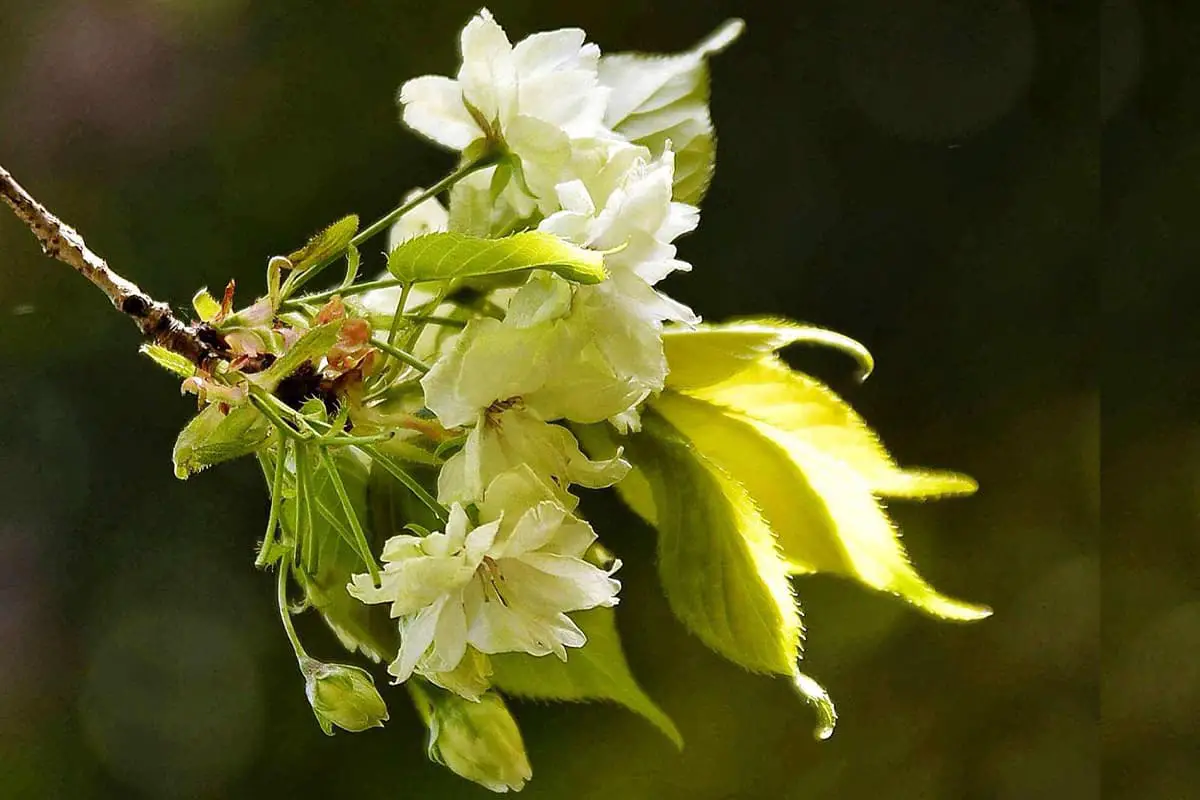
Gyoiko’s floral language: Full of wisdom and refinement, elegant.

Peggie was once a high school mathematics teacher, but she set aside her chalkboard and textbooks to follow her lifelong passion for flowers. After years of dedication and learning, she not only established a thriving flower shop but also founded this blog, “Flowers Library”. If you have any questions or wish to learn more about flowers, feel free to contact Peggie.
 English
  العربية
  Bahasa Indonesia
  Deutsch
  Français
  Italiano
  Nederlands
  Português
  Русский
  日本語
日本語