600+ Types of Flowers A To Z (With Names and Pictures)
Types Of Flowers By Names (A-Z) Types Of Flowers By Color Types Of Flowers By Season Types Of Flowers By Blooming Time 600+ Types of Flowers No. Flower Name No.…

The Mountain Gardenia, also known as the Wild Gardenia, Yellow Gardenia, Yellow Branch Flower, Mountain Yellow Branch, Mountain Gardenia, and Gardenia Flower, is a wild variety of the Gardenia flower.
It is found in tropical and subtropical regions such as China, Japan, and Vietnam, and is often planted as a garden shrub. This variety has smaller leaves compared to the Large-leaved Gardenia, with single-petaled flowers each consisting of six petals.
The fragrance is intoxicating, and when dried, can be used as a tea or spice. Therefore, it is quite popular in the horticultural world.
The drought-resistant Yellow Gardenia thrives in temperatures between 22-28℃. It is suitable for warm, moist environments with abundant sunlight and good drainage. The ideal soil is loamy with a slight stickiness.
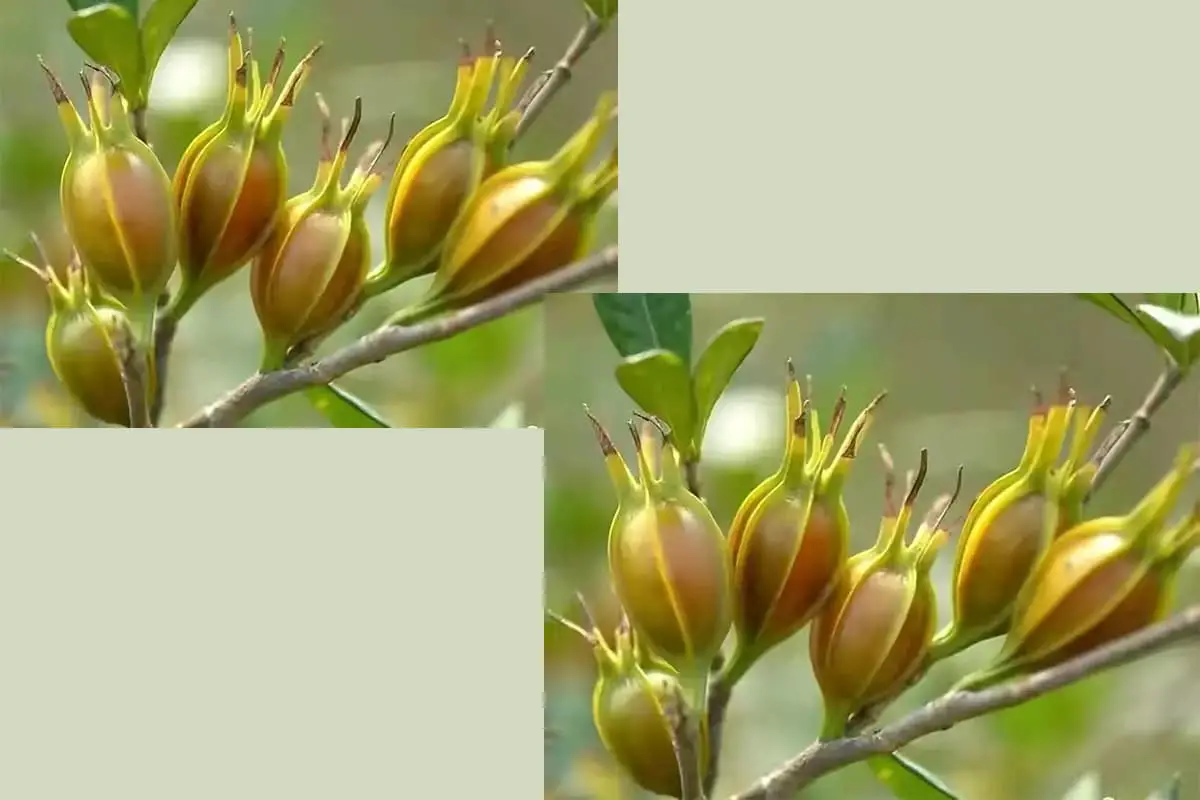
The Mountain Gardenia is a shrub measuring 0.3-3 meters in height. Its young branches are often short-haired and cylindrical, gray in color.
The leaves are opposite, leathery, rarely papery, occasionally with three whorled leaves. The leaf shape varies, usually being oblong lanceolate, ovate oblong, ovate or elliptical, 3-25 cm in length and 1.5-8 cm in width.
The top is tapering, abruptly tapering or bluntly pointed, the base is wedge-shaped or bluntly pointed, both surfaces are usually hairless, the upper surface is shiny green, the lower surface is darker.
The lateral veins are 8-15 pairs, protruding below and flat above; the petiole is 0.2-1 cm long; the stipules are membranous.
The flowers are fragrant, usually single at the branch tip, the pedicle is 3-5 mm long; the calyx tube is inverted conical or ovate, 8-25 mm long, with longitudinal ribs, the calyx limb is tubular, inflated, the top is 5-8 lobed, usually 6 lobed, the lobes are lanceolate or linear-lanceolate, 10-30 mm long, 1-4 mm wide, increasing in fruit, persistent.
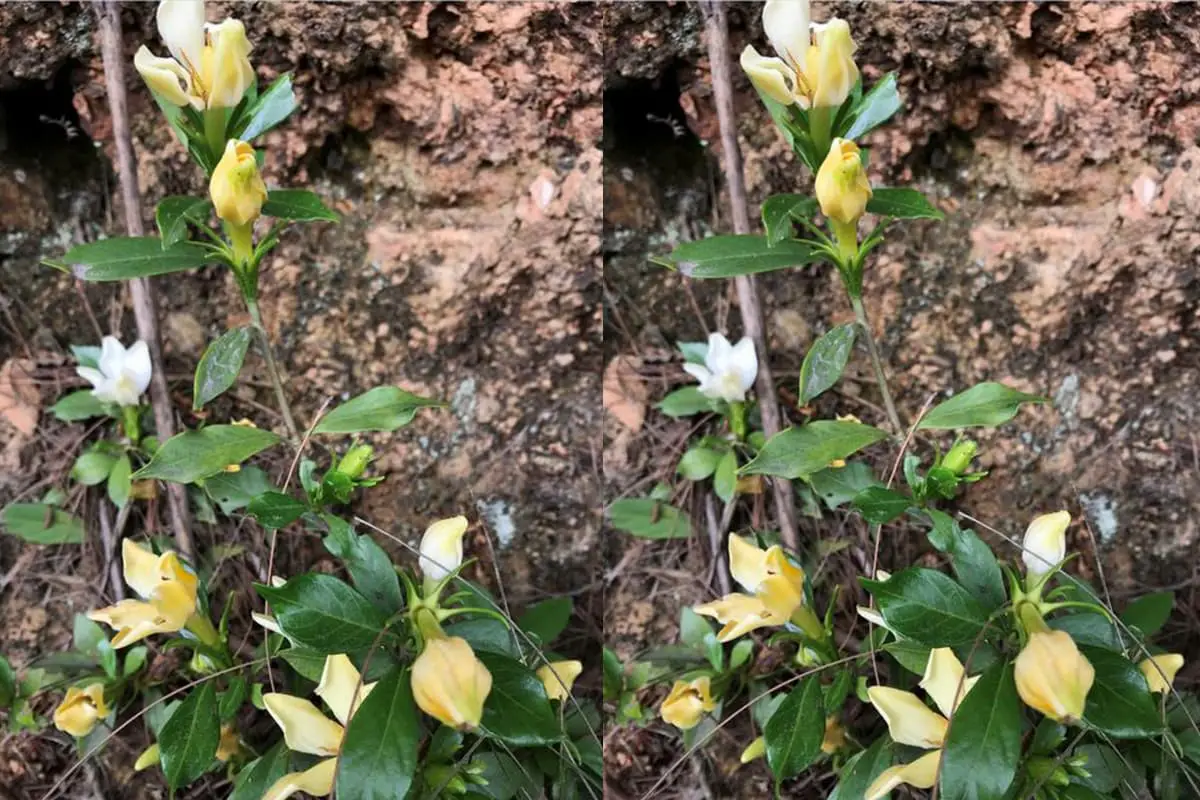
The corolla is white or milky yellow, high-pedicel, the throat is sparsely soft-haired, the crown tube is narrow cylindrical, 3-5 cm long, 4-6 mm wide, the top is 5 to 8 lobed, usually 6 lobed, the lobes are spreading, ovate or ovate-oblong, 1.5-4 cm long, 0.6-2.8 cm wide.
The filaments are very short, the anthers are linear, 1.5-2.2 cm long, protruding; the style is thick, about 4.5 cm long, the stigma is spindle-shaped, protruding, 1-1.5 cm long, 3-7 mm wide, the ovary is about 3 mm in diameter, yellow, smooth.
The fruit is ovate, nearly spherical, elliptical or oblong, yellow or orange-red, 1.5-7 cm long, 1.2-2 cm in diameter, with 5-9 winged longitudinal ribs, the persistent sepals at the top are up to 4 cm long and up to 6 mm wide.
The seeds are numerous, flat, nearly round and slightly angular, about 3.5 mm long and about 3 mm wide.
The flowering period is from March to July, and the fruiting period is from May to February of the following year.
The robust and resilient Gardenia (Gardenia jasminoides), also known as Yellow Gardenia, has strong rooting capabilities. The primary method of propagation is by cutting, but it can also be propagated by seeding and layering.
Cuttings should be taken in the spring months of March and April or the early autumn month of September. Choose a branch approximately 20 cm long with a diameter of roughly 1 cm, and insert it into the flower bed at an angle, providing proper protection.
Within a month, roots should form. Once established, the cuttings can be transplanted the following year. Seeding is typically done in September or October.
Although this method can yield a larger number of offspring, it requires 2-3 years before the plants bloom, and is thus primarily used for breeding and seed collection. Layering is best done in spring for a higher survival rate.
After 1-2 years, the plants will produce lush and graceful flowers. After the flowering period, prune any overcrowded or withered branches, and apply fertilizer and change the soil during the autumn and winter seasons to promote lush growth in the following year.
The Yellow Gardenia is an evergreen shrub or small tree belonging to the family Rubiaceae and the genus Gardenia. It is also known by various names such as Cape Jasmine, Golden Gardenia, and Yellow Jasmine among others, with nearly a hundred species.
The Yellow Gardenia typically grows to a height of 2 to 4 meters and is found in southern China, the Indochina Peninsula, Japan, and Taiwan.
It thrives in sunny slopes and broad-leaved forests at low altitudes, and can often be seen in parks, gardens, and campuses where they have been planted by people. It is suitable for pot culture, bonsai, hedging, and open-air cultivation in gardens.
The leaves of the Yellow Gardenia are opposite, elliptical or long elliptical in shape, with sharp tips, smooth surfaces, and nearly stemless. The stipules are fused at the base to form a sheath.
The plant blooms from mid-spring to early summer, from March to June. The flowers are umbellate, single-petaled, and white, growing from small branches, either axillary or terminal, with six petals.
The fragrance is strong and pleasing, and the flowers can be dried and used as a tea or perfume, making them popular in the horticultural world. As the flowers fade, they turn a milky yellow, making it one of China’s typical fragrant plants.
In autumn and winter, it produces long, elliptical berries with five corners. When ripe, the skin turns orange-yellow and often attracts birds such as White-eared Sibias, Green-backed Tits, Japanese White-eyes, and White-rumped Shamas.
The fruit contains a yellow pigment called crocin, which can be used as a yellow dye, hence the name “Yellow Gardenia”. It can also be processed into food coloring and used as a medicinal herb.
The fragrance of the Yellow Gardenia comes from essential oils such as benzyl-acetate, linalool-acetate, and anthranylic-methylester.
Recently, the use of fragrant flowers to make tea and floral water for drinking as a natural remedy has become popular, and the Yellow Gardenia is one of the favored choices for this purpose.
Peggie was once a high school mathematics teacher, but she set aside her chalkboard and textbooks to follow her lifelong passion for flowers. After years of dedication and learning, she not only established a thriving flower shop but also founded this blog, “Flowers Library”. If you have any questions or wish to learn more about flowers, feel free to contact Peggie.
 English
  العربية
  Bahasa Indonesia
  Deutsch
  Français
  Italiano
  Nederlands
  Português
  Русский
  日本語
日本語