The Lupinus polyphyllus is an annual herbaceous plant that can grow up to 70 cm tall. The stem at the base is branched, and it has palmately compound leaves with thick, lanceolate to inversely lanceolate leaflets.
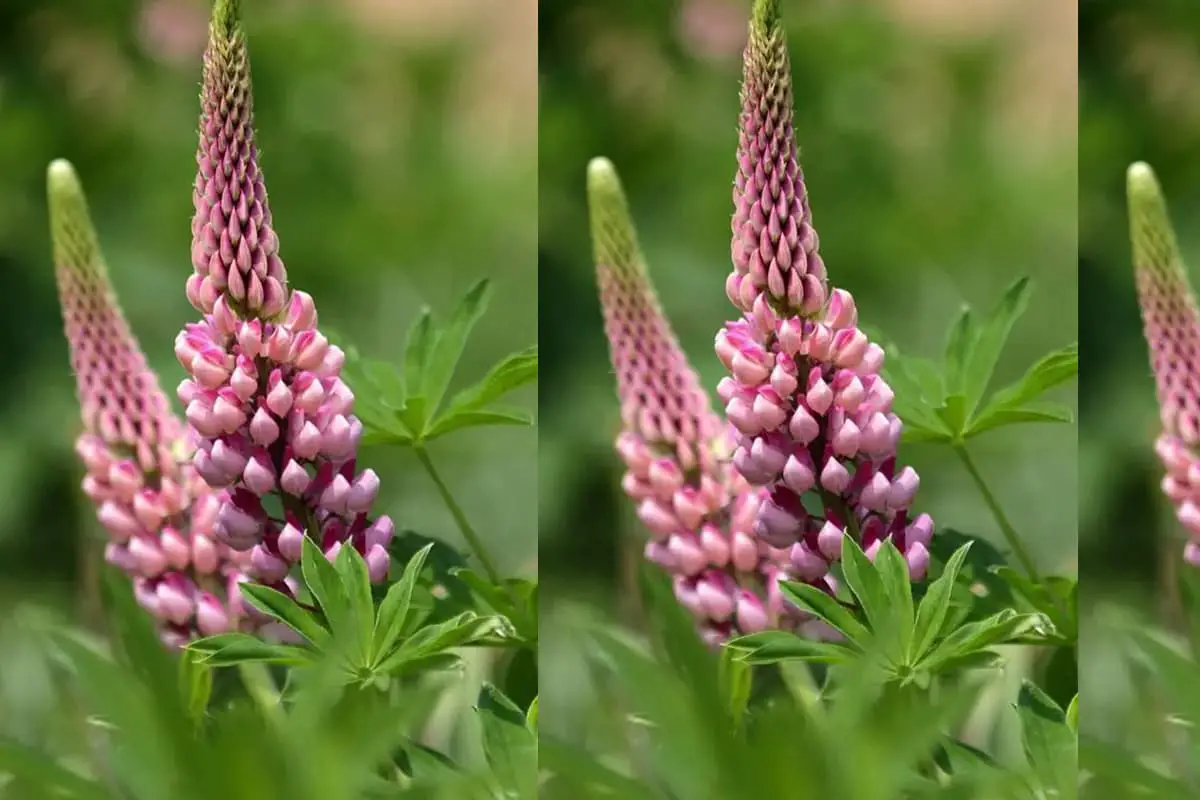
The terminal racemes bear delicate flower spikes with very short pedicels. The sepals are bilabiate and covered with stiff hairs. The flowers are predominantly blue with white patches on the standard and keel petals.
The fruit is a linear-oblong pod containing oval, flattened, speckled, and smooth seeds. Blooming occurs from March to May, and fruiting from April to July.
Native to North America, it thrives in sandy temperate regions. There are many horticultural varieties of this plant.
Commonly known as Lupine or Lupin, its upright and bountiful flower spikes come in a vivid array of colors including white, red, blue, and purple, boasting a long flowering period.
It is suitable for individual planting or as a grouped feature in flowerbeds, and it’s also an excellent material for cut flowers. The stems and leaves are mainly used for green fodder and grazing, as well as for making superior silage, providing quality feed for pigs and dairy cattle.
Its high-protein seeds are a fine feed for livestock, and they also serve as a green manure and cover crop, in addition to being a source of nectar and an ornamental plant.
I. Morphological Characteristics
The Bigleaf Lupine is an annual herb ranging from 20 to 70 cm in height. Its stems are ascending or erect, branching at the base, and the whole plant is covered with brown or rust-colored stiff hairs.
The palmately compound leaves have 5-8 leaflets; the petioles are significantly longer than the leaflets; the stipules are lance-shaped, up to 1 cm long, and fused to the petiole at the lower half.
The leaflets are inversely ovate, inversely lanceolate to spatulate, 15-70 mm long, 5-15 mm wide, with blunt or acutely pointed tips, short points, gradually narrowing bases, and are covered with stiff hairs on both sides.
The terminal raceme is relatively short, 5-12 cm in length, not extending beyond the compound leaves, with the axis being slender.
The lower flowers are alternate, and the upper flowers are irregularly whorled, each flower measuring 10-14 mm; the bracts are lance-shaped and hairy, 3-4 mm long.
The very short pedicels are 1-2 mm in length; the sepals are bilabiate and hairy, with the lower lip longer than the upper and featuring three deep lobes, while the upper lip is shallower and persistent during fruiting.
The corolla is blue with white patches on the standard and keel petals. The fruiting axis thickens but remains within the length of the compound leaves; the pod is linear-oblong, 2.5-5 cm long, 0.8-1.2 cm wide, densely covered with brown stiff hairs, and has a short beak pointing downwards at the tip.
The pod contains 3-4 seeds. The seeds are oval, flattened, yellow with brown or red speckles, and smooth. The flowering period is from March to May, and the fruiting period is from April to July.
II. Distribution
The Bigleaf Lupine is originally from the Mediterranean region and is found in sandy soils. It is cultivated in China.
III. Growing Environment
The plant is cold-tolerant (above -5°C), prefers cool climates, and abundant sunlight. It does not fare well in heat, tolerates slight shade, and requires fertile, well-drained sandy soil.
With a well-developed taproot and few lateral roots, it does not withstand transplantation well. It is drought-tolerant, thrives in sandy soils, and can utilize insoluble phosphates in phosphate rocks.
Despite being able to grow in rainy, flood-prone areas, and acidic soils where other plants struggle, it does not grow well in calcareous soils or those with poor drainage.
It can withstand temperatures of 0°C but will die if the temperature falls below -4°C. Extreme summer heat also inhibits its growth.
IV. Growth and Propagation
Propagation by sowing is carried out in autumn, with uniform germination at high temperatures between 21-30°C. Bigleaf Lupine is commonly propagated by seeds, with both spring and autumn sowing possible.
Spring sowing occurs in March, but the growth period coincides with summer, high temperatures can prevent some varieties from flowering or lead to a lower proportion of flowering plants with shorter inflorescences, resulting in poor ornamental value.
Under natural conditions, autumn sowing results in earlier and more vigorous flowering; sowing in mid-September to October leads to a flowering period in the following year from April to June.
Seeds are sown in 72 or 128 cell trays and covered. The seedling soil should be loose, even, breathable, and water-retentive, using specialized seedling soil or a mix of peat and perlite.
The seeds are large, with normal or coated treatment, and about 40 seeds per gram. The optimal germination temperature is around 25°C, and the medium should be kept moist. Seeds emerge from the soil and germinate within 7-10 days, with a high germination rate.
Cuttings are taken in the spring from sprouting branches at the rootstock, cut into 8-10 cm pieces, preferably with some rootstock, and inserted in a cold frame.
In hot and rainy summer regions, the Bigleaf Lupine often does not survive the summer and thus can be cultivated as a biennial. It is advisable to plant early in the spring at a spacing of 40 cm in the cultivation area, which leads to early growth and seed formation.
Before summer, the aerial parts wither after setting seeds; new plants sprout in the fall, or seeds are collected before withering. In North China, protection is needed for overwintering.
V. Disease Prevention and Control
Leaf spot on lupines appears as brown to black spots, which can damage the leaves and stems, leading to early leaf senescence. A good control measure is spraying with a 1500 times diluted solution of carbendazim wettable powder, which has proven effective.
Symptoms: The disease manifests as brown spots on leaves, which can grow to 5-14 millimeters in diameter.
These spots may coalesce into irregular brown patches that lead to tissue death, especially during the summer and autumn. The petioles, stems, and sometimes petals can also be affected.
The pathogen produces round or spindle-shaped conidia with 4-5 septa that constrict at the septa. The end cells are lighter in color, while the central cells are darker, measuring 64-80×16-16.5 micrometers. The disease overwinters on infected plant debris and seeds.
Powdery Mildew
The causative agent of lupine powdery mildew is Erysiphe polygoni.
Symptoms: Initially, small white powdery spots appear on the leaves. Under suitable temperature and humidity, the spots can rapidly expand to cover the entire plant.
In severe cases, the leaves may be covered with a white mycelium and later develop yellowish-brown to black fruiting bodies. This can result in leaf thickening and discolored, deformed flowers.
Pathogen and patterns of occurrence: Erysiphe polygoni and other species overwinter on plant debris. When temperatures rise in April and May, conidia are produced and spread by air currents and rain, and can infect multiple times from April to October.
The pathogen can also enter greenhouses or rooms with plants in October, causing indoor infestations that can be a source of outdoor infections the following year.
Control Methods
Cultural management includes pruning to maintain appropriate spacing for light and air circulation, ensuring the greenhouse is not too cold in winter, planting in well-drained sandy soil, and applying fertilizers judiciously to strengthen plant vigor and disease resistance.
Elimination of pathogens involves promptly removing infected leaves when disease incidence is low.
Strict inspections should be carried out when entering greenhouses or homes, with immediate burning of diseased leaves to prevent them from becoming a source of infection.
Chemical control can be initiated at the early stages of the disease with sprays of either “Agricultural Antagonist 120” or “Antibacterial BO-10” emulsion at a 100 times dilution, or 50% “Garennon” wettable powder or 75% “Thiram” emulsion at a 1000 times dilution, sprayed every 10 days.
Several applications can effectively control the spread of the disease, particularly resistant strains of powdery mildew. For new products, refer to the instructions or conduct small-scale trials before widespread use.
VI. Main Value
Economic
The stems and leaves are primarily used for forage and grazing and are made into high-quality silage for pigs and dairy cows.
The seeds are high in protein and used as concentrated feed, in addition to serving as green manure and cover crops, and they are also a source of nectar and ornamental beauty.
Ornamental
Perfect for flower bed arrangements, border plantings, or cluster planting on grassy slopes, it can also be potted or used for cut flowers.
Potted ornamentals: Compact, symmetrical, and lush-leafed dwarf varieties have expanded the market for lupines, making them accessible to the average family. With their special symbolism, it is believed that people will cherish them even more.
Cut flower use: Rich plant materials have always been essential for floral artists, and as lupine cultivation increases, its value as a cut flower is being recognized and appreciated, leading to its cultivation for cut flower production.
Garden use: Lupines have a unique plant form and a rich variety of inflorescence colors, making them a rare and valued material for landscape gardening.
When used in flower bed backgrounds or planted in clusters along forest edges and riverbanks, they provide a unique and exotic visual experience, which is increasingly accepted and esteemed by professionals.




 English
  العربية
  Bahasa Indonesia
  Deutsch
  Français
  Italiano
  Nederlands
  Português
  Русский
  日本語
日本語