600+ Types of Flowers A To Z (With Names and Pictures)
Types Of Flowers By Names (A-Z) Types Of Flowers By Color Types Of Flowers By Season Types Of Flowers By Blooming Time 600+ Types of Flowers No. Flower Name No.…

Armeria maritima is a herbaceous plant of the Plumbaginaceae family and the genus Armeria, characterized by its compact growth, green linear leaves, and flower stems that rise above the foliage.
The globular flower heads are terminal and composed of small flowers clustered at the top of the stems, typically white, pink, or rose-red in color. Its flowering season is relatively short, mainly from May to June.
Native to Europe and the Americas, Sea Thrift is now distributed worldwide. It thrives in warm conditions but does not tolerate high heat and humidity, being drought-resistant and tolerant of saline-alkaline soils.
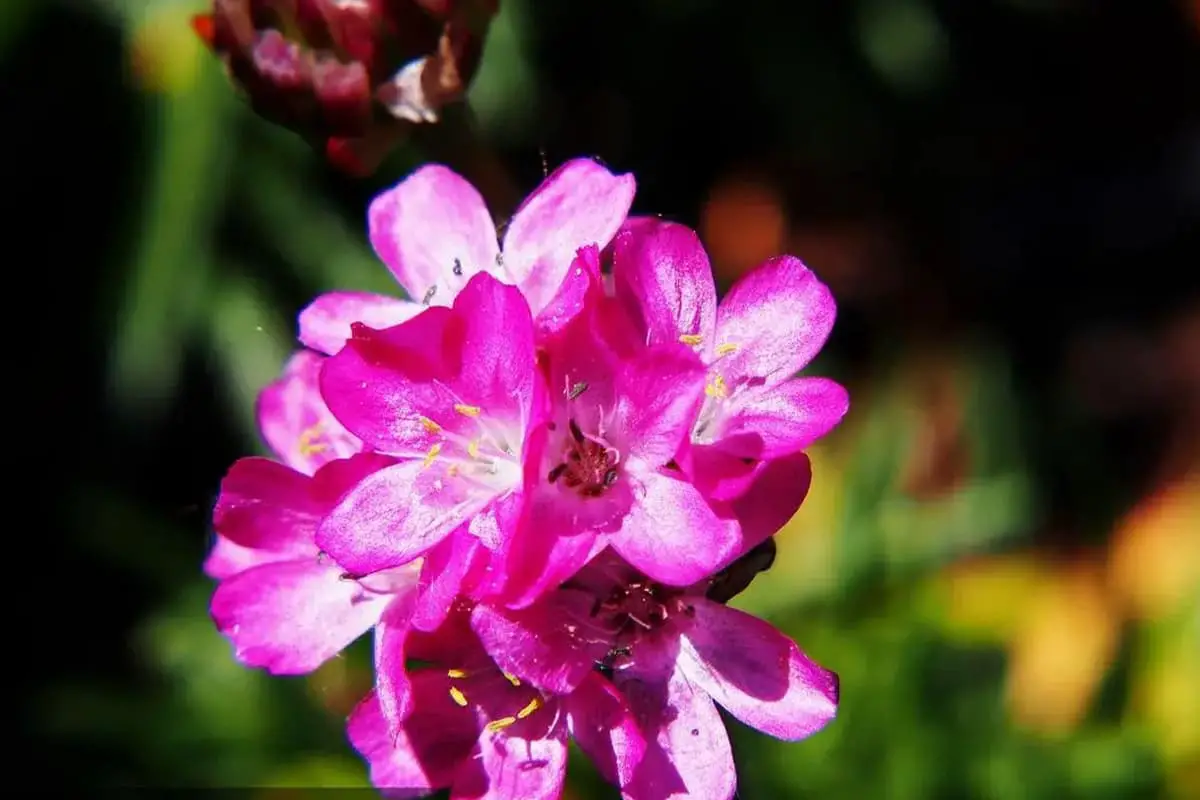
It grows well in environments with full sunlight, mainly found in well-drained sandy soils and beaches. Its primary method of propagation is through seeding.
The Sea Thrift is highly valued for its ornamental and economic worth. Its delicate form and elegant bloom colors make it suitable for planting along park pathways, green spaces, yard borders, flowerbeds, or as ground cover.
Potted varieties can be displayed on balconies, windowsills, or living rooms for decoration.

This perennial herb has a clumping growth habit, reaching 20-30 centimeters in height. The leaves are basal and green linear, with slender, elongated flower stems that emerge above the leaf surface and bloom in the spring.
The flower heads are globular and terminal, comprised of small flowers clustered at the tip of the stems, generally white, pink, or rose-red, with entire, dark green leaves.
The flowers are hemispherical and purple-red, with stems around 3 centimeters long. The flowering period is short, mainly in May and June.
There are approximately 126 species within the genus Armeria, originally from Europe and the Americas, now found across the globe. They are primarily distributed in well-drained sandy soils and beaches.
This clump-forming perennial prefers full sunlight and well-drained sandy soils, with cultivation soil ideally rich in organic matter from leaf mold.
It requires good drainage and sunlight, loves warmth, dislikes high temperatures and high humidity, and is tolerant of drought and saline-alkaline conditions. The optimal growing temperature is between 15-25°C.
The hybrid Sea Thrift “Ornament” (Armeria hybrida “Ornament”) grows up to 30 centimeters tall, with flowers in a variety of bright colors and evergreen leaves.
The Sea Thrift “Laucheana” (Armeria maritima “Laucheana”) reaches 20 centimeters in height, with bright pink flowers and a long blooming cluster.
The Sea Thrift “Morning Star” (Armeria maritima “Morning Star”) stands about 15 centimeters tall with a compact form, deep green leaves, and bright, deep magenta flowers that are abundant and long-blooming.
It does not require vernalization and can flower in its first year. It is suitable for rock gardens, container cultivation, and as a border plant.
The main method of propagation for Sea Thrift is through seeding.
To flower in May, seeds should be sown in January; for blooming in the spring after winter, sow in July to August for outdoor cultivation, or in August to September for glass or film greenhouses.
Seeds should be lightly covered with vermiculite and kept evenly moist. At 20-21°C, germination takes 7-10 days. Once the cotyledons are fully spread (during growth phase II), temperatures should be lowered to 17-20°C, and soil moisture reduced.
Six to eight weeks after sowing, transplant a single seedling into an 8-15 centimeter pot, or 2-3 seedlings together into a 10-12 centimeter pot.
The potting substrate should be loose with coarse particles of herbaceous soil, maintaining a pH value of 5.8-7.0. The temperature should be kept at 13-17°C, overwintering frost-free at 3-5°C, or using fabric covers outdoors.
It requires 10-11 weeks at 15-18°C to flower in the spring, while lower temperatures of 7-12°C will slow growth and extend the growth cycle. Growth stops at temperatures below 7°C.
The best period for division is from autumn to winter. During division, clumps should be dug up and separated with a sharp knife into 1-2 buds per plant, then planted in pots, with increased care and attention to warmth during the winter.
Growing Medium: The best medium for cultivation is leaf mold rich in organic matter.
Temperature and Light: The optimal growth temperature ranges from 59 to 77°F (15 to 25°C). The plant requires full sunlight during its growing period and should be placed in a sunny location.
In the summer, diffused light is preferable to prevent scorching from direct sunlight. Shade and cooling are necessary when temperatures are high.
Fertilization and Watering: Sea thrift does not require a high amount of fertilizer; a solution of Flower Food No.2 diluted 1000 times can be applied every 2 to 3 weeks. Watering should be moderate.
Damage to the roots can occur if large amounts of water are applied when the temperature is high, especially after a prolonged drought or when the water temperature is low.
This disease affects the leaves and flower stalks, starting with blister-like spots, which are clusters of fungal spores. In the intermediate stage, the epidermis bursts, releasing a yellow-brown powder, the summer spores of the fungus.
Occasionally, the entire leaf turns yellow. In the later stages of the host’s growth, black, elongated, or short-lined clusters of winter spores form.
These winter spores form under the epidermis without breaking through it. Both summer and winter spores typically appear on the underside of leaves.
Control Methods
Improve cultivation management: For potted plants, use loose, well-draining soil. For large-scale planting, choose a location with high elevation and good drainage.
Ensure proper ventilation and light penetration, regularly weed, apply nitrogen, phosphorus, and potassium fertilizers reasonably, and avoid excessive nitrogen.
Remove pathogens: In late autumn or early spring, thoroughly remove and burn the remains of diseased plants.
Chemical treatment: During the growing period, spray with a 63% zinc dimethyldithiocarbamate solution diluted 600 times for prevention.
If the disease occurs, spray with a 23% Oxycarboxin solution diluted 1500 to 2500 times, a 96% sodium phosphide solution diluted 250 times, or a 50% wettable powder of Metalaxyl diluted 1500 times.
Red spider mites overwinter as eggs, which generally begin hatching in early March and completely hatch by early April.
Control Methods
In severe infestations, evenly spray with a 1.8% abamectin emulsion diluted 7000 to 9000 times; a 15% Damite oil emulsion diluted 2500 to 3000 times is also effective.
Alternatively, use a 40% chlorfenapyr emulsion diluted 1000 to 1500 times, a 20% Fenpyroximate wettable powder diluted 2000 times, or a 1.8% Spiromesifen emulsion diluted 6000 to 8000 times for control.
Adding a new high-lipid film to the pesticide mixture can achieve very satisfactory results.
Sea thrift is highly valued for both its ornamental and economic worth. Its compact form and elegant flower colors make it suitable for parks, green spaces, roadside gardens, and as ground cover.
When potted, it can be used for decoration on balconies, windowsills, and in living rooms.

Peggie was once a high school mathematics teacher, but she set aside her chalkboard and textbooks to follow her lifelong passion for flowers. After years of dedication and learning, she not only established a thriving flower shop but also founded this blog, “Flowers Library”. If you have any questions or wish to learn more about flowers, feel free to contact Peggie.
 English
  العربية
  Bahasa Indonesia
  Deutsch
  Français
  Italiano
  Nederlands
  Português
  Русский
  日本語
日本語