The Gardenia jasminoides Radicans, also known as the Creeping Gardenia, can grow up to 2 meters high. It has light yellow roots, plenty of branches, a smooth plant body, and soft hairs on the twig tips.
Its leaves are generally thicker, narrower, and pointed, making it one of the latest varieties to hit the market in spring.
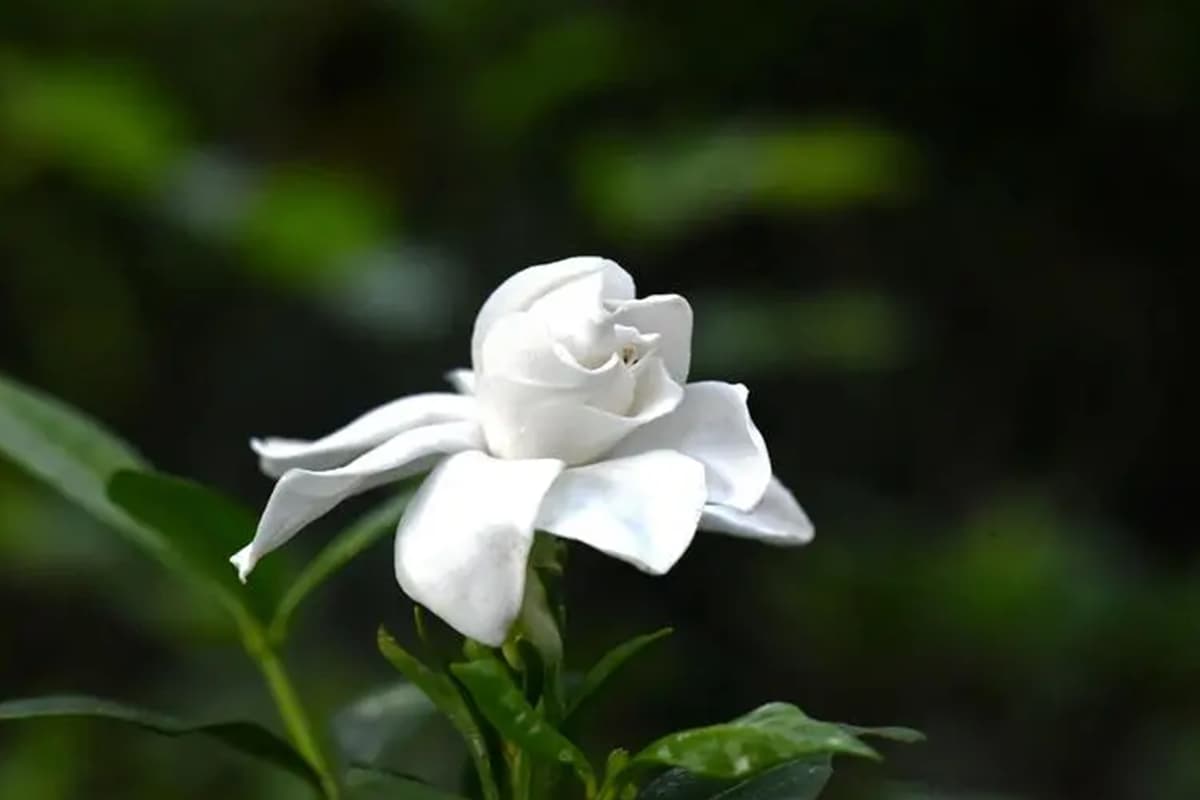
The flowers it produces are relatively large and fragrant, blooming in the leaf axils or at the top, with a green calyx, a white corolla, and 3-4 layers of double petals. The stamens are attached to the corolla.
This variety is a good source for extracting natural pigments and has cooling, calming, pain-relieving, wind-dispelling, and dampness-removing properties. It has a wide range of uses and can be used as a hedge in gardens, blooming all year round.
I. Growth and Distribution
The Creeping Gardenia is native to the Yangtze River Basin and southern provinces of China. It prefers warm, moist conditions, lots of sunlight, high temperatures, and grows best in loose, fertile, well-drained, slightly acidic soil.
It tends to turn yellow when cultivated in alkaline soil, can withstand slight cold, and the leaves may fall off when the temperature drops below -12℃.
II. Morphology and Characteristics
It is an evergreen dwarf shrub, 60-80 cm tall, with a creeping habit. The twigs are green, initially hairy, then nearly hairless. The leaves are opposite, virtually without a petiole, leathery, entire, elliptical to inverted lanceolate, 1.6-5.4 cm long, 0.5-1.4 cm wide, with pinnate side veins.
The fragrant flowers bloom in the leaf axils or at the top, with a green calyx, and tubular at the base. The corolla is white, double-layered with 3-4 circles, 3.2-5.0 cm in diameter, with the innermost layer sometimes showing transitional types from stamens to petals.
The flower has six parts, corolla lobes are 2.0-2.4 cm long, 0.8-1.4 cm wide. Stamens are attached to the corolla, and there is one pistil. The ovary is inferior, with a lateral placenta and many ovules.
The fruit is a berry, yellowish-red, spherical or elliptical, 3.4-4.0 cm long, 1.0-1.6 cm in diameter, with many wart-like protrusions on the surface.
The outer seed coat consists of a row of large stone cells, nearly square or rectangular, with particularly thickened outer and side walls. The cell cavity contains brown-red matter and yellow pigment, and the inner seed coat consists of collapsed, thin-walled cells.
The endosperm cells are polygonal, containing oil droplets and starch grains. The center contains two flat cotyledons, the cotyledon cells contain many starch grains and fat oil droplets. The flowering period is June to July, and the fruiting period is August to November.
III. Cultivation Method
Soil: Choose loose, fertile, well-drained acidic soil for cultivation. If planted in a field, separate the compartments for drainage and weed removal, usually at 1.0-1.2m. If the soil is neutral or alkaline, timely water with alum fertilizer or spray with ferrous sulfate solution on the leaf surface.
Transplant: Use cuttings for transplanting, ensuring that the root system of the plant is fully extended. Choose overcast days or early mornings and evenings on sunny days for transplanting.
The planting density is about 10 cm x 10 cm, planting 900,000 to 1,050,000 plants per hectare, and water thoroughly immediately after planting.
Fertilizer and Water Management:
⑴ Fertilize. The Creeping Gardenia is not a plant that likes a lot of fertilizer. It can grow vigorously in poor soil, but reasonable fertilization should be given during the growth period in nursery production.
Apply rotten human manure or cake fertilizer every 10 days, and stop watering one day before fertilizing. On the day of fertilization, water thoroughly. Stop fertilizing after mid-October.
⑵ Watering. The Creeping Gardenia loves water, hence its nickname “Water Gardenia”. After the summer heat comes in, water appropriately.
It’s best to use soft water for irrigation in the summer, as hard water contains more calcium and magnesium salts, which are very detrimental to the growth of the Creeping Gardenia, causing the branches and leaves to turn yellow and die quickly.
To overcome the alkalinity of the soil and water, water with alum fertilizer once a week during the growing season to keep the Creeping Gardenia lush and green.
IV. Propagation Methods
The propagation of the Gardenia jasminoides var. radicans can be done through seeding, cutting, and layering, with cutting being the predominant method in nursery production. It is easy for cuttings to survive.
In southern China, cutting can be performed from March to October, and in northern China from May to June, with the highest survival rate seen in the spring.
The cuttings can be planted in flower pots or outdoor seedbeds, preferably in loose and well-drained sandy loam or river sand. Cuttings are taken from healthy parent plants, using one to two-year-old branches, cut into approximately 5-10 cm sections, each with at least three nodes.
Remove the leaves at the bottom third of the cuttings, retaining 2-4 leaves at the top for photosynthesis, stimulating root growth. To reduce evaporation and increase survival chances, each remaining leaf can be cut in half.
Then the cut end is dipped quickly into a solution of 500mg/kg rooting powder for 15 seconds, and after drying the solution slightly, the cuttings can be planted. Before planting, holes are made in the prepared seedbed with a small stick.
After planting, water thoroughly and maintain soil moisture, avoiding excessive dampness. To prevent direct sunlight, a shed can be built and shaded with a sunshade net. The cuttings can take root after about a month.
Once they survive, apply a weak solution of 10% matured human urine or cake fertilizer every 15 days. After about three months, choose a cloudy day for transplanting.
Water cutting can also be used for propagation, with a survival rate close to 100%. This is usually done from April to July. Cut the cuttings, leaving only the top two leaves and the bud, and place them in a container with clean water.
The water needs to be changed frequently to prevent the cuttings from rotting. After about three weeks, they start to root.
V. Disease and Pest Control
Disease
Gardenia jasminoides var. radicans often suffers from chlorosis, which turns the leaves yellow. This disease can be caused by various factors, and different measures should be taken for prevention and control.
Nutrient Deficiency: This type of chlorosis starts from the older leaves at the bottom of the plant and gradually spreads to the new leaves.
Nitrogen Deficiency: The leaves turn yellow, and the new leaves are small and brittle.
Potassium Deficiency: The old leaves turn from green to brown.
Phosphorus Deficiency: The old leaves turn purplish-red or dark red. In all these cases, apply matured human urine or cake fertilizer.
Pests
Gardenia jasminoides var. radicans may occasionally suffer from scale insects and red spider mites in high summer temperatures and poor ventilation. Spray with a 1000 times diluted solution of 40% Le Gus milk oil to prevent scale insects, and a 1000-1500 times diluted solution of 40% Trichlorfon milk oil to control red spider mites, both with good results.
VI. Value and Others
Gardenia jasminoides var. radicans makes an excellent plant for potting, bonsai, and ground cover.


 English
  العربية
  Bahasa Indonesia
  Deutsch
  Français
  Italiano
  Nederlands
  Português
  Русский
  日本語
日本語