The Large-flowered Gardenia, scientifically known as Gardenia jasminoides, is a plant in the Rubiaceae family and a variant of the gardenia. It’s also known as the Large-leaf Gardenia, Peony Gardenia, and Water Branch Flower.
The plant has a single leaf that is opposite or whorled in threes, with a larger leaf blade that is elliptical. Its flowers are large and heavily scented. The plant itself is tall, and it is cultivated for ornamental purposes.
It can also be used to extract fragrances or for tea curing. Its main flowering period is in May and June, and with proper care, it can bloom again between September and October.
The Large-flowered Gardenia is an excellent aromatic flower; its flowers can be used as tea fragrances and its fruit has anti-inflammatory and heat-clearing properties.
I. Growth and Distribution
It thrives in humid, warm environments with ample sunlight and good ventilation, but it should be protected from strong sunlight.
II. Morphology and Characteristics
The gardenia is an evergreen shrub. Its branches are green and young branches have scale-like hairs. Its leaves are opposite or whorled in threes, and are long, ovate, or lanceolate, with a length of 7-14 cm and a width of 2-5 cm.
The leaves taper to a point or short point, have a smooth surface, and are leather-like. They have short stalks and membranous stipules that form a sheath at the base.
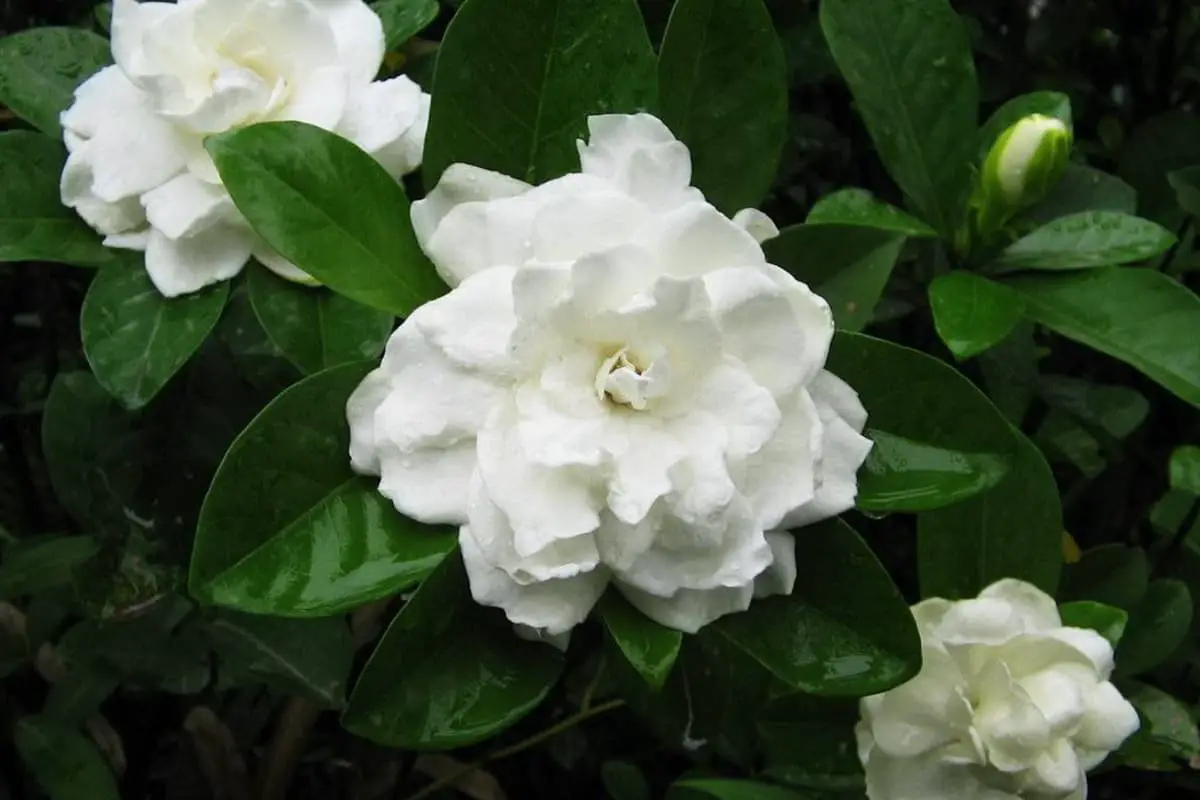
The flowers are large, grow singly at the ends of branches or in leaf axils, are about 7 cm in diameter, are white and extremely fragrant. The calyx has six segments, which are linear. The corolla segments are broadly inverted lanceolate.
The stamens are six in number and the anthers are linear. The ovary is inferior and one-chambered, the style is thick, and the stigma is rod-shaped.
The fruit is inverted ovate or elongated oval in shape, 3-7 cm long, 1-1.5 cm in diameter, yellow, with high vertical ribs, thick skin, and persistent calyx.
The flowering period is from May to July. The difference between this variant and the original is that the flowers are large and double, and do not bear fruit.
III. Cultivation Method
It should be planted in loose, fertile, well-drained acidic soil. It can be propagated by cutting, layering, division, or seeding.
Water cultivation of the Large-flowered Gardenia is key. Too high or too low nutrient solution concentration is not conducive to the growth of the plant, only the appropriate concentration is suitable for the growth of the plant.
The water cultivation seedling technology of the Large-flowered Gardenia reduces the measures of tillage, watering, and spraying in the nursery, which is simple and easy to master. It is a new way of propagation for the Large-flowered Gardenia and has the value of promotion and application.
IV. Value and Other Aspects
It is cultivated for ornamental purposes, and can also be used to extract fragrances or for tea curing. Its flowers can be used as tea fragrances, and its fruit has anti-inflammatory and heat-clearing properties.
It contains a large amount of pigment, which is mainly used as a non-toxic dye in industry. It can be used externally as a trauma medicine, but it is not used as an internal medicine.




 English
  العربية
  Bahasa Indonesia
  Deutsch
  Français
  Italiano
  Nederlands
  Português
  Русский
  日本語
日本語