600+ Types of Flowers A To Z (With Names and Pictures)
Types Of Flowers By Names (A-Z) Types Of Flowers By Color Types Of Flowers By Season Types Of Flowers By Blooming Time 600+ Types of Flowers No. Flower Name No.…
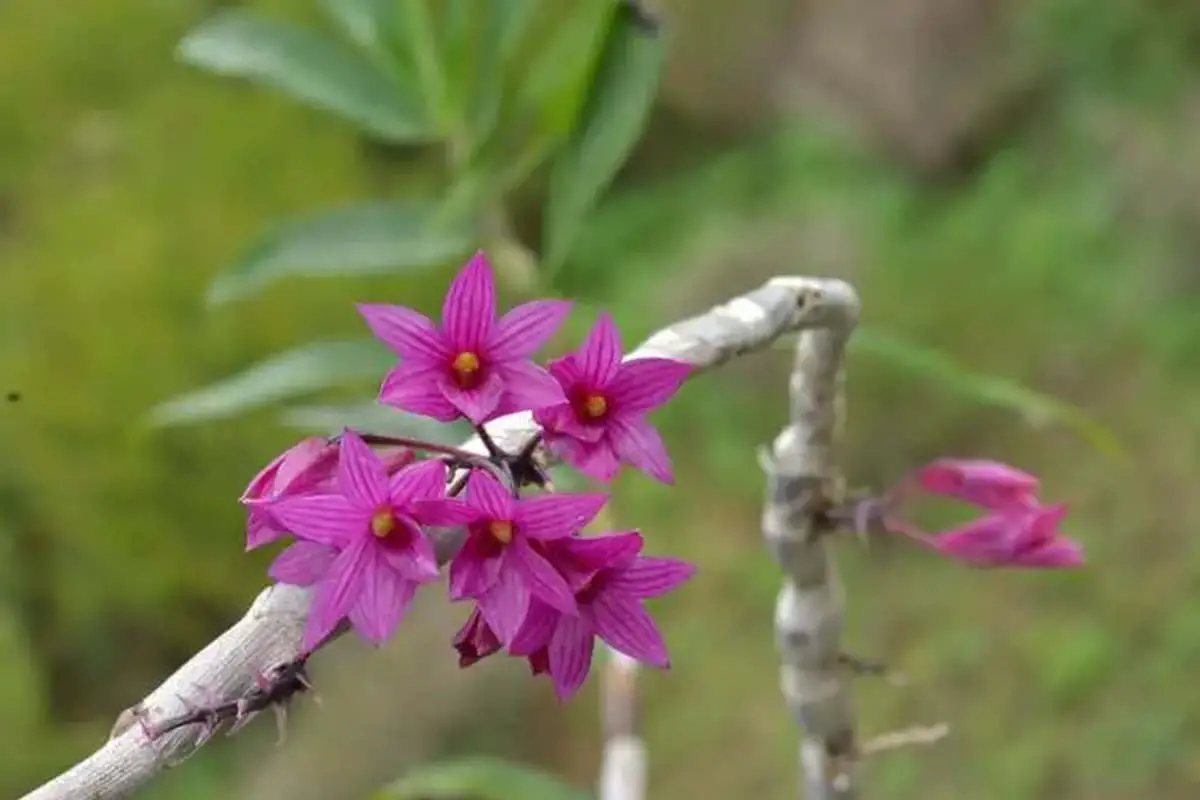
Dendrobium goldschmidtianum, commonly known as the Red Flowered Dendrobium: The stems stand upright or droop, are cylindrical, occasionally swelling in the middle to resemble a spindle shape, and taper at the base.
These stems do not branch and have multiple nodes. The leaves are thinly leathery, either lanceolate or ovate-lanceolate. The racemose inflorescence grows from older stems that have lost their leaves. It clusters with 6-10 closely packed flowers; these flowers are bright red and do not fully open.
The petals are obliquely ovoid-oblong, almost the same length as the medial sepal but slightly narrower, tapering to a sharp tip. The labellum is spoon-shaped, measuring 1.5-2.2 cm in length and 7-8.5 mm in width, with a blunt tip and a narrow base.
The flowers bloom irregularly from March to November. They are native to elevations between 200-400 meters in Taiwan, China, and the Philippines. This flower is cultivated and holds significant horticultural value.
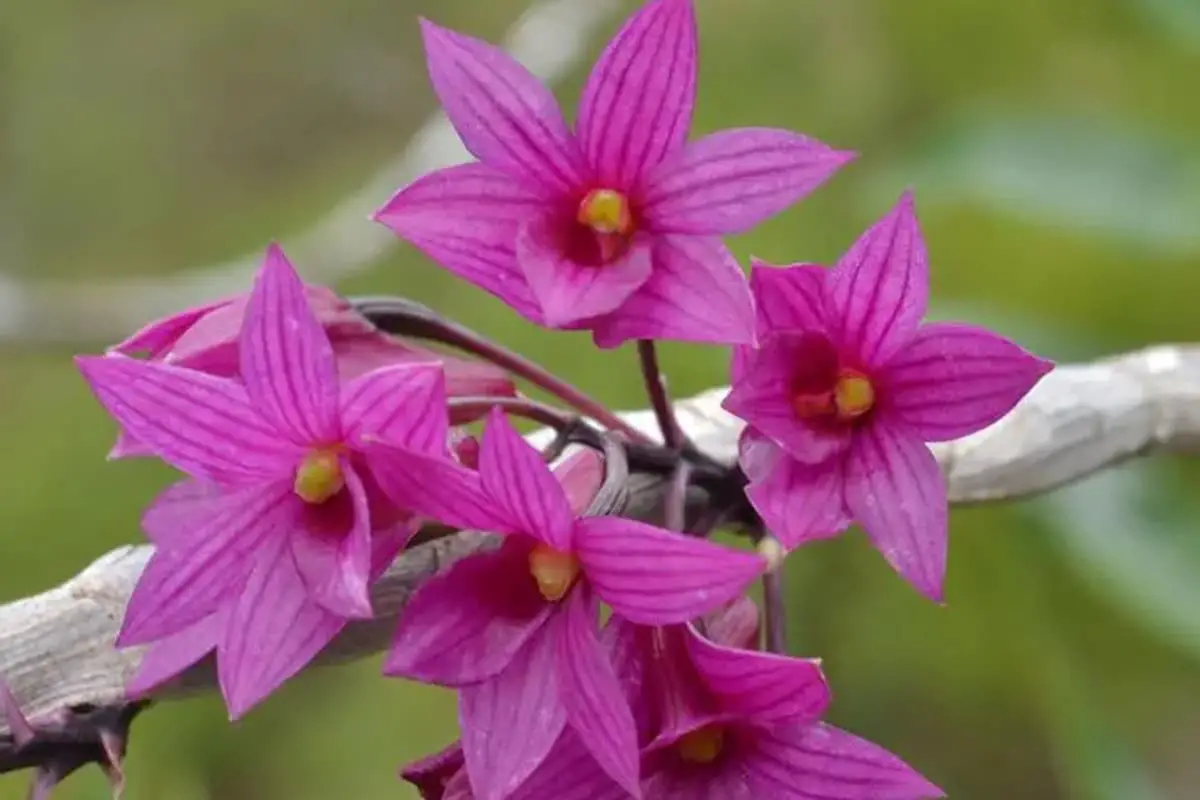
The Red Flowered Dendrobium’s stem is upright or pendulous, cylindrical, sometimes swollen in the middle to a spindle shape, measuring 40-60 cm in length and 5-10 mm in thickness. It tapers at the base, doesn’t branch, and features several nodes.
The leaves are thinly leathery, lanceolate or ovate-lanceolate, 6-10 cm long, and 1.2-2 cm wide. The leaf sheaths are green tinged with purplish-red and tightly wrap around the stem. The inflorescence, clustering with 6-10 flowers, emerges from older stems that have lost their leaves.
The flower bracts are membranous, and the flowers are bright red. The medial sepal is elliptical, about 1 cm long and 5 mm wide. The petals are obliquely ovoid-oblong, nearly the same length as the medial sepal but slightly narrower.
This plant thrives at altitudes between 200-400 meters, native to Taiwan (Lanyu Island) and also found in the Philippines. The Red Flowered Dendrobium is a perennial herb that prefers shady, cool environments.
It thrives best in warm, humid conditions with an annual rainfall of over 1000 mm, in semi-shaded areas. Optimal temperatures for growth range between 15 to 28 degrees Celsius with humidity above 60%. It’s not particularly demanding regarding soil fertility.
In the wild, they often grow on loose, thick tree bark or tree trunks. Some also grow in crevices of rocks. They belong to the epiphytic root system, requiring good root aeration. In suitable temperature and humidity, they grow rapidly and demonstrate strong vitality.
Selecting a Site: Based on its growth habits, Dendrobiums should be cultivated in semi-shaded areas with humidity above 80% and winter temperatures above 0°C.
Suitable trees include Michelia, pear, and camphor trees with thick bark, plenty of water retention, and substantial branches and trunks.
Division: After flowering, thickly grown plants can be taken from the pot and divided.
Budding: For plants older than 3 years or those with small plants growing on their stems, budding can be used for propagation.
Cuttings: Cuttings can be combined with repotting and division.
With high ornamental value, the Red Flowered Dendrobium is recognized for its elegant and vibrant flowers. It is considered one of the “Four Great Ornamental Exotic Flowers”. Not only is it used as a cut flower, but it’s also commonly potted for decoration.
The flowers remain vibrant for 2-3 days after being cut. The plant symbolizes strength and loyalty. In Western cultures, it’s often gifted to respected elders. On June 19th every year, the Dendrobium is given as a “Father’s Day Flower”.
With a message of “Welcome, dear one”, it’s paired with African daisies and rounded eucalyptus to create a boutonniere.
In Europe and America, Dendrobium flowers are used in boutonnieres combined with Gypsophila and Asparagus fern to signify a warm welcome. Today, they are widely used in grand banquets, opening ceremonies, and hosting VIPs.
Peggie was once a high school mathematics teacher, but she set aside her chalkboard and textbooks to follow her lifelong passion for flowers. After years of dedication and learning, she not only established a thriving flower shop but also founded this blog, “Flowers Library”. If you have any questions or wish to learn more about flowers, feel free to contact Peggie.
 English
  العربية
  Bahasa Indonesia
  Deutsch
  Français
  Italiano
  Nederlands
  Português
  Русский
  日本語
日本語