600+ Types of Flowers A To Z (With Names and Pictures)
Types Of Flowers By Names (A-Z) Types Of Flowers By Color Types Of Flowers By Season Types Of Flowers By Blooming Time 600+ Types of Flowers No. Flower Name No.…

The Cerbera manghas, commonly known as the Sea Mango or Yellow Gold Eggplant, stands at a height of 4-8 meters. It possesses alternately arranged leaves that are of a thick papery texture, shaped like an inverted elongated oval.
Its flowers, which bloom from March to October, are white with a delicate red center, giving off a jasmine-like fragrance. The fruit, either broadly oval or spherical, turns a rich orange-yellow when mature, ripening from July to the following April.
Naturally found near the coastlines or in moist coastal regions, the Sea Mango is renowned for its profusion of aromatic flowers, deep green leaves, and a picturesque canopy, making it an ideal choice for gardens, parks, roadside landscaping, and coastal protection.
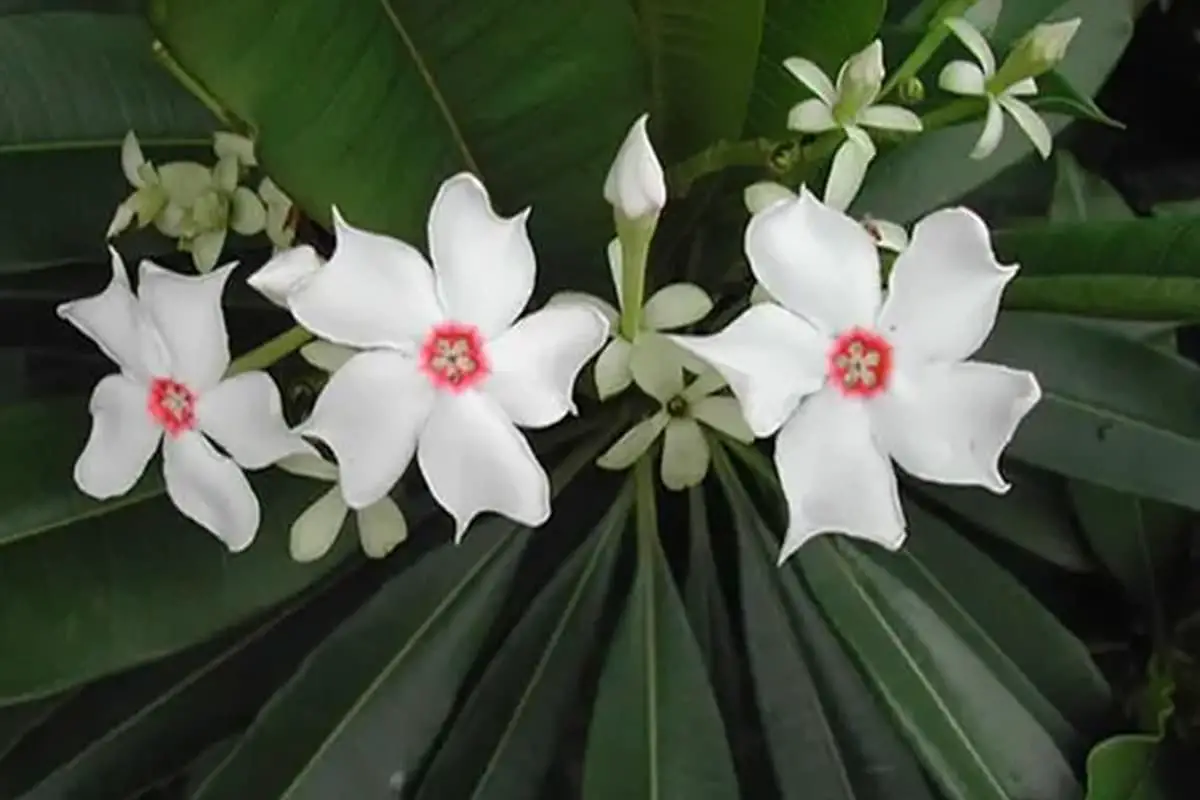
It can be found in regions such as Hainan, Guangdong, Guangxi, and Taiwan in China.
This tree, with a height of 4-8 meters and a trunk diameter of 6-20 cm, has a gray-brown bark. Its branches are thick, green, with subtle lenticels, and are hairless.
The entire tree secretes a rich milky latex. Its leaves, which are of a thick papery texture, can be inverted ovate oblong, inverted ovate lanceolate, or occasionally oblong.
They measure between 6-37 cm in length and 2.3-7.8 cm in width, hairless with a deep green upper surface and a lighter green underside. The leaf stalks, which are pale green and hairless, range from 2.5-5 cm in length.
The fragrant white flowers have a diameter of about 5 cm. Their green, hairless peduncles and pedicels exhibit faint spots, with the former being 5-21 cm long and the latter 1-2 cm. The flowers’ outer tubes are cylindrical, expanding at the top and narrowing at the bottom, measuring 2.5-4 cm in length.
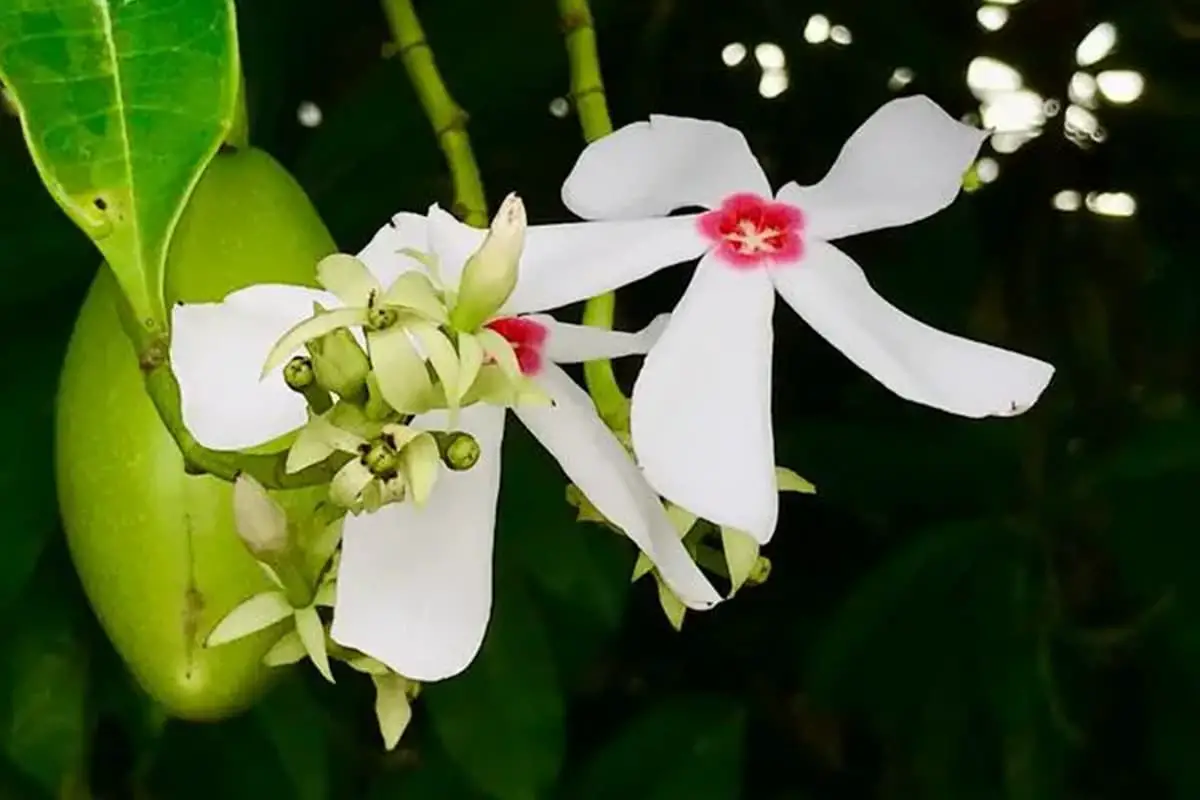
Its diameter is around 7-10 mm at the top and approximately 3 mm at the base. The exterior is yellow-green and hairless, while the interior is lined with long soft hairs. The throat of the tube is tinged with red and houses five soft-haired scales.
The corolla segments are white, with a light red hue on the left side of their back. They are shaped like an inverted oval with a sickle curve, measuring between 1.5-2.5 cm in length and 1.5-2.5 cm in width at the top, narrowing to about 8 mm at the base. They spread out horizontally and are hairless on both sides.
Stamens are attached at the throat of the floral tube. The filaments are short, yellow, with a ribbed base, and the anthers are oval-shaped, having a slight point at the top and a rounded base that curves inwards.
There is no disk present. The pistil consists of two separate carpels, which are hairless. The style is filament-like, measuring 2.3-2.8 cm, slender, and hairless, ending with a spherical stigma, which is ringed at the base and has a rounded top with a slight split.
The fruit can either be found singly or in pairs and is broadly oval or spherical in shape. It measures 5-7.5 cm in length with a diameter of 4-5.6 cm, having a blunt or sharp tip. The outer skin is either fibrous or woody, green when immature, and turns to a vibrant orange-yellow upon maturing.
Typically, each fruit contains a single seed. The flowering season is from March to October, and the fruiting season is from July to the subsequent April.
It thrives in moist areas near the sea or close to coastlines.
Predominantly found in the southern regions of Guangdong, Guangxi, Hainan, and Taiwan in China, with Hainan having the densest population. Its presence is also noted in tropical areas of Asia and Australia. The reference specimen originates from India.

Peggie was once a high school mathematics teacher, but she set aside her chalkboard and textbooks to follow her lifelong passion for flowers. After years of dedication and learning, she not only established a thriving flower shop but also founded this blog, “Flowers Library”. If you have any questions or wish to learn more about flowers, feel free to contact Peggie.
 English
  العربية
  Bahasa Indonesia
  Deutsch
  Français
  Italiano
  Nederlands
  Português
  Русский
  日本語
日本語