600+ Types of Flowers A To Z (With Names and Pictures)
Types Of Flowers By Names (A-Z) Types Of Flowers By Color Types Of Flowers By Season Types Of Flowers By Blooming Time 600+ Types of Flowers No. Flower Name No.…

Tiger Thorn Plum (scientific name: Euphorbia milii var. splendens (Bojer ex Hook.) Ursch et Leandri) is a shrubby succulent plant belonging to the Euphorbiaceae family. It grows up to 1 meter tall. The stems have multiple branches and are slender and cylindrical. Brown cone-shaped spines are arranged along the ridges. The leaves are alternate and inverted-ovate, concentrated on the tender branches. The symmetrical cup-shaped flowers are yellow-red in color and bloom throughout the year. It is called “Tiger Thorn Plum” due to its flower’s resemblance to a plum blossom.
Tiger Thorn Plum is native to Madagascar, Africa, and is distributed in both northern and southern regions of China. It can be grown outdoors in South China and Southwest China, while in other areas, it is cultivated as an indoor potted plant. Tiger Thorn Plum prefers a warm, dry, and sunny environment, and thrives in fertile, loose, and well-drained sandy loam soil. It is mainly propagated through stem cuttings.
Tiger Thorn Plum has a bitter taste, cooling properties, and slight toxicity. It has detoxifying and purulent-discharging effects, promotes blood circulation, and possesses antiviral and anti-inflammatory properties. It contains various chemical components, including Euphol and Iron Camellia Alkaloids. The stems and branches of Tiger Thorn Plum are soft, the leaves are glossy, and it has a long flowering period, making it suitable for indoor cultivation. It can also be planted in patches or clusters in parks, gardens, and other green spaces. The flower language of Tiger Thorn Plum represents being stubborn yet steadfast, gentle yet loyal, and brave yet elegant.
Tiger Thorn Plum is a shrubby succulent plant that can grow up to 2 meters in height. The stems are approximately 1 centimeter thick, highly branched, and have a slender cylindrical shape. They contain a white milky sap. The stems and branches exhibit shallow ridges and are adorned with brown spines measuring about 2 centimeters in length. The leaves are arranged alternately and are inverted-ovate in shape. They are concentrated on the tender branches and measure around 4-5 centimeters in length and 2 centimeters in width. The leaves have a smooth and shiny surface, with a bright green color and sharp serrated edges. The inflorescence is in the form of an umbel-shaped cluster with long stalks, and each flower is accompanied by two red bracts, measuring approximately 1 centimeter in diameter. The plant blooms throughout the year.
Tiger Thorn Plum is native to the western part of Madagascar, Africa. It has been introduced and widely cultivated in various regions of China. Its native habitat experiences a tropical dry and wet season climate, with consistently high temperatures throughout the year. The annual precipitation ranges from 500 to 1000 millimeters, with a dry season from May to October and a particularly dry and hot period in September and October. The vegetation in its native habitat is lush, with deciduous trees in the upper canopy and abundant shrubs and weeds in the understory. The soil is brown and rich in organic matter. Tiger Thorn Plum thrives in warm, moist, and sunny environments. It can tolerate partial shade, high temperatures, and moderate drought, but it is not frost-tolerant. Loose, well-drained humus soil is preferred. During winter, it may undergo a short dormant period if exposed to low temperatures. Tiger Thorn Plum is distributed in both northern and southern regions of China, with open-field cultivation possible in South China and Southwest China, while it is primarily grown as an indoor potted plant in other areas.
The main propagation method for Tiger Thorn Plum is through stem cuttings.
Stem Cuttings:
Propagation through stem cuttings is relatively easy and can be done throughout the entire growth period, but it is best to do it from May to June. Select well-developed branches for cuttings, and trim them into small sections measuring 6-10 centimeters in length. If white milky sap oozes from the cut ends, rinse them with warm water or apply ash to the cut ends and let them dry for a few days. Once the cut ends are fully dried, insert them into sandy soil, keeping the potting medium slightly dry. After about 30 days, the cuttings should root and establish.
Tissue Culture:
Material Type:
Seeds of Tiger Thorn Plum.
Cultivation Conditions:
Cultivation Method and Growth and Differentiation Status:
Handling of aseptic materials: Use the ovary as the explant. Dip the Tiger Thorn Plum flower (removing the bracts) in a 1000-fold dilution of carbendazim solution for 5 minutes. Rinse it twice with sterile water, then place it in 70% ethanol for 30 seconds, followed by immersion in a 0.1% mercury chloride solution for 5 minutes. After rinsing 3-5 times with sterile water, remove the ovary from the receptacle and inoculate it onto the induction culture medium (1).
Callus induction: After 7 days of culturing the ovary on the induction culture medium (1), it starts to sprout and grow. After 20-25 days of cultivation, large callus tissues are formed. Transfer the callus tissues to the differentiation culture medium (2).
Bud induction and proliferation: After 15 days of culturing the callus tissues on the differentiation culture medium (2), bud primordia start to appear. By 35 days of cultivation, multiple solitary buds measuring over 1 centimeter in length and a few clusters of buds are formed on the callus tissues. Transfer the buds to the proliferation culture medium (3). With further cultivation, the buds grow taller, and lateral buds start to sprout and grow. Callus tissues form at the junction between the buds and the culture medium. By 45-50 days of cultivation, more than 10 lateral buds, with 5-6 of them measuring over 1 centimeter in height, can be formed. Multiple subcultures can be performed on this culture medium.
Rooting: Cut the buds above 1 centimeter in length and transfer them to the rooting culture medium (4). After 5-7 days of cultivation, white root protrusions can be observed at the base.
Select loose and well-drained humus soil as the potting medium and repot the plant every spring. During the summer and autumn growing seasons, the plant requires an adequate water supply, so watering should be done promptly. In spring, avoid excessive watering and water once every 2-3 days. During the summer, when it is the active growth period, provide sufficient water and water thoroughly once a day. In autumn, follow the same watering schedule as in spring, watering every 2-3 days. During winter, strictly control watering and keep the soil dry. With low winter temperatures, the leaves will shed, and the plant enters a dormant period, so it is important to keep the potting medium dry. During the flowering period, maintain moderate soil moisture. It is recommended to apply fertilizer once a month. During the growth period, use bamboo stakes and lead wire to create various supports for tying and training the branches to prevent them from falling over. If the temperature remains above 15°C during the winter and spring seasons, the plant can continue to bloom. During this period, ensure an adequate amount of light for vibrant flower colors. Insufficient sunlight can result in dull flower colors, and if kept in shade for a prolonged period, the plant may not bloom. When the branches become overly dense and crowded, pruning and shaping can be done before new leaves emerge in spring.
Tiger Thorn Plum is susceptible to stem blight and rot diseases. To control these diseases, you can use a solution of carbendazim and spray it every two weeks.
For pest control, common pests that affect Tiger Thorn Plum include aphids and scale insects. You can use a solution of insecticidal soap or malathion to spray and eliminate these pests.
Ornamental:
Tiger Thorn Plum is highly valued for its ornamental qualities. The stems are soft, the leaves are glossy, and it has a long flowering period, making it suitable for indoor potted plants. It can also be used for landscaping in parks, gardens, and other green spaces. It is a common choice as a decorative flowering plant for indoor cultivation.
Medicinal:
Tiger Thorn Plum has medicinal value. It has a bitter taste, cooling properties, and slight toxicity. It can be used to detoxify and promote the discharge of pus, improve blood circulation, and exhibit antiviral and anti-inflammatory effects. It contains various chemical components, including Euphol and Iron Camellia Alkaloids.
Flower Language: Tiger Thorn Plum conveys the message of being stubborn yet steadfast, gentle yet loyal, and brave yet elegant. Its flowers are elegant, pure, aloof, with varying shades, well-balanced spacing, and captivating beauty.
Symbolism: Tiger Thorn Plum, also known as “Flower Unicorn,” combines the power of “tiger” and “unicorn” to protect homes, ward off impurities, and reflect the stability of the owner.
Tiger Thorn, Iron Camellia, Flower Unicorn, Fan Thorn, Fan Tree, Fan Thorn Plum, Unicorn Thorn.
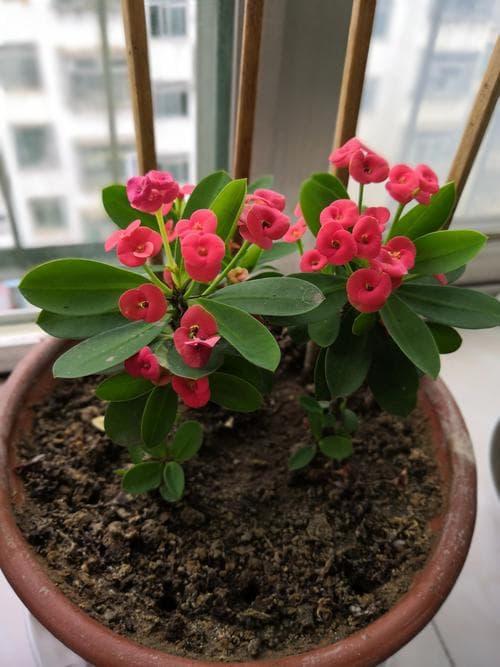
Tiger Thorn Plum prefers warmth, sunlight, drought tolerance, and dislikes excessive moisture and cold.
Tiger Thorn Plum thrives in loose, well-drained sandy soil. With suitable environmental conditions, it can bloom all year round, especially in the northern hemisphere where it blooms most profusely in winter.
The growth period of Tiger Thorn Plum is in summer and autumn, and it can safely overwinter at temperatures above 3°C.
If the temperature is controlled above 15°C and ample sunlight is provided, it can continue to bloom. However, high humidity can cause leaf drop, and the plant enters a dormant period.
During the flowering period of Tiger Thorn Plum, it requires sufficient nutrients. Apply a fertilizer every two weeks, using organic liquid fertilizer or compound fertilizer.
Stubborn yet steadfast, gentle yet loyal, brave yet elegant.
Tiger Thorn Plum has sharp thorns throughout the plant, and the white milky sap in the stems is toxic. The white milky sap secreted from wounds caused by Tiger Thorn Plum and similar plants can irritate the skin and mucous membranes of humans. Ingestion can lead to symptoms such as nausea, vomiting, diarrhea, and dizziness. However, as long as Tiger Thorn Plum is not casually picked and given to children as playthings, there is no significant risk in home cultivation.

Peggie was once a high school mathematics teacher, but she set aside her chalkboard and textbooks to follow her lifelong passion for flowers. After years of dedication and learning, she not only established a thriving flower shop but also founded this blog, “Flowers Library”. If you have any questions or wish to learn more about flowers, feel free to contact Peggie.
 English
  العربية
  Bahasa Indonesia
  Deutsch
  Français
  Italiano
  Nederlands
  Português
  Русский
  日本語
日本語